
director
Thunderbolt and Lightfoot (1974)
- Duration
- 1h 54m
- Talk coverage
- 97%
- Words
- 15,705
- Speakers
- 0
Commentary density
Topics
People mentioned
The film
- Director
- Michael Cimino
- Cinematographer
- Frank Stanley
- Writer
- Michael Cimino
- Editor
- Ferris Webster
- Runtime
- 116 min
Transcript
15,705 words
As the United Artists Entertainment from Transamerica Corporation unfurls, I will say hello. My name is Nick Pinkerton. I'm a film critic and writer by trade, and I'm here to watch Michael Cimino's Thunderbolt and Lightfoot with you, talk through the thing, and hopefully, along the way, convey a few insights into the circumstances of its production and how what wound up on screen got there. This is the first feature for Cimino, who by the end of the 1970s would have a massive critical and popular success with The Deer Hunter, and who by the beginning of the 1980s would be persona non grata in Hollywood due to the massive losses incurred by his 1980 film Heaven's Gate, whose failure would essentially sink United Artists, the studio that underwrote Thunderbolt and Lightfoot. though it was made, in fact, under the auspices of Clint Eastwood's Malposo Company. The movie stars Eastwood, who at the moment was one of the biggest stars on the planet, and Jeff Bridges, who is still a bit of a tenderfoot, but who would receive a massive boost in his public profile due to the work he does here, though already very well on the way up, but we're getting ahead of ourselves. Beginnings are important. Here we start on an honest-to-God field of amber waves of grain with at least some purplish mountains in the distance, some gently fretted guitar and the sounds of voices raised in praise, a country church, an image that will find its counterweight in the image of the little one-room schoolhouse that appears very near the end of the film. These are images of an unspoiled rural America, a land of promise. Offscreen somewhere, a horse whinnies, and this is then contrasted with the sound of a car with a bad muffler, a 1959 Cadillac Series 62 interrupting the piece. We can draw a comparison here to the montage of deceptively peaceful, all-American, idyllic small-town imagery that opens Charlie Varrick, a film released just about seven months before Thunderbolt and Lightfoot, made by Eastwood's mentor Don Siegel. We could even ask if Eastwood or Cimino had a peek at the rushes before they got started. The church we're looking at, incidentally, is St. John's Lutheran Church in Hobson, Montana, as of the 2010 census, population 215. In 1981, the church was sold and moved to Troy, Montana, which will be relevant later. Ambling out of the car here is Roy Jensen on a mission, the nature of which is not entirely clear as of yet.
Now there, standing in front of the altar, is none other than Clintus Eastwood, the man with no name, who in his screen appearances to date has not exactly been playing characters synonymous with Christian virtue. If this scene already didn't seem a bit too tranquil, a bit too perfect, the presence of Eastwood wearing a clerical collar should act as a bit of a tell. Some viewers might have at this point remembered Eastwood and Siegel's Two Mules for Sister Sarah of 1970, in which he acts as a bodyguard to a nun played by Shirley MacLaine, who in the last act twist is revealed as a prostitute in disguise. Such subterfuge is not being unknown. From the pulpit, Clint quotes Isaiah 11.6, "'The wolf shall dwell with the lamb "'and the leopard shall lie down with the kid.'" and as he does so we meet the kid that is bridges swaggering in from out of nowhere wearing leather pants in what seems to be melting midsummer heat strolling up to stand next to a piece of cowboy signage and suddenly acquiring a mysterious limp a subterfuge of his own though that fake limp will connect to the real bum leg that Eastwood's character has and a very real limp that pops up later for Bridge's character. The car he's making a beeline for is a 1973 Pontiac Firebird Trans Am, identifiable by the big hood bird and the egg crate grill. As the used car salesman, here we have Gregory Walcott. A native of North Carolina, born Bernard Maddox in 1928, he was a part of Eastwood's repertory group, having been friendly with Clint since appearing on several episodes of Rawhide, the CBS Western series that had given Eastwood his breakthrough role. He appears in the Eastwood films Joe Kidd, The Iger Sanction, and Every Which Way But Loose, though perhaps his greatest gift to posterity is having played pilot Jeff Trent, the protagonist of Ed Wood's 1959 masterpiece Plan 9 from Outer Space. The chummy paternalism and slight nudging rivalry that he establishes towards Bridges' character puts down a dynamic that's going to run through the Bridges' character's relationships with other older men throughout the movie, as does this air of vague sexual menace that he poses to the young man. The bullying, the suggestions of flirtation, the question that he poses, you man enough to take on a car like this? And this... measuring of machismo, this kind of dick measuring contest way of men relating to one another runs through the film, as of course does the subterfuge and make-believe that we've seen right here in the opening coming together when Bridges goes into costume later on. Strolling down the main aisle of the church here is the Calgary-born Canadian-American actor Roy Jensen in the role of Dunlop. He was a lumberjack construction worker, a veteran of the U.S. Navy, a college ball player at UCLA, and then a Canadian football player for the Calgary Stampeders and B.C. Lions from 1951 to 1957. He was a busy bit player in films and television, also part of that Eastwood Circle, with appearances in The Gauntlet, Every Which Way But Loose, Any Which Way You Can, and Honky Tonk Man, often utilized for his big... Uh, Bruiser is kind of roused about physique, also has at least a footnote in history as being the first man to be beat down by Kane on television's Kung Fu in 1972. So, as Eastwood takes flight through the amber fields, it's pretty obvious that the virtues of meekness, brotherly love, and forgiveness that we have heard voiced by the preacher Eastwood don't apply in this world. The gel that we saw in Eastwood's quiff at the beginning seems to have bounced out of the hair, which has now regained the volume and bounce that we've come to expect. Chimino's going between fairly close coverage in which we get the jostle and the ragged breathing, and then these expansive widescreen vista shots that dwarf the two men in counterpoint. And now, Very briefly, we will have the meet cute as fake preacher Eastwood waves down fake crippled bridges and bridges spins into the amber waves of grain and runs over Roy Jensen. The stunt coordinator on the film is Buddy Van Horn, a name that will be familiar to Eastwoodites. Van Horn was Eastwood's longtime stunt double, and the men had one of those semi-symbiotic relationships that sometimes occur between leading men and their doubles, the sort of thing that's very much at the center of Quentin Tarantino's Once Upon a Time in Hollywood. Van Horn was the stunt coordinator on all of Eastwood's films from 1972 to 2011. as a not insignificant on-screen part in Eastwood's 1973 High Plains Drifter, was second unit director on 1973's Dirty Harry sequel Magnum Force, a movie significant to the story of Thunderbolt and Lightfoot, and Eastwood's 1990 The Rookie, and also directed three Eastwood vehicles, 1980's Any Which Way You Can, 1988's The Deadpool, and 1989's Pink Cadillac, Like Is Not, that was Buddy clinging to the Trans Am in the long shots. Eastwood's character has finally managed to heave his way into the passenger seat and he and Bridges immediately get to talking like it's the most natural thing in the world. We've gleaned Eastwood's character as a pretty deft con artist who has managed to set himself as a small town preacher when anything but and he sizes up the situation and pretty quickly decides that he's going to need this kid for the time being and so he pretty quickly figures out the right dynamic to develop which is a little paternalistic, again, this time a little flattering, telling the kid that he has the makings of a great race car driver. He calls himself Lightfoot. We are in a movie that takes place in a world of invented identities and subterfuges where people make it up as they go along, and so nicknames are very vital. We are, after all, in the land of self-invention, America. Eastwood's character asks Bridges, you Indian, on hearing the name Lightfoot. Bridges responds, nope, just American. For good or ill, Michael Cimino is a filmmaker who conceived of himself specifically as an American artist, and that's already very much evident in this, his first feature. The song we're hearing is by Paul Williams, titled Where Do I Go From Here, written expressly for the film. It begins, if I knew the way I'd go back home, but the countryside has changed so much I'd surely end up lost, which expresses something key to the movie and to the movie's relationship to the countryside and to the country itself, a sense that even as the familiar American iconography like the little humble country church remains, that iconography is imperceptibly but permanently changed. Williams, of course, is the author or co-author of a number of songs, including The Carpenters, Rainy Days, and Mondays, and We've Only Just Begun, Three Dog Nights, Just an Old Fashioned Love Song, and The Rainbow Connection, as well as playing the villain Swan in Brian De Palma's 1974 Phantom of the Paradise. We have arrived now on the shores of Diversion Lake, Montana. Eastwood, who, returning to Don Siegel's Two Mules for Sister Sarah, has a very nice arrow removal scene in that film, is about to now show us and the impressionable young Lightfoot how you take care of a sprained shoulder when no... clean and well-lit medical facility is immediately available. The movie, again, is going to be very much concerned with a mentor-mentee relationship and the idea of mentoring relevant, especially... in the relationship between Eastwood and Bridges, also perhaps Eastwood and Cimino, the first-time director. Eastwood himself was fairly new to the director's chair, having started out in 1971 with his directorial debut, Play Misty for Me, released when he was 41 years old. It had been a very long trip from the days of Francis and the Navy and TV westerns to A-list status. and he himself credited Tooman in particular as having helped him enormously along the way. One of these was Sergio Leone, who had given him his starring role in the Man With No Name trilogy. 1963's A Fistful of Dollars, 1965's For a Few Dollars More, 1966's The Good, the Bad, and the Ugly. The other mentor of note was Don Siegel, already mentioned, who Eastwood had worked under on Coogan's Bluff in 68 and who he would work with many times more afterwards. Here we have a gas station attendant played by Dub Taylor who arrives to deliver a little monologue that seemed to sum up the general sense of disillusion and unease toward the American dream that hangs over this otherwise enormously picturesque movie. The life of this wayward movie, writes Richard Schickel in his biography of Eastwood, is to be found in its excursions away from its main line, all of which suggests that nothing in America is what it once was, or perhaps one should say what we once, in deluded confidence, thought it was. Says Taylor, in this business, you're always one step away from bankruptcy. Funny money, credit speculation. Somewhere in this country, there's a little old lady with $79.25 and five cents as a buffalo nickel. She ever cashes in her investment, the whole thing will collapse. General Motors, the Pentagon, the two-party system, and the whole shebang. We're all running downhill. Got to keep running faster all the time or it'll fall down. Taylor was born Walter C. Taylor Jr. in Richmond, Virginia, member of the Alabama Crimson Tide football team that played in the 1938 Rose Bowl. His key role in films being that of Cannonball. Sidekick to Bill Elliott's character Wild Bill Saunders, later Hickok through 13 film westerns. Then in the same role, sidekick to Tex Ritter, Russell Lucky Hayden, Charles Starts, the Durango Kid, and Jimmy Wakely. More recently, he'd shown up as a member of the Sam Peckinpah Stock Company. and would have been seen as the father of Michael J. Pollard's C.W. Moss in Arthur Penn's 1967 Bonnie and Clyde, which did a great deal to initiate a little road movie boom to which Thunderbolt and Lightfoot somewhat belongs. The couple tossed out of the car just now were Virginia Baker and Stuart Nisbet. the first of several utterly miserable middle-class couples that we'll encounter scattered through the film. Nisbet, a busy character actor who popped up on just about every series you can think of. I want to quote for not the last time from a piece by Peter Biskind with the piquant title Tight Ass and Cocksucker, Sexual Politics and Thunderbolt and Lightfoot. Biskin writes that the film draws heavily on such films as Vanishing Point, Scarecrow, Cops and Robbers, Midnight Cowboy, Slither, The Sting, Butch Cassidy and the Sundance Kid, The Outfit, The Last Detail, and Dirty Mary and Crazy Larry, but it is distinguished from its predecessors largely by the audacity with which it plays with the barely submerged homosexual element in the male friendship formula and by its frank and undisguised contempt for heterosexuality. I saw the film in a medium-sized industrial city in upstate New York, and it was clear from the enthusiastic response of a predominantly working-class audience that Cimino's efforts touched a responsive chord. We're in the Intermountain Bus Depot in Great Falls, Montana, on 1st Avenue, South and 4th Street.
Thunderbolt has shaken off his pal, and we've just gotten our first glimpse of George Kennedy in the role of Red Leary. To quote Killdozer's immortal classic, Man vs. Nature, no less a man than George Kennedy, who was at this point enjoying the peak of his celebrity in middle age, having pulled down an Academy Award for work in 1967's Cool Hand Luke. and starred in the box office phenomenon of 1970, Airport. Born 1925, Kennedy had put in 16 years in the U.S. Army, which he joined just in time for World War II, then came relatively late to a film career, popping up first in small parts in the early 1960s, including a bit in the David Miller-directed Western Lonely or The Brave in 1962. He's in Robert Aldrich's The Flight of the Phoenix, Otto Preminger's In Harm's Way, and Henry Hathaway's The Sons of Katie Elder, all in 1965, then has his breakthrough years, which include appearances in Aldrich's The Dirty Dozen and Richard Fleischer's The Boston Strangler, as well as a role in the Eastwood-directed The Iger Sanction in 75, fresh off this film. Those of my generation will know him almost certainly as Police Captain Ed Hocken. in the Naked Gun films, doing a fantastic triple act with Leslie Nielsen and O.J. Simpson. The name of the character, Red Leary, consistent with Kennedy's Irish ancestry, also puts across something essentially seedy about the character. You can read that Leary as L-E-E-R-Y. For example, it is a dirty old man name, and it is one that the Kennedy character lives up to or down to. Here, another little line of bullshit, another subterfuge. This one, a pickup scam. The victim willing to go along with it, as it turns out, is one Melody, played by Catherine Bach, a graduate of Stevens High School in Rapid City, South Dakota, who is almost certainly best known for her recurring part on the Dukes of Hazzard. 1979 to 85 on CBS as Daisy Duke, fetching cousin of Beau, Luke, Coy, and Vance. From 2012 to 2018, those so inclined could catch her in the recurring role of Anita Lawson on the CBS daytime soap The Young and the Restless. Here she is quite early on in the career.
ostensibly the object of desire, though we get a pretty pin-up shot of Eastwood immediately thereafter. Here she's brought a girlfriend along, Gloria, played by June Fairchild, born June Edna Wilson, graduate of Redondo Beach's Aviation High School, came to showbiz by way of a role as one of the Ghazari dancers on Hollywood A Go-Go, shot at Ghazari's restaurant. Involved romantically with Danny Hutton of Three Dog Night. There's the Paul Williams connection. Appears in Bob Raffleson's The Monkees film Head in 68. The Jack Nicholson directed Drive, He Said in 71. And Cheech and Chong's Up in Smoke in 78. Her final film role as an addict who snorts Ajax. In point of fact, did have some quite heavy drug issues. and appeared in the news in 2001 when a Los Angeles Times reporter discovered her hawking newspapers outside the Los Angeles courthouse, living on Skid Row and trying to scrape together enough money for a place to flop. She got it together, but died in 2015. And if that isn't bleak enough, let's go right into this sex scene. As mentioned, there have been... more than a few reads on the movie that we're watching that have focused on its, shall we say, sexual politics. In particular, one from Cimino's most eloquent defender consistently, the English film critic Robin Wood. I'd like to quote again here from the aforementioned Biskin piece, Biskin later the author of the trashy tome of new Hollywood lore, Easy Riders and Raging Bulls. This piece published in 1974 in Close-Up Magazine. This is Biscuit on the scene we're watching or just watched. Of the love-making, Thunderbolt is reluctant and uncomfortable but allows himself to be seduced. A close-up of his face while he's being worked over, making love is not quite the word for it, reveals a variety of emotions from embarrassment to boredom, anything but pleasure. God forbid the Eastwood character should obtain pleasure from another, especially a woman. usual he is sufficient unto himself and again it is pretty tough if anything to make an argument for this movie as heterosexual propaganda here we have a false rape accusation catching the attention of yet another of the film's miserable ill-suited couples do you think we should stay here why not Eastwood, in films that he's directed and in those he's appeared in for others, has gone rather deeper into questions of gender roles and sexuality than he's sometimes given credit for. Thunderbolt and Lightfoot doubles down, for example, on the kind of homosocial nature of the buddy movie. Elsewhere, the destructive force of Eastwood's sex appeal is essential in a number of his films in this period, including that directorial debut Play Misty for me, also The Beguiled with Don Siegel, made in the same year, 71. As regards homosexuality, you have a whole spectrum from the nervous machismo of the Iger Sanction, a tacit admission to experimenting with homosexuality by Clint's character in Tightrope, a rather devastating, thwarted queer love affair in his J. Edgar, and the breezy, you're welcome, Dykes, in The Mule, in which Eastwood's nonagenarian character has not one but two threesomes with two women. So, as they say, a lot to unpack here. On screen, we have pulling up in the 1951 Mercury Coupe, Kennedy and as his character, Red's right-hand man, Jeffrey Lewis, a native of Plainfield, New Jersey, born 1935, raised in Wrightwood, California, trained at the Neighborhood Playhouse in New York City, toured New England regional theaters before trying his luck in Hollywood during the TV boom years where he kept busy in TV westerns and more. He, too, part of this crew of Eastwood favorites. He appears in 1973's High Plains Drifters, 1978's Every Which Way But Loose, 1980's Bronco Billy, 1989's Pink Cadillac, and 1997's Midnight in the Garden of Good and Evil. Also would work for Cimino again on 1980's Heaven's Gate. Also bears mentioning that one of his eight children is Juliette Lewis. Inside the diner, we have Bridges putting in his order for American fries years before the Freedom Fries phenomenon. The actress is Erica Hagen, who died last year, mostly a television actor through the 1970s and stuff like Love, American Style and Mannix, Adam-12, Wonder Woman, then hangs it up at the end of the decade. As I've been talking about our dramatist persona and our actors, I might as well get into Bridges himself, all in goofy, insouciant mode here. Shortly, we're going to go into a car chase, the late 60s and early 70s being a real period of one-upsmanship in this department, set off to the races by Peter Yates' Bullitt, William Friedkin's The French Connection, and many others beside. It was a great time for car chases, and this one ain't half bad, but onto Bridges. He was the son of actor Lloyd, the younger brother of actor Beau, and appeared occasionally with the old man and his brother on the TV series Sea Hunt from 1958 to 60, then on the Lloyd Bridges show, which ran from 62 to 63. He studied acting in New York at the Herbert Berghoff Studio. And by the time Thunderbolt and Lightfoot came around, he was already marked as one of the best young actors in Hollywood. In 1971, he'd appeared in Peter Bogdanovich's The Last Picture Show. playing a high schooler in dead-end small-town Texas, and that garners him an Academy Award nomination, which doesn't very often happen with male ingenues. In 72, he'll appear in John Huston's superlative Fat City as a callow young wannabe boxer who is taken under the wing of a washed-up alcoholic pug tomato can, played by Stacey Keech. a very different kind of movie than the one we're watching, much more dreadfully downbeat, but right at the heart of it, you have a not wholly unfamiliar mentor-mentee relationship with Bridges at his most wide-eyed and malleable. In 73, he plays NASCAR star Junior Jackson in The Last American Hero. It's based on an essay by Tom Wolfe, originally published in 1965 in Esquire magazine. Earlier, when Clint tells him, Lightfoot, that he's got the makings of a great race car driver, you might even say there's a bit of a nudge nudge there. At any rate, he looks pretty good taking the curves here. The car, incidentally, is a 1973 Buick Riviera. The cutter who is making this all come together so well is Clint's usual guy during this period, whose career goes back to the late 30s, who at this point had very recently handled the race scenes in the 1971 Le Mans with Steve McQueen. The first Eastwood film that Webster cut was 1972's Joe Kidd, and he would remain Clint's go-to up until Honky Tonk Man in 1982, which was released seven years before Webster's death. So, against the double act of Thunderbolt and Lightfoot, we get Red and Goody, who are a bit like one of these crusty old married couples who are scattered throughout the film, easily annoyed with one another, but... used to one another as well. Having lost their target, they stop and smolder a bit, and Goody, as one does, decides to take a piss, only to have Red scare him with a squeezed-off rifle shot, a bit of unnecessary spite, one of many that Red expresses through the course of the film. Here we get some lavish landscapes in which the film abounds. Lightfoot momentarily is going to identify them as being in Hell's Canyon near Snake River, which is on the Oregon-Washington-Idaho border. They're going to catch the Idaho Dream mail boat to head downriver, though in point of fact, we are not in Idaho. These scenes were shot at the Gates of the Mountain Marina in Helena, Montana, and the role of the Idaho Dream is played by the Sacagawea II. Now having been caught up with Bridge's career to date, we can get to Mr. Eastwood. Where is he in 1974? At the time of the film's release in May of that year, he is on the doorstep of his 44th birthday. Get one of these fantastic deep focus widescreen shots, which Cimino composes many here. Clint was born to one Clinton Eastwood, who died in 1970, and Ruth Wood. His family, when he was a kid, moved around a lot, then settled in Piedmont in the East Bay, surrounded by the precincts of Oakland. He attended Oakland Technical High School, where he may or may not have graduated, worked a series of odd jobs, and was drafted into the Army during the Korean War, which he spent the run of as a lifeguard at Fort Ord in Northern California. strapping handsome lad of 6'4 that he was. He was scouted out and given a $100 a week contract under Arthur Lubin, creator of the TV series Mr. Ed, who put the raw, untrained kid right into some drama classes. There were, through the mid-1950s, a few undistinguished roles for Clint, a sequel to Creature from the Black Lagoon and Francis in the Navy, directed by Lubin. and featuring Francis the Talking Mule. It was very catch-as-catch-can for Clint until 58, when he was cast in the role of Rowdy Yates on the hour-long CBS Western series Rawhide, opposite Eric Fleming, both men playing cattle drovers. The rowdy character is almost comparable to Lightfoot here, untrained, rough-edged, impetuous, in need of instruction, in need of tutelage from Fleming's older, more seasoned Gil Flavor. In point of fact, Fleming was only about five years older than Eastwood, who was a bit of a late bloomer, then already pushing 30. The show ran for eight seasons and 217 episodes from 1959 to 1965. It made Eastwood a television star. The next... step, however, would come in 1963 when Fleming turned down an offer to go to Italy and shoot a western with a director called Sergio Leone, leading to Eastwood getting the job instead, playing the taciturn, cigarillo-chomping, serape-clad, sharp-shooting, man-with-no-name, and anonymous mercenary drifter in three films for Leone. It was enough to make him a star in Italy, and when the entire trilogy came out in 1967 in the United States, it was enough to get him noticed and to launch Eastwood as a leading man proper, starring in the Ted Post-directed 1968 Western Hang'em High, which did a brisk business, enough to set Eastwood up for himself, which he did starting his own production company, Malpaso, named after a creek that runs through his property in Monterey County, California. Around the same time that other great mentor-mentee relationship began, with Eastwood signing on Don Siegel to make a project he'd been developing called Coogan's Bluff, the first of five films the men would make together, Two Mules for Sister Sarah, The Beguiled, Escape from Alcatraz, and Dirty Harry, whose year of release was the pivotal year for Eastwood's career. We have the directorial debut. We have also that massive success in the form of Dirty Harry, which made $36 million on a $4 million budget. Two years later, a sequel in which he would reprise the role of San Francisco cop Harry Callahan makes even more. And this puts him well on his way to being one of the most bankable actors going. So there we are. Another one of these deep-focus, short-lens shots. Remember that scene by the riverbank with bridges in the foreground, Clint in the distant background, both perfectly in focus. Characters in foreground and background all sharp and lucid. We are here in Montana in big sky country and Chimino's just going for it, getting that whole overarching bowl of the sky. Also a somewhat suggestive crotch shot if you really want to get into the more suggestive aspects. Bridge's character is, of that counterculture generation, hippy-dippy enough to indulge in a bit of meditation. And again, that generational clash is going to be very much in play as the film moves along. The car that's just pulled up with its ass up in the air is a 1973 Plymouth Fury II. The driver is Bill McKinney. McKinney is at this point not very far removed from perhaps his most legendary screen role, that of the mountain man who misuses a certain actor in John Borman's 1972 Deliverance. He was also a member of that Eastwood stable. He's Captain Tyrrell in Eastwood Civil War set The Outlaw Josie Wales of 1976, appears also in Eastwood vehicles The Gauntlet, Every Which Way But Loose, Bronco Billy, Any Which Way You Can, and Pink Cadillac, sufficiently grateful for the opportunities to name his son Clinton. Other notable turns in Sam Peckinpah's Junior Bonner, John Huston's The Life and Times of Judge Roy Bean, and Alan Jay Pakula's The Parallax View. Veteran of the Korean War on a Navy minesweeper who, after discharge, went to the Pasadena Playhouse, where he had as a classmate Dustin Hoffman, then worked as a tree-trimming arborist for a living while taking up odd parts up until around the mid-'70s when it became a living. One more indication, should any be needed, that things aren't all right here in the Republic. We've got a caged raccoon in the passenger seat, a trunk full of white rabbits, and the exhaust system rigged to fill the car with carbon monoxide. No explanation for any of this will be demanded and none will be given. A touch of peck and paw in the close proximity of explosive charges and live animals here. McKinney would later say that his choice to speak as though he had a cleft palate was an onset improvisation encouraged by Eastwood. An aggressively grating scene, indecipherable yammering and the sound of a souped up big block car growling away. The movie for a minute just turns into like pure noise music. And now back on the road, here we have our hot young actor very much on the rise bridges. We have a hot not so young actor who after a long time on the periphery is now firmly big time here picking up the playful and even slightly flirtatious banter that runs through the film. This leaves us with one more important figure that we haven't brought in yet, the director. It's Michael Cimino. Cimino was the oldest son of a music publisher. He's often claimed a date of birth 1943, though more generally 1939 is believed to be the actual date. He was born in New York City, grew up in Westbury, Long Island. had gone to Michigan State University, where he graduated with a BA in graphic arts and was the art director and managing editor of the school humor magazine Spartan. From there, Cimino proceeds on to Yale, where he picks up a BFA and MFA in painting. Interesting, because there are not a great, great number of filmmakers who come to cinema through painting. Catherine Bigelow immediately comes to mind. I'm sure there are others. Um... but it's not the usual trajectory, particularly into narrative filmmaking. That background will be reflected in a very impactful, graphically bold visual style, and this will also be a point on which some critics will harp over the years. Singling out Cimino is a style over substance filmmaker. Pauline Kael shellacked him over this in reviewing his admittedly very maladroit Year of the Dragon, writing that Michael Cimino doesn't think in terms of dramatic values. He doesn't know how to develop characters or how to get any interaction among them. He transposes an art school student's approach from painting to movies and makes visual choices. This is a New York movie. This is a Year of the Dragon. So he wants a lot of blue and harsh light and realistic surface. He works completely derivatively from earlier movies and his only idea of how to dramatize things is to churn up this surface and get it roiling. The whole thing is just material for Cimino, the visual artist, to impose his personality on. Whatever way you may think of this with regards to Year of the Dragon, I don't think that you can call the Cimino of this film indifferent to story or indifferent to character. Moving on, though... Like Ridley Scott a few years later, Cimino actually came up through advertising. After Yale, he went to Madison Avenue in those prime Mad Men years of the mid-1960s, became a standout TV commercial director, doing spots for Cool Cigarettes, Eastman Kodak, Legs, Hosiery, Pepsi, and United Airlines, for whom he produced the musical review spot Take Me Along, using the language of the Hollywood musical. He gained quickly a reputation for excellence and for meticulousness. And with that reputation in his back pocket, in 1971, he headed out to Hollywood, egged on by his then-partner, Joanne Corelli. Rather quickly, with two collaborators, Derek Washburn and Stephen Baccio, yes, that is Hill Street Blues and L.A. Law's Stephen Baccio, Cimino had contributed to the script for 1971's Silent Running, the directorial debut of special effects maestro Douglas Trumbull, and there he had his first feature credit. Let's take a moment just to appreciate this very lovely scene, strolling along the riverfront, cracking open a sixer of Olympia beers as we look out at the water. We are now in Fort Benton, Montana, the oldest settlement in the state, established in 1846. We've got a glimpse, I believe, of the Chuteau County Courthouse, and now we're looking out over the Missouri River. The city was known as the head of navigation of the river, the furthest point of navigable water, allowing for steamboat travel from all the way down in St. Louis. Once again, very central to the movie, And very central to this is the idea of the West and the promise of the West. And here we're getting the whole story on Thunderbolt. The whole story of a pile of money stuck somewhere in a schoolhouse in Warsaw, Montana. And Thunderbolt, for the first time, is named as Thunderbolt. The title of the film and the names... homage, Douglas Sirk's 1955 film Captain Lightfoot, an adventure movie concerning early 19th century highwaymen in the foothills near Dublin, Ireland, starring Rock Hudson as Michael Martin, a.k.a. Lightfoot, and Jeff Morrow as John Doherty, same name as the Eastwood character here, a.k.a. Captain Thunderbolt. The source material was a book by W.R. Burnett, though Martin lore had a real historical basis. Michael Martin was born in County Kilkenny in 1795, and at age 20 was taken under the tutelage of the older John Doherty, aka Captain Thunderbolt, Ireland's most notorious and celebrated highwayman who, when the men met, was disguised as an Anglican clergyman. In 1819, Martin parted from his mentor, boarded a ship for New York, plied his trade in the New World, and then was nabbed in Springfield, Massachusetts, convicted of robbing one Major Bray of Medford, and strung up in front of a large crowd at Lechmere Point, becoming the last man hanged in New England for the charge of highway robbery he made after his death. a literary sensation, having dictated his life story to a local reporter, Frederick W. Waldo, before going to the gallows and after his decease was a real franchise. Francis Alexander Duravage penned a volume called Mike Martin or the Last of the Highwaymen, a Romance of Reality, and this was sufficiently popular to merit two anonymous knockoffs in 1847, an authentic account of Thunderbolt and Lightfoot, two notorious highwaymen, and Confessions of Michael Martin. and also stage productions at the Bowery Theater and National Theater. So at the heart of this very 20th century script, a 19th century romanticization of the criminal life, a capital R 19th century romanticism that in Cimino's film is placed against the very quotidian and unromantic backdrop of the contemporary West. We are now at Meadowlark Elementary School 2204, Fox Farm Road, Great Falls, Montana. What the hell happened to it? Lightfoot asks of the one-room schoolhouse with the fortune stashed inside, and Thunderbolt's response, given with a detectable sneer, is progress. The 1970s were the great time for the bummer movie, the pop movie that still had the freedom to express a not entirely positivistic view of where the country was and where we were going, something that is variously attributed to Watergate, Vietnam, stagflation, you name it. This is the time of Peckinpah's Pat Garrett and Billy the Kid with screenwriter Rudy Willerlitzer's immortal line, times change, not me. It's a time for being out of step. Barely visible here being handed an ice cream cone, by the way, is a five-year-old Kyle Eastwood, later a jazz bassist of note and the co-star with his old man on Honky Tonk Man. Both Clint and Cimino, incidentally, big jazz bows, big jazz enthusiasts, with Clint even working a visit to the Monterey Jazz Festival in to play Misty for me. Returning, however, to the tale of Thunderbolt and Lightfoot. Um... We know all of our major players now, so let's get to the nitty-gritty. The pre-production belongs very much to a period in the mid-1970s, a period in which the major studios were less and less decisive in originating projects, meaning that very often now the work was being done by talent agents and agencies who would put together package deals involving clients. This particular package began with Stan Kamen at William Morris Agency, head of the motion picture department, whose client, Cimino, had written a script with Eastwood in mind, written it in six weeks to be polished over the next couple of months. Eastwood was always the intended thunderbolt, but the other role, that of Lightfoot, wasn't custom-built for anyone. though it would be perfect for the male ingenue of the moment, and it just so happened that William Morris had Jeff Bridges as a client. Briefly, I'll just mention the irascible Red has put guns to the back of our heroes' heads with the line, drop your cocks and reach for your socks, while Lightfoot fellates an ice cream cone. Later, he'll bark at Thunderbolt, I want your ass, that's what I want, my friend, and you're queer for dumb towns. The subtext practically text at times here. Cimino, though still very much the rookie, had the stones to insist on directing his own script. Clint came on board on the condition that the film could be done as a Malposo project. Lenny Hershan, Clint's longtime representative, the Colonel Tom Parker to Clint's Elvis, had taken the project to Warner Brothers prior to Clint's coming on board, and Frank Wells and John Calley at Warner's had turned it down. They said, no, not at that price, Eastwood would recall, so 20 minutes later I had a deal at United Artists. United Artists had handled the Man With No Names film and made a lot of money off of Clint, and so they offered Clint a two-film contract, and he signed. While this deal was coming together, Eastwood had yet another iron in the fire, this being the first of what would be several sequels to Dirty Harry. The movie released on Christmas of 1973 is Magnum Force. At the moment, it was only a screenplay, or more specifically, the beginning of a screenplay. John Milius, who'd done uncredited work on Dirty Harry, was writing the script for Magnum Force. but about 60 pages in got a piece of news that he was going to get his first opportunity to direct his own script for the film that would be 1973's Dillinger, starring Warren Oates, released through American International Pictures. So Milius was off, and Eastwood needed someone to finish the job on Magnum Force, and who happened to be hanging around at the moment but Michael Cimino. And so Cimino... brought home the half-completed screenplay for Magnum Force to be eventually directed by Ted Post. We've got Thunderbolt and Red mixing it up on screen with some nice handheld work here. The DP on the film is Frank Stanley, on the third of four Eastwood-starring films that he'd shoot, the others being 1973's Breezy, the aforementioned Magnum Force, and the Iger Sanction the following year, the shoot of which comes with a story that we'll get to in due time. A few cracks to the head and an asthma attack are enough to put red on his ass and also to... give us a sure indication that our hard-boiled criminals aren't quite the invincible hard cases that they represent themselves as. Amidst the Donnybrook, we also have some more lovely scenery here. This courtesy a tremendous amount of pre-production work prior to the shoot, Cimino and Robert Daly hit the road on a very extensive location scout. Per the production notes, they covered an incredible amount of ground in the so-called Big Sky country of Montana, eventually centering in on an area around Grand Falls, Montana, near the Missouri River Basin in Cascade County. an area that had cost Lewis and Clark 31 days to navigate. In the 1805-06 expedition to explore the Louisiana Purchase and Pacific Northwest Coast, during the shoot, Eastwood was a regular at the Minneapolis Bar in Southside Great Falls, hanging around and shooting pool. Here, Cimino showing that John Ford tutelage. though working in widescreen, which was very much not Ford's preferred format. Cimino would find locations in Hobson, in Ulm, population 738, in Choteau, named for a French fur trapper and explorer, located in nearby Teton County, and in Fort Benton, the county seat of Chuteau County. There is, incidentally, a Norwegian television journalist called Klaus-Erik Olstad, whose obsession with Thunderbolt and Lightfoot apparently inspired him to three times visit Big Sky Country, making what was described in 2017 in an edition of the Great Falls Tribune as a large format three-volume work comparing images from the film to photographs shot today in the same locations, the entire thing running around 300 pages long. So, devoted fans this film inspires. This was, it should be mentioned, not Cimino's last time in Montana. He would be back in 1979 to shoot principal photography of His Heaven's Gate, a film concerned with the historical events of the Johnson County War in Johnson County, Wyoming, a series of conflicts between homesteader settlers, many of them European immigrants, and land barons employing hired guns resulting in bloodshed. From almost the moment of its release, Heaven's Gate was to be adjudged as something more than a movie. It was for many instead Exhibit A in an indictment of directorial egomania. having run totally amok in a Hollywood that had begun to take too seriously the French mystifications around the auteur theory and the director as lone presiding genius on a film set without getting into value judgments surrounding the film, which I would call an interesting failure, whereas Thunderbolt and Lightfoot strikes me as a much more interesting success. It's worth thinking a little bit about what through-line or lines exist between the two, which we might call the most important of Cimino's Western films. To that number, we can add his 1990 Desperate Hours, a remake of the 1955 William Wyler thriller starring Mickey Rourke, Anthony Hopkins, and Mimi Rogers, which is mostly a home invasion movie but does set its scene in Utah. and has some early landscape glimpses. And also 1996's Sun Chaser, in which a 16-year-old half-Navajo juvenile offender, played by John Seda, kidnaps his yuppie oncologist, played by Woody Harrelson, and the ailing John Seda, dying quickly, forces his doctor to drive him to Arizona and to a mountain lake sacred to the Navajos. Both movies I would call uninteresting failures, but at any rate, they indicate the New York-bred Chimino's abiding interest in Western scenes, Western vistas, Western landscape. Back to Heaven's Gate, certainly the most convincing reappraisal and defense of that movie comes from the English writer and pioneering out gay film critic Robin Wood, an admirer of Cimino's, who had also written quite feelingly on the homosexual subtext of Thunderbolt and Lightfoot. Heaven's Gate, Wood writes, is about loss in national as well as personal terms, its distinction lying in the way it counterpoints and connects the two. It is an elegy for a possible alternative America destroyed before it could properly exist by forces generated within yet beyond the control of democratic capitalism. If Heaven's Gate contains an embryonic Marxist content, It is in its playing down of the heroic individual and its emphasis on the communal action of the common people, here the immigrant farmers, shown groping toward the formation of a socialist democracy, the solidarity of citizens of many nationalities, tending, like characters Nadinella, to stress their belief in America by adopting American names, and both sexes, the women playing as active a role as the men. Central characters are all, to varying degrees, denied fully heroic status in the American tradition. Wood continues that the film also develops the inquiry into the validity of the individual hero that was complexly initiated in The Deer Hunter. I wondered how Cimino would follow up the earlier film's insights into the archaism of the individual hero, Wood continues, whether indeed in the context of American commercial cinema it could be followed up as opposed to endlessly reiterated. The move in Heaven's Gate toward a concept of the people as hero is at once perfectly logical and totally unexpected. It is necessary, however, to stress the move toward. The film on this level, too, is not without its uncertainties and confusion. Averell, the character played by Kris Kristofferson, delays his engagement on the side of the farmers until the battle appears to be lost. He is nonetheless still able to rally the disintegrating forces and lead them on the final, almost triumphant charge. If this true proves useless, It is less because the individual hero has been effectively discredited than because the powers of monopoly capitalism are too strong. And speaking of the powers of capitalism, here we get a sequence that is nearly unique in heist films, which finds the outlaws forced to go to work for a living so they can get a pot of money together. The big reveal here, Thunderbolt working as a humble spot welder. Grilling him is Rhode Island-raised soul singer Claudia Linnear, a former Iket who was on the road with Ike and Tina Turner. She was apparently the inspiration for both the Rolling Stones' 1971 Brown Sugar and David Bowie's 1973 The Lady Grinning Soul. And in the year after the release of Thunderbolt and Lightfoot appeared in a Playboy pictorial titled Brown Sugar, her lone solo album, Few, was released in 1973 through Real Gone Music. Here jawing just now with the goofy grin is Burton Gilliam of Dallas, Texas, perhaps a familiar face from his role as Smiley in Burt Reynolds's 1976 Gator or as Jimmy Jack in Michael Mann's 1979 The Jericho Mile or Bud in Michael Ritchie's 1985 Fletch. He was a dominant member of the Coast Guard boxing team later a member of the Dallas Fire Department, discovered by Peter Bogdanovich on the shoot for 1973's Paper Moon, in which he plays a hotel desk clerk. Of course, who's going to get the most belittling, effeminizing, ridiculous job? It will be Goody, who's driving a teeny-weeny little ice cream truck all around town. Red... Doesn't at first take on a job because that's just Red, though he feels very free to rag on Goody. A nice little widescreen sight gag here with the very large Kennedy smudged into the cab of this little rolling freezer.
Something for the drive-in crowd to yuck it up at. Lightfoot, for his part, is doing a bit of home improvements at this Suburban Monts, which is on Riverview Drive, East Great Falls, Montana. His co-worker, who we can hear if we can't see him much here, a young Gary Busey, who was Wayne Jackson, brother of Bridge's character in The Last American Hero, still a ways away from being a known quantity. Bridges working in midday sun shirtless and leather pants and a woman in the window in this almost Edward Hopper-like scene displaying herself to Bridges. The itty-bitty ice cream cart scene whenever possible in extreme wide shots. Now we've got this redhead rotter who is a young Ted Fuchs, at this point only seen in television, in Adam 12, an episode of the FBI, two Doris Day shows, a night gallery, a Bewitched. He is here at the end of his career. I'm going to take a wild guess and say he always played incredibly annoying children and that that was not a skill set transferable to being an adult actor. Apparently, Kennedy had a lot of difficulty getting through his go-fuck-a-duck line reading, breaking up repeatedly. Now Lightfoot gets ready to swagger back into the trailer where he and the boys are playing house, and he's going to tell the tale of the woman in the window. And when he does, the air will be thick with resentment and envy and sexual jealousy, particularly the jealousy of Redd, not only for the effect that the young fair-haired lightfoot has on members of the opposite sex but notably perhaps for the fact that lightfoot has taken over red's former place of privilege as a bosom buddy and partner to thunderbolt his old buddy from korea here is biskind again leary The most sexually repressed and adolescent of the four male characters, goaded by Lightfoot's sexual precocity and his own semi-acknowledged jealousy, acts out society's prohibition by, spoiler, beating Lightfoot to death. The violence of Leary's own death torn to pieces by dogs is an indication of the film's sympathies. The relation between Leary, Thunderbolt, and Lightfoot is in one sense a commentary on the changing male image in films of the 50s, 60s, and 70s. Leary, the oldest, having had His most vital experience in the Korean War embodies the repressed sexuality of the 50s, a decade of domesticity and sexual underdevelopment. Thunderbolt, some 10 years younger, is the self-contained loner of the 60s, identified with the Eastwood persona of the Leone cycles and the Segal films. Lightfoot is the sexually ambiguous youth of the 70s, heir to the 60s breakdown of sex roles. He is as dangerous to the system of sex taboos as he is to the system of law and order. He threatens the 50s male image by mocking its bad faith and tries to seduce the 60s loner into an idyllic male community. This proves to be impossible. Now, Red Kennedy has finally gotten a gig, and opposite him here is Alvin Childress, best known for portraying cabbie Amos Jones in the 1950s television program Amos and Andy. After leaving pre-med at Rust College, the Meridian, Mississippi-born Childress relocated to New York City and joined the Harlem-based Lafayette Players, a troupe connected to the Lafayette Theater. He appeared in several all-black, quote-unquote, race films, including 1939's Keep Punching, appeared on stage in both the Federal Theater Project and the American Negro Theater Productions, and then in 1951 was hired onto Amos & Andy forever after typecast as Jones, though CBS forbade him from cashing in on the character in the years after the show went off the air, threatening legal action when he toured with other former Amos & Andy cast members. Now, Thunderbolt is going to very shortly get his first glimpse of Cliff Emick as a character who is identified as the Fat Man. Emick is a native of Cincinnati, Ohio. The year before, he had played the flunky, stooge, driver, peon named Chicago. to Rip Torn's honky-tonk Hellraiser Maury Dan in Daryl Dukes' 1972 Payday. He is later Birdbrain in Floyd Muttrux's 1975 Aloha Bobby and Rose, and in 1981 shows up in Robert Aldrich's brilliant swan song All the Marbles, and gets murked by Michael Myers in Halloween II. Burton Gilliam's character here is recalling an earlier incident in which he put a fright into the fat man, luring him away from his office and putting his hand on his pecker. He didn't know whether to hold it or drop it. So now the fat man, still a little cheesed about, that stays in his post, flipping through his concealed porno magazines. which we'll get a big reveal of and a very interesting pair of dollies. I don't say that movies need ever be only about one thing, but at the very least, Thunderbolt and Lightfoot has something to do with the sexual peccadilloes of the American male. Now we're going to get some more star power here. This is Vic Tabak as Mario. In the same year as Thunderbolt and Lightfoot, he would have his signature role as the diner owner Mel Sharples in Martin Scorsese's Alice Doesn't Live Here Anymore, which would in turn lead to a recurring role in the same part on the television series Alice, which ran on CBS from 1976 to 1985. All of this reflective of a period during which American movies and television were actually concerned with the working lives of Americans and in which people in movies seemed to actually have jobs and go to work, all of which is exemplified here. Taye Back is also in 1973's Emperor of the North Pole, 1977's The Choir Boys, both for Robert Aldrich. Did tons of TV aside from Alice, including an episode of Rawhide, a Brooklyn native of Syrian stock who moved to Burbank as a teenager, stayed on in Glendale, and a longtime actor's studio member. Here we have some badinage between Busey and Bridges, who offers to teach Busey's character to lick his eyebrows so that he can bring the girls running. Everything sex, sex, sex, though remarkably little of it is actually ever had. As mentioned, Busey was still getting his career off the ground here, this movie being a step along the way. In a couple of years, he'd be the road manager to Kris Kristofferson's character in the 1976 remake of A Star is Born. A couple years after that, He'd be playing fellow Texas native Buddy Holly in the Buddy Holly story and have a crack at every award you can think of. The girl rolling up on the motorcycle here is Karen Lamb, born in Indianapolis, Indiana in 1952, died in Playa del Rey in 2001. Aside from her work as an actress, she's in Jerry Schatzberg's 1973 Scarecrow and a smattering of TV, Columbo and Starsky and Hutch and Police Woman. She was a close, close confidante. to Beach Boy Dennis Wilson. In fact, was married to him twice, from 1976 to 77, then from 78 to 80. She has a writing credit on the song Baby Blue on the band's 23rd album, L.A., Light Album, and is also a songwriter and contributing vocalist on Wilson's very great album, Pacific Ocean Blue. She has the distinction in this film of being the one woman who gives back as good as she gets in the rowdy boy's world, taking a hammer, to Lightfoot's car. The shoot for Thunderbolt and Lightfoot ran from July to September 1973 over the course of 47 days. This was, as I've mentioned, a period during which Eastwood had become very proactive about shaping his own career. He had founded his Malposo Productions with his financial advisor Irving Leonard, and the post-directed Hang Him High was, as mentioned, Malposo's first film. And after making his directorial debut with Play Misty for me, Eastwood preferred to appear in films that he directed himself through the 1970s, exceptions through the decade being John Sturges' lackluster Joe Kidd in 1972, the post-directed Magnum Force, the James Fargo-directed third Harry Callahan film, The Enforcer in 1976, 1978's Every Which Way But Loose, also a Fargo vehicle, and 1979's Escape from Alcatraz, a very, very superlative film and reunion with his old collaborator, Don Siegel. Now, that's more than a few films that I've just named, but we have to look a little closer to get the full measure of what's going on here. Fargo, for example, is a figure very much from inside Eastwood's camp, the assistant director on a number of films starring Eastwood. And there is some sense that Clint used him for less personal or for somewhat lowbrow projects that he wasn't certain he'd want on his own filmography, sequels like The Enforcer or a monkey movie like Every Which Way But Loose. But the question arises, is James Fargo a strong directorial personality on the level of Segal, who is going to stand up to his boss in pursuit of a strong personal vision? On this point, I somewhat have my doubts. And through the years, there have been a number of stories of Eastwood essentially ghost directing movies in which he's ostensibly only appearing as an actor. 1984's Tightrope is officially credited to one Richard Tuggle. but generally conceded to be a Eastwood job on the sly. There's even speculation around the 2012 Trouble with the Curb, which is credited to Eastwood's longtime producer Robert Lawrence. Magnum Force 2 is a tricky proposition because it's quite close in proximity to the film we're watching now. It's worth talking about. On the set, there'd been chatter about tensions running high between Eastwood and his director, Ted Post, who, as mentioned, had directed Eastwood only five years before on Hang Him High. But those five years, as we've seen, have done a lot for Eastwood's reputation and for his view of himself as the most qualified man on almost any given set. It was said then that Eastwood had essentially taken the film over. Hal Holbrook, who co-starred with Eastwood, would say that Eastwood and Post consulted on everything and that he was, quote, surprised that Clint directed as much as he did. Years later, with Rage, Post remembered Eastwood stepping in on several key scenes to take over, telling him with a pat on the head, you have to learn to let go. On the set, to a reporter visiting, Post said, he hasn't changed since I first knew him, he being Eastwood. He was just the same in Rawhide days, always supplying imaginative ideas. I'm not no tour director. I'm interested and happy working with someone who collaborates and contributes. But, privately, Post would tell another story. And then later, snake bit by the experience, he would become convinced that Magnum Force had really been a setback in his career because, he said, this kind of phony rumor got around saying, oh, Clint directed the whole thing, and that's what hurt my career. I was soaring, ready to bounce into the big time. So with this in mind, what went on on the day-to-day shooting of Thunderbolt and Lightfoot with a first-time director at the helm? Was Cimino able to back down his interloping star in a manner that a more experienced filmmaker like Post was not? By most accounts that we have, and most of these accounts come from Cimino, the answer is a qualified yes. Cimino remembered Clint sort of sidling up to me by the camera and saying, what do you think about putting the camera here, pointing to some other spot? And I'd say, well, that's interesting, but I think it's better the way we have it. And he'd sort of smile, you know, almost as if he's saying, just testing. Bridges gives us another account. According to him, Eastwood was fairly hard and fast about not wanting to go over three takes, and as such, it would have... been difficult for Cimino to keep his later infamous perfectionism going. As Bridges would tell it, I would always go to Mike and say, I think I can do one more. I got an idea. And Mike would say, I got to ask Clint. And Clint would say, give the kid a shot. So at the end of the day, the arbiter the boss is Clint Charles Okun who was the first assistant director on the film said that quote Clint was the only guy that ever said no Michael said okay let's go for it another take it was take four Clint would say no we got enough we got it and if Chimino took too long to get it ready Clint would say it's good let's go And that hastiness is something that would make Eastwood some enemies along the way. You may recall earlier I mentioned the cinematographer of this film, Frank Stanley. It's worth saying that his collaboration with Eastwood ended rather acrimoniously when... shooting the mountain climbing heavy action film The Eiger Sanction in Switzerland, Stanley had a very bad fall, which put him out of action for some time. And thereafter, he would blame Eastwood for the accident and for the subsequent interruption in his career. Stanley would later call Eastwood a very impatient man who doesn't really plan his pictures or do any homework. He figures he can go right in and sail through these things. Cimino, who remained ever after extremely grateful to Eastwood for the opportunity to direct his first picture, remembers a very amiable relationship on the set. He remembers asking Eastwood for feedback but having a great deal of freedom aside from that. Every single time, Cimino would say, Eastwood would say, nope, I want you to shoot exactly the way you envision the movie. I mean, he didn't change one period, one comma, one word in the script. The way I wrote it is the way it was made. And Cimino, of course, would later in his career gain a reputation perhaps the opposite of the fast and loose, penny-pinching Eastwood, a reputation for perfectionism and profligacy. But at this point, he was very much a director after the no-nonsense model of Eastwood and Eastwood's mentor and early model, Don Siegel. On his last day with Eastwood, with only... one more working day with the actor. Cimino had to get a whole host of shots. He remembers sitting down with a roll of brown wrapping paper and laying out a shot list overnight, finally determining that he needed to knock off 56 separate setups in a day of work. Next day, they went straight through from 7.30 a.m. to 7.30 p.m. Cimino says, all day long, all you heard was cut, print, next setup, cut, print, next setup. The minute the camera was on the head, on the floor, on the dolly, wherever the hell it was, we would do the shot. So, able to bang it out when called on. And now we've just cut from a bit of ribbing of Lightfoot to Mr. Warmth himself, Don Rickles, the ne plus ultra of insult comics. Should it not be clear, the put-down is the basic unit of exchange between American males, and as often as not, the put-down comes with a little tincture of gay panic, fear of effeminacy, as Red is forever exemplifying. Another bleak snippet of domestic life, the vault manager, played by Jack Dodson, a Pittsburgh native, 1931-94, played Mealy Maltz, Howard Sprague on The Andy Griffith Show and spinoff Mayberry R.F.D. He was also Mickey Mouth, the father of Donnie Most's Ralph Mouth on Happy Days in the late 70s. Another, the meek, milquetoast husbands who recur through the film. Wife Uncredited, played by Beth Howland, would soon be with Tabak on the cast of Alice in the role of Vera Gorman, for which she would receive four Golden Globe nominations. Born in Boston 1941, She had her Broadway debut in Carol Burnett musical Once Upon a Mattress and originated the role of Amy in the Broadway cast of Stephen Sondheim's Company. And the blighted sexuality continues here with a gross and rubicund red ogling. What exactly isn't clear? It's hard to follow the line of his eyes there. Another consummately unpleasant view into middle American married life. Married couples zonked out watching late night television, sleeping arrangements and bedclothes bespeaking a long-ago ceasing of any actual physical sexual activity. Meanwhile, in the daughter's bedroom, innocent little girl has company. Teenage couple, by the way, portrayed by Leslie Oliver and Mark Montgomery. A little from Biskind again. Not only are heterosexual couples the object of ridicule, but in the film heterosexual passion is portrayed as grotesque. Leary is mocked for his dirty old man view of women while a poor sign telegraph operator slavers over Playboy pinups and spends much of his time masturbating in the john. Frustrated heterosexual desires then are demeaning and obsessional while unconsummated homosexual passion is sentimentalized as both ennobling and liberating. Here we can briefly recall that the title of the film we're watching refers to a vehicle for the closeted Rock Hudson, directed by Douglas Sirk, who had made his reputation largely as the maker of what were demeaningly called women's pictures. We have bridges scampering to fulfill his end of the heist. As we prepare for what's to come, let's hear again from Biskind. The humiliation of women and heterosexual couples, he writes, is contrasted to the affection and tenderness exchanged by Thunderbolt and Lightfoot to the male pinup stance the film adopts towards Eastwood and perhaps not towards Eastwood alone. He is constantly preening himself, Biskin writes, removing his shirt, flexing his muscles, taking off his belt, while the camera prowls around him looking for the most flattering angle, the most seductive pose. The homosexual fable, as Biskin calls it, becomes more explicit when Lightfoot dresses in drag in order to incapacitate the telegraph operator so that he won't turn in an alarm when the bank is busted. In a bizarre sexual allegory which one hesitates to disturb, Lightfoot zaps the man with a blackjack he pulls out of his underpants, otherwise stuffed with gauze and tape for use in gagging the victim. We get a generous glimpse of Lightfoot's ass under his dress, covered with a body stocking as he exits through a window. Meanwhile, Thunderbolt and Leary are performing the heist. The two sequences are complementary, and their relationship is underscored by the cross-cutting between them.
This occasion is the only time in the film in which Thunderbolt and Lightfoot are separated and the separation seems to allow them safely and symbolically to indulge in their homosexual role fantasies without danger of real consummation. Now we've heard only whispered references to the previous job, so the specifics of how the piece of work is to be undertaken have remained a mystery to us up to this point. We've seen the individual pieces and we've heard plenty of plotting, but the actual nitty-gritty of it
unfolds before us. Now about this great big goddamn cannon. Biskin writes, Lightfoot's feminine attire compliments Thunderbolt's phallic cannon. Even the use of stockings underlines the symbolic relationship. Lightfoot wears women's stockings over the lower half of his body. Thunderbolt and Leary wear stockings over their heads.
a nice bit of business there. Biskind, as I mentioned, is not the only one who has reached these conclusions about the central role in the film and particularly how that central role
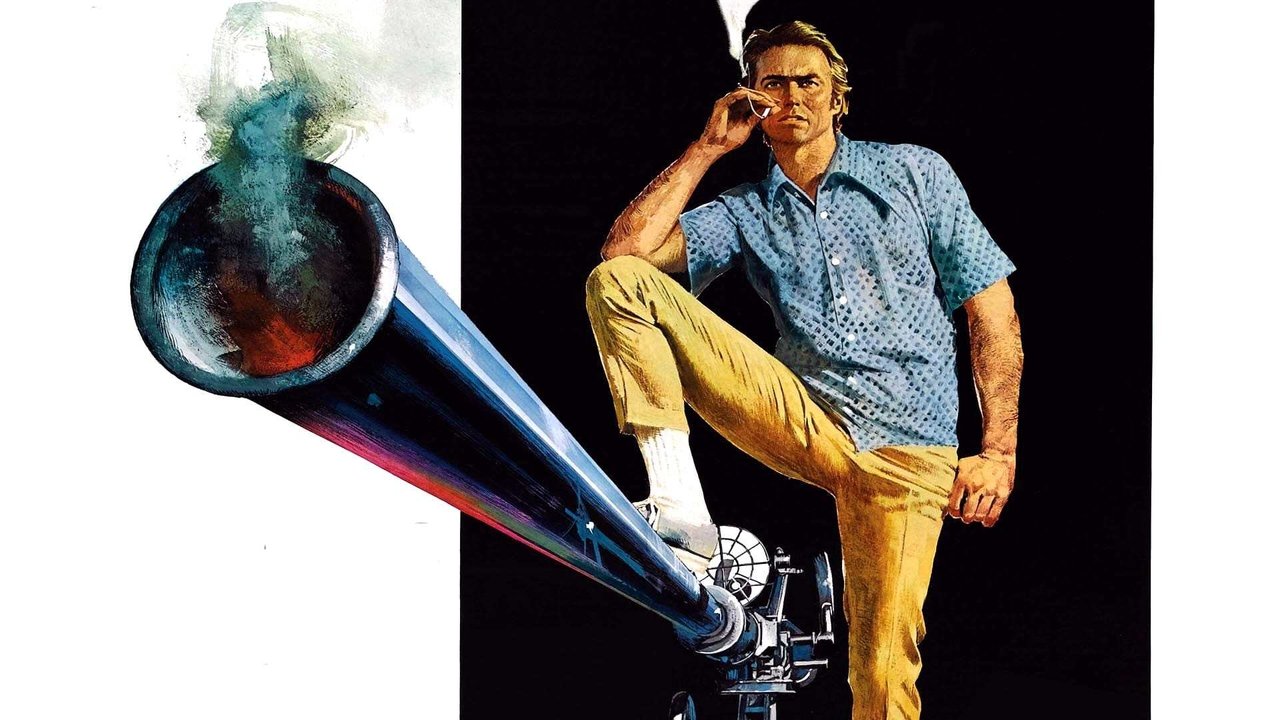
plays a part in the staging of the heist scene, which certainly is more sensual than the one act of physical love that we've seen in the film. Here's Wood on the heist scene. Significantly, from the point where the disguise is adopted, the film keeps the two men apart as long as possible and the sexual overtones are restricted again to the implications of the editing. Lightfoot walking down the street in drag is intercut with Thunderbolt removing his clothes in preparation for the robbery. Lightfoot's masquerade is then juxtaposed with the erection of Thunderbolt's enormous cannon. This culminates in the film's most outrageous moment. In a washroom, Lightfoot, back to camera, bends over the washman he has knocked out, his skirt raised to expose ass clad only in the briefest of briefs from which he extracts a revolver. The film immediately cuts to Thunderbolt fixing his cannon in its fully erect position. In its recent treatments of male homosexuality, Wood continues, the Hollywood cinema has never dared give us anything comparable to that. Here's more from Richard Schickel's 1996 Clint Eastwood, a biography. For purposes of the robbery, Lightfoot is obliged to don drag in order to distract a guard at the bank. and in the getaway to look like Thunderbolt's date at a drive-in movie. Lightfoot is very much at ease cross-dressed and rather attractive at that. Lightly played, these scenes suggest that here is another line in the traditional American view the most inviolable of all that is more easily crossed than most people dream. and Schickel quotes Fromwood. It is the essentially gentle Lightfoot with his indeterminate sexuality, his freedom from the constraints of normal gender roles, and his air of a pre-socialized child who constitutes the real threat to the culture. Finally, Biskind again. The lament, he says of the film, for an impossible and fugitive homosexual love is merged with a tearful tribute to lost innocence and youth. The three older men live in the shadow of the past of meaningful actions, the Korean War, the first Montana armored job, which occurred years ago. Thunderbolt tells Lightfoot he appeared 10 years too late. The second Montana armored robbery is a pale copy of the first one. Two of the original gang members have been killed. a abiding heir, if nothing else, of there are no new worlds to conquer. You don't need necessarily to agree with Wood and Biskin all the way down the line. Sometimes a cigar, and Lightfoot later is going to whip out a fat stogie at a key moment, is just a cigar. Sometimes an anti-aircraft gun is just an anti-aircraft gun, but Even if you don't read the movie as a coded queer love story, I think it's pretty hard to look at it and say that it isn't concerned rather expressly with sexual hang-ups, with a macho desire to project an air of mastery and potency, and not at all cause to look like a sissy, a obsession with red. and with the difference in these sort of attitudes between different generations and the way in which those differences between generations, those differences in attitudes breed conflict fatally eventually. But let's stretch out here for a moment. We've just enjoyed the clumsy bathroom encounter between Lightfoot and the Fat Man, complete with ball gag for extra kink. and now the hasty retreat as Lightfoot beats feet after Goody, who seems he would be only too happy to leave the kid behind. The much-discussed cannon here is a Oral Icon 20 millimeter with a flexible mount of Swiss design, widely in use during World War II.
Seemingly, it was thought that the Dirty Harry Magnum had to be one-upped somehow and definitely managed it. In other regards, Thunderbolt and Lightfoot was not going to one-up Dirty Harry. It pulled down a respectable take at the box office. not chicken feed by any stretch of the imagination, but less than half of what Magnum Force earned, United artist executive Stephen Bach reported that it returned rentals of a solidly profitable level, a respectable, if not spectacular, hit for Eastwood. It was Bach who, in his book Final Cut, suggested that Eastwood was unhappy when most of the praise for the film on the performance level went to Bridges rather than to himself. Cimino, it may be said, called the book a work of fiction written by a degenerate who never even came on the set. At any rate, there were respectable and even a few glowing reviews from Variety and the New York Times, from Jay Cox and Time, and from the LA Times, though nothing approaching the hosannas that would be heaped at the feet of Chimino's the deer hunter in a little while. There's plenty else to suggest that Eastwood was more than generous towards and happy for his co-star, though It can be confirmed that he was not particularly pleased with United Artists and with their handling of the film, and apparently would vow not to work again with the company, which indeed he didn't. You may recall the two-picture deal, while the second picture never got made.
Eastwood also never worked again with Cimino, though by all accounts relations between the two men remained perfectly amenable. Cimino, in fact, said that Eastwood offered him a three-picture deal after Thunderbolt and Lightfoot wrapped, but this was not to be.
The familiar experience of trying to cut your admissions cost by sneaking into a drive-through with people in the trunk is given a little extra spin here. Our heroes pulling into the drive-in, about to park next to some necking teens, which will elevate the already rather obvious awkwardness of the predicament as they've been paired as a couple. As mentioned, the reviews were more than respectable. One outlier, however, in assessing Thunderbolt and Lightfoot, which has only gained admirers through the years, is Dave Kerr, some years after the fact, in the Chicago Reader. Kerr writes, Clint Eastwood gave Michael Cimino his first chance to direct on this 1974 heist film, with Eastwood as a demolition expert and Jeff Bridges as his drifter sidekick. It looked awful then, and probably still does, though Cimino's personal mark seems clear in retrospect. It has the deer hunter's worshipful pupil-mentor relationship with its cryptic gay overtones, Bridges' plays one scene in drag, as well as Heaven's Gate's fatal preference for lyrical interlude over plot. Cimino was already making an aesthetic of inarticulateness, and the film is by turns surly, incoherent, and provocatively mysterious. What is interesting here is that Kerr, in addition to being an excellent critic, was also one of the early champions of Eastwood as a director, and that, in fact, Eastwood and Cimino make a very interesting study in comparisons. The no-nonsense... get the shot and get out of there, Eastwood, who continues on the cusp of his 90th year to work in Hollywood, and the stylist and perfectionist Cimino, who was already well out of the picture-making game before his death. This is, of course, largely to do with the affair of Heaven's Gate, with its $40 million price tag and its long-lingering shoot. There's an article by Janet Maslin in the New York Times dated January 11th, 1981, in which Eastwood is drawn specifically into discussing the Heaven's Gate debacle and Chimino's perceived inability to rein in the production. Eastwood says of their work together on Thunderbolt, I didn't see it in him at the time, but then he wasn't allowed to do anything excessive because the whole thing was very well organized by the time he came in. I had a big discussion with him before we started. He'd done commercials prior to that, and I said, you know, when you make a commercial, you take 10 days to do one minute of film. When you make a movie, it's the other way around. You work as quickly as you can. He seemed to understand it at the time. Eastwood continues, to me, if you've got 50 takes to make every shot, you're not directing, you're guessing. I don't blame Mike. He did what he was allowed to do. I suppose if they'd said make it for $80 million, he'd have done it for $80 instead of $40. What I wonder is what would have happened in a case like that in the old days. What would Jack L. Warner or Harry Cohn have done? They would have been down there when the guy was $100,000 over budget saying, take a hike, kid. When I read that they wanted to go back and re-edit Heaven's Gate with the same care it took to make the movie... I thought, that is exactly what they don't need. What they need to do is go in and be brutal with themselves. You can't love every shot, or if you love it, you'd better love it for a few seconds and then get off it. Eastwood goes on, it's hard to convince people of that, especially new directors. When I first started out, I always felt torn about pulling shots out of a movie because I knew how difficult it had been to get them. There I was in the Eiger Sanction, hanging four thousand feet off a cliff. That kind of thing is hard to part with. But the audience doesn't care about that. Once you've given them a taste of something, they want to move on.
I'm not here to endorse either the Eastwoodian view of things or the Cimino approach, though certainly I have feelings about the matter that may become clear, but to explain why this is the particular film it is, because as Kerr observes, it certainly does connect with later Cimino films, but it has a economy and a straight narrative line that one doesn't necessarily connect with the later films that Cimino would make. None of which is to speculate that Eastwood was actually the brains behind the operation, only to say that perhaps some tempering influence was brought to bear. But movies are strange things dependent on the curious alchemy of the personnel who happen to be on hand. Not much chemistry here. Things taking a very bad turn for our heroes. Red is cold-cocked Thunderbolt and is now giving Lightfoot that long-threatened beating, which, if you were to watch Sans context, would look mighty like a hate crime.
To return to the Cimino-Eastwood comparison, whatever one might think of Eastwood as a director, it can't be said that he's ever made an aesthetic of inarticulateness. Here's Kent Jones writing in the September-October 2003 issue of Film Comment about the particular punctiliousness of Eastwood's filmmaking style. He writes that Clint Eastwood has an old-fashioned sense of responsibility to his audience, giving his movies a nice overtone. At times, they have the air of a teenage boy who's being polite and attentive to the adults at a Sunday gathering before retreating to his room and burying himself in a book of poetry. Eastwood often feels obliged to cross Ts and dot Is that other filmmakers leave cryptically unadorned. there's something quaintly reassuring about a modern American filmmaker who feels obliged to give his characters summarizing speeches. Sometimes I feel like all three of us got in the car that day, says Kevin Bacon in the new Mystic River, articulating a point that's already been made in the larger arc of the action and tone of the movie, or inventing bits of winking business that were a staple of mid-70s Quinn Martin productions on TV. So we have old-fashioned Eastwood, the last of the old pros, the one-time studio contract star who'd carved out an independent niche for himself but would still give lip service to the business acumen of ballbusters like Jack L. Warner or Harry Cohn. And we have young hotshot Cimino, whose admirers will have it that Heaven's Gate failed not because of indiscipline and profligacy, but because the press had knives out for it before it was even in the can, and because it was too modern for audiences of 1980, and because the critical establishment had done nothing to prepare those audiences for its modernity or to negotiate that modernity. And this makes for a rather odd couple, Eastwood and Cimino. Not to put too fine a point on it, but as odd in some ways as are the taciturn thunderbolt and the rather more flamboyant lightfoot. Here, one last subterfuge, one last bit of identity play is... got through. It is revealed that Thunderbolt, in fact, won the Silver Star in Korea, was all along the real hero, though he tried to deflect the attention. And the false hero, Red, meanwhile, speeds toward his final stand, which, as described, is a particularly gruesome one.
Asked in 2000 for a quote on Cimino in a Vanity Fair profile, Eastwood was more measured than he had been almost 20 years earlier about the lesson of Heaven's Gate. George Lucas made Howard the Duck and the guy who made Waterworld. Those films didn't destroy them, Eastwood said. Critics were set up to hate Heaven's Gate. The picture didn't work with the public. If it had, it would have been the same as Titanic. Titanic worked, so all is forgiven. It's rather funny that Eastwood is sufficiently disdainful of Kevin Costner to refer to him as the guy who made Waterworld. Here is Red about to get much the same treatment from the department store dogs as Cimino received from the American Critical Establishment. Eastwood continues in the same piece saying certain things may have been his fault, but ultimately it was perhaps elsewhere. The accolades for the deer hunter, he says, probably made him think, I am a genius king of the world. Titanic seems to be fresh in Clint's mind. But if you say you're king of the world, people will root for you to fall. Always said that if you're prepared to accept reviews calling you brilliant, you'd better be prepared to accept reviews saying you're a bum. The guy calling you a bum may be wrong, but the guy calling you brilliant may be wrong, too. Here we have another ride for Thunderbolt and Lightfoot, like something out of a 1930s movie, the ride, a 1933 Ford Model B.
Eastwood, again, encouraging a filmmaking approach where the director isn't afraid to pull the trigger. A few years back, there was a minor item revolving around the use of a fake baby in Eastwood's American Sniper, which is dandled by Bradley Cooper playing Chris Kyle. And this, in some ways, exemplifies Eastwood's corner cutting. If the real baby is giving you problems on set, just fly a doll and get the fucking shot. And this is how you keep a career going for as long as Eastwood has, by rolling with the punches, adapting to exigencies, keeping to a schedule. This is also how you wind up occasionally accidentally dropping your cinematographer off of a cliff. There's a paradox in that Eastwood-Chamino comparison that I find troubling but fascinating, because on the evidence of Thunderbolt, on some levels I think Chamino may have... a richer visual imagination, be possessed of at least some level of innate pictorial genius, whereas Eastwood's is a modest talent stretched to its limits by virtue of application and discipline, and yet and yet I believe that Eastwood has made more good-to-great movies than has Cimino on something like a 20-to-1 ratio. When Cimino, who died in 2016, gave his first interview to the American press in years to the Hollywood Reporter in 2015, it was specifically to praise Eastwood's accomplishment with American Sniper. In the interview, Cimino sounds like he's talking about an idolized older brother. There's something of the same idolization that you can catch in the way that Lightfoot looks up to the older and accomplished Thunderbolt. On Clint, Cimino says, we just don't produce people like that anymore. I mean, that's another reason I'm so happy that he made American Sniper when he did, while he was able to, with vigor and conviction. That, to me, is what's important. I mean, and figures like John Wayne are unique. They're unique Americans, and they're unique in the history of film, obviously. But they're unique... In terms of Americans and American men, American people, I think both of them are special. Two legends, two American legends. My God. Now, we'll recall that the St. John's Lutheran's Church in Hobson, Montana was picked up and moved out to Troy in 1981. as we are shortly to discover something quite similar has happened to the old one-room schoolhouse where the loot was squirreled away the country church and the one-room schoolhouse two symbols of the pioneer world and its ambitions for spiritual and intellectual betterment a pioneer world displaced by the new west Around the same time that Cimino was making Thunderbolt and Lightfoot, the photographer Robert Adams was shooting in Colorado, showing a Western landscape very different than that of the other Adams, Ansel, a landscape altered and subjugated by man. The didactic outside the one-room schoolhouse evokes a vision of a vanished America. Inside, we find a vision of contemporary America, one more miserable married couple, Jean Ellman and Lila Teague, two of what you might broadly call urban ethnic types, the type to which Cimino, Italian-American Long Islander himself belongs, very much flummoxed by an encounter with these Western he-men who spook the pussy husband out of his wits and inspire him to give up smooth everything that he's got without a struggle. Cimino, remember, is a New York kid, a city kid, an art school kid, but in his 2015 interview, is very eager to tell the Hollywood Reporter journalist about his rough-and-tumble social circle, the tough guys he runs with, and there's more than a whiff of hero worship in the way that he does, and in the way that he is so strident in differentiating himself from the movie brat directors. who lived through films alone. He says, I mean, I have friends who are partially in the business, but they're the kind of guys that Ford, that is John, would have been friends with. They're cowboys. I mean, honest to God, real cowboys and rodeo champions and tough guys. And I love them because there's nobody like them and they're a dying breed. I love those guys. They're straight shooters. Those are the people I spend more time with than film people. I'm not someone who enjoys talking about movies the way Quentin Guess Who does. Quentin loves to talk about movies. He's like Scorsese. They'll talk about every old movie that was ever made, know every line that was ever written. I don't do that. I can't retain lines of dialogue from movies made in the 20s or 30s or 40s. I prefer people to talk about horses and rodeo bull riding, steer roping, where you can get a good pair of leather gloves made, work gloves, where you can get a good saddle made. There is just maybe a little over-defensiveness here, and Cimino is definitely set on edge later when the issue is raised of rumors about his undergoing male-to-female transition surgery, which he vehemently denies. Issue is made of this in the aforementioned Vanity Fair profile from 2000, the writer saying, even in Los Angeles where nip-and-tuck surgery is a given, Cimino's appearance has given rise to gossip. Over the past half decade, word is channeled through agents' offices and industry hangouts that the macho director who sets his films in tough-talking steel mills, sun-split deserts, and torture-happy jungles is a pre-op transsexual, readying himself for his final cut. The same piece mentions Cimino's foray into literary fiction, a novel called Big Jane. Later in life, he would write novels to be translated into French and then published. distrusting and disliking English language cultural journalists. He preferred at this point to expose himself only to the more sympathetic French. The writer notes that Cimino has a side project that he hopes will kick in if Big Jane is a success here, a women's blue jean line also called Big Jane. I've been doing casual surveys, he says. I think they should go lower in the front and then higher in the back. A female friend, he says, gives him her blue jeans when she's done with them. Because the girls' ones fit better, the new ones are cut more for a guy's figure. None of which makes the cross-dressing subplot in Thunderbolt a confession or turns the film into a film a clef, but to quote Thunderbolt, it do present mind-boggling possibilities. If nothing else, again... This movie has issues to do with sexual fluidity and gender fluidity very much on its mind. In an interview from the late 70s done on the set of The Deer Hunter, Cimino notes the autobiographical aspects of the film that he's working on, saying, When I was growing up, I had a number of very close friends who were Russian Jews. I was influenced a great deal by them. Certain things stayed with me. For instance, I was best man at one of their weddings, a Russian Orthodox wedding. There is a wedding very similar to that one in the film. The... Interviewer Mark Patrick Carducci then asks, is this the first opportunity you've had to draw upon your own life as source material? Cimino responds, no, I would say that Thunderbolt and Lightfoot is similar to The Deer Hunter in that respect. The things that interest me are present to a degree in both films. Thunderbolt, however, masquerades more easily as a less personal work. Do with it what you will and without dwelling too much on any of it. Let's at least say that this same ruefulness about the disappearance of a certain kind of machismo as found in the figure of Eastwood here or in Cimino's lauded cowboy pals or in the Eastern European steel town tough guys in the deer hunter, it's all over Cimino's filmography and it's all over particularly Thunderbolt and Lightfoot. And as we've seen, Cimino, born a New Yorker, was deeply dedicated to an idea of the West, dressed the part of a cow poke, kept a 300-acre ranch in Montana, was enormously sentimentally attached to this part of the country. So what does Thunderbolt and Lightfoot have to tell us about this part of the country, about the West? Janet McCracken, in a paper called The Non-Western of the New West, 1973-75, places Thunderbolt and Lightfoot alongside three roughly contemporary films, Electra Glide and Blue, Charlie Varick, and Rancho Deluxe, and gives an interesting read. She writes, The Wild West in Thunderbolt and Lightfoot is depicted as frenzied, humiliating, and ominously frightening, a scene in which Doherty and Lightfoot hitch a ride in a souped-up Plymouth Fury may demonstrate this best. Lightfoot opens the passenger side door to get in and notices that the passenger seat is occupied by a caged raccoon. The driver, Bill McKinney, tells Lightfoot to never mind the raccoon, just get in the back in a hurry. Once Doherty and Lightfoot are settled in the back seat, he races off in various directions on and off the road. He yells a lot in a celebratory fashion, mostly incoherent. Soon, Dirty and Lightfoot begin coughing, realizing that he has turned the exhaust inside the car. Eventually, the driver runs the car off the road into a gully, turning it over 360 degrees. No sooner has the car landed back on its wheels than the driver gets out of the car with the shotgun in hand, walks to the back of the car, and opens the trunk, revealing dozens, maybe hundreds, of white rabbits there. Shooing them out of the trunk with the butt of his gun, he starts shooting at them. When Doherty and Lightfoot finally make their way out of the car and Doherty knocks out the driver, they release the rabbits and Lightfoot in the passenger seat sets his hand down and raccoons shit. How should we understand this very disturbing scene? It adds nothing to the plot or to Doherty's or Lightfoot's character. It seems to be in the film solely to represent the new West in which our protagonists find themselves, the one that has changed so completely that Doherty is lost in it, according to the song. This West has no community, just a lone gunman and a couple of hitchhikers. The countryside is unpoliced but not really wild, and there are no ideals, no nations, and no settlements struggling for the space to live a meaningful life. In fact, the Wild West and Thunderbolt and Lightfoot is merely feral. It's a tame domestic animal, like this driver and his trunk full of rabbits gone out of its mind. At any rate, in the new West as in the old, it's the pioneers who take the risks. And so Lightfoot, who poses a challenge to traditional machismo, the machismo that Cimino both worships and looks askance at, takes an ultimately fatal beating for doing so, giving out the ghost in the white Cadillac sedan DeVille, the last car the duo goes through, the car that Lightfoot dreamed of. The feigned wooden leg of the opening scam has become a real limp. The body has dropped off. Some manner of internal bleeding. There's much speculation spiriting Lightfoot on to the next horizon. Eastwood, in the film as life, goes on to see what's over the next mountain as his young companion doesn't make it around the bend. And folks, I think that's my cue to mosey off. It's been a pleasure. Tell me where Where does a fool go When there's no one left to listen To a story without meaning That nobody wants to hear Tell me where Where does a fool go When he knows there's something missing Tell me where Where do I go from here Where do I go from here To get back home When my childhood dreams and wishes still outnumber my regrets. Get back to a place where I can figure on the odds. Have a fighting chance to lose the blues and win my share of bets. Tell me where, where does a fool go when there's no one left to listen to a story without me? Tell me where, where does the fool go?
Keyboard shortcuts
- Next paragraph
- J
- Previous paragraph
- K
- Jump to top
- T
- Focus search
- /
- Show / hide this
- ?
- Close
- Esc
Press ? to dismiss