scholar
The Night of the Hunter (1955)
Release The Night of the Hunter Two-Blu-ray Special Edition (The Criterion Collection)
Sanders, Gitt, Feeney, and Jones discuss Laughton's work with the script, child actors, and silent-film references during a 35-day shoot. They examine Stanley Cortez's lighting, Hilyard Brown's sets, Walter Schumann's music, and Mitchum's performance. They also compare alternate takes, restoration material, location and studio river footage, and differing accounts of production decisions.
- Duration
- 1h 32m
- Talk coverage
- 97%
- Words
- 16,161
- Speakers
- 4
Commentary density
Highlights
Topics
People mentioned
The film
- Director
- Charles Laughton
- Cinematographer
- Stanley Cortez
- Writer
- James Agee , Charles Laughton
- Editor
- Robert Golden
- Runtime
- 93 min
- Also on
- OneSheet ↗
- External
- IMDb ↗ TMDB ↗ Find on Amazon ↗
Transcript
16,161 words
Welcome to Night of the Hunter, everybody. My name's FX Feeney. I'm a film critic, and we have a wonderful distinguished panel here to watch the movie with you. We have Terry Sanders, who together with his brother Dennis was instrumental in helping Charles Lawton direct the film. And we also have with us, we have Robert Gitt, formerly of UCLA, who was instrumental in restoring the film. And we also have Preston Neal Jones, who wrote the definitive book, Heaven and Hell to Play With, about the making of Night of the Hunter. Why don't you introduce yourselves, gentlemen? Terry Sanders. Bob Gitt. And Preston Jones. This film is all about good and evil, light and shadow, love and hate, and that duality is heard in Walter Schumann's score right at the beginning of the credits. We started with the demonic theme for Preacher, and now you hear the angelic theme, which is the lullaby for the children.
Robert Golden, the editor, felt that Walter Schumann was next to Lawton, the most important person on the film. And I'll try to say some more things about the score later. Lawton perhaps felt that the most important person was Lillian Gish, who's the first person we'll see after the credits. Lawton was trying to recreate the power of the silent era, especially D. W. Griffith, and he loved Lillian Gish. Now, Terry, the These opening shots here, well, actually, after Lillian Gish, we can talk about what it was that you and your brother Dennis did, because I think a lot of the second unit work that you did is in the beginning. Right. My brother and I had done a film called A Time Out of War, which was a short story film that was Civil War short story filmed along a river. And Lawton had seen this and asked me to direct the second unit, which was...
shots of extras, or not extras, but doubles. There it is along the river. Well, he had the first unit in Los Angeles, so I did all the second unit shots back east. Mm-hmm. So you did these two in the helicopters? Right, and had a Bell helicopter and doubles for the children, and we shot. Now, this is the first unit again, intercut with your footage. Right. This is in the studio here. Exactly. This is a very suspenseful and poetic touch, I thought, because we open with Lillian Gish. And for people who don't know the movie, it might occur to them, oh, is that Lillian Gish's body that's been found? Because she looks like she's in heaven. So it creates an extra element of suspense. And now here's Robert Mitchum. But again, this is Terry's work with Mitchum's double there. Yes. The nice payoff is that Lillian Gish is actually the avenger of these women. Right. I have to say that in this shot, too, the backgrounds are my shots. And this was processed in Hollywood, yeah? Right. And they blend in very well. They're called background plates.
I remember Lawton sent a memo to Agee during the script writing stage saying, I know that Mitchum's uneasy about talking to God there in the car, but frankly, I don't know how else to really introduce the character cinematically. Because there never had been a character quite like this in movies. Yeah. And Mitchum's low-key delivery is so perfect because you could read the words as very overheated on the page and he just delivers them cold. Actually, in some of the outtakes that we found for the film, in this scene, Mitchum at the end of a take just starts giggling and kind of shakes his head like, God, how can I say these lines? But, of course, he does a beautiful job anyway. And this is all your wonderful footage, Terry, in the background. Right, all the background plates. Of the cemetery. Now what's coming up is the... Expressionistic, non-set set. I love the way Cortez lit this. It's like you're peeping through a keyhole at her. That's an uncredited lady named Gloria Paul. And this is the first of many sets which really is no set. It's just the chairs and the gentleman sitting there and the lighting.
Well, they had a very low budget, really, I think. They had a low budget, and the low budget and Lawton's intentions sort of coincided because he wanted a not quite real dreamlike fairy tale atmosphere to a lot of this. He told the people that he was working with that he wanted the whole thing to be, from the boy's point of view, almost as if it was a nightmare that he was having. What was the budget, Terry, do you recall? My recollection is it was $800,000 back in 1954. Yes. Now Lawton tried to draw parallels between some of the characters and other characters in the story. For instance, note this shot, and then remember that it'll be repeated when the children's father, Peter Graves, is brought before the judge, so that there's a parallel visually between the real father and the phony father. This is the penitentiary in Moundsville. I don't think this is the penitentiary yet. This is actually the town now, the kids. Yeah, the penitentiary's coming up later. I think we saw the... There was a brief glimpse of the penitentiary from above, though.
Now, there's been a lot of controversy about the screenplay, you know, that James Agee, a legend grew, you know, that Agee had turned in a screenplay that was about 400 pages and that it was full of all kinds of incoherent rambles. But fortunately, in recent years, the Agee family has found the actual first draft, which was 293 pages, exactly twice the number of pages of the shooting script, which was 148. Oh, yes. Fortunately found, unfortunately, after I'd already published my book. But, you know, it's fun. Now that Agee, 2009, next year it'll be his centenary, and they'll be able to republish it. And basically what it is is it's an extended version of the film, beat for beat, including something that was not in Grubb's novel, which is to hint strongly that he's hiding the money. That's him. You know, with the doll. Could I just say something about Peter Graves right here? Sure. I think it's interesting. We're recording this commentary on March 18, 2008, and today I read in the newspaper this is...
Peter Graves' 82nd birthday. So happy birthday and many more. Many happy returns. Hilliard Brown, the art director, had a boy the same age as Billy Chapin. Lawton often conferred with Hilliard Brown about working with Billy Chapin. It was Hilliard Brown who said, make Peter have Billy look him right in the eyes. Make sure that he's paying attention. That's where that line came from. Now, this scene where they're arresting him, Lawton staged this with very specific choreography. He thought of it as a ballet. And this is another way he was setting it up so that there could be a parallel at the end of the film, so that the same shots and choreography would be repeated when they arrest Mitchum. Dad.
It's interesting to notice, too, how the camera is very light, almost like handheld in certain places, like when Peter Graves stood up and so forth, and the camera moves with the characters, which I think was fairly new to movies. Getting away from the static shots of the 40s here in the 50s is lighter equipment, I'm thinking. That's what I mean. It's a different lens, but it's the exact same angle. And again, very simple set. You've got a flag, the wooden... the podium and the Lincoln, and that's, you know, that's all there is to this. Also, Ben's more in light, too, so it indicates he's got a shot at redemption, whereas, you know, Robert Mitchum is entirely in silhouette. Excellent. And I love this touch here. Yeah. This always gets a laugh in theaters when Mitchum makes his first appearance in this scene. I think it's interesting that Lawton
very subtly undermines his menace. And I was wondering, Terry, what did he tell you about developing the character? I mean, you were there for the pre-planning and so forth, even before Mitchum came aboard, perhaps. You mean undermining as far as the humor? A little bit, maybe increasing the menace. I mean, it could work both ways, but just that balance of light and shadow in the character. You felt that. I know that Lawton had some misgiving somehow, and he introduced what he felt was humor to lighten the... the darkness of the Mitchum role. And I think it was possibly a mistake, because particularly toward the end, when Lillian Gish fires the shotgun and goes off yelping into the barn. Lawton thought that was hilarious, but nobody else really did. I know I wondered about that, too. Lillian Gish felt the same way as you did. She said, in Griffith's day, you made as big a success, if not more, if you played a villain. Actually, Lawton filmed that scene twice. The first time, Mitchum runs out the screen door and doesn't do that. But the second time, Lawton says, don't forget the yips this time. And then Mitchum runs out and does that cackling laugh.
Yeah. It's interesting to speculate, though. Apparently, one version of Lawton's thinking was that he didn't want to ruin the young actor's career by being so villainous. And think about Anthony Perkins, who had a great career going, but it really wasn't the same as it would have been if he hadn't played Psycho. So who knows? Maybe Lawton was right, ultimately. But also, I think it's brilliant to have... I love that close-up. And I think it's very important, maybe one reason why there are emphasizing that line with a close-up is because of the whole dicey business of a preacher being a villain. So by establishing that he's not any organized religion, we worked out the religion betwixt us, me and the Lord. I think that might have been one reason why that got a big close-up. Another layer to the film, though, too, is notice, you know, that Peter Graves and the other adults are not scared of Mitchum at all. So that maybe what Lawton was undercutting was the idea that this guy was a menace to other adults, that he's, you know, that he really can only bully children. You know?
Well, before we get away from what you started to say about Agee's script, I wanted to say that we've talked about this, and I think you agree with me. On the one hand, the legend is true that the script was incredibly overlong at 293 pages, but it turns out that it is faithful in spirit and letter to Grubb's novel. It's as if he was writing the world's first miniseries before there was such a thing. Because even the things that he added that weren't in the book very much are in keeping with the book and some of them made their way into the final script you know isn't it true that lawton kept a lot of ag's lines and the lines from exactly he was an editor really exactly what i mean and the documentation that has turned up at the paul koner archive indicates that you know contrary to the accounts that ag was fired after 10 weeks he actually was hired for the final five weeks and so he under lawton's close direction cut the script
himself, but he wanted to give Lawton a co-credit, and Lawton said no. A. G. wanted to. A. G. wanted to give Lawton a co-credit, and Lawton refused, and Paul Gregory refused too. That's right. That's interesting. That's not my recollection, guys. My recollection is that Lawton just took over the whole project and just rewrote the script from scratch on his own, didn't want credit. In fact... Well, it's true that he didn't want credit, but there is some documentation that A. G. He definitely wasn't there the last five weeks before the shooting at all, because...
Somewhere in the papers that I saw on this film, Lawton was quoted as saying he didn't want to be thought of as a credit hog and so forth, and that's why he didn't want to do that. And he did acknowledge, he said, sometimes I think you should get all the credit, but Lawton didn't want any of the credit. And Lawton remembered Orson Welles and how he was treated by everybody when he took all the credit for everything on Citizen Kane. Excuse me just a second. This gentleman uncredited is Paul Breyer, and this whole business with the hangman is one of the important elements that Lawton zeroed in on in the book that was emphasized. And again, there's a duality. you will see the hangman again at the end of the picture. And I also love that haunting shot of him looking up from his own children, and even while the camera's holding on him, we're hearing the song of the scene that's coming up. Lawton experiments with scene transitions like that several times in the picture, where we hear the sound of the upcoming moment while we're on a different moment.
And here's another seed being planted, the TikTok watch. Are you going to buy it, John? Oh. So your mommy's keeping you out of school these days. Have we ever been able to identify this woman? Yes. I'm sorry. I should have written it down before we gave you. But we do know her name now. You can also see her in the Mankiewicz movie, People Will Talk. She's uncredited, is she? She's uncredited in the film. Lots of people are uncredited in this film. Credits have certainly gone a long ways. Oh, yes. This film will now have 15 minutes of credits at the end of it if it were made today. Yeah, every person who supplied the coffee and whatever. Yeah. Now, was this all shot on Back Lot, Terry, or did they have locations near L. A. that served? I think it was the Columbia Ranch, was it? It was the Rollin' V. Lee Ranch in Chatsworth. Okay, in Chatsworth. It was all... But then they... But the studio was... Yeah, I think it was in Culver City. Oh, Culver City, yeah. This is a stock shot, actually from an old Fox picture made during World War II, interestingly enough, that Stanley Cortez had remembered and mentioned it to Lawton, and Lawton found it and used it.
Initially, the script called for a toy train effect, but Bob Golden used these. He said these are much more effective, and I mean, look at it. It's a great shot. Yes, isn't it? And there's again that four-note preacher theme. You know exactly who's on his way. Exactly. And there's a lovely soft arrangement of what's going to be the Pretty Fly song and the river theme. Lawton loved the way Lawton recognized that the river was really the hero or heroine, if you will, of his story. And I love a shot that's coming up where they actually photograph the little boy through the shadows. on the wall they did that with here it is yeah with a few scrims that's like something that hadn't been seen since the silent days too yeah there are a lot of griffith effects in this film but the thing that impressed me in this scene and the outtakes is that billy goes through billy chapin goes through the scene several times in long takes and does does it perfectly from beginning to end so it's not just put together a lot of shots of short line readings he did the whole thing he did it beautifully
later on there are two crucial scenes one with billy and lillian gish and one with gloria cristillo and lillian gish and they're all done single take beginning to end so lawton trusted his younger performers as much as the old veteran
Now, it was Cortez's idea that they pull back here at this point. Originally, they were going to zero in from back and go into a close-up, but he had the idea of reversing it, and Lawton immediately said, oh, that's much better. I think that's the first time we've heard this. That's the Dixie Queen, yeah. Or the Delta Queen, excuse me. Delta Queen, probably, yeah. Now, this is like a lake or a pond at the Rollinvillee Ranch. And you had footage you had shot. That's the Delta Queen, yeah. Yeah. It was very successfully integrated, so it looks like a river. There's a match shot coming up that combines Bertie's wharf boat with the boat in the background. That's it. There it is. And for the period, it's pretty good, at least briefly. Yeah. Now, of course, James Gleeson, wonderful character actor, oddly enough, was not originally cast in the film. No. They had another actor who was not as well-known, and Lawton was not happy with his performance. So after trying twice to do the same scene with Billy and Uncle Bertie... Emmett Lynn was his name. Emmett Lynn, that's right. Thank you for remembering. He just gave up, and a few days later they were shooting
It's the scene that's coming up in the rowboat with Jimmy Gleason. That must be a background plate outside. Must be. Yeah, yeah, it is. Obviously, yeah. And there's another sea shanty tune. But it's beautifully done, though. And that must be Cortez to a degree. Do you... Remember anything, Terry, about Cortez? Sour old Cortez. No, well, I do remember he was sour. But, you know, all these shots were worked out ahead of time because I had to get certain angles that would work later. But I remember that Stanley was like never very, he was always grumpy and never really helpful somehow, I hate to say. Hmm. Because Orson Welles, you know, loved his work on Magnificent Ambersons, but also described him as criminally slow was one of his problems. And I don't know, he was very meticulous, that's for sure. I mean, the effects he gets. That's true. He lost some work sometimes because of that slowness. It cost him Chinatown, too.
Now, we heard underneath there Preacher's theme again when he was telling the boy about the fellow from Moundsville Penitentiary. But now they're back to this jaunty sort of river shanty tune of Schumann's. But we're going to end on Preacher's theme in no uncertain terms. Well, this is sort of John's theme, isn't it? The man he might become. No, we only hear that shanty in just that one scene. That's not one of the recurring themes. Evelyn Varden and Don Beto there with Shelley Winters. She was a wonderful vaudeville and Broadway professional, and he was a character actor of long standing. Yeah, they're terrific as a kind of chorus throughout this movie and, you know, meddlers. Paul Gregory said they brought a lot of much-needed humor to the film, and you'd have thought they were married forever. They were really marvelous together. Right. And, of course, Shelley Winters had been a pupil of Charles Lawton's, hadn't she? Oh, yes. Already, yeah. That's right.
The story of good and evil. H-A-T-E. The first time Lawton met with Mitchum after Mitchum read the book, Mitchum immediately started demonstrating what his ideas were for doing this love-hate business. Mitchum caught fire from the book as soon as he read it. And when I interviewed him in the 70s, he still remembered tiny details from the novel, even though he hadn't probably read it since 54. Now watch him. old brother left hand left hand hates a fighting and it looks like loves are gonna now there's a little moment coming up here after the sermon where in the novel and as the script is originally written a game sort of begins a war of wits between billy chapin's character and mitchum's character But simply by his choice of shots, Lawton delayed that moment till a later moment in the film. See, the boy is going to say, you know, what did my dad tell you? And Mitchum's going to say, oh, nice things, boy. But they shot a close-up of Mitchum, but they don't use the close-up for that at that moment.
but later they'll use a close-up how many is the time poor brother ben told me about these youngins what'd he tell you well he told me what fine little lambs you and your sister both was is that all this is the moment he told me lots and lots he underplays it by putting it in a four shot like that and later on i'll point out the moment where because he goes to a close-up it begins proper it's for the picnic And you don't get a smidgen of my fudge unless you stay for the picnic. The totality of her crush on the preacher is great. Yeah. As Davis Grubb told me, she really brought out a 60-year-old Yenta's way of getting off by trying to match, make Mitchum and Winters. Now this again, there's Bertie's wharf boat at the top of the screen. This is the Rollin' V. Lee Ranch. And Lawton's thought was that this was
It would be a little bit like Le Grand Jeté, the famous impressionist painting. I think there's a shot where you even see an umbrella in the background. How old was Benjamin at this time? I think he was mid-30s. Mid-30s, I think. Yeah, 34. Oh, there's the umbrella you can see over the head on the right, over behind one of the singers. Yeah, Mitchum was the idol of Elvis Presley, and you can really see why. Oh, yes. It's the way he moves with his whole body. It's interesting that Lawton originally wanted Gary Cooper for the part. He had worked with Cooper in the 30s. I don't see that at all. No, I don't. He was very lucky that it worked out with Mitchum. But the point is that he was always thinking in terms of a handsome leading man for this villainous part. He explained it to Davis Grubb. As Davis Grubb remembered it, Lawton told him, Davis, people who... who sell God must be sexy," unquote.
Also, Gary Cooper moved beautifully, and that's what you need for the part. It's understandable that Lawton was thinking in those terms, you know. But wouldn't he have been too old at this point? Wouldn't Cooper have been too old at this stage of his career? Maybe the young Gary Cooper. He was still playing leading man. Well, he was. And the cragginess of his age might have actually fit Preacher. It's the high noon Gary Cooper period, but how lucky we are that it worked out how it did. Yes, Cooper didn't want to do it. He was scared off by it, and the rest is history. Now, Terry, were you present for any of the filming of these? I was pretty much back east, and Dennis was the dialogue coach. You know, he would read lines with actors, and so, you know, I heard... Occasionally, when I came back from the second unit, I hung around the set. What kind of stories would Dennis tell you? Were there any that come to mind? Well, because the big scandalous story with Mitchum was his relationship with Paul Gregory, which deteriorated over the weeks to the point where he, at one point, urinated on Paul's white...
Cadillac convertible. Oh, dear. Quick little interjection here. That reaction shot of Beto's always gets a laugh in the theaters. And there's a continuity break, because the next thing you see, he's got the chicken back in his hand. We haven't mentioned Paul Gregory really in depth yet. And he is in many ways the initiator of this project. Oh, there's no question. Because he was the one that discovered the Davis Grubb novel in galleys and thought it would be right for Charles Lawton. And it was Paul Gregory who had basically resurrected Lawton's career. A popular career by sending him out on the road with a one-man show in the late 40s. Readings from the Bible and Shakespeare. I think driving him, you know, being his driver and agent and everything. Well, that also led to Lawton as a director having a career because he directed a lot of stage shows. Yeah, The King and Mutiny, Court Martial. And John Brown's Body and Don Juan in Hell. So this was the next logical extension was for Lawton to direct a film. Right, and the extension after this was going to be The Naked and the Dead.
which you can tell us all about that was not to be yeah yeah unfortunately you and your brother dennis did wrote the screenplay we did yeah based on mailer's book i love this shot coming up it's bright daylight but with the triax film of stanley cortez you still have that dark villainous shadow on mitchum it's like he carries it wherever he goes well also that trick that Orson Welles knew, and maybe Cortez taught it to him, of breaking up a mirror, putting it in a bowl of water, and then shining a bright light on it to make the waves ripple across somebody's face, which was actually even as, like you've got going here. Right there, yeah. And it can actually act as a tremendously sinister thing, as you see. That's the water effect. The water effect, yes. Now James Gleeson is singing this live.
Is he playing, actually? Yes, he's actually playing. One of the skiff be ready. Have her ready inside a week, and then we'll go fishing. How's your ma? Oh, she's all right. Now, a lot of these people, like Uncle Bertie, were people that Davis Grubb grew up with as a child. He loved his real uncle. He drank all the time. He said, I also used to love to come up and hug him, because he smelled like a fruitcake. And those are the real sounds of the crickets, I believe, that you actually heard at that ranch. It's nice to see how, you know, these significant shots of John walking from place to place and how subtly that does allow him to claim the film and own it as the protagonist. You know, it's his viewpoint and his navigating the world.
told Hilliard Brown he wanted the whole film from the boy's point of view. And when you look at the long shots of the town, you'll see that Hilliard Brown put a picket fence where there was no house behind it, the idea being that a boy might pay attention to the fence but not even notice the house. Now, this is the scene coming up, the crucial scene where the war of wits will begin. I had a little talk with your mother tonight, John. And your mother decided it might be best for me to let you know the news. The close-ups of Mitchum were done on a different day than the close-ups of Billy Chapin. When we examined the shooting schedule, it was rather weird the way some scenes were shot over two or three different times in the shooting schedule. They'd wait a few days and go back to it.
Now this, the close shot here of Mitchum, it's going to be wonderful. When the game begins, by a lucky accident, he does something with his eyes that is just able to catch the highlight. It's coming up here. See, this is where the game begins. Now watch this evil glint in Mitchum's eye. There you go. So that's the moment that was delayed from the ice cream parlor scene. One characteristic of the... visual staging of this film that's constant, and we'll see more and more of it as the honeymoon goes on, is the proximity of the walls, that the people are framed within the frame by the walls and stuff. Terry, did Lawton draw a lot of the things in advance? Did he storyboard, or how did he work? He did. Well, first of all, in preparation for this, he ran a lot of D. W. Griffith films, including Intolerance. He got prints from, like, original nitrate prints from the Museum of Modern Art, which were incredible. He ran The Birth of a Nation.
And that was partly his infatuation with Lillian Gish, but he was inspired by D. W. Griffith in so many ways, and he wanted it to be a kind of post-Griffith film, but using a lot of that. Now, the underscore here is a waltz, and this becomes the theme for Shelley Winters. And this all came about because of Stanley Cortez shooting the later scene where Shelly Winters is finally going to be murdered by Preacher. Lawton saw a look in Cortez's eye and said, what are you thinking of? And he said, false priest. And as soon as he said that, Lawton said, how right you are. This whole scene needs a waltz tempo. So all the scenes involving Willa have a waltz tempo. Terry, you were... picking up on that moment with the pocket knife there. When Willa takes out the knife and says, oh, men, you know. Yeah, that also gets a laugh. You know she's doomed. Yeah. Here's a brilliant visual piece of business where Mitchum's going to offer her her hand. She thinks, but. I didn't know why.
This is a great moment. Oh, maybe we just pass it. Yeah, it's where he holds the hand up and she thinks he's offering it to her, but he's just telling her to close the window. That's something that Lawton added in the staging. Now, unusual for the time, and really for any time, Lawton had his art director, his editor, and his composer on the set with him, working as part of the creative unit all the time. Lawton didn't want Bob Golden to do any editing until all of the film was shot. This is the one scene in the picture that Bob Golden did start editing ahead of time because they wanted to be sure to clear it with the Breen office. It's a dicey, very dramatic scene. intimate scene, it's a honeymoon, et cetera, et cetera. Was it still the code in those days not to show a couple in bed side by side? Because it's nice they've got a single bed, but then neither of them is in it at the same time. I believe so, yes. Still was. 1954, 55. Yeah. Even without the nudity of the novel, just the cruelty of him having her look at herself in that shabby little nightgown.
Well, there's the framing, the genius in the framing, too, because you're seeing her whole body, so you're very body conscious of her. You don't need to have the nudity. Who's in the picture? Is that Teddy Roosevelt or something? Charging up San Juan Hill? Or Civil War, perhaps? Looks like Teddy Roosevelt, actually. We had Lincoln earlier. American heroes and so on. Of course, Mitchum is famous for his portrayal. I think Shelley Winters has never been fully appreciated because, in a sense, she has the harder role. Preacher is preacher throughout the movie but she has to make all these transitions and turn on a dime and this is one of the key transition scenes that you're watching right now now that she's been shamed she has this little prayer which keys off the whole rest of the picture help me to get clean so i can be what harry wants me to be
And it was beautiful, too, the way they were both facing in the same direction, you know, to show the inner divorce. Now, this is an interesting scene, I think, from a rear projection point of view, because originally a lot of this was shot with Emmett Lynn and then thrown away. Instead of going back to the lake again, this is done with rear projection, and it's extremely well lit by Stanley Cortez. You wouldn't really know it, I think, that it wasn't made on location. Absolutely right. You mind my cussing, boy? No. Like, this is a lump and whale, and that's a cuss. Well, yes, that is. It's the best they could do. 1955 is the best you could do. Davis Grubb felt a little abashed. He wished that he could have worked with the scriptwriters on that moment. He said, I could have come up with some real river talk that would have been stronger than that and still passed the censors. Uncle Bertie's your friend. Of course, that's the key moment, so we feel that Uncle Bertie's going to be there for him. Ah, you slimy snake!
Now, this scene also that we just saw was inserted earlier in the script than it was originally planned. And I think Lawton was wise to do that so that the transition wouldn't be so abrupt to seeing Shelley Winters in this impassioned vein. And again, this is another set that's no set. It's just that hunk of muslin, that tent, and the seats for the people. And the torches and the piano in the background.
There is one funny outtake in this scene of Mitchum looking a little bit alarmed by one of the torches getting a little close to his head. And, of course, there's this wonderful moment of revelation coming up where she's talking about the money, and we're finally going to find out what she doesn't know and what Mitchum doesn't know, but the kids know. And you throw it in the river! In the river!
reveal where the money is. Exactly. And, of course, they couldn't photograph real U. S. money at that time. That was also against, I guess, rules and regulations then. So they had to use fake money. I think it's Mexican pesos. Is that what it is? Yeah. But nobody ever notices that. No. Now, I always love this scene when I'm seeing it, especially in a theater, because in a few moments, it starts out with just the two kids, but a moment is coming that always elicits a gasp in a theater crowd. And I know whenever I hear that, that Lawton's hooked them and they're gonna go for the whole rest of the ride. It's the moment when Mitchum first appears in the background. What was Lawton's work with the children, Terry? Do you remember or remember stories?
I really don't. Probably from the outtakes, Bob knows as much as anybody. Well, actually, well, here's this moment. That's that moment. And let me just say that what's also brilliant about this is that he holds the shot. In the script, it was broken up into many shots. But he increases the suspense by keeping it all in real time in one shot. So the audience is all the more anxious. We already got the money put away. Exactly. That's right. That's what's so great about this scene. And just to answer your question, in the outtakes and so forth, Lawton has a very good relationship, of course, with Billy Chapin. Chapin responds instantly to what Lawton asks him to do. He's absolutely brilliant. He's wonderful. Of course, Sally Jane is another matter altogether because she's just a little girl, and she's charming and fun and bubbly in the rushes and very entertaining, but she obviously is not
you know, an actress and can't really fully respond to what Lawton's trying to get her to do. So I think he was very frustrated with her, don't you, Preston? Yes, and actually it was your brother Dennis who recollected that Lawton told him that he purposefully chose an actress for the sister who would be less appealing than the actor playing the brother because he wanted the focus to be on the boy. Okay. Now the music has come in here and it's not going to let up for all the scenes to follow until we say goodbye by Ticheli Winter's character. Lawton told Walter Schumann that the concept was like long muscles. He says, because every scene is so short, I want you to feel free to write long, extended passages of music that will bridge them together. And so what we're hearing now is a variation on the waltz, Willa's waltz theme. And eventually you're going to hear it corrupted, if you will, by Preacher's theme until the final moment of her life.
Beautiful shot of her coming up. Beautiful shot coming up. I was gonna say it's one of my favorites. And the next one. That's an optical fog machine. Raven and DeWitt added more fog than we saw in the actual original footage. Where's the money hidden? I don't know. She thinks that money's at the bottom of the river. But you and me, we know better, don't we, little lad? I don't know nothing. I love how the shadows just create lines of force pointing at the heads of the characters and just highlighting the dynamics. I guess there's a little bit of silence here, but the music's going to come in very quickly at a crucial moment when Mitchum whisks her away from her brother. The silence does create extra anticipation around their words, though. Oh, absolutely. It's really crucial. Absolutely. All right, now it's your turn.
What secret shall I tell? Ooh, uh, what's your name? You're just fooling. My name's Pill. Playing off the back of his head. That's really great, too. Well, I reckon we'll have to try again. Uh, where's the money hid? Oh, you swore you wouldn't tell! You swore you swore you wouldn't tell! They did many takes of that, so we can only assume it was a special prop from Joe DiBella. Now, you see, we just can't have anything to do with John. You and me are going down to the parlor, Perk. Now the music's coming in and it's never going to stop till after Winters succumbs. Yeah. It's also, you know, on the doll and to the little girl, it's like females in danger from here on. Yes. Isn't it sad that Walter Schumann didn't live very much longer because he had a heart problem and died in an operation? In 1958. Yeah, because he wrote such wonderful music and think what he could have done, you know? Yeah. Of course, people remember him for the Dragnet TV show, too. Yeah. From the 50s. So, Preston, did you talk to Mitchum? Yes. And did he talk about why he decided to do this role?
Well, he cooked up a little story that he more or less made up about Lawton calling him. But it was a good story, like most of Mitchum's exaggerations. He said that Lawton called him and said, I've got a character in this movie who's the most diabolical shit. And Mitchum said... present and that was Mitchum's version but really it was an actor friend named Bill Phipps who knew Lawton and Mitchum who as soon as he read the book what Lawton urged him to do so was lobbying for Mitchum and eventually that did lead to Mitchum meeting Lawton and his getting the part. Now, this is a set that's not a set. It's just all background. The bed is in the foreground, but there are no other walls except the background wall, which, as you can see, is designed and lit sort of like a chapel for this human sacrifice. Answer me. It's a very ritualistic scene. And doesn't some of the scene remind you of Cabinet of Dr. Caligari, too? Absolutely. Expressionistic. Again, it's a silent, expressionistic influence.
And of course, there was that trick of her eyes when she came in with that fixed smile downstairs. She's known what he was doing to her daughter, so now she's just preparing for her own fate. Exactly. She sees what's coming. And that's the other importance probably under her looking at the knife before, just to plant the seed that she's already accepted a part of him that now is coming full circle. And so now in the music, you're hearing Mitchum's theme against her theme, her waltz. And it's important, when I've talked about tying in characters, the waltz theme is going to recur later in the film, long after she's dead, to make a connection between her. Oh, I love that. All the shots of him with the moonlight in his hand at the window. He's going to make a connection between her character and the Gloria Castillo character. When Lawton's directing this, he says, okay, Mitch, kill her. That's right. And it's interesting, unlike films today, the ultimate moment isn't there and doesn't have to be. But it's a wipe-dissolve, just like the direction of the knife across her throat. It's odd he kills her with his love hand.
yeah because he's right-handed well the whole beautiful introduction where he's watching the stripper and the knife pops up through the pocket it clearly shows a guy who can't distinguish in his madness between his erotic impulses and his murderous impulses so it's very fitting that the love hand is the one that handles the knife although he raises his hate hand to the window yes exactly Now, I just have a question. I don't know the Davis Grubb novel. I've been trying to find it. And is there a scene in there where he hears the car starting up at night and carrying the mother off? I believe there is. I'd have to double check. It's been a while since I've read it.
I'm just curious because James Agee was at that time finishing A Death in the Family too, which has a scene of hearing his father drive off at night, and I wondered if he was triggered by the memory of hearing his father drive off to his death. Pretty much everything that's in the movie was in the book one way or another. Lawton was wonderfully faithful to the book, which was another thing that was strange about this movie for a Hollywood product of the time. The book was one of those books that you could almost rip the pages out and paste it. Like Maltese Falcon. Like Maltese Falcon, exactly.
Now, that's another moment that gets a needed laugh relief when he went for the drink. Now, this happens to have been the first scene that Beddow shot on the picture. And he was very nervous, and he kept blowing his lines. And Lon said, what's the matter? You're not nervous, are you? He says, yes, I am, because you're such a great actor. So Lon said, oh, you silly son of a bitch, and immediately put him at his ease. And Beddow was so appreciative. I wanted to ask you something, Preston. Leonard Maltin, when he saw the film, mentioned to me that somebody told him that he had heard the name pronounced as Don Beddow. And he wanted if perhaps that was the correct pronunciation. I don't know. I always say Beto. I always say Beto, too. Yeah, yeah. I don't know. It was so long ago when I interviewed him at the age of 92. And he maybe wouldn't remember himself. That's right. Well, what do you figure to do? Do?
Now, of course, we're leading up to the most famous image in the picture. And once again, we're going to hear the waltz in a totally different arrangement. And it was shot in a tank using a dummy. And they very carefully made a face mask of Shelley Winters, a makeup man named Maurice Siderman, who had worked with Cortez and Wells on Magnificent Emerson. And worked on Citizen Kane. Aging Charles Foster Kane. He's the one who aged Charles Foster Kane. He created the of Shelly Winters that makes this scene so effective. It's incredible. I remember meeting him. He's a fantastic makeup person. And also way ahead of its time, Lawton really went for the full effect. He could have had the willows and the hair obscuring the wound in her throat, but you'll see that he, that's revealed in the shot as well. And Hilliard Brown, the art director, was down there with an aqualung handling the actual camera work. And they also had another camera shooting the scene through a window outside. But all the really close stuff, like following the hook, that'll be Hilliard Brown himself handling the camera. The devil wins sometimes.
Isn't that unusual in a film to have an art director do the camera work? What did the union say about this? I wondered what the union would say when Lawton, we see in the outtakes, moves a little furniture around or the costume. That's true. Well, there's the shot. Those willows came, and that's an upside-down tree. That came from the ranch where they were shooting, and there's the wound, and there's the shot. Another one of the great moments. Yes. Yes. And that's like echoing in a distant ballroom, that waltz. It's a huge hook. Yeah. Getting that big gar. Now, this is quite something here. Yeah. This is the shot that Hilger Braun remembers shooting the following morning.
Now, these days, at least, I don't know about 55, that shot gets a laugh in theaters these days. Does it? Because it's so clear, I think. If they had murked it up a little bit, it would... But, of course, nobody could argue with this last shot there. It's like Dolly somehow. Yes. And you're hearing Mitchum sing what is the recurring hymn that he sings. It was suggested that Schumann use the theme in his underscoring, but he said, no, that would give credence. This is a Griffith moment coming up. Absolutely, yes. Griffith used this effect a lot. The iris in... And not since Cortez had used it for Wells in Magnificent Ambersons. True. And this is not an optical. This is done live right there on the location. Yeah, they're doing it with the camera lens and the device on the camera. Focusing on the children. Anyhow, just to finish the thought. And great on the cutaway there, too. Schumann didn't want to dignify Mitchum's murderous madness by taking a real hymn and using that as a theme.
Now, this cellar was a set which you'll see later when Mitchum is in the scene with the kids, was built deliberately smaller than an actual basement so that Mitchum would seem to loom larger over them. Again, it was that child's point of view that Lawton was after. If we stay here, something awful will happen. See, here they are in mortal danger. I love the moment coming up where Mrs. Spoon is going to show up. And even though John's very life is at stake, when a maternal figure stomps her foot, the game is over, and he has to go up the stairs reluctantly and sheepishly. Those jars he's just jiggled will come into play, won't they? Yes, that was an important plant right there, that shot. that in the in the uh... early draft the a g script the heat
makes the recommendation of having Buster Keaton work on some of the, because Buster Keaton was for hire in those days, to work out the gag of the escape. That didn't happen, but it's interesting. Yes, that's coming up, and again, that shows how consciously they were thinking in terms of humor playing off the character. I'll have more to say about that, too. I just want to refer back to a moment ago, there was that lacy shadow on the wall, just like the lacy things, curly things, that just sort of went with, you know, his guilty conscience. Sorry, Bob, I didn't mean to cut you off. No, I just wanted to say, coming up is an interesting thing that's in A. G.' s script, and there's actually Lawton did film because it's in the outtakes with sound and everything. When Icy calls the children upstairs and they're standing in the kitchen, there's this very chilling moment when Icy reaches over and pats
John's head, and Mitchum leans over and runs his love hand through her hair. And it's very creepy and strange, but I guess Lawton thought maybe it was just a little too much. I always, when I see that shot, wished he had used it. Yeah, it's a nice shot. It's coming up in just a moment. They have to go up because the woman has said, come on, knock it off. That's right. Dust and filth from top to toe. Want me to take them up and wash them good? No. And here is where, right around in here is where that shot occurred originally. Exactly. Where they did that bit of action. And this is one of the scenes where Mitchum pitched in and helped Lawton direct the actors. The kids. The kids. He showed Sally Jane Bruce how sharp the knife was before the dinner scene that's coming up. So she would be very conscious of it. Yes, that's right. Yeah, but that's about the full extent of Mitchum directing the kids, though, right? It's this scene coming up at the dinner table. Yeah, and also when they're about to go down into the steps. He does a little... Yes. Yeah. But that's about it, really. Yeah, at least in the evidence of the outtakes.
Actually, we're going to see Uncle Bertie now next. I forgot about that. Here's another lucky photographic accident, the stroboscopic effect of the drunken man. Is that an accident, or did Stanley do that? I asked him if he had planned it, and he said no. That's interesting. But there are other scenes where there's motion that you don't have this effect, though, seems to me. It has to do with the opening of the camera shutter, I believe, what the opening of the shutter is as it's revolving, what kind of effect you get stroboscopically speaking, if I can say it. Well, it's a perfect expression, of course, of his Yeah, no, it's great. Interesting to wonder, too, because the Stanley Cortez shot Magnificent Ambersons and the original ending was Agnes Moorhead rocking back and forth into shadow, you know, while Joseph Cotton talks to her. Interesting. Maybe we get a little echo of that here. Yeah, that could be. Now, there's some very grisly dialogue here where he was just describing the slit in her throat like she had an extra mouth. Lawton could have just gone with that, and most movies of its day would have, but instead he showed us that great shot under the water. Yeah.
Well, that's in theater. They call that the rule of the gesture. You always have to show before you tell. Otherwise, people laugh, you know? Now, here's the scene where Mitchum is kind of coaching, particularly Sally Jane, who kept flubbing her lines right at this point. And he's... tells the kids to stop and they'll start over again and then he prepares to begin the scene over again and in a sense he is sort of directing particularly her although every now and then you hear lawton's voice whispering so he lawton is there very much there this might be the moment to mention that lawton directed the film like a silent movie with the camera rolling they didn't do slates except at the very beginning in the very end of every 10 minute reel i think one reason might have been because he was working with kids and he wanted to be sure that anything they did spontaneously would be
be caught on film. So in a sense, he was filming his rehearsals as well as his final takes. Yes, that's right. I mean, of course, not all the takes were a full 10 minutes long, but some of them were. Yes, but the point is that as long as they were shooting, the camera was rolling. Also, he felt it would help the actors concentrate on their character, not to have to stop and start with the slits. I think he's right, too. Have people yell cut and so forth in action and so on while you're in the middle of a mood and so on. Now that's a glycerin tear. Yes. There now. You made me lose my temper. Orson Welles would do that too, running through everything. So the energy wouldn't drop either. People stop, go make a phone call, do all the, you know, between take stuff. I thought I told you to keep your mouth shut. It ain't fair to make Pearl tell when she squashed you wouldn't. I'll tell. Now, in the scene coming up when they go to the basement, Lawton wanted a subterranean effect, so Hilliard Brown cut out some flats to put in front of the camera so you get a cross-section, sort of ant farm effect in the shadows.
And again, the whole set was built just a little small so that Mitchum would appear looming over them all the larger. One little technical thing. You may notice that this shot doesn't look quite as sharp and clear as some of the previous things. This is one small part of the original negative that had... that had been destroyed by the year 2000. And so this shot had to be, these shots right in here had to be replaced. But right now we'll go back to the original negative again when they go down to the basement. You can see it looks better of course. And here are the panels masking off the parts to give you that subterranean effect. And the music has started with Preacher's theme. And the strings are bringing in a little theme we are hearing for the first time that's going to become the big theme of the chase.
Oh, no, you don't. Robert Golden felt that the comedy coming up when Mitchum starts giving chase was actually necessary. He said, in a sense, you needed some relief, but also there was no reason why the Mitchum character couldn't get them if he didn't have those pratfalls coming up. But he made a point that the music stayed serious and scary all the way through, even under the comedy. The lords are talking to me now. Now, again, there's a timing and a staging thing here. Lawton waits till the really ultimate moment for Mitchum to open up the knife. Speak, boy, where's it here? So that it builds up to that moment. Speak, or I'll cut your throat and leave you to drip like a hog hung up in butchering time. Pearl, shut up! Pearl, you swore! You could save him, little bird. It's time by now! It's time by now!
He's so taken aback that he doesn't know to grab for it, you know? Yeah. It's great. Just a little aside here, where Mitchum falls as he's going up the steps, that's a stuntman doing that, a double. Naturally. He didn't actually do that. Yeah. It's coming right up. But then when it's Mitchum himself going up the stairs, he looks, yes, that's the stuntman. Now he looks like Frankenstein's monster with the short cuffs. Yeah, yeah, he does. Wow. It was actually James Whale who directed Frankenstein and Bride of Frankenstein who introduced Whale. I mean, Lawton to Gregory. That's a strange shot there of the two kids, which is a freeze. And it actually, Lawton removes some dialogue between Mitchum and the kids at that point that he didn't like. And that's why they had to put that in there to cover that. I always wondered why that was there. There's a gap. Yeah. Great. You finally figured it out. Yeah, yeah. It's in the outtakes, yeah, with sound and everything right there.
Now, just as a sample of what the original age he had been, there's a moment when he goes to try and wake up Bertie Steptoe. It was coming right up. Yeah, and it says, And now John becomes aware that there is no hope and no help. He stops pummeling the old man and crying at him. In his face, something changes as if a page in his life and soul were being turned. He grows up. He is no longer a dependent little boy, except for Pearl, who can now only be protected. He is alone in this world now. Now, Lawton directed him to cut it down to... A page turns. He is a man. That's the... Exactly. Well, all he says is, there's still the river, as you'll see. That's the moment. But it's just as a sample of, you know, of the overriding versus what wound up being... Overriding versus, yeah. The simplicity. Literary versus cinematic. Yeah. So any hope we had been led in the fishing scene that Bertie might be helpful is now dashed. So it seems as if there is no hope until this moment. Here it is.
There's still the river. Now, this was shot at the ranch, but we're going to get to scenes that were shot in Culver City on a soundstage for most of the rest of the river sequences. And you're not aware that you're on a soundstage. Exactly. Now, there were lines that Mitchum had that Lawton also cut from this chase, so that it becomes pure silent movie, pure Griffith intercutting back and forth between Mitchum and the kids.
This was in Culver City? Exactly. Now the script, as in the book, called for the boy to sort of throw the girl into the boat, but you couldn't do that with a little girl, and so it's all the more excruciatingly suspenseful that he has to do this careful lifting in. You know, you want to say, get her in the boat! And when Mitchum goes down into the water, the water's really only three or four feet. It's about hip high. And we're really building up what for me is the heart of the movie and the It's the pinnacle of the movie. It's like the peak of a mountain in the center of the film. Now, there's the preacher's theme at its highest. And Mitchum is about to do a famous scream. He said, I was just showing off for Charles. But Lawton took that scream with Walter Schumann, and they stretched it out. They told Paul Gregory, we've got a sound that's going to knock you out of your seat, old boy. And that was it.
the movie becomes something entirely else. The movie suddenly grows into something else, into this wonderful dreamlike 10 minutes that we're about to see. Lawton told Bob Golden, I want that shot under the stars to hold as long as it can possibly hold. The stars were added by Rabin and DeWitt, but all the other stuff was live, shot by Cortez on the soundstage. Rabin and DeWitt being the special effects. Exactly, the optical people. Oh, this is interesting. Sally Jane here singing. She actually had won a singing contest at a local Los Angeles radio station. That's one of the reasons she got the part. And there does exist a recording of her voice actually doing this song. Here we're hearing a grown-up woman attempting to sound like her. And she's not bad, you know. There's one or two words that she... has trouble pronouncing, but her sense of melody and so forth is really very good for a five-year-old child. But I think it's because of the slightly, oh, that spider web, that's three feet in diameter. Yeah, Lawton wanted me to try to find the spider web back in West Virginia and a frog. He did drawings, actually, of all these shots.
Hilliard Brown was dripping honey on that. And then it was superimposed photographically. Almost all the shots with animals in the boat are composite shots. Did you photograph that frog, Terry? No, no. I looked for one. And those were at the ranch. Now, one of your great helicopter shots, which were so striking in the film, is coming up... ... right after this scene. This is like the eye of the hurricane, this quiet scene, and we're about to go back into the maelstrom with your helicopter shot. Interesting, the shadow on the wall of Spoon's ice cream parlor. Yes. Luminous, yeah. At least the kids will get a plenty of good home cooking. It was nice, that slow motion of the weeds, the dandelions that were backlit. They look undersea, even though we know they're above ground. It's nice, the, you know, little... Hard to tell what's underwater and what's not. You and your gypsies, they've been gone a week. Sure. But not before one of them knifed a farmer and stole his horse. I love that. Even now they've got the story wrong, you know? Yeah. Must have been some gypsy knifed that farmer and stole his horse. So that was a double that you photographed. Yeah, but cut works very well. Yeah, it's beautiful.
And, of course, there's Preacher's theme again. And now the Pretty Fly song has become the theme of the river in Schumann's scoring. Go away, children. That... theme of such times when youngins run the roads. That was something that Agee may have influenced Lawton on because it definitely is an emphasis more in the movie than in the novel. They had Ben Harper using his children as the motivation for the robbery that kicks off the whole story. He doesn't put it that way quite in the book. He just says, I was tired of being poor. Well, Agee was the author of Let Us Now Praise Famous Men. Of course. It's a great book of the Great Depression, and I think Gregory and Lawton were both aware of that and wanted that. Interesting. We'll see that owl again, won't we? Yes, we will. Definitely. And also now the theme of defenseless little things, which comes to a climax in words later, but that's probably... All the animals. That's my shot. Beautiful.
Now, this is really a composite of three things, the background with the boat, and that's actually one rabbit photographed twice. I hope the rabbit got double residual payments. I don't know. Well, he's a very versatile animal. He played both parts beautifully. Yeah, beautiful. And here we are back on the stage. Backlit sky is fantastic. And the name of the woman who's going to sing this lullaby is Kitty White. Davis Grubb was a friend of hers, but it's sheer coincidence that Schumann discovered her and had her sing this lullaby so beautifully. Now, Originally, they were going to use some of your shots for rear projection for Mitchum in the scene coming up. Right. I think, you know, Lawton wanted me to get as much as I could. And if it worked, fine. If it didn't, then it was done on the stage. This is all done on the stage. It's another instance where they went for an unabashedly fairytale effect. You're going to see the farmhouse and the barn. They're really just cutouts.
on that stage. Very effective. Oh, absolutely. And notice how tranquil the water is now. It's not going to be tranquil the next time we see it after the kid has realized that Mitchum is still pursuing him and is so close by. Mm-hmm.
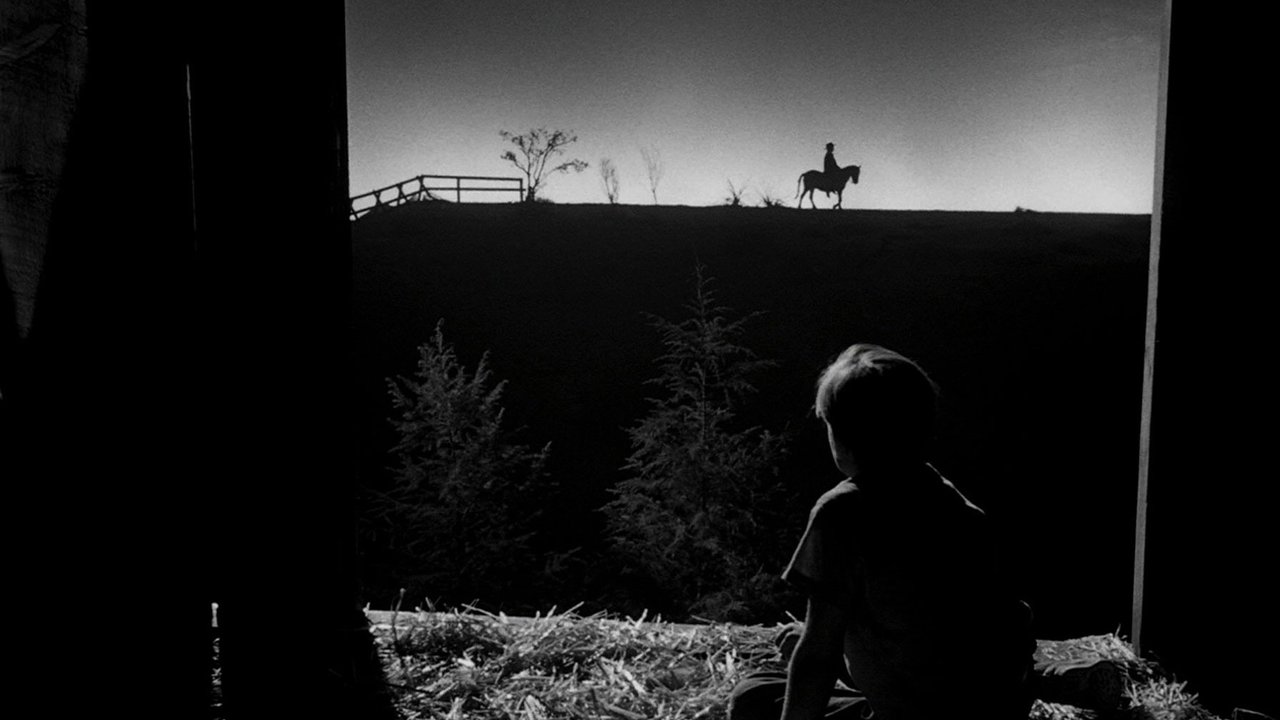
And how nice that the effect of the rooftop there being choppy, you know, and turbulent and squiggly. Beautiful. Yeah. It's like everywhere your eye falls, there's something that's very carefully considered. That's part of the power of it. Hilliard Brown had the idea of using forced perspective, and we'll see that coming up. Once they decided to shoot it on a stage, they said, how are we going to handle the business of Mitchum on the horse in the distance? And that's when he thought of forced perspective. I'll say a little more about that when we get closer to the scene. Lawton also wanted something of nature and nurturing the children. That's why he's had all these animals associated with him. And now they're the animals in the barn. And I always question lighting the udders so brightly, you know. They could have been silhouetted. Yes. It's nice that, you know, a lesser director might have cut inside the kitchen to let us see who's singing.
keeping it mysterious and just letting us you know wonder like children do it has more power and it's a theme which is going to be used when they first meet lillian gish so that we will see that john is associating with her her with like the eternal mother finally succor at last and here's the first taste of that forced perspective you're speaking of exactly what they did was um Mitchum's going to be riding his horse in the distance. Except it's not Mitchum, is it? Exactly. It's his voice singing that, leaning him. But what we're actually seeing is a Shetland pony, not a horse, supporting the little boy's double, who was a very short man, practically a midget. Or a little person is, I should say, I guess, nowadays. That way it made you feel that it really was Mitchum and he really was way off in the distance, but he's actually a lot closer than that. Of course, here you hear a dog barking, which is the approach of evil, I guess, in some way. Reminds me of the dog barking in the graveyard scene that opens Frankenstein. Just a perfect touch. Now, of course, we hear Mitchum. And here's this great shot. Yeah.
One of the unforgettable shots from people who've seen the picture. The whole movie has an effect on people who see it when they're young for the first time. And that was something that Lawton wanted, that impact on the young audience. So when did this film become a classic? Because it wasn't at the time. It wasn't at the time, no. It became a classic partly in the 60s and then the early 70s. And this is where, you know, in trying to set the record straight about aging, I'm really grateful for the insight you've given, Terry, because a lot of film critics gravitate to his name. And I think that... early on, people were sort of accrediting a lot of it to him because of Death and the Family. And Paul Gregory was very irritated by that. And eventually, as the various biographies came out, his voice was heard loudest about, you know, like the missing script, that it was incoherent and so forth. Excuse me, there's the turbulent water now that Mitchum is shaking up their lives. I think also it was the fact that it was one of the first films released to television or was released very shortly. So it was our generation that wasn't able to discover it in theater.
that saw it when we were young and it made such a big impact on. As our numbers grew, it got more and more revivals in theaters and museums. In the summer of 1959, I had just graduated from high school, And the film, The Night of the Hunter, was shown. I lived in Hanover, Pennsylvania, and the nearest town was Baltimore, a big city, and they showed it on Channel 13. And my parents were very excited that a movie with Lillian Gish and Robert Mitchum was going to be shown because they loved her in silent films. And we watched The Night of the Hunter, and that's when I fell in love with it.
And sadly, when I went to college about a year later, the film was run on the college's film program on a Saturday night for a bunch of drunken fraternity boys. And basically, every time Robert Mitchum appeared, they sang the theme from Thunder Road. Then they threw paper airplanes. They rolled beer cans down. And on the scene here with the kids going down the river, they actually got up and danced across the stage. It was really very upsetting, and I'm glad Charles Lutton didn't see it. So at that time in the early 60s, it wasn't yet considered a classic, at least by general audiences, I'm sorry.
Or at least by drunken frat boys. By drunken frat boys. No. But you know, talking to people who saw it on TV, you'd see it piecemeal. And part of the power of the movie is because each of the sequences is so powerfully conceived in itself that sometimes you only have a fragmentary memory of the film. And so putting the fragments together, it becomes unforgettable. You know, it's a funny thing. When I first saw it on TV, I saw it at one, started at one in the morning and they'd run out of commercials. So they showed the first 40 minutes without a single break. And then they only had two or three quick public service announcements. so that I was very lucky as a 12-year-old kid. I practically saw it uninterrupted. And that was a beautiful shot, again, from Rabin and DeWitt of the moon combined. And they've added the stars that we're about to see. They're really the unsung heroes of the whole river sequence. They added so much to it that, of course, was beautifully shot by Cortez to begin with. And then we have another beautiful shot from your work, Terry, back east. All right.
I love clouds, so if I see beautiful clouds, I shoot. Well, you're a right-thinking individual. Well, the other thing about the stars is that they bring us back to Lillian Gish who opened the film, so we helped creating an anticipation. Get on up to my house. Mind me now. I'll get me a switch. This has a sort of... Griffith made a film with her called True Heart Susie in 1919, and this is a little bit like Susie grown up now, basically. She's playing the same type of rural character. Lawton's image was of Mother Goose. Mother Goose, too. Yeah, absolutely, yeah. And he said to one of the reporters in his interview, it's really a nightmarish Mother Goose story we're telling. I liken it to Mother Goose with goosebumps. Yeah, they're the geese, by the way. Yes. Lest we forget. Yes, lest we miss the point. But the other nice thing is that they meet cute, you know, in the romantic tradition as a hostile meeting and then...
All tender as follows. Now, right now, they're playing a pastoral theme, which is introduced only with her and her orphans, and superimposed over that when the first time John gets a good look at Rachel right now is when we're about to go to the lullaby theme. Where you from? Where you folks? Come on, speak up now. That's a great shot. Yeah. So I've got two more mouths to feed. And that's Gloria Castillo. This was her first film. And she was very nervous. A lot of Lawton's direction to her was simply trying to put her at ease. But she does a lovely job in this picture. Yes, she does.
Now, that's an optical that they did. Apparently, they needed a close-up there that they hadn't made, so that was done sort of after the fact. Tightening in. Tightening in, yeah. And there was John Hamilton, who played Perry White in the Superman series. Good heavens. Trivia fans. Trivia fans. And the picnic baskets emphasize the Mother Goose theme because it gives them the duck-shaped bodies kind of. Oh, yes. In profile. Where are your folks? Someplace. My daddy's in Detroit. Detroit. It's interesting, for the rest of the film, Pearl hardly matters very much, doesn't she? Sally Jane has very little to do from now on. Now that they've arrived with the other orphans within Gish, yeah. Well, Gloria Castillo begins to dominate as the vulnerable target of Robert Mitchum, so it's sort of... That's right. You know, I think it's interesting in the scene coming up that Billy Chapin's older brother, Michael Chapin, plays one of the parts. Ah, that's right.
He plays one of the end loungers? One of the teenage boys, yeah. But what's also interesting is the other teenage boy is Corey Allen. Oh, yes. Allen Cohen from A Time Out of War that was the film that brought me into this project. So that might be how he got to the part. Oh, absolutely. Of course, later that same year, he was playing Buzz opposite James Dean. Rambled Out of Cause. And here they are coming up right now. Yeah. That's Corey on the left and Michael on the right. And Michael Chapin on the right, who was 17, I think, at the time. The old gal thinks she comes in for sewing lessons on Thursday. Miss Cooper wants you. And will you show me your dolly, little lady? See, you got two more peeps, you brood. Yeah, and on rear than the rest.
Stanley Cortez remembered that they had to pack a lot of set onto a very small soundstage, so much so that they didn't even have the legal three or four feet between the edge of the set and the wall that you usually had to have. It was hard to light and shoot, he remembered. I read that Stanley Cortez once referred to light as that incredible thing that can't be described, and he said, of the directors I worked with, only two have understood it, Orson Welles and Charles Lawton. Wonderful praise for Lawton. I wish Lawton had lived to see this moment and see the success of this film. Mary Ellen Clemens is on the left. She became an actress and a teacher. She just passed away, sadly, a few weeks ago. She taught at Cal State Northridge. It's interesting that you mention that because in real life, Sally Jane Bruce grew up to become a teacher. That's right. In Central California, yeah. And on the other side of Billy Chapin is another wonderful child actress. Yes, Cheryl Calloway.
She works at Disney now, but she did a lot of acting as a kid. She's just such a lovable squeeze box. I love her line, my daddy's in Detroit, when we were walking through the town earlier. It's interesting about light, what you were saying before, and I think maybe the common bond... Orson Welles, Charles Lawton, and light, is actors would understand the value of light and silence because, yeah, there's a good text under you, but when you act, you want to be able to show a decision being made, and your physical presence and the light have to work together. And it's really a lot of decisions get made by the characters in this back and forth, and it's always clear what everybody's thinking. Now, I may be wrong, but I think this is the scene with the boy and Rachel, which is all in one shot. Yes, it's all in one shot. And it went over so well that there was no need. They didn't make a second take. He did it in one take and never made any more. They didn't need them.
and the way the light plays under her eyes. Yeah. And note the apple, which is going to have a payoff in the final scene. Right. The Christmas present. Exactly. Exactly. Tell me that story again. Story? What story, honey? About them kings. And the queen found out in the sandbar that time on the skiff. Kings? See, such is her simplicity, she doesn't even remember the story she was telling the kids, you know? It's great. And I don't mean by simplicity, a kind of stupidity, but just a kind of openness, just a spontaneity. Yeah. Now we're about to go. to the adolescent Ruby. And now this is a jazzed up 50s dance band version of Willis Waltz. So that we see a susceptible female for Preacher to seduce. So there's that connection that Schumann is helping Lawton make between those two characters. And very stylized signs and so forth. Well, this was part of the idea of the picket fence with no house behind it. This was designed so that there were only certain highlights that a boy might notice, but not everything that you would actually have on a realistic set. That was part of Hilliard Brown trying to fulfill Lawton's concept. Can I have this?
I'd like to talk to you, my dear. Will you buy me an ice cream? And it's especially nice, the tension, because you've got the third guy always in view. Right. You know? Did Lawton talk to you about the choreography, Terry, at all, about staging and showing you and Dennis who to put in a frame and why and when? No, I really wasn't on the main first unit set that much, actually, but... Did Dennis tell you any stories? Not really. I mean, you know, when the film was finished, we had already started working on The Naked and the Dead, so we had a lot of dinners or lunches with Lawton, so he would talk about the film, and he was so convinced it was going to be an enormous commercial success.
I'm glad you mentioned dinners. That's an important part. This film was rushed into production by United Artists, and consequently, there wasn't as much time for pre-production preparation as Lawton would have liked or as would have been usual. Consequently, the way this film was shot, every night after shooting, Lawton and that unit of his, the composer, the editor, the art director, and the assistant director, would go out to dinner and plan the next day's shooting. Hilliard Brown did a lot of his sketches on tablecloths restaurant. As the editor, Bob Golden, told me, we ate a lot of food, we drank a lot of booze, but we got the job done that way. I think the whole production of First Unit was just about six weeks, wasn't it? That's right, just about. 35-day shooting schedule, wasn't it? There's a line coming up here. She says, he was looking for love the only way you'd know how.
This is another one-take scene, by the way. We're looking for love, Ruby, in the only foolish way you knew how. Yeah, it's a great line. And Simon Callow, in his great book on the film, he wondered who came up with the line because it's not in the Davis Grubb novel, and it is in the first draft of the AG. But it's in the page. It's marooned in a page of a lot of other dialogue, so it's the brilliance of Lawton to say, no, that's your line. That's the only line they need, you know? Yes, it really wasn't in the novel, and it enriches the characters that Grubb had created. Now, who was this? He didn't ask me for nothing. What'd you talk about? How transparent Lillian Gish's face is. It's so great. Yeah. 30 years later, I made a biographical film on her. This is when I met her. You had met her on the making of this or when you met her later? I met her on the making of this, and then a year later, Dennis and I did...
The day Lincoln was shot, she played Mary Lincoln. Another Paul Gregory production for television. Oh, Miss Cooper! Of course, we're back at Robin V. Lee's ranch. And drops the eggs. The world is tough on defenseless things, you know? In other words, it's... constant reiteration. Now here we're on the sound stage. We're going to go back and forth all through this because they shot the scene originally on the ranch and then must have realized that they didn't have enough closer shots and details. So they brought Mitchum back because he was already working on Stanley Kramer's movie, Not As A Stranger, by then. They said, can we bring you back for one Sunday to reshoot the stuff that we need for that crucial scene outside Lillian's house? So going
told me this was the hardest scene for him to cut, and I'm sure it was because he had to match the real outdoors with the soundstage stuff and make it all homogeneous, if you will. There was another reason, too, if I remember correctly. Mitchum had been out partying the night before, and this is one of the few times he had trouble remembering his lines. He kept screwing up the lines in this scene, and they had to cut around that. I had not heard. Yeah, yeah. That might be the day that he piddled on Paul Gregory's car. Maybe, yeah. The way he had on David O. Selznick's carpet one time. Having said that, In all the rest of the film, when you see the outtakes, Mitchum is always very professional, always very polite, obviously very easy to work with with Lawton and the others.
Well, Bill Phipps, the actor buddy of Lawton and Mitchum, told me that he saw a movie of Mitchum's and he said, oh, Bob, I saw your movie Thus and Such the other day. And Mitchum said, yeah, could you tell which scenes were I was high? But I asked him, do you think he was smoking during this film? He said, no, he had too much respect for Lawton and the whole project. I think he just wanted to do a good job for this one. And Lawton told the story that when Mitchum saw himself in the rushes for the first time, he went out and vomited. And Lawton said, what's wrong, Bob? And Mitchum said, I had no idea I could be that good. Oh. By the way, one little minor thing here, but when Billy jumps under the porch or John jumps under the porch, it isn't...
As I remember it. Well, there was a stunt boy. There's a stunt boy. Who jumps down, but they cut the shot of him jumping. But they cut it out anyway. You're right. You're right. So it's okay. Now, here's the classic moment. Davis Grubbs said, I didn't write it for comedy, but you see it adds to the drama and the comedy. Yeah, this always gets a laugh. That famous scene. You haven't heard the last of Harry Powell yet. The Lord God Jehovah will guide my hand in vengeance. He's about to use a naughty word from the Bible. Battles. You whores of Babylon! Wasn't that unusual for that period to say the word whore? Exactly. The Breen office got on their case about it, but... It's whores of Babylon, not whores. Yes, exactly. Yeah, it's in the Bible, so we're sticking with it. There was no more said. Now, Terry, what was the deterioration between Mitchum and Paul Gregory? I mean, was the...
What was the dynamic? You know, I just got bits and pieces, but there was some... Maybe Mitchum was drunk or something, but there was some incident in his dressing room where he ripped the telephone off the wall, and there was... I don't know whether it was over... I don't know what it was over, but they just developed this animosity between them, and... I arrived at the studio just after the piddling, as Bob says. And Gregory was saying, did you see that? Did you see what he did? Did you see that? Yeah, apparently that was when he showed up too drunk to work and Gregory wanted him to go home and Mitchum didn't want to go home. He wanted to act. That feels right. Yeah. Now, this is interesting, because notice she's going to join in on his song. In the novel, it simply says she joins in on the song, but she doesn't just repeat what he's singing. She sings this counterpoint.
And she mentions Jesus, which preacher has never mentioned. No, never mentioned. I'm sure that was something else. Because he's not a real preacher. Yes. Again, that was another way that Lawton was able to get away with the character in the movie because the preacher does mention Jesus in the book, but he was very careful to never have him mention Jesus. Well, Paul Gregory grew up in Iowa. He knew from Baptist churches that this is the way the men and the women folk combined singing this song. So he was the one who knew about that when Lawton heard about it. He thought it was a wonderful juxtaposition of the angel and the devil together. Yeah. And, of course, that's a brilliant piece of business that was added, the screen with the light. Yes. That scene there was the only time in the rushes where Lillian Gish seems to be frustrated and angry briefly because she has to mouth the playback to her voice singing the song again and again and again. She gets very irritated about it. But other than that, she was always... Here's the culmination of the defenseless. Easy. And the key line coming up. Yeah.
Did you shoot these? No, no. It's a great choice of an owl. That owl is so well cast. It's a hard world for little things. Yeah, that's beautifully counterpointed in a minute or two when she's talking about how children are manned at its strongest. Yeah, yeah. Now, a line that was cut from the film was, kids, it's been more fun to play games in the dark. So she's turned the lights out here, setting the stage for one final shock moment. But Lawton, here's where I really have reservations about his choice. He really softened the shock of the next moment when we're going to actually see Mitchum again. We don't know where he is, but we hear him, or we're about to hear him and then see him. You know, he's gonna pop up into the frame.
He pops up because of this silly cat, which is just like out of any cheap horror movie that we never saw in the movie before and we're never going to see again. And it's because he supposedly steps on the cat that he suddenly leaps into the frame. But in the book, he leaps up into the light because he's attacking. So this was another moment where Lawton was making more comedy than terror. And I really think this is the one moment where I disagree with that choice. I think they do establish the cat for a moment. Yeah, they established it, but just for the sake of this one moment. But I think to respectfully disagree, I think that what happens is the movie has transformed. Mitchum is so menacing through the first half of the film. It's a testament to the power of this character that he's off balance by her. And it's not just sentimental. She's actually got the strength to see through him.
Well, all right, as long as you disagree respectfully. And there was the cat established. There was the cat established. Exactly. And it's still a great shot. And establishing a close-up with a foot. Yes, even with him more reactive than active, it's still a great shock moment. Here he's doing the yips, as Lawton called them. Yeah. Which, I don't know, do some people find that a little bit awkward, perhaps? I don't know. I think so. Yeah. Lillian did. Rachel Cooper, get your state troopers out to my place. I got something trapped in my barn. I think the Yips set up that line, though, you know? I got something trapped in my barn, a wild animal. Yeah. That's right, yeah. And the screams are in the novel. Mm-hmm. Oh, yeah. Yeah, because he can't be invincible, you know what I mean? He is, at the end of the day, a coward and a bully.
Because from here on, even when he's being herded into the cop car and stuff like that. Now, that business of hers calling the state cops, that's one of those Hitchcock moments where you don't like to think logically. You know, like, why didn't she call them before instead of after? Why does she have to bring that up? Well, that's the beauty of it. When the story is working, you don't think of these things. Oh, she didn't have any... any solid basis to call him. I suppose you could say that, except that the kids could say he killed my mother. This is the same angle that we had when they arrived to arrest Peter Graves in the opening. Exactly, just like the ballet arrest that's going to repeat the choreography. The choreography is coming back, you know, the same. And it's very important for what happens with John's character that there be a parallel between the father and the phony father.
And here's the way they hit... Coming up is the way they hit... Exactly. This is exactly the same choreography, the same sequence of shots. One, two, three. Exactly. And what's fascinating is, in the novel, Davis Grubb didn't think to mention this great image of the... He just says he hit him with the doll. He doesn't mention the money spilling out. Oh, yeah, that's right. Yeah. Hmm. But that's the thing, you know, they've not mentioned that their parents were killed. You know, they've been silent about that and have not even mentioned the money. Yeah, you're right. The return of Icy. And there's the two hangers over their shoulder. They're obviously amused by the whole thing. Yeah. They look like they're...
And some of these folks were at the Tent Revival meeting, too. Probably. But the two boys are just having a good time. I think they're looking down at everybody and making fun of them there. Once again, Lincoln in the background again. And I love how you only see, that's James Griffith, but you never see his face. You're just all focused on John. That's great. Who can't bring himself to testify. Like Lincoln in the corner there. Merry Christmas to you and yours, Mrs. Cooper. And what's Santa Claus going to bring you for Christmas, little man? So there's the watch motif returning. And of course, the silent movie actress doing a little pantomime for us, just like the good old days.
Now, this whole sequence coming up, Bob Golden was of the opinion that if they had eliminated this whole scene, it just might have made a difference with the public reception of the picture, because he felt it didn't add as much as it might have. I don't necessarily agree with him, but that was his thought. One doesn't remember it until one sees the movie again, I've noticed, but it does emphasize the mother goose. Yes. And it really helps to have the music going into dramatic mode again before the transition to the final scene. It's like an opera. Musically and dramatically it makes sense even if it may or may not. It also shows the people earlier in the revival meeting who got all worked up. Here they are even more worked up. Exactly. And Icy who brought about the death is basically wanting to bring about another one. Right, yeah.
That's right. And again, I love about this scene the fact that it culminates with the hangman. Even the hangman gets redemption in Lawton's version of this story. From the opening film. Exactly. He instinctively knew that that hangman was important to Grubb, and Grubb wrote about hangman later in some of his other books. He also had a line, Grubb, in one of his books, For what is hate but love that has lost its way in the dark? He's like their mother. Still hanging on. That's right. Still in love with the evil preacher. Yep. See, that's the other side of abiding, too. To have this extra scene, yeah, they abide. They abide in their wrong ways, too, you know? That's right. That's the last we'll hear of the preacher theme in its menacing mode. Yeah? We're saving this bird up for you. This time it'll be a privilege. See, contrast. Christmas music. Exactly. It's a beautiful transition. And this is nice where they're walking with the Christmas music. Merry Christmas. Perfect shot. Mother Goose. Now, in the actual outtakes, this snow machine is making such a racket. Such a racket. It's like D-Day. You can't hear a word that she's saying. So anything you hear her say was post-dubbed, you can rest assured. Yeah, absolutely.
It looks beautiful, but, you know. Whenever they do, it's nothing I want, but just something to show me how fancy and smart they come up with. Now, I'd mention the love and hate. At the very end, you will hear Preacher's theme, but no longer in the menacing mode. They're the last notes of the story, so it's almost as if hate has found its way home in the dark musically at the very last moment of the picture. And she's making chocolate, is she, like Icy was before? Probably. Interesting question. You don't really know what it is. She was really cooking, though. They did have a hot plate there. And now the apple is going to return. And there's redemption coming up for Ruby that wasn't in the book when Lillian gives her the brooch. That's such a beautiful moment. Now there's the pretty fly theme. It's like a recapitulation of all the themes, dramatically and musically, in this scene. Because Willa's waltz is going to be heard when Ruby gets the brooch, but no longer with any compromises from Mitchum's theme. It's just a beautiful, lovely little musical and dramatic moment.
There's the lullaby theme. And there she was, frustrated about not getting any presents. That's the richest gift a body could have. And your presents are in the cupboard under the china closet. Ruby. We should mention that Davis Grubb, Lawton asked Davis Grubb to do sketches of how the novel had appeared in his head. He did 130 drawings. And there's the brooch. see there's willa's theme which well it means she's sort of grown up now exactly exactly beautiful moment and now listen to the lullaby under this great speech you'd think the world would be ashamed to name such a day as christmas for one of them and then go on in the same old way love that line my soul is humble when i see the way little ones accept their lot
This is right out of the novel. And there were similar thoughts out of the novel that she also expressed. But again, Lawton knew enough to cut and just use a little bit of it. Yes. He also cut out a bit of business from the novel that would have had John saying, I ain't afraid. I got to watch the ticks. I got to watch the chines in the dark. He eliminated all of that. So Terry, this movie didn't do well when it came out. What was Lawton's reaction? I mean, how did he? When this film didn't do well, it It crushed Lawton's spirit. It just totally threw him, which it shouldn't have. It was a brilliant, brilliant first film for a director. But he expected so much from it because he'd come off so many great successes with his stage plays, Kane, Mutiny, Court Martial, and so forth. he had really hurt him tremendously and also the film has redeemed itself ultimately just like all the characters in it yeah but the fact that it wasn't excess it took they they i mean meaning uh
RKO took the making the dad away from him. Very sad. Well, mainly it was going to be another Lawton-Gregory collaboration, but their partnership dissolved. So Gregory still had the rights to it, but Lawton was no longer a part of the package. But presumably the people with the money didn't want Lawton to be attached to it after this film had failed so miserably. Oh, absolutely. No, not together.
Keep exploring
Other commentaries on related filmmaking topics
-
8 shared topics
Goodfellas (1990)
Martin Scorsese, Nicholas Pileggi, Ray Liotta
-
7 shared topics
Let the Right One In (2008)
Tomas Alfredson, John Ajvide Lindqvist
-
8 shared topics
Red Dragon (2002)
Brett Ratner, Ted Tally
-
8 shared topics
The Way of the Gun (2000)
Christopher McQuarrie, Joe Kraemer
-
8 shared topics
The Lord of the Rings The Two Towers (2002)
Peter Jackson, Fran Walsh, Philippa Boyens
-
7 shared topics
The Lord of the Rings The Return of the King (2003)
Peter Jackson, Fran Walsh, Philippa Boyens