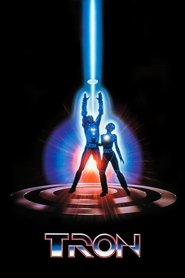
One little anecdote here is that the cameraman that was up on the platform shooting this, the viewfinder of his camera was broken, the pellicle mirror had shattered, and he couldn't see anything through the camera and he just aimed and shot. He didn't want to slow down the production by telling anyone that he couldn't see anything, and held his breath all the way till dailies, and the shot worked out. Oh, that's right. 'Cause there weren't very many 65-millimeter cameras available, and all this was shot in 65 millimeter. Yeah. When we opened these cameras, they still had the sand of Lawrence of Arabia in them. Well, Flynn's arcade was in Culver City. Yeah, it's across the street from the old MGM lot, which is now the Columbia lot, but now renamed as Sony Pictures. Now, there was actually a loft at the location. But then the re-shoot... The close-ups were the re-shoots on a stage. Yeah. That's the... The actual... The practical location. Space Paranoids. Space Paranoids. I take my son to the arcade in Westwood. We go once in a while. I have to bring my earplugs. But I've never seen an old couple like that in a video game arcade. That's right. We knew that Bally was going to release a video game simultaneous to the release of the picture, and therefore we wanted to have the design of the game in the arcade and the game in the real world that people would actually play be very similar. So, we go to Flynn's, and we see Flynn playing the electronic game and fighting off a Recognizer. That is the console which we created for the film that represented the game that Bally was going to create. Although, obviously, at that time, there was no way that a computer game could have real-time, interactive, full raster graphic imagery. So, it was a prediction of the future of the way games were going to evolve, and that is what we're now seeing in CD-ROM games and the games that are in home computers and arcades today. Jeff did get very good at video games. We had some on the set. Yeah, he was remarkable, and one day you suggested that we videotape him while he was actually doing it. And look at the neon in the back. I'd forgotten about that. OA, right. I don't think any of the actors actually went so far as to get themselves a computer and spend hours backstage... Programming. -... learning how to program and... That didn't happen, but they got as far as games. Battle Tank. We used to play a lot of Battle Tank. Battlezone. Yeah. Battlezone. There you go. Now, as! recall, you... We re-shot this sequence. Yeah, and I don't even remember... The lighting... To match, I think, the lighting of the game arcade. Well, I think, actually... - We changed dialogue. Did we? - Changed dialogue. And here's a little secret. We told the studio that we needed to redo it to match the lighting. Well, see, /... Still using the same excuse. That's right, you're still... You're still well-programmed... - /'// never tell. The lighting didn't match. The casting process was interesting. Originally, I'd pictured Jeff's character being younger and the Tron character being older. We were affected by some things that were definitely outside of our control. Tron predates Splash, and people forget that, really, Disney was having a hell of a time getting popular actors to work for the studio. And it had been a tough time for Disney. And it didn't help that we were saying, "Yeah, we want you to wear these funny costumes." And Jeff was always enthusiastic about being part of the picture. The Tron character... Bruce was... I don't think Bruce was quite as adventuresome at first, although he got into it after a while. I would have liked to have seen Bruce possibly be a little, I think... I had pictured him as sort of a younger Kirk Douglas. I think he would have been better if he had been a little older like he is now. I like the way he looks now. And I think Jeff... I was surprised at how physical Jeff was. I thought that... I pictured Flynn being a little more geekish or a pencil neck, and Jeff is very physically strong. So, in that sense, the two became somewhat similar, although their personalities and what they represent are completely different. One little anecdote is that... I can't point back at the character of Tron and say, "There were all these actors." Or, "It was between this one and that one." But I do remember one surprising actor who really wanted to play this part, and it was Peter O'Toole. - Yes. Oh, he wanted to play the part of Dillinger. No, it was Tron. Tron, that's right. I think we wanted him for Dillinger and he said, "No." And I had this amazing scene with him in the Beverly Wilshire Hotel where... In his hotel room where he said, "I can do this!" And he started leaping from one piece of furniture to the other and screaming that, "I want Tron on my tombstone right next to Lawrence of Arabia!" And who knows, maybe he would have been great, maybe I really missed it right there. All these interiors... Shooting them, these low-light interiors, in 65 millimeter is very difficult, because the depth of field, the focus plane is incredibly short, and it was a real struggle. And some of the close-ups, we actually had to run light stands up the backs of the actors through their jackets as braces, so that they would stay in the exact same spot, so that we could keep their eyes and faces in focus. You know, if your file was in there... - Hey, wait a minute. If we can get in there, I can forge us a Group 6 access. Well, shall we dance? And ENCOM was shot in downtown Los Angeles. I forget the building. Of, the Transam building? Oh, yeah, the Transamerica building. At the top of that was the helicopter pad. This sequence between these two heads of the company really expresses the philosophical problems that the other characters are going through. Again, the office is designed to mirror the other world in terms of its graphic look. Wasn't there something about the cold, corporate look as well, Steven? There's your door. - There's the door. The scene where they sneak into ENCOM and open the door that is 10 feet thick or 12 feet thick, that's a real door, that's not a prop movie door. That's an actual radiation door at Lawrence Livermore. ENCOM isn't the business you started in your garage anymore. In one scene, you see a number of things flip up into four corners. Images. That was a traditional optical that had to be done, and opticals in those days would take two, three, four, five weeks at least, and it was a big task. It was like making its own little movie. You know, you can remove men like Alan and me from the system, but we helped create it, and our spirit remains in every program we designed... That line is one of the key lines in the whole script, about the human element that the programmers put into the system. And it's this discussion between those two characters that really elevates the picture well beyond a video game movie. Now, the reverse was shot, actually, on the Iot, so there's a reverse... Getting into the Disney vaults? Yeah. Lawrence Livermore was quite proud of the fact that although this door weighed tens of tons, or whatever it was, it was so well hinged that you could open it by just pushing it. One person could. In fact, you found... I believe you saw that door as we were taking a tour of the facility and you Said, "This would be a great place for them to sneak in." So, you kind of re-wrote the scene to accommodate that huge door. And the irony is, as he punches the buttons, that the giant door opens, and no strength is exerted, but it's opened automatically. I kind of inherited the job of not only setting up the giant rear projector and the mirror and all that stuff, but I also had the job of putting together what would end up going onto the desk. That's an actual wireframe on there, for the carrier, as you See... Right. - ...in the film. I began searching around for footage to go onto the desk, and it was getting late, and we were about to shoot this thing in a couple of days, and I just ran out of stuff, so I put the flowchart from the film on there, and probably things out of my address book and anything I could... I was down to pulling things out of Life magazine and re-photographing those. I was just running out of stuff to put on the desk. What's interesting about this protagonist, Jeff Bridges' character, is that he's actually, um... He's a creative, technical type, and he's fighting for his creations, he's fighting for his work. I think that's pretty unique. He is somewhat of a paranoid character. But with some reason. With some... Yeah. - Some good reason. Dillinger will never know we've been in here. Good luck, hot shot.
16:15 · jump to transcript →