director
Platoon (1986)
Release Platoon 4K UHD + Blu-ray Collector's Edition (Shout! Factory)
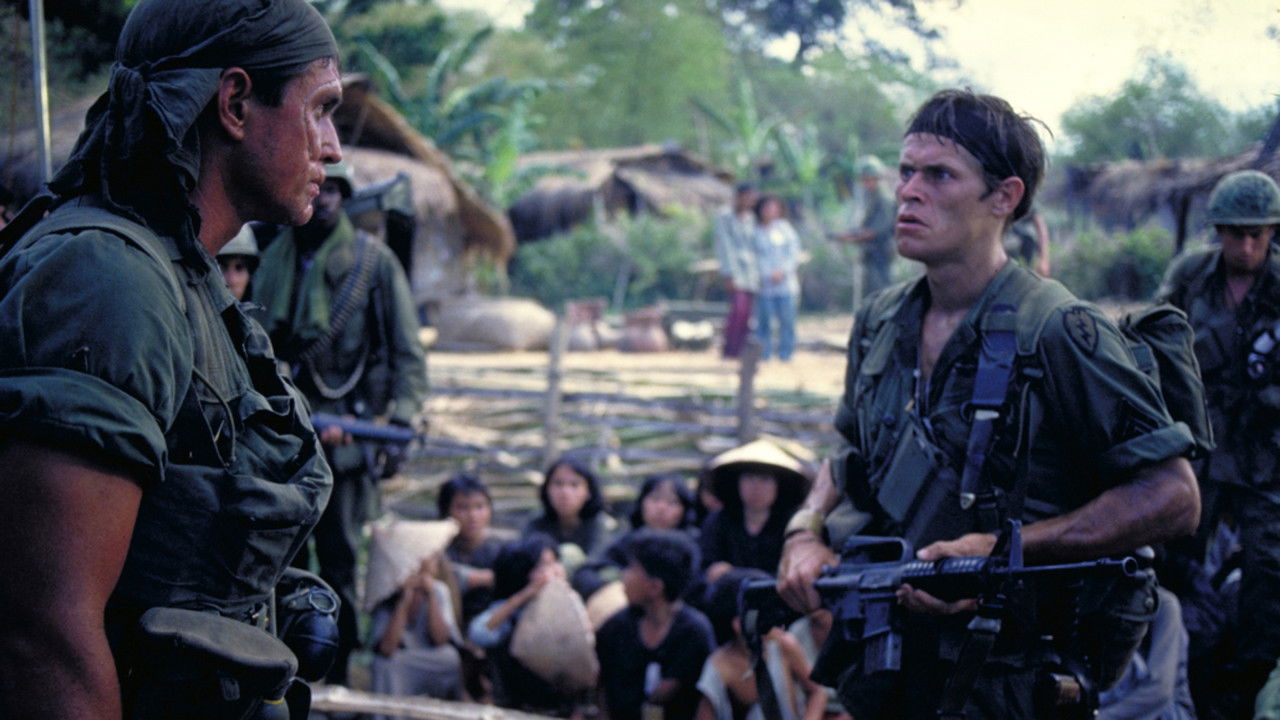
Stone identifies events, people, and conflicts from his Vietnam service that he adapted for Platoon. He describes the ten-year financing effort, the Philippines shoot, Dale Dye's training, location difficulties, helicopter work, and the 60-day schedule. He also explains Bob Richardson's use of flares for the night battle and distinguishes personal memory from changes needed to condense the story.
- Duration
- 1h 57m
- Talk coverage
- 91%
- Words
- 16,091
- Speaker
- 1
Commentary density
Highlights
Topics
People mentioned
The film
- Director
- Oliver Stone
- Cinematographer
- Robert Richardson
- Writer
- Oliver Stone
- Editor
- Claire Simpson
- Runtime
- 120 min
- Also on
- OneSheet ↗
- External
- IMDb ↗ TMDB ↗ Find on Amazon ↗
Transcript
16,091 words
Arnold Copelson, John Daly, England, put up the money. That was quite something. Couldn't get the money for ten years, and a British company finally put it up and took a chance. Grandiose opening, opening invocation, sort of something from the Iliad or the Odyssey, but it's the Bible, I felt, would be, Rejoice, O young man, rejoice in thy life and the days of thy youth. We put a lot of dust in there. It was hard to get this airport in the Philippines, in Manila, outside Manila. And we also get the planes. We didn't have a lot of money to make the movie, less than about $6 million, so it was all struggling. We got this gigantic plane through barter. And coming out of the belly of the whale, it was the first memory of a lot of my memory over there in Vietnam. When I arrived in September 1967, September 15th to be precise, it was my...
21st birthday. Came out of these big planes on the way inland, actually from Cam Ranh Bay back into places like Coochie. This would probably be like arriving at Coochie, or it could be from Coochie up to Dao Tieng, which was the 3rd Brigade base camp where I was based in the rubber plantation, Michelin rubber plantation. Near the Cambodian border, not far from it. I remember seeing bodies coming out as we arrived at various places. There'd always be bodies moving back. And obviously, you can see that the guys that came into Vietnam were replacements. They just went filtered out for these dead people. They would be sent to the units where these dead people had come from. So we were all broken up when we arrived. Very few of us stayed together from basic training, advanced training, or anything. We just were separated. Here's the returning veterans. I looked for a man with a death's head. Crossing Dollies, I remember we did that at the airport. That was an interesting shot. And Adagio by Samuel Barber sort of came about because we wanted a noble theme, a solemn theme, an austere one. And in the temp dub, while we were editing the film, we cut it to Barber. We asked our composer, Georges Delarue,
French composer who worked with Francois Truffaut to follow this style of this. And he worked very hard, Georges, and worked very difficult hours to match the majesty of Barber, but it's impossible. We ended up using much of Georges' music in the movie, and we'll see that later, but this opening theme could not be matched, so we went with the adagio from the temp job and we left it into the final I wanted to introduce the men in the platoon in this sequence, quiet silence of the jungle moving through bush. Men fell, men slipped, men cut themselves. It's hard to move through bush and I wanted to establish this is a young point man, Charlie Sheen. He never been around, doesn't know much and he's cutting point practically the first day. It's a very, it happened to me. And it represents sort of the demoralized state of this unit too. They would put a guy who really didn't have much experience up on point. These are flank guys, they're out there on the flank. These guys are M79s, you see M60s, you see M16s. What's our tail end, Charlie?
That's the faces of the young guys that is important, too, because that's why I made all these troops go through two weeks of jungle training with Captain Dale Dye, our technical advisor. I wanted them to not sleep for two weeks, essentially, and to really feel what it was like to live in the earth next to me, in the jungle, to get the smell of the jungle, no showers, no sleep. By the time they started to work here, this is one of the first scenes we shot. They were really pissed off at these troops. Pissed off at me, pissed off at the world. They were hungry. So it was a great experience. You can't take an actor and just make him into an infantryman like that. You need to have a context.
beginning to just fall apart here you can see the state that he's getting into where you just get so exhausted you don't even see what's in front of you and the six inches in front of your face are gone he he smells death here you smell it before you see it it's a dead dead vietnamese soldier could be nba could be vietcong That's Sergeant Barnes, who is his platoon sergeant. He walks right behind him. And gave him a hard time, gave me a hard time too. Set up the tension of the jungle, silence, the smell, the feel. All these young actors were really a pleasure to pick. Johnny Depp, Forest Whitaker, they all moved on to do something with their lives. This was like almost their first or second film roles. It was just great to be with a bunch like this. It was sort of my fantasy of a John Sturgis picture, like Magnificent Seven or something, but with youngsters. And I kind of sensed that these guys would be around for some years, and it would be a pleasure to sort of have known them in their youth.
Tom Berringer had been on a downslide, I think, on TV stuff, and it was a pleasure to work with him. I always thought he was a rugged guy, and I was able to work with him and get his tougher side out there. Get your ass up the hill, you fat fuck. They feel lost in this jungle, wandering like ghosts in the landscape. There's no much sense of purpose or destination. Like in the World War II or Korean pictures, you know, you're going someplace. You have a mission here. The mission is basically just to keep walking. Red ants, black ants. Black ants were actually worse bite than red ants, but they plagued us all the time. And Willem Dafoe is... Sergeant Elias is interesting. Also a cast against time, because Barringer had been sort of the good guy. basically made it a little more darker. And Willem here had been playing thugs and terrorists, and I thought I could do something with him, his sweetness, his essential sort of Nordic sweetness. Got a nice voice, Willem, very soft and soothing. We shot a lot of corals. I remember we tested in the jungle in the Philippines.
And this is a rainforest about two hours out of Manila. We're based in Manila, I think, at this point. We went back and forth every day. Charlie has a heat spell and faints. This is a very difficult location to get to. Tough shot. A lot of close helicopter work. We almost got wiped out a couple of times. This is what we secure perimeters every night. In Vietnam, dug our holes. It's hard work, get the water out, get the resupplies. Another tough shot. You can see the actors are really struggling against the prop wash. On the feet, they're always getting swollen. People are screwing around with their feet, too, to try to get out of the field, too, because it's a miserable existence sometimes. You see some nice coral work here. We're giving it a nice flavor for reddish hue. We built these perimeters. Yeah, I had a problem with one of the producers and I were arguing because I really wanted to get up on this hill over here. This is a fairly large hike. There was no vehicles able to get into this spot. So we walked about a mile up the hill
up the valley into this hill range, and I said, I want everybody to sleep out here, and let's do like the old John Ford pictures where you just camp out. So they all said yes, and they went up the hill. We did the shooting, and they ran back down the hill that night to get back to the hotels. But we got up there, and it's a hard look. You can see how far it is from anything. You can sense it. That's Forrest Whitaker. That's Reggie Johnson. Another fine young actor. Hey, white boy, what you waiting for? That hole ain't gonna dig itself. Come on, boy, get your dick skin on that thing. Dig. We can get all day. Dig, dig. Somebody once wrote, hell is the impossibility of reason. That's what this place feels like, hell. I hate it already. These were my feelings pretty much at the time. I was really caught out of sorts. I mean, I...
good athlete but I just as a soldier this is a rugged life and cutting point all day not knowing anybody being picked on because they didn't care about the new guys as much you know they were we were expendable by because if you've been there for a while you always bonded with the people that have been there with you so I was uh I as all people a lot of new people was was lost confused and writing letters to my grandmother of all people because I was having a I struggled with my parents at that time, and I wasn't getting along with them, so I was writing to my grandmother. And these guys were all in my... I was in four different combat platoons, basically. And 1st Cavalry and 1st Air Cavalry. This is a combination of men that I met in these units. So it's not necessarily that they were all in the same unit at the same time. Sergeant Barnes and Sergeant Elias were not in the same unit at the same time, for example.
I don't think I can keep this up for a year, Grandma. I think I made a big mistake coming here. Charlie has an interesting stoicism in his face. At the same time, he evokes a boy who comes from a middle class strata of America, or upper middle class strata. So it was an interesting admixture for me. I like Charlie's integrity. I almost cast his brother Emilio in it a few years before when I was trying to make the film. And it's ironic that Charlie, who I had met when he was 15 years old, came back in when he was about 19, 18. And the moment he walked in the room, I knew he was the right one. Scar on Sergeant Barnes is work of Gordon Smith. It's a very interesting new technique. It was used at that time in 1986 when we shot the movie. It involved applying a glue-like prosthetic to his face and giving it that shape within an hour. And I think we got it down by the end. We got it down to about half an hour of work. So it's an amazing amount of...
I mean, the conventional way would have taken hours to put that makeup on. It did have a tightening effect and a deleterious effect on Barringer's skin, so we used it sparingly so that he would not... In other words, we would ask him to put the scar on when we did all as much work as we could on the right side of his face so that he wouldn't have to walk around with it all day long. I think in front of the men, it's necessary for me to give the orders.
Beautiful Philippine foliage, colors, long lensing here in this valley. This is a shot done at the lip of night. One of my favorite shots. You see a storm coming up. Goddamn, man. What's O'Neal got, a nose up the lieutenant's ass already? How come we always get fucking ambushed? Because it's politics, man. Politics. Hey, Chris. Did I show you a picture of Lucy Jean? No, you didn't. She's the one for me, all right. That Lucy Jean. She's waiting for me, too. Yeah, she's real pretty. You're a lucky guy, Garner. Hey, you got a picture of your girl? No. I guess that leaves some unlucky girl back at home, don't it? I went with boys. This boy never acted before. I went with boys from southern towns, small towns, people with accents. I wanted to get as much of America as I could into the picture. Elias is good to Charlie, establishes a relationship with him out of just need because he knows that these guys aren't going to make it by themselves, so he's trying to be helpful in some minimal way. Bear in mind that these men, you know, are not bad. They're just tired. When you're very tired and you're irritable and you're...
Struggling for your own, it's hard to take care of somebody else who comes into the unit who doesn't know what he's doing. So it's not like there is a badness or a bad lynch gang mentality here at all, but they're just being ignored. Lock it low! I come from Alabama with my banjo on my knee And I'm going to Louisiana My true love Night ambush is something we all never liked. No matter how good you were, you'd come out there every night. You'd go out there from the perimeter. On the nights that you went out, and it was spooky. Because anything could happen out there at night. That's an optical we laid in. I wanted to get a sense of the rain that was coming on. Because I remember ambushes where we'd sit in the rain all damn night and be soaked to the bone. This is one of those nights. It happened to me right away, early on in my stay, where I was on an ambush where I fell asleep, as you'll see. They wanted me to be just like them. Respectable, hardworking, a little house, a family. They drove me crazy with their goddamn world, Grandma. You know, Mom.
I guess having always been sheltered and special, I just want to be anonymous, like everybody else. Do my share for my country. Live up to what Grandpa did in the first war and Dad did in the second. Well, here I am, anonymous, all right. With guys nobody really cares about. They come from the end of the line, most of them. Small towns you never heard of. That's Anthony Quinn's son. Alaska, Tennessee. Brandon, Mississippi. Pork Bend, Utah. Wampum, Pennsylvania. Two years high school's about it. Maybe if they're lucky, a job waiting for them back in a factory. But most of them got nothing. They're poor. They're the unwanted. Yet they're fighting for our society and our freedom. It's weird, isn't it? They're the bottom of the barrel. They know it. Maybe that's why they call themselves grunts. Because a grunt can take it. Can take anything. They're the best I've ever seen, Grandma. The heart and soul.
Hey, Taylor. Hey, cheese dick, you're up. What? You're up. Keith David is the... Yeah, I'm sure. ... is a king. He was also a fairly new actor. It's just a great Shakespearean baritone voice. He resembled so many guys that I knew that were strong and helpful to me in the field, helped keep me alive. This guy was based on a guy I knew from Texas, was a real badass. and not very nice. Looking through one of these stupid scopes, any Vietnam veteran will tell you early on from the 67 times and how it was difficult to see through these things at night. They always would get wet or smoggy or something. It never worked. So here we see a transition. He's tired and the rain is stopping. This is a dangerous time because the mosquitoes come out on full force. And they are serious mosquitoes over there. And you get bitten to death.
I hated those mosquitoes. But it's one of my favorite voice letters that he sends in the movie to his grandma describing his feelings of wanting to be anonymous and wanting to escape from what he thinks is the fake Western life that he had been grown up in and wants to sort of find out where reality is in his life. So he goes to the bottom of the barrel. Here he wakes up Mr. Junior. He was played by Reggie Johnson. Badass kid.
She's obviously fallen asleep. Chris Taylor, Charlie Sheen here jumps up and he's just shocked awake. He knows something's up. Mosquitoes are eating him. You can see the bumps on his skin, big bumps. Everybody's asleep. You don't know where he is. Mosquitoes are killing him. I don't know what time it is. Can't even see his watch. Nice use of sound here to create There's a tension and a foreboding. Mosquitoes are really so bad that you really want to cover up completely and hide from them with a towel or anything. And at the same time, you've got to keep your eye out. Get hot under that towel, miserable. Moments there that you thought, like, you know, you'd rather shoot yourself than go on. And, you know, It takes hours and hours of ambush time. You're just sitting there, sitting there. Movie, of course, goes much faster, so you have this problem of reality versus movie time. Things speed up in movies. But you try to condense and give a compressed reflection of the truth. God. Terrifying image to him. He sees, suddenly for the first time in his arrival in Vietnam, he sees the enemy.
He looks at his claymore and he can't reach it because he thinks that if he reaches for it, it's going to make noise and they will hear it and kill him. He's terrified. He's looking at his grenades because he had told him to throw the grenades too. Don't fire. Blow your claymore, throw your grenades and shoot your rifle in that order. That's the standard policy. He can't do any of it. He can't call for his other men. He put a wide angle lens on the camera. It looks like they're further away from him. The enemy is getting closer. You're gonna see him any moment. He's terrified. He's frozen to the spot. He can't do anything. Nothing. He's dead. What the hell happened? Somebody blew something. He doesn't know what it is. It's all confusion now. He can't blow the claymore. The safety's on. He fucked up.
The other guy reaches over, blows the claymore for him. The claymore goes. He got one of them. They're up there. He's firing. It's confusion. Everybody's firing. No one knows who's firing at what. And here's Tex. He's going for his M60. He's firing. He's got one of them somewhere. He thinks. Boom. Here he is, Sergeant McKinley. He throws the grenade. Stupid idiot. Blows Charlie Sheen away and Tex away. Blows his arm off him. Often happened. Many of our casualties were from friendly fire, not enemy fire. Who knows how many? 20%, 30%? I've heard higher estimates. But this is a common condition of war that is overlooked in war moves. This is Tex. He's in pain. Tourniquet comes on. That's Doc. That Charlie thinks he's dead. He just felt the blood coming off the back of his neck. And as I did, I was shot that night myself. I felt like I was dying. I got shot in the neck.
But it wasn't really a severe wound, it was just a scratch. So you never know. Big Harold, you keep an eye on him. You don't let him go into shock. Shut up! Shut up and take the pain. Take the pain! It's one of my favorite lines, which I remember it every day. Take the pain. Guys go into shock, they die from shock too. Sometimes they die from internal bleeding. They're smiling. You put them on the helicopter and they're gone. Now they're looking for body, I forgot the word, blood trails. They found one. He finds one. He shoots him. That's Barnes. Not supposed to shoot him. He could have gotten information out of him, brought him in. But Barnes has a vendetta with the Viet Cong. Is she going to die?
You feel like everything's just gonna be fine. Don't give me that boy. He thinks he's dying. He's on morphine. I'm about to get out of here. They're gonna give you three hot meals a day. White sheets. And pretty white nurses. Everybody dreamed about getting out of the field, getting into a hospital. White nurses were in the back. You let him walk right up on us, you know you do shit! Just shut up, Junior. Junior blamed me, the real Junior blamed me, for falling asleep in this position. Uh... That is a point still in debate in the historical texts right up to today, but I think Junior fell asleep. How long? Charlie thinks he's dying, but he's not really. And the other guy, the guy who's really dying is his buddy Gardner, right here. My Gardner is based on a guy who was given me, not quite like this, but the guy that I knew, Gardner, was from the South, and he was smiling as we put him on the chopper.
And he died several hours later of internal bleeding. Nobody could believe it. Here he dies pretty quickly. That's sort of the way we did it. Sometimes they get carried away. You try to keep somebody alive with noise and beatings and stuff. And they're gone. That's too bad. He was a good kid. Everybody feels bad about it in the field. And especially if they think it's that guy's fault. So he's going to take the onus of the blame, which I did. And it's a hard thing to live with, too. But it's a lot of anger and irritation. This particular ambush. Remember what it looks like. You fuck up in a firefight and I goddamn guarantee you a trip out of the bush. In a body bag. Out here, assholes, you keep your shit wired tight at all times. And that goes for you, shit for brains. You don't sleep on no fucking ambush. On the other hand, Barnes... I can catch a cop and Z's in the bush.
I'm personally going to take an interest in seeing them suffer. Seems like Barnes knows and senses that Junior was screwed up too, and that's why he's giving him that second look, but he's putting the overt blame on Chris. At this actual ambush, I was frustrated because we actually blew Claymore's shot up three NVA soldiers. and we only found one body on one long blood trail for several hundred yards, and the third person just vanished. So we began to think they were an amazingly supernatural type of soldiers. In fact, you know, you could say that they were something weird about them. They had a tremendous resistance to death and were very tenacious. We took several wounded that night. We were supposed to be ambushing them.
So I went back to the hospital in the rear. I spent a couple of days and then went right back out to the bush. So this is the interlude back at base camp where I get to know people a little bit better because a wound kind of lulls you in. A wound takes you into another level of the infantry. You're more of a veteran. Ambush scene that night must have taken three, four nights to shoot. It was a tough one. because the nights don't last that long we had rain mosquitoes real mosquitoes and bob richardson my dp and i was our first big film together and bob was struggling with you know lighting nights in the jungle it's not easy with very limited equipment we went with the idea of at least in the day times of a hard to see look in the jungle nothing is
Overt, nothing is easy to see. It's always hard to pick up. We went with that look in the daytime. Nighttime, I think Bob was struggling more with it. I think we have, you know, I think sometimes it was too clear. And, you know, you find that hard, you have that difficulty at night. Sometimes you see too little or do you see too much, you know, and it's a hard margin to work. This is based on the outhouse details I worked on. We always, guys like me and these guys always ended up on outhouse detail because we were always in the shithouse in some way or another. And we take the barrels out from the toilets and burn them with kerosene and philosophize as we did so. These guys are mostly talking about getting out of Vietnam, which is an interesting issue because everybody had different dates. I mean, if you were there for, you had 360 days to go or...
Oh yeah, always dreams of home. I mean, home never looked better than it did now. Little motels in Georgia or houses in Mississippi, New York apartments, I don't know, anything seemed like a dream. We all built up fantasy castles in our head of what life would be like in the States when we got back. Guys were back too. beautiful women and found out they were in divorces. Tremendous suicide problems. It was like a second war at home when we returned. I tried to deal with that more and born on the 4th of July. I volunteered. I dropped out of college and told them I wanted the infantry, combat, Vietnam. You volunteered for this shit, man? You believe that? He was a crazy fucker. Giving up college? Didn't make much sense. I wasn't learning anything. I figured why should just the poor kids go off to war and the rich kids always get away with it? Oh, I see. What we got here is a crusader. Sounds like it. Shit. You gotta be rich in the first place to think like that. Everybody know... the poor always being fucked over by the rich. Always have, always will. Well, I guess by now you know that...
Most of the people who went to Vietnam in the infantry were mostly from the lower economic classes and mostly draftees. Very few middle class kids went or upper class because they were basically shielded by a crazy set of laws that provided if you went to college or had a psychiatric deferment, you could get out of the war. So as a result, it never really became a democratic war in that sense. It was more of a class war. And the pressure to end it did not come from the parents of those middle-class people who could have gone, because if they had gone and started to die in any great number, I believe that their parents would have ended that war much faster. So in the First Cavalry, much later in my tour, actually, I got a chance to... Through King and some black friends, I got into the hoochers down below. So they had these crazy bunkers up in the 1st Cavalry where guys would really design them. And lights and neon, sort of underground nightclubs. And we'd smoke great dope, great Vietnamese dope. Pipes and all kinds of ways, very inventive. And this was a relaxed and great stimulant and an alternative lifestyle to a very dull and...
and angry uh day style you know a lot of people were drinking and uh partying but here we had a chance to bond with other people and to talk about dreams and keep sane in a way keep sane keep human it was important to keep human there because uh the place would deaden you after a while and uh i'm very grateful to uh yeah to these soldiers. They introduced me to music. That's where I started to hear a lot of black jazz, a lot of Motown and The Doors, Jefferson Airplane. I discovered Jim Morrison there in an underground bunker. It was the late 60s and acid was popular in the States and marijuana. And people were starting to think in different terms. These soldiers, I would say, were not politicized in any sense. They knew the war sucked. They had that feeling already. And, you know, Muhammad Ali characterized it. I ain't got no dispute with the gooks, he said something like that, with the Viet Cong. I ain't got no dispute with the Viet Cong. And he went to jail for it. And these guys all knew the score. They knew that the war was a lot of bogus political maneuvering.
But I went along with it and just tried to survive it with dope, good dope, and good friends, and talk of home. Guys here in the hooch didn't party so hard down with us. They didn't like us down there. There was sort of a civil war in the hotel. But a lot of these guys were into boozing and country music, both of which I kind of liked too, but I found that this group was a little tougher. and did not approve of marijuana. And thought anybody who did smoke it was really had his mind to the winds and would be untrustworthy. So there was some alienation there in each platoon that I was in. I was in four different units and I saw it everywhere. Everything kind of gets weird, you know what I mean? You hear that story about the gooks putting chemicals in the grass so we don't fight, so we become pacifists? Yeah, well, don't you worry, Bunny.
You was a killer anyway, man. Yeah, but I still like a piece of pussy once in a while. Ain't nothing like a piece of pussy except maybe the Indy 500. Only way you get some pussy, man, is the bitch dies and wheels it to you. And then, maybe. How's it going, buddy? I think we had a lieutenant like this. Nice guy. But out of his depth, though. He was an all-star boy, a nice guy. He was killed. Tried to be friends. You can't be friends sometimes with other people. A lot of Confederate flags around. A lot of good old boys. Good soldiers, too. Good poker players, too. Those guys like Rodriguez. Very quiet Spanish guy. Says right home a lot. keep to himself and stay close with Jesus. Poker was very popular, a lot of money, a lot of drinking. Sergeant O'Neill, now there was a type like that that really gave me a hard time. He was always assigning me to shit duty and he was always like
coast and he never went out to the field. He'd go out to the field as little as possible. He'd always, like, stay in. Barnes and Lieutenant are having a bit of a, you know, territory struggle for the platoon here. Lieutenants are normally in charge, but often the platoon sergeant runs the, ran the platoon. because he was more experienced. In this case, Barnes was based on a guy I knew, I won't say who, from Montana, who was in one of my units, and I carried his radio. He had actually been shot. Uh-huh, uh-huh. I have to tell you, that's precisely what I saw. I mean, sometimes I just look at a guy, and I know this fellow's not going to make it. There's no fucking way.
It's almost as if Barnes knows O'Neal might not make it. But Barnes had been shot in the head, right? Amazing, miraculous recovery. And went to Japan for seven months, reconstructed his face, married a Japanese girl and came back to the NAM. Been wounded six, seven times, something like that. And he volunteered again. He wanted to get out there, kill him. Tracks of My Tears, one of my favorite songs I found over there. And Smokey just died, too. It was sad. But... This was a great song. Just moved my heart. And I remember dancing. Guys would be dancing. We danced with each other. It was a way to release this tension. And it was a good thing. It was a good thing to party like this. Kept us sane. And some of the guys would get out in the field. You know, we'd go nuts sometimes. We want to kill the Vietnamese villagers or people that got in our way. And I think doing things like this kept us more balanced and kept us...
more human, and we wouldn't go out and kill people so quickly, you know, without respecting life a little more. I think respect for life is ingrained in that music. There's been a lot of movement near the Cambodian border. Regiments of NVA moving across. And the sense of humor, too. Firefights, ambushes. We drop a lot of bombs, then we walk through the jungle like ghosts in a landscape.
We went through jungle like this a lot. This is based on a lot of the search and destroy missions that we did. And then you'd walk up in the jungle. I was getting better on point. You can see it there. But you'd walk right up on something like this and you wouldn't see it. And it'd be right there in front of you. Right in front of you. A bunker. Where? You wouldn't see it. It could be six feet in front of you. It could be an NVA soldier looking at you. You wouldn't know it. It's hard to see in jungle. So you have to trust your senses. It's all visceral. It's not a place for cerebral thinking. It's not a place for cerebrics. It's a place for radar. You need radar, you need instinct. I think that there are natural born warriors, to be honest. I think some people just do the best they can. Some people are dead the moment they put on a uniform. It doesn't make any difference.
This is an NVA base camp, but you see how clever it is. Production design was wonderful by Bruno Ribeiro, but they just folded in the landscape. There's an entire little village here that you can barely see. Everything's tucked away. And the soldiers move warily because we knew there would be traps around here. And they were just here. You can see the smoke, and they just split. We missed them by maybe a minute. but they might still be around. Bravo 6, Bravo 6, Bravo 2. Be advised there is a bunker complex up front. See you next week. Defoe, character of Elias, is also a tunnel rat. I'd throw in a little bit of tunnel lore here. Often the other units would come out and do the tunnel work, but I took the liberty of getting right into it and showing. Elias was not really a tunnel rat, but usually the tunnel rats were really small guys who would squeeze down and through there. We built a tunnel complex close to the jungle, which we shot in. We had to. We lost a Filipino crew member, unfortunately, early on, trying to build a tunnel, and it caved on us, and he was killed.
I was not in the Philippines at that time, but Bruno went to the, there was offerings that had to be made to the village and to the spirits for his soul. And the film was tough to shoot. There were snake bites a couple of times and there was a lot of, what do you call, fatigue and flu and colds and giving in to the roughness of the temperature. On day 42, I remember standing out there. I was one of the few that left from the first crew that was out there still. We had a very bad day. A lot of people didn't show up that night. So I think we were calling in like 70% sick on some days. Basically, people were fatigued. It wasn't game playing. It was just fatigue. This is a guy named John Glover from Boston. This is Richard Edson who went on to do some Jim Jarmusch pictures. And he was also in the band The Lounge Lizards.
Cross-cutting here, I think, was effective to show the search, build. Something's going to happen, but what? You don't know. And where? Which incident? Elias has stumbled onto an underground tunnel here. He's putting a flash on his face so you'll see him as he makes the corner here. Otherwise, he would have been lost in the dark. He comes across one of the wounded or dying, a dead NVA. Charlie's on flank. He's guarding. And this happened to me, too. I was on the flank in a rubber forest, and this huge, not huge, but medium-sized crate snake, viper, went right through my legs and stared at me. Made me, took the wind out of me. The other flank, that's Manny out there. He's on the other flank. Aloysius has spotted something, feels something, so he's working his way up the tunnel. This is a tough scene to shoot. Watch the timing.
Maps, we had a lot of maps. We dug up so much information about them in these bunkers. And then we'd send it back to, you know, Intel, and they'd never do anything with it. It didn't seem to add up. We never got feedback, which is another demoralizing thing in infantry. You want to know, you know, you make your objective, you keep it. They'd ship us out after we took their place and then send us back ten days later. To take the same place, we'd lose more lives. So he triggered a booby trap there. You saw that one. That's George Delarue music. We kind of went with a Japanese style there. That's a little dramatic license, but he did manage to stumble out. It's a pretty horrifying sight. He comes back from flank. Something's happened. God damn it. See a lot of dirty smoke. The uniforms are really stonewashed. I mean, they're dirty. Towels, the sweat. I mean, I think these are attention to details. It's very good, important. Some guys are straps and sometimes they're bare-chested. I mean, there's a variety of individual styles in the soldier.
And each one sort of, the more you look at it, I think a veteran could spot some of this stuff, but each uniform is a statement, really, of the way the person's attitude is. And even the graffiti, the choice of the graffiti on the helmets is important, so we had to individualize as much as possible. Barnes is loved by his men because he cares for them. He has a military affection for the hierarchy. And it's clear that he's emotionally involved with the men who die. If anything, I would say that his moods veer more towards death than life. So this NVA bunker sequence took maybe three days to shoot. And I really like and study the camera movements, the choreography of camera as we reveal people, and I thought it was very nicely done. Keep a sinuous, almost serpent-like quality to the moves and reveals, and racking the focus and walking people in and out of frames, circling around. As you saw, Manny vanished.
Missing in action. There were a lot of, not a lot, but there was a few MIAs, you know, and that happens in war. We don't know what happened. Manny was taken off the flank, and here we reveal one of the more basic fears we all have of being captured and cut up and castrated alone. Indian country feeling.
This works on the emotions of the men, obviously, and you're going to see the cause and effect, as the Buddhists say. You will see the results of this, the effect of this in the next scene, when they will take out their wrath on the villagers. Motherfuckers. Spare movie. Love that sky, pink, dangerous, coming at you. I love framing these landscapes, putting men into landscapes. I love that always in movies. It's fun to have guys all the way back out there. Two, three, four hundred yards from camera. Charlie's literary and quality, that's the way I was. I mean, he wrote about people like Captain Ahab. I love this shot. This is a toughie. Great hit on the back. Timing is good. You saw, you got a real realistic feel of how a shot goes. Missed the first one, probably got him on the second or the third. And it took, you saw the delay in him hitting them. Timing-wise, it's complicated to pull that off. You gotta pop the squib at the right time, but it was a good, terrific Filipino crew, assistant directors, and stunt guys, and special effects helpers that were really terrific, with Yves Bono on special effects. Yves Bono was an Englishman.
He did everything almost first with his hands himself. But nobody got hurt in the special effects crew. Now here's our village. This one was a tough one because we had to build it. We stocked it with as many Vietnamese as we could get with a limited budget. And we found some of these people. by total accident were tourists in the Philippines from Vietnam, coming from South Carolina, and had some money. They were a bit rich tourists and they were traveling through the Philippines. We spotted them and grabbed them. We grabbed this woman, put her in the movie. First time she'd ever been in a movie. She's actually an upper class Vietnamese from the, probably from Saigon, playing a peasant woman. But her English was, she understood what I was saying. We pulled people out of bunkers all the time. We blew the bunkers. If they didn't get out, the others didn't get out. This is a tough shot, actually. Vietnamese expressed their grief the way I remembered it in the villages, very phonetically, very strongly. They would seem almost like actors, the way they would scream and yell. And it irritated us more because we thought that they were fake, faking it by the accentuation on screaming and crying.
And as a result, we misunderstood. What about me, man? What about me? I'm sick of this fucking shit! Come on, motherfucker, move! Watch this fucker! Fuckers don't want to see, man. Who the fuck do you think they're fighting for, huh? I like Kevin Dillon very much. He was the younger brother of Matt Dillon. Very strong Irish-American features. Very, uh... Had a... a coldness in him, a cruelty that was true to the... In a sense, there was nothing more dangerous in Vietnam than a 19-year-old American with a shotgun. He exemplified that, did a wonderful job, performance. Sergeant Warren, you bring that honcho over here. Here you see the essence of the problem. In any village, we did find many links to the North Vietnamese Army. The villagers were sympathetic to them, and we didn't like them for that. Some people would argue that they didn't have a choice. They had to store the weapons and help the North Vietnamese. But the fact is that they were sympathetic to them because the North Vietnamese were fighting for their independence, whereas we were perceived by them as invaders. I went nuts one day against one of these poor guys, an older man.
shot at his feet because he would not listen to what I said I almost killed him in the bunker and he wouldn't come out of the bunker and I went crazy because I just had enough that particular day so we're all in touch with our anger at some point there that's for sure and I didn't kill him but I came mighty close I'm glad I never did whereas my friend Bunny I didn't see this this is a dramatization but I know that he clubbed somebody to death. You're real sorry, ain't you? You're crying your little hearts out about Sandy and Sal and Manny. You forgot about it, Bunny, huh? Let's go. What do you say? This is a retard. And Bunny, I mean, we killed villagers at random everywhere. I mean, it wasn't like something we did as a policy by any means, but it was like done in a way that you'd be walking in a village and you were called to somebody and he didn't come. When you told him to, you'd shoot him. You had the right to. It depended on the mood. I mean, sometimes we were very friendly to him and we would give them...
food and make jokes with him. But that's Johnny Depp in the middle. It was one of his first roles. I thought he was a splendid looking young guy. He obviously, I felt like he would become a star one day and it was fun to work with him. It was very obliging. He learned some Vietnamese for this translator role. And this scene, in a sense, brings the whole focus of the platoon together. I mean, everyone runs up to see what's going on, and we sense that there's some kind of moral showdown about to happen here. Who the hell is the gook we nailed on the riverbank? He doesn't know. He says that the NVA ain't been around in a couple of months. Maybe he was a scout or something. Yeah, sure, a scout. What about the fucking rice and the weapons? Who they for? Are they OVCs?
That cocksucker knows what I'm saying. He understands. Don't you, Pop? Goddamn right he does. You bick. You bick. He's lying through his teeth. Come on. That little guy's a rodeo rider from Texas. That's Ivan Kane from the Bronx with a little bit of a heavy beard. I'm going to go out of here. I swear he doesn't know anything. He hates the NBA, but they come when they want and they just take the place. What's the bitch saying? This is the essence of the problem is that the villagers all supported the NBA and we were going nuts because we never could get the hearts and minds of the villagers. We did. We had basically, we'd moved a lot of them off the land into hamlets, strategic hamlets, and those that were left in the land were so brutalized by the bombings and the defoliants that by the time we got there, they were terrified of us anyway. I like the delay on that shot, you know, it takes that second to be stunned.
He just couldn't stand her voice anymore. She was driving him nuts, and he decided to get to the point, which is basically to terrify these people. But what he does is he really pisses the village chief off. You're going to see the guy is very, very resilient. He intends to kill more. Barnes has lost it partly because of the man he killing. And this is turning into a small version of My Lai, My Lai Massacre, the famous massacre of 1968. The point being that these type of things could happen very easily in that heat and intensity, 100 degrees of sun or 95 degrees, and people get nuts. He gets nuts, your pride, your territory gets at stake. You wanna show how tough you are and how serious you are, and the next thing you know, you're killing people. It's easy to cross that line. In the ears of Charlie, he doesn't want to do it. He wants to stop it, but he doesn't have the guts to go up against the sergeant. Very few people would. He's warned him. But he won't give in either. So it seemed like a good spot to have Elias get us out of this hole before we got into another melee.
That is lies. This ain't your show. You ain't a fighter in squad, you piece of shit! Come on, boys! Come on, boys! No, no, no! I fight in the dust. I always wanted to do something like that. John Wayne, Montgomery Clift, Red River, guys rolling in the dust. I love this shot, these graphics. The two sides of the platoon are leaning in from both directions. You sense sort of like a... Almost a Homeric battle here between two giants, titans. The men separated them. Look at there, you see? Comes back at him. I love this break it up. Look at the dust. Look at his face there. He looks like a silent film star with those eyes. Lights flaring off Elias. He's gone nuts too. And now the lieutenant emerges as a force here. At least he has a... At least he shows some determination. Torch this place! Blow the weapons in place! Round up all suspected... Well, the village is a legitimate NVA supply point, it seems. Why the fuck didn't you do something? What are you talking about? You know what the fuck I'm talking about. No, I don't. I don't know what the fuck you're talking about, Elias.
It's a good shot here. Barnes is obviously... You know, this is a very strong... It's an interesting legal point, you know. If there had been a court-martial, what would have happened? There was so many of these incidents that they were all buried. Most of them were buried. Occasional unlucky fellow would get busted for killing a Vietnamese and would go to jail, but he would be probably in the unlucky 5% or 2%. On the other hand, it was a village with known enemy sympathizers, and the orders were to torture it. So you would get into this gray area, this dilemma of where the villagers are. Are the villagers NVA, North Vietnamese sympathizers and allies, or are they not? Here they're putting a white phosphorus grenade in the rice storage bin. That's one of the effective ways to destroy the rice. There's acid and fire. Here they're grenading the well, blowing out the water. Here we are, herding the villagers. This scene had a lot of impact on people. People told me about it. Especially... The barber comes in. Here, I was in a situation. It was another day, but I saved a girl once from being raped and killed, probably. I thought this was a good time for Charlie to show some colors.
That's the way it was. He didn't talk too much about it, but he just didn't get it. But Elias sees Chris behaving like this. I think that's important. Come on, guys. Police up your dicks. Let's get out of here. As I said, this scene had some impact. He's taking pictures with a lot of cameras. Guys were burning their village, killing them, but carrying them out and taking care of them. Strange bilateral relationship we had with the Vietnamese. Two different directions, love, hate. It's like the knuckles on Ra's hand. We got some great light here. You can see the sun on the grass. It must be that magic hour around five o'clock, maybe six. The green is popping, the sun's popping off the green. And in the background, we blew the village. Two cameras, you see that?
So here we are. We're back in the perimeter that night. And Elias and the lieutenant are explaining the situation to the company commander, the captain. All right, Elias. Staff Sergeant Barnes? Sir! I want a full report from you on this when we get back to the CP. You've got to die a week, and I can throw in plenty of eyewitnesses if you want, sir. That's Dale Dye, my military advisor. Get into this when we get back to the base camp. With a dye on his hair. If I find out there was an illegal killing... Dye is several times in Vietnam and very helpful in remembering and outfitting and arming and helping these stage military actions. Sir, we're going back into that NVA bunker complex tomorrow. This time from the east. You people get some rest. Be back up here at the CP at night. In this particular scene, this is an interesting hinge to the film because he is telling Barnes that he is going to be, the charges are going to be looked into. So now Barnes does have something to lose. I mean, his career, his military career, his promotions, everything could be jeopardized by an Article 15 or a court-martial situation. So there's something at stake going on.
But the commanding officer doesn't want to pursue it now. Obviously, we're in the field. We're going back into the NVA bunker complex. Why? We always wondered why we had to go back to places where we'd lost people. And this is an interesting thing that happened a lot. You'd go back and circle around, take more casualties. Here you'll see the Bloods talking together and bitching about what the white man's doing to them. It's the white man's war. It's really getting out of hand, man. It's flowing way out of control. Seems to me. You don't seem to know the difference. And drugs was an issue. And also, towards the later part of my tour in 68, that's when I started to feel there was much more racial dissension. In my earlier part of the tour, I didn't feel that at all. I felt like they were more unified. And I was befriended by many black soldiers, but I felt there was a lot of angry ones too, especially after Martin Luther King and Malcolm X were killed in the United States. We don't need a time for courtroom out here.
Bob Barnes sums up his vigilante feelings about war. How'd it go there, Bob? Yeah. Yeah, that way, Sarge. Fucking Elias, man. He's a fucking rat. That's what he is. The platoon is really dividing now over this issue at the village. Half the platoon is going with Bob Barnes. They're worried. The other half is going with Elias. But Bob is worried because basically, fundamentally, he's a military man. And promotions and rank and all that stuff matters to him. And he knows he's screwed if he gets into a pissing contest in a legal situation. Elias sums up his feelings about the war here. Put those stars in. That's a nice way of putting it. I couldn't at that time find... an Indian actor who conveyed to me the essence of Elias successfully. And I looked. So I ended up casting a Dutch actor out of New York. I was very impressed with Willem's performance in To Live and Die in L. A. And the moment I saw him, I felt that he looked so evil and seductive and interesting that I thought that we could go the other way with that sense of strangeness.
We're gonna lose this war. Come on. You really think so? Us? We've been kicking other people's asses for so long, I figure it's time we got ours kicked. Day by day, I struggle to maintain not only my strength, Chris continues writing. Home. But he stops writing here, he says. This is rain against sun. This is tough. We were scheduled for rain, too much sun, but we lit it anyway. I mean, the sun pops the rain out, so we went with it. It's a strange look, but it did happen in Vietnam. We would occasionally have rain and sun. Hope things are well, Grandma. Tell Mom and Dad I... Well, just tell them. Chris. He sees a spider hole back here. This is interesting, because he senses right away there could be an ambush coming. Somebody... Because anybody can get in that hole behind you or in between you. That's what they want. They want to get you in a crossfire situation.
I forgot about the leeches. We had a lot of leeches. Go right up your socks, into your socks. Some of them might really rained a lot. One time we got stuck out 12 days. There's a leech on his face. Didn't see them everywhere. They'd come right up on our, sometimes they come right up your penis canal or your anal canal or your ears, your nose. They get in overnight. Some guys had to be evacuated. He had an inflated leech in his intestine. And they had to cut it out operatively. This is based on an ambush that happened to me on January 15th, 1968. We got picked off like... We took 35 wounded, I think. Four or five dead. And we didn't even see one of them.
Johnny Depp in the lead. Guy in a bunker. You see there's an explosion right there. They got him. Those are mortars. They're walking mortars. RPGs are gonna come next. RPGs are rockets. They're the most dangerous of all. Charlie comes running up. Good baseball slide there. You see the mud. He slid an extra three feet. I'm trying to be a hero today. I don't know why. Maybe because of what happened in the village. Sometimes you become a hero, you don't know why. You give enough, you know, you just get sick of it. Good sound effects here. Good thuds, good concussions. This is sort of the pre-The Terminator era, so we were still working with a lot of more primitive sound effect system. We've since enhanced a lot of the artillery on board on the Fourth of July and Heaven and Earth. This picture was done in a very quick mix, actually, over at Rider Sound in Hollywood. There's some good shots there, good relationship shots to Bunker. Here he is behind an anthill. I ended up behind an anthill one day. The mud, I love the mud, crawling up alongside a guy that's been shot. Look at the way it's laid out.
You can't even read the goddamn compass. These are practical considerations people don't know. You can barely read it. Your watch gets clogged up, your compass. He's going to call in the wrong artillery. He's going to walk it right in on his own men. You're nervous, too. Elias offers a strategy that makes sense to roll up the flank, but he doesn't know what to do. It's a tough call, too. How do you do when you get pinned down like this? You got people behind you? Do you know that happened at Yedra? Barnes sees the plan. He understands. I don't want to be stuck out there with my ass hanging in the breeze. Barnes lets Elias go do what he wants. I don't know if Barnes has a plan in his head. It would make sense to spread out, get somebody on the flank there, try to turn them.
Meanwhile, Chris is up front there. He's being shot to shit by this guy in a hole. Happened to me. I had an M79, so I couldn't even use it. It doesn't fire at that close range. I was stuck up there without anything, except for grenades. I threw grenades. The guy was popping up, you see. Didn't know that he had a grenade. It was in the hole. That was his first kill, or his first known kill, anyway.
Then he's gone up to his friend Johnny Depp. Meanwhile, King's been able to get up in the M60. You always need to try to get that M60 up front. Trying to lay out some fire, you've got a lot of... Modern firepower is very cutting and intense. The theory is if you can lay out fire, you can cut your casualties and, you know... Oh, shit, this guy is fucked. He just looked up in time to see his own artillery coming down on him. These are some good shots. Oh, man, that guy got, there he goes. He got shrapnel all over his back. And he's hot, you see, because he gets shrapnel in your back, too, and you're really boiling. Barnes is taking out the shrapnel. You see the smoke coming off his shirt. That's cool.
It's horrible to be, that artillery and bombs. He trips the satchel, that's what happened to me. A friend of mine, not a friend, a guy I was with, great shot, a guy I was with tripped a satchel. I got wounded for my second time on January 15th. Shot in the shrapnel in the legs and the ass. So they're trying to regroup in the back here, get their wounded back. This is a sad scene for Chris. He knows his friend is really in bad shape, may not make it, and it inspires Chris in a strange way to get back into the fight and make good. You know, a sense of vengeance sets in, and is often the case of brings out the heroism. Chain reaction, cause and effect. Barnes is really pissed off at the lieutenant for doing this.
the fuck coordinates you've given. You waste a lot of people up there with your fucked up fire mission. You know that? You know that? Puts his helmet on the wrong way. It's mosquito repellent on the helmet there, that helmet band liner. You know, while Elias is out on the flank, he's trying to turn the flank. He's got Charlie Sheen with him and Francesco Quinn, who's Anthony Quinn's son. And Chris Peterson. Stab yourself across this line. Shoot anything that moves. They'll be coming from over there. Elias feels that they're going to try to come in between the two platoons. They're going to have a bigger day. They're going to really wipe out two platoons here. So it's important action that he does. Third platoon's coming up to our rear. So watch for them. Hey, can I go with you? No. They move faster alone. You can get stuck up there for two or three hours sometimes. They just wait and they'll bait you. You tell everybody to pull back to the church. We link up with third platoon. You got that? What about alliance? We can pull back if we cut off. You just haul ass too, lieutenant.
Rain's stopping. A few minutes have gone by. A lot of fog. Probably jungle fog. They're coming all right. And these four guys are going to try to stop them.
You know, this feels pretty good. You've been nailed all day, and then you get them. So these guys are really excited. I got two of them fuckers, man! I got one! Hutchie, man! Fuck! And they gloat. I mean, you go a little crazy. It's going to be a long, frustrating war. You don't see them often. When you see them, you get them. It's amazing. It's like fishing around, except you're dealing with human lives. You realize it later in your life. But right then and there, when you're a kid, it's... This was shot on a rainforest right outside Manila, not too far from Manila. kung fu ninja film shooting next door so occasionally we look over and we see a chinese guy flying through the air in a black pajama off a trampoline we built a uh one of these you know some of these shots we look closely we built a dolly here in the jungle that was about 90 feet long 120 feet long and we just whipped it through there i mean it's hard dolly because this jungle is not even layered so we had to
put a lot of, you know, compensations in on the Dali. And boy, we were flying down these tracks. These guys are really running. They're trying to get in between the American platoons. OAS is the only thing that can prevent them from doing so. And he's running counter direction. You see left to right, right to left. They're coming. He's coming. That's a tough shot in the jungle. And they are running, these guys. And boom, they meet.
He's also stalking, as you can see, Barnes is stalking him left to right, and now he turns and he goes back right to left, indicating that he's picking up on something on Elias in another direction. Elias is circling. You can hear on the soundtrack some interesting George Delarue Japanese-style music, indicating the spookiness and mystery of this jungle.
Look at the parameter they're restocking, putting the wounded and the dying in. This is a mess. It smells. It's awful. People are shot. Dying, screaming. Charlie goes back out.
moving through the bush, on a track, coming in on him. Here he is, this is cool, we laid mist on the floor. He thinks it's an NVA, now he realizes. He thinks it's Barnes, okay, he's okay, he smiles, Barnes lets up, oh, it's Elias, you see, he didn't even decide until now. Good friends, right? Right, Jack. Elias gets it, so does Barnes. You can't hesitate when you're a warrior. I don't think he planned it. I think it's an interesting equation that grew out of this coincidence that Elias got stretched out, and Barnes just took advantage of that situation. Get rid of the trial, too. No, he didn't count on this punk. Last is dead. Fall back with the platoon. Keep going. Tom Behringer seems to have a bit of a guilt complex there. Charlie really doesn't know what to do. Go with him or try to look for Elias. It's hopeless to look for him. Nice reverse dollies in there, kind of going in on Chris and reversing to Barnes. This sequence coming up is really tough to shoot. We were in choppers in and out, on the ground, above the ground. This is a tough one. Bodies moving towards the chopper for evacuation.
No wind, no wash. Good wounds, good makeup. A lot of these guys, they're really struggling. Some of them are getting out, though, and they're happy. Some of these actors are finishing today, you know, too. We shot in sequence. So they're getting home, going home. They're getting out of this mess. Yeah, that happened. and knock off the bodies. That's great makeup on those dead bodies. It's a good shot, come on. Yeah, I told him, lift them. Just lift them. I don't care how you get them. Just drag it and make it awkward. Make it ugly. It's hard carrying guys. Faces are good, though. They got that rigor mortis look.
He's got a defiant new graffiti on his helmet, if you notice. And that's Forrest Whitaker there. He's happy. He's getting out. Big job. He's getting out of the field. Now, this is a tough shot. Look at how close we are to the chopper on that one. You're right on top. I know we're nailing around. We're coming around on a dolly, picking this up. That's pretty dangerous. Plus, we got a lot of explosions near the choppers. The Filipino army really went out of their way to help us, but the U. S. Pentagon, of course, thought the script was unrealistic and told us that they would not cooperate. These are tough shots. There's Dale Dykstra now in the back. Again, this is a tough one, too, because we had a lot of people in this chopper. This is where we almost bought it. You see about six, seven people in this chopper. Look at that down there. That's cool.
in the air coming up. We were too many people with the camera equipment, the sound equipment. There's just too many people in this chopper. We almost went right into the side of the mountain there on the ravine. But there's slow motion shot. Back down, back down. Go back down there. Because they got Elias's there, you see. They just spotted him. He wasn't killed by Barnes's bullet. So I got a little operatic here. Obviously Elias didn't die this grandiose, but What the hell, it's only a movie. This is interesting, we have the NVA shooting at the, keeping the air support from getting too close and they're getting blown to smithereens. Squibs in the ground, that's tough, complicated. Great shot though, long lens, seeing them in the background. Double, triple actions. But they are keeping the choppers off. Here's a really beautiful wide shot. Shot from another chopper over the church, given in the frame. You see the second chopper flying over. You get a sense of the madness of this. And here, ironically, this became our poster. That's a tough match of sky. We couldn't do it, but it was a great shot. Great try. That's one of the beauty, too, of all the ones. And Charlie knows. He knows.
So does Bob Barnes. Elias didn't make it back to base camp. There's a good shot coming to the base camp. That's a six o'clock magic hour shot. The heads are back in the hooch and they're pissed off about Elias's death. As the war progressed in the 1968 period, there was much more fragging that was going on. Sergeants and sometimes lieutenants were attacked. There was dissension in the troops. There was mutinies. And, you know, already with a large amount of friendly fire that occurred and casualties, this was another added burden. There was a tremendous amount of demoralization. based on Johnson's withdrawing from the war in March. Lyndon Johnson said that he would not run for office, and that was it, basically. From that point on, every infantryman knew that the game was up. It was just a question of survival. And demoralization set in, more drug usage, more race war. And questioning, not an openly overt question as to why we were there, but just sort of an underlying feeling of disease.
But she done left his manes down here. You're wrong, man. Any way you cut it, Barnes is a fucking murderer. Right on. Taylor, I don't know when you first came in here. Telling me... Ra was a country boy from South Carolina. Very interesting sort of Robert Mitchum, Knight of the Hunter character, who really nailed me a couple of times, told me things I didn't want to hear. But good country sense, good sense of what to do in combat. And he's saying to me here, basically, not to go against Barnes. Take a little bit of dramatic license, Barnes never confronted us like this, but for the purpose of this scene, I decided to walk him right into the hooch, right into the head hooch. And it became one of Tom's favorite scenes, one of his best. You all experts? You all know about killing? I'd like to hear about it, potheads. Barnes was not a person who liked potheads at all. But I took the liberty, as I said in the scene, to push it. And they're coming to a head here in the conclusion. I am reality.
There's the way it ought to be, and there's the way it is. That's the kind of feeling I had, that... Blythe was full of shit. Charlie was an idealist. Blythe was a crusader. Now, I got no fight with any man who does what he's told. And when he don't, the machine breaks down. Talk about Charlie not telling lies. And when the machine breaks down, we break down. There's some truth to that. And I ain't going to allow that. Many of you. Any commander will tell you. Not one. There, Elias had an element of individuality that works against the machine. You all love lies.
You want kick-ass. Most Americans that I talk to sided with Barnes in this dispute. Well, here I am, all by my lonesome. And ain't nobody gonna know. Six you boys against me.
Well, you don't often respond to that kind of provocation. It's a provocation that's hard to resist. Chris falls for it. And he's not the street fighter that Barnes is, and he loses quite quickly.
I find this scene a little bit melodramatic in hindsight. I'd probably do it differently if I were directing it now. But... Barnes, of course, thinks about trials, thinks about the system. He can't do it. Takes Charlie... cherry in a sense there warns him off death well you all know about death couldn't resist this line of course it's a little bit more dramatic but uh i just couldn't resist that kind of thing he's a little drunk as you can see he bangs against the crate there so he might be presumed to say something like that i felt that about barnes you know that he had that Dead eyes. He'd been to death. He'd been back from across the Gulf. That's what gave him his power over men. In this scene, we're returning to the same area where we'd been ambushed before, and this is a very bad feeling. It's sort of like going back down into one of the bardos, past the church. Flashback. Past the church where Elias died.
I built this two battalion perimeter for the film because we wanted to... I wanted to match this battle I had on January 1, 1968. We were about two battalions, but weak battalions, not fully loaded, and we were hit by 5,000 North Vietnamese. Somewhere out there was the entire 141st NVA regiment. It was near a place called Sui Khan on the... Vietnamese maps, S-U-O-I-K-U-T. It was called Firebase Burt, B-U-R-T by the Americans. And it was some hell of a firefight. There wasn't much written about it. In fact, I never saw it written about in any military history. It was sort of ignored. It was a strange thing. And years later, I finally ran into some veterans of that night. And they told me incredible stories about it. So I knew that I had happened. And for a while there after the war, I doubted my own
sanity i thought it would may have been an illusion that i had a dream but sure i know that that fight happened we're in fucking cambodia right now cambodia man you're kidding me you're gonna see me sir yeah it's like you got elias's squad now squad sir i know we're still referring to this platoon in terms of squads all right look i want you to take those two holes right there and there You're tying it off? Well, by this time, the lieutenant's really toughened up, but as you can see, he's toughened up in a sort of negative way, and frustration is high. And represents every platoon, every company was undermanned by January and February. Been a lot of wounded being shipped out, a lot of people went to the rear. So we were carrying, you know, two men on foxholes all night. I don't want to hear it, because to tell you the truth, I don't give a shit. Just don't give a flying fuck anymore.
Well, here you see King putting out a claymore mine, and you see an ambush patrol going out at the edge of night, near the... night ambush. People are pretty down here. King is going home any day. He's pissed off because he's still out in the bush, and he should be back in the rear at this point. He's got, I think, ten days left. What's the matter with you, man? How come you ain't writing nobody? What about your folks? That grandma you were telling me about? Girl? I sense that Chris has changed. He doesn't need to ride, doesn't want to ride anymore. Doesn't believe anymore. You've been smoking too much of this shit, Jewel. Grass puts you in another head. Changes your reality.
Very rarely would we smoke in the field, I think once or twice, like this, but it was an extreme circumstance. Just keep your pecker hard and your powder dry, and the worm will turn. The worm will turn. I think it's an expression we got from, probably from Mexico, mezcal bottle. The worm inside the bottle. Things change. So what do we do? Sit in the middle and suck on it. Charlie continues to be an idealist in a situation that... I don't know, why do we have idealism? In war, I don't know. It's insane. It's a no-win proposition. And why do we dramatize it? And why do we like it as drama? Reality is that there's very little idealism. Mostly... Functional. Turning the knobs at Auschwitz, so to speak. Everybody's pissed. He got the chopper out. A late night lift into town or something. Then you get out. It's a nice look in Charlie's eyes. He has a friend in life. That's a hard thing to get.
He's gonna miss this man, Fitzgerald. He's going back to Tennessee. Humble Tennessee. Take it easy. Don't think too much. It's like a mother. There ain't no such thing as a coward out here. It don't mean nothing. My man. Power handshake. But it was felt. I'll miss a guy like that, you know? ever get into that same situation in the States, you know. Sometimes you did cross skin racial barriers. And it was the best to have that relationship without any of the ideology and the bullshit. A lot of guys would put mosquito repellent on their feet like Junior just did. I'd get the hell out of the field because they sensed some shit was coming. So the feet would swell up. going on your fucking feet. I'm going to court-martial your nigger ass. Well, then court-martial me, motherfucker! Bust my ass! Send me a fucking log bin! You can do your fucking work! You white folks have got your last click out of Junior! O'Neal, get me that centipede. Sorry? Yeah, that long, hairy, red, and black bastard I found in the ammo crate.
I'm going to put it in this boy's car, see if he can walk. I remember now. Hey! Now hold up, man! Just hold up and wait, all right? Fuck it, I'll walk. I'll fucking walk, man. Fucking pussy, man. Hey, Sarge, I got to have him in my home. Yeah. Barron seems a little drunk there. But anything you can do to keep a guy in the field, you have to. You're short of men. Even the sergeant's trying to get out here. Bob, I got a license, R&R. It's coming up in three days. I was thinking about going to Hawaii. Bob, come on. I never asked you for a fucking thing over here. You know, I was thinking maybe... Bob, to be honest with you, I was hoping you'd put me on a chopper with King out of here. What do you say there, Chief Rooney? I can't do that for you, Red. We need every swinging dick in the field, and you know that. Hey, Bob, come on. You can talk to me for Christ's sake. All I'm asking you for is three fucking days here. I am talking to you, Red, and I'm telling you no.
Get back in your foxhole. Bob, I got a bad feeling on this one, all right? I mean, I got a bad feeling. I don't think I'm going to make it out of here. You understand what I'm saying to you? Everybody got to die sometime, Red. Hard lines. There's something very pathetic about Sergeant O'Neal. He's always a bully, pushing other people around. In deciding what to do with this character, you're going to see I... Instead of killing them off, I guess would be the typical thing in a platoon movie, would be I reversed it and let them live with a different set of consequences. Goodbye, motherfuckers! I love that exit. It's so cool. Straight up.
I don't know, man. I fucking know. You know, Junior, some of the things we've done, man, I don't feel like we've done something wrong. I always love this act of contrition on the part of Bunny as if he doesn't quite be able to put his finger on what his concept of hell is like, but he certainly feels the flames of it. I love this existential explanation of his philosophy, which is when you die, you don't feel it anyway, so you can do anything you want while you're alive. It makes sense. It makes sense for an American teenager. Don't you worry, Junior. You're hanging with Artie Murphy here, my man. Bravo 3, Bravo 3, Bravo 6... This could have been even scarier. It didn't have the right light, but this is supposed to be the edge of nine. Okay, three alpha now, calm down, son. I'll get you a fire mission ASAP. Smoke will be first. This could be a potentially very scary conversation. I'm not sure I succeeded as a director in that I just wanted to feel the horror of the ambush through the radio, never see them, a disembodied kind of effect of horror of an ambush platoon being wiped out, overrun.
But I missed it. Here, Barnes is giving the lieutenant a little grin. I love that focus pull. But Barnes is digging the oncoming tension. Now, obviously, the ambush is gone. They're not responding. This should have been really later in the day. I just, given the budget we had and the conditions, we just had to grab what we could when we could. We were running out of... Towards the end of the schedule, we're running out of time. Shit. In struggling to deal with how do we light this huge battle at night with a limited amount of time and money, we didn't have the money for the lighting, certainly, We decided to go au naturel in the sense that we, in Vietnam, I remember everything was lit by truck flare, by night flares and artillery. So Bob Richardson, my camera, just adventurously decided to light the whole thing with flares. Okay, ready and go.
Here he trips a flare. This is important. This sets off the ambush. We know that they're out there now. And at the same time, you're going to see that it's an American soldier who comes back into their purview and they're shocked because he's coming right from the ambush. This happened to us. It's one of the most frightening things is to see one of your own men fleeing naked, almost naked through the jungle and throwing away his equipment and terrified of what he saw up there. It makes you want to run out of your foxhole and leave it. You know, we're not superheroes here. This is a very frightening position because you're isolated from your other troop. You're only two men in a foxhole. First of all, that's very low. You should be like three, four men. And you're lonely. You're scared. You don't know what's out there. That's Corey Glover. He became a lead singer of the Living Color. Very, very sweet-voiced young man.
plays a nice friend of Chris's called Francis. That's the sound, I believe, of mortars. It could be mortars or it could be flares popping. That empty hollow thud, it was an interesting sound. Nothing, silence. There goes another trip flare. And a claymore goes, it looks like. It's an American soldier, very confusing. That's the American soldier I was talking about. That's scary. He says, don't shoot, he's speaking English. You can see he's all lit by flares. Goes dark, goes light, goes dark. He comes in, he smashes somebody. Why? Like football injuries. Can't hear what he's saying, he's just screeching, he's terrified. There's a lot of rumor like that. It hits the radio. Guys come up, they tell you stuff. Should I get out of there? Now Charlie displays a hell of a lot of courage here. Sticking it out. Tendency to want to be the split. There you see the FBA over there. He blows his claymores. This is, he blows them maybe too fast. He blows all three. That's a lot of fire. Now he's revealed his position though.
Nice tracers on those. Tracer effects are very expensive for us. We try to use them sparingly. They got spotted. You can see that. They got some kind of concussion grenade, I think. Knocked the shit out of him. It's a good shot. Knocked the shit out of him, but he's okay. But they've been spotted. They know where the bunker is. Hold it! Hold it! There's a whistle. Something weird's going on. There must be more men. See the flares bouncing off the trees? Great shadow effects. NVA on a loudspeaker. That's even more terrifying to the mind. I can't say I've ever heard it myself. He knows they're in the hole and they should get out because they're going to get blown. Figures there's an RPG rocket coming in on them. That's a great shot. Look at the way he distorts in the shadows. But he's smart to get out. You don't want to be in a hole once you've been spotted, when they've got heavy, superior firepower on you.
And there it goes. That's an RPG. I shot that shot. I stood right in there with a glass shield and did it. It was great. Blew the whole bunker. That is scary. RPGs are dangerous. This is a little melodramatic, granted. Charlie goes nuts. He goes storming back into the air, swooping over the hole. Charlie goes right out there and takes him on. It is John Wayne. I can't say I was even close to that. But he's incensed. He's on another planet right now. And Francis shares it. He gets swept up in it and they go in there. And not only does he go back in at all, but Charlie goes nuts and goes down the hill. And after the NVA, he's gone. He's gone. He's out of his mind. It's possible. In another position, Bunny is out of... He's down to his last shells. He's got a shotgun. Junior's freaked out. He's really scared. Bunny's gone. Junior wants out. And here he goes. I don't blame him. But it's dark, and he runs right into a fucking tree. Knocks himself out. Bunny gets it. Right in the chest. And so does Junior. He's obeying it.
There was hand-to-hand at night on the bunker, on the perimeter. Shovels were used, it was down to the wire. C Company was, entrenching tools were used. This is Barnes, he's fired a law, a shoulder rocket, and he's trying to retake the perimeter. There's McGinley, Sergeant O'Neil is scared, and he buries himself underneath a dead body, and he's missed. The NBA sweep past him, and they leave him for dead, and he makes it. So, reluctantly, I stepped in as the major. I played as a younger me. I look so much younger, but about the right age for a major in the bunker, Central Command. There's my staff sergeant. He's a big, fat drunk. And the NBA are in the perimeter. You can see they got in as they did that night. And they have a satchel charge, and he's a suicide mission. There he goes. And there I go. All right, well, that's a big one. Their major's bunker is all gone. This is amazing. The captain is stunned. He is now on his own. Central Command is disorganized. This is a platoon sergeant. They're all confused. That's a lieutenant. Everything's breaking down. Chaos. Disorder.
They don't know who's alive, who's dead. Lieutenant is stunned to hear that Barnes may be dead, so he doesn't have any support from his staff ends here. He has to make his own decision. He's lost. He wants to pull back. The captain tells him, what are you going to pull back to? It's a good point. This is an amazing shot lit by flair. You see quite a huge, huge for him in the staging of action, simultaneous. Artillery player, NVA overrunning here. This is a little quite big shot. Probably it's overdone. They didn't overrun it quite this way. They'd be further apart, but you wouldn't be able to get it on film. They'd be all over the place. So I had to concentrize the perimeter, make more bodies visible than would be normally in a battle. Here's a great shot too, fairly big. Looks like Civil War almost.
The captain is beside himself, and he is going to call in his airstrike on his perimeter. He has no choice. For the record, it's my call. Dump everything you've got left on my pods. I say again, expend all remaining in my perimeter. It's a lovely fucking war. Bravo 6 out. So they're coming down now. I think it'd be a Phantom. Yeah. Here they come out of the sky. This is a process shot. We had it fly over. No, this is an actual jet from the Filipino Air Force. And Barnes is really into it. He's got his entrenching tool and he is taking it on. He's insane. He gets shot in the thigh. Keeps going. And he's saved here, actually, by Charlie, who comes roaring down his foxhole. Charlie's gone nuts, too. But Barnes doesn't seem to even know what's going on. He goes right back to work, grabs another NBA and starts killing him. Charlie yells for Barnes.
trying to help him, trying to... Or is he? Barnes doesn't pay any attention. Just could be an NBA. Doesn't know the difference goes for him. There's it. That's the war right in his eyes. And Charlie is saved by his own airplanes. Bomb goes off on the perimeter. Blasts Barnes out of there. Blasts the whole damn perimeter. Takes it to hell. Both sides. Went to an early form of black and white here and brought back the colors. Charlie's consciousness returned. That dawn was miraculous to us on the perimeter, those of us who'd survived. And I remember the concept of somehow the deer being there. And I would wake, and there would be a deer, some sign of fresh life out there. It's the first thing you'd see.
Getting that Filipino deer to do anything was tough. They don't have many deer out there.
The next morning was probably the most vivid for me, because we went out and there must have been 500, 700 dead North Vietnamese. We put them into pits, mass graves, and we had about 25 dead and 175 wounded of our own. So about 200 guys went down out of 600, 600, 700. Significant casualty rate that night.
He's tracking Barnes. He owes him one.
Do it. He did it. I never shot my sergeant, so rest assured that my feelings were such that I would have shot Lieutenant Calley if I could have. The man who massacred the people at My Lai. But I think that Charlie's acting out of retribution, really, for what he did to Elias.
I think Charlie is bitten off a fairly large responsibility by that action. Once you become a killer like that, it haunts you for the rest of your life. We had guys, of course, like the APC units were notorious for being dirty and for being having a lot of Nazi memorabilia and for scalping VC and NVA. So they would come up and support us. We were infantry. They were a little different than us. They were certainly out there. Here's a guy who was stabbing himself in the thigh because he about had it. And I don't blame him. I mean, a lot of guys did that. Man, that must have been some fucking fight. It was rough. The sergeant, the cowardly sergeant, Bert Lahr, made it out of there. A bunch of frickin' faggots, they all left me. Here's a guy who just took an ear. This guy's our scalpin'. Well, here's Rob. He made it through with his walking stick. He's walking around, checking out the bodies, getting rat scavenging. 25th Infantry, there you see that. We find something. Looks like either opium or heroin off an NVA soldier. These are the mass graves that we buried him in.
He's going out on morphine. That's Charlie. Good shot. You get a sense of the bodies and the movement. Moving towards the exit, the helicopter's taking him out. There's Dale Dye. There's a true moment for Dale. That's where his feelings come out about his troops and his losses.
Francis made it. He didn't think so. Hey, Francis. Hey, man, how you doing? I'm okay. How you doing? Fine, man, just fine. Hey, dig it. We two Thomas, man, we gonna get out of here, boy. I'm gonna see you in the hospital. We gonna get high, high. Yes, sir. Twice wounded, you're out. For at least that time. I was out for a while, then I went back in in my own volition. That's good. Meanwhile, the cowardly sergeant, because there's nobody left, now inherits second platoon, which means that inevitably he will, too, probably meet his match. There goes Francis. There goes Chris. And we're out of here. Thank God. It was sad. You say goodbye to your friends. The last time you see most of them, you're out of there. You're gone. Come back, they're either dead or gone themselves. It was a very fractured business. I remember looking at that helicopter as I went away. January 15, actually. I didn't go away at this battle, but I went after this. There's Ra. Giving him his Nietzsche trip. Bolt of power. Decided to go quiet here.
Great shot of the chopper dust. It's light, glinting off. Slow-mo. It's a lot of dust in the chopper blades. A lot of dead. There's Samuel Barber. That's how he sums it up. Elegy. Good tree. I think now, looking back, we did not fight the enemy. We fought ourselves, and the enemy was in us. The war is over for me now, but it will always be there the rest of my days, as I'm sure Elias will be, fighting with Barnes for what Ra called possession of my soul. There are times since I've felt like the child born of those two fathers. But be that as it may, those of us who did make it have an obligation to build again. To teach to others what we know. And to try with what's left of our lives to find a goodness and meaning to this life. There is no enemy. The enemy is in you.
I hadn't seen this in a while. I missed it from the 40s movies, so I wanted to pay a little tribute to the actors because it's hard to remember every name, so many male faces in the movie. This was a little special thing for me. These guys really worked. They really went through that basic training in the jungle, put up with a lot of hard days and nights.
They bonded, and they were a platoon. We shot the whole thing in the Philippines in about 60 days. Having heard all the stories about the Francis couple I went through with Apocalypse Now, we really tried to get in and out as fast as we could. So we shot around, we shot hard. We shot grueling hours and made it in and out. We came in on budget. In the editing, we had no problem. We cut within a few months and everyone who saw the film immediately reacted to it. It wasn't like a lot of refinements went on. The changes in the editing, it was smooth. And it was just the mood in the country. There was a great mood to receive another truth about Vietnam. It certainly was a long time coming. 1986, the last men really left in 71, 2, and 3. It was 15, 20 years. picture not only swept the United States, but it swept the world, which was amazing. The world picked up on it. And it was a tremendous, tremendous respect for the veteran. And it was a long time coming.
Keep exploring
Other commentaries on related filmmaking topics
-
8 shared topics
Phantasm (1979)
Don Coscarelli, A. Michael Baldwin, Angus Scrimm
-
8 shared topics
The Night of the Hunter (1955)
Terry Sanders, Robert Gitt, F. X. Feeney
-
8 shared topics
The Lord of the Rings The Return of the King (2003)
Peter Jackson, Fran Walsh, Philippa Boyens
-
8 shared topics
The Lord of the Rings The Two Towers (2002)
Peter Jackson, Fran Walsh, Philippa Boyens
-
8 shared topics
Mission Impossible Dead Reckoning Part One (2023)
Christopher McQuarrie, Eddie Hamilton
-
7 shared topics
Leprechaun (1993)
Mark Jones, Gabe Bartalos