scholar
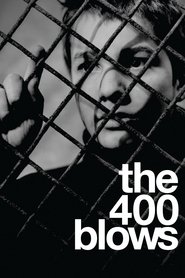
The 400 Blows (1959)
Release The 400 Blows Blu-ray Special Edition (Criterion Collection)
Stonehill uses interviews with Truffaut, Marcel Moussy, Robert Lachenay, and Jean-Pierre Léaud to connect Antoine's experiences to Truffaut's life. He discusses locations, long takes, point of view, mirrors, transitions, music, and editing. His analysis of the final run and freeze frame examines how the film conveys Antoine's isolation through specific camera and editing choices.
- Duration
- 1h 39m
- Talk coverage
- 95%
- Words
- 16,552
- Speaker
- 1
Commentary density
Highlights
Topics
People mentioned
The film
- Director
- François Truffaut
- Cinematographer
- Henri Decaë
- Writer
- François Truffaut
- Editor
- Marie-Josèphe Yoyotte
- Runtime
- 99 min
- Also on
- OneSheet ↗
- External
- IMDb ↗ TMDB ↗ Find on Amazon ↗
Transcript
16,552 words
Hello, this is Brian Stonehill, and I will assume as you listen to this audio essay that you've already watched François Truffaut's wonderful film The 400 Blows. I don't want to spoil any of its surprises for you. The title sequence is shot out of doors in the actual Paris streets, announcing that the film is going to be shot out of the studio in the new tradition. the Eiffel Tower clearly anchors Paris as the location. François Truffaut, his friends will tell us, was an avid collector of miniature Eiffel Towers and kept them all over his apartment. This sequence was actually shot for a scene in the film where Antoine and René take a Parisian taxi cab and go in search of the Eiffel Tower, a trip that takes them a ridiculously long time. Truffaut decided to cut that scene from the film, but to use some of the footage from it for the title sequence.
The film's title, Les Quatre Cent Coups, or The Four Hundred Blows, is a colloquial French expression meaning to sow one's wild oats or to raise hell. Faire les quatre cent coups means to have a wild and unruly childhood. Behind this title, we see the copyright notice, 1959 by Les Films du Carros. For all his rebellious ways as a director, Truffaut had a reverential streak to his character, and he named his production company after a film of his idol, Jean Renoir, called Le Carros d'Or, The Golden Coach. Truffaut, who was 27 years old when he directed this, his first feature-length film, takes credit for the original story of The 400 Blows, and fairly enough since it retells in fictional form the story of his own childhood. But then he gives an adaptation and dialogue credit to Marcel Moussy. Our interview with Marcel Mousty can be heard later in this commentary. The screenwriter explains why Truffaut requested his collaboration and how he was called on to give structure and memorable dialogue to embody Truffaut's novelistic prose. Philippe de Broca, indicated here as one of Truffaut's assistant directors, would later have a successful career in his own right. He would direct King of Hearts, for instance, in 1966.
Note that the signature shot, that is, where the director places his own name, occurs at the unique moment of perfect framing by the base of the Eiffel Tower. The film on many levels will seek such a balance of the unsteady handheld look of cinéma vérité, the disorderliness of life itself, and yet the perfection of form, the balance that comes only from art. It's one of the light touches of mastery that gives The 400 Blows its charm. As if it were a novel and he its author, Truffaut dedicates his film to his mentor, André Bazin, the famous theoretician of film who had been like a father to him and who had died unexpectedly at the end of the first day of this film's shooting. We will need to talk more about Bazin and about Truffaut's own childhood as our story proceeds. The story begins with the schoolboy's forbidden image of the pinup girl as we follow its circulation through the classroom. The power of images, both to fascinate us and to get us into trouble,
is a theme that echoes not only throughout this film, but throughout Truffaut's career as well. The camera, by tracking the girly picture's course, lets us in on the secret, so that when young Antoine Douanel is caught red-handed, we are, in a sense, caught with him. From this moment on, Truffaut's script, Henri Deca's camerawork, Marie-Joseph Yoyot's editing, and Jean-Pierre Léo's performance will all encourage us to identify with the feelings and the experiences of Antoine. Before picking up a camera, Truffaut was a critic for the now-famous Parisian film journal called Les Cahiers du Cinéma, or Cinema Notebooks, where his mentor André Bazin had argued that too many edits or cuts tended to create a sense of phoniness or trickery in the viewer's mind. Starting with this very first shot, which lasts nearly a full minute, you can see Bazin's protege, Francois Truffaut, striving for a kind of sincerity in his film, exactly as the master would have suggested, by prolonging the integrity of the individual shots. The 400 Blows is a treat for students of film and of what is termed visual literacy in many ways, not the least of which is the film's use is here of what we will refer to as expressive editing.
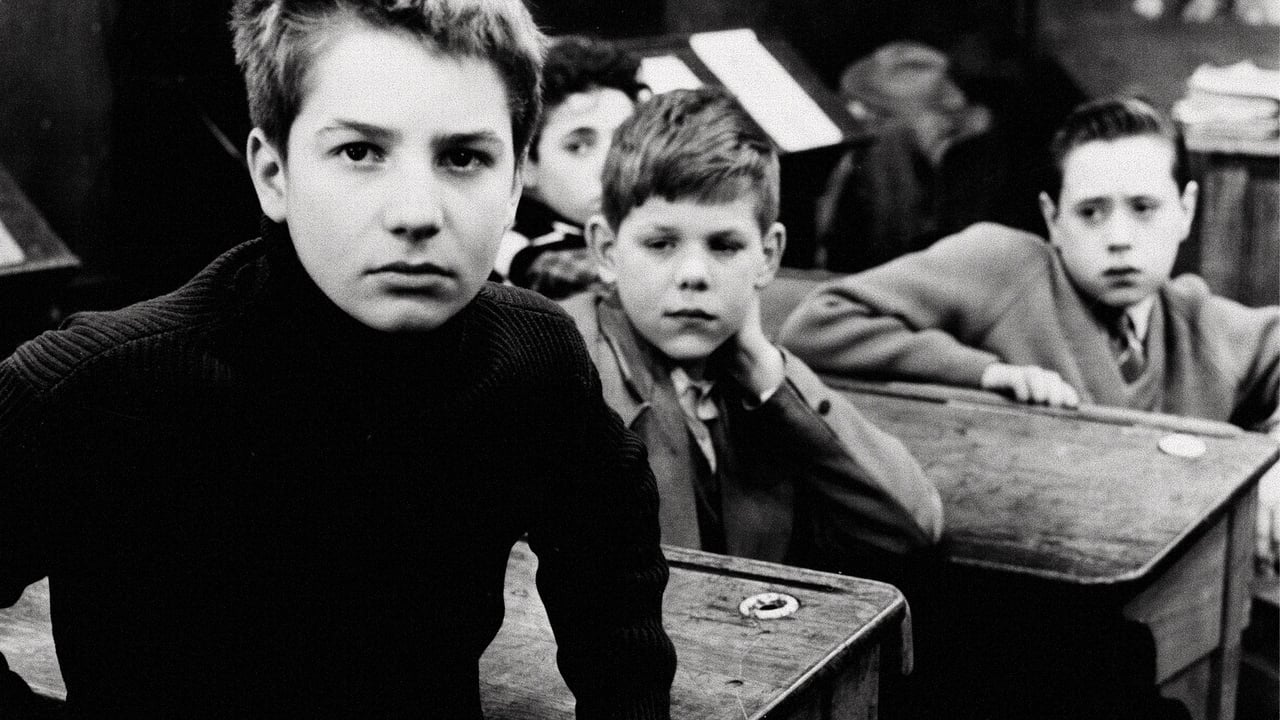
Many of the director's choices in this film were dictated by budgetary constraints, for the film was produced independently. Thus, the choice of black and white film stock, which came to be associated with new wave films, was essentially a matter of economy. Similarly, the handheld camera, which permitted shooting in narrow locations and made the quick pans back and forth in this classroom scene feel natural, was less costly to operate than the bulky camera setups of studio filming. Truffaut also cast his film largely with unknowns or with actors whose chief exposure had been only on television. Guy de Comble, playing the teacher, is one of the few exceptions. French filmgoers would have recalled him from Jacques Tati's 1949 comedy Jour de Fête, among other films. The classroom itself is in the Parisian film school on the rue de Vaugirard. Since he's the victim of injustice, our sympathies with Antoine are now cemented.
In contrast to his trouble with pictures, Antoine now reveals himself as a writer of sorts, as we glimpse him writing his testament in graffiti on the classroom wall. He has a kind of creative knack, that is, but it seems always to come out in socially unacceptable ways. Note that we hear the testament in Antoine's off-camera voiceover, even though our eyes are taken back to the schoolyard. We're familiar with such overlapping of image and sound now, more than 30 years after the release of this film. But in 1959, such a move was innovative and helped to define an important aspect of the new wave. One aspect of that movement was, as we've noted, the refusal to shoot films in a studio or on a soundstage, but to take the camera out into the streets and the locations themselves. Another new wave innovation was to trust the viewer to be able to look at one thing, yet hear another, and not be confused.
Respect for the viewer's intelligence is in fact a hallmark of the best and most memorable of the New Wave films. Cutting between two different things tends to highlight their differences, and what Truffaut emphasizes here is the emotional distance between the rowdy boys who are enjoying their freedom out in the playground and the authoritarian discipline imposed on Antoine by the teacher indoors. As a passionate moviegoer all his life, Truffaut is more saturated than most directors with the films that preceded him. We are not far removed in this scene, for instance, from the classroom scenes in Josef von Sternberg's classic film The Blue Angel, where a girly postcard gets some other boys in trouble with the teacher. This teacher, called Little Quiz in the script, humiliates Antoine publicly by assigning the class a sentence to conjugate based on Antoine's clumsy graffiti. Truffaut's co-screenwriter on this film, Marcel Moussy, had himself been a high school teacher, and as he tells us in our interview, Truffaut asked him for help on this feature because he had a sure sense of what teacher-pupil dialogues actually sounded like. In this, as in so many other ways in the film, Truffaut endeavors to get away from the traditional or literary ways of doing things and back to the reality of life itself.
We now get to see the traditional French way of teaching literature at this time, which is dictation, and it epitomizes the authoritarian nature of the relation between teachers and students. The unequal status is reflected in their very body postures, as the students hunch over their work while the teacher stands erect above them. Here's the wonderfully comic scene of the student who rips out a page each time his pathetically impractical nib pen makes a blot on the page, and who is left at the end with nothing to write on. As a college professor myself, I think of this scene every time my students are taking an exam and I hear someone ripping a page out of their blue book. Part of the deeper comedy of this scene comes from the fact that whatever slight literary quality the poem may have is being completely lost on these kids, for whom it is being reduced to the status of a mere mechanical exercise. As we will see, whatever feeling for literature the students do develop will have to happen outside of and practically despite the mind-numbing routine of what goes on in the classroom.
Here is what Marcel Moussy, Truffaut's co-screenwriter, told us about the tone of these scenes. In the classroom scenes, their tone had been suggested to me by the behavior of some slightly wacky and even puppet-like teachers whom I had known. In fact, in the building where I live, and where quite a few teachers happen also to live, my neighbors gave me a hard time after the film came out, complaining that just because I had left teaching was not really an excuse for me to have ridiculed the teaching profession so much. As far as experience goes, I was a few years older than Truffaut and had started working in television on a series that was called It Could Happen to You. We dramatized contemporary social cases a little bit like what Paddy Chayefsky was doing in American TV at the time. Truffaut's friend, Andre Bazin, had advised him to watch some of the broadcasts. Having watched those programs, he got in touch with me. Concerning my experience with children, Truffaut had read my first novel.
called Hard Blood, which I'd sent him, and which deals with a childhood in a completely different context, in Northern Africa, in fact. But it deals with a boy of 12 or 13. And he also knew that I'd been an English teacher for several years, and therefore, I knew something about the teaching milieu. And I remembered what the attitude of the kids was like. When you've taught them for four or five years, you get the habit of their reaction to things, of children at any rate, as they were at that time, because they've evolved a great deal since then. But there is, after all, a certain constant in children's relation with teachers and with school. Again, since this is a sexually segregated classroom, as were all such classrooms in France at this time, the merest mention of romance sets off the kids' hilarity. As the pinup girl in the opening shot suggested, these 12-year-olds can barely contain their fascination and their self-consciousness on the subject of sex. The camera now takes us for the first time outside the school and looks up at the sculptural frieze on the building's facade. We don't linger on this image, but it is significantly a bas-relief allegory of France's national motto, liberty, equality, fraternity.
Ultimately, the significance of this motto for Antoine Doinel's story is ironic, for what we will see the boy deprived of systematically are precisely his liberty, his equality, and his ability to rely on the fraternity of his classmates. Antoine and his friend René are now briefly free for a time to walk along the streets of Paris' 9th arrondissement, where Truffaut himself grew up. The 400 Blows presents a fictionalized autobiography of Truffaut's childhood. And the more you know the facts of Truffaut's life, the closer to reality the film may be understood to come. Truffaut's own best friend in boyhood was named Robert Lacheney, and it would be Lacheney who would one day provide Truffaut with the money to make Les Mistons, one of Truffaut's first short 16mm films. Lacheney worked as production supervisor on The 400 Blows as well, and he would remain Truffaut's closest friend throughout the director's life.
In the summer of 1992, we located Robert Lacheney at his country house in the Oise district of France and talked at length with him about the origins of this film. You can hear translated portions of that interview later in this commentary, as well as in the original French elsewhere on this disc. After stoking the coal fire, central heating is still a thing of the future in post-war France, Antoine gives a comic demonstration of bad manners in wiping his hands on the curtains. Such gestures have been compared by some critics to the uncivilized behavior of the bum, Boudou, in Jean Renoir's classic comedy, Boudou Saved from Drowning. Since Truffaut himself repeatedly embraced Jean Renoir as one of his favorite filmmakers, the comparison is a plausible one. Antoine and society will never be on good terms. Antoine, fascinated by his mother's toilet articles, sits down at her vanity table, giving Truffaut's camera the opportunity to present the first of a career's worth of deep mirror shots. In a film that is largely about a boy's search for his identity, Antoine's multiple reflections suggest his own perplexity on that subject, even as his curiosity about sex is also engaged. Here is what Robert Lacheney told us about his childhood friendship with Truffaut.
I always thought that he'd become famous, probably as a writer. That's one of the reasons that I thought of him as my closest friend, even when we were kids. Even when we first met in school after the first week, I told him, you were the smartest kid in the class. He was only 11, but I don't think I was wrong. It's true, because who's heard of the rest of them? I was really conscious of his superiority. He had to teach himself, though, because he never even got his diploma. Not even the certificate that you're supposed to get when you're 14. I don't think you have that in America. It's a certificate that says you've learned to read and write and do arithmetic. Well, he didn't even get that. But everything he knew, he'd read in books. And then he'd observe people and memorize what he saw. Sometimes when we were walking in the street, he'd follow people and listen to what they were saying. That was pretty funny.
The very mobile camera has followed Antoine as he dutifully sets the table for his family's dinner and prepares to tackle some of his homework. His mother, Gilbert Douanel, played by French television actress Claude Maurier, comes home, and we note that she does not greet him in any physical way at all, a subtle but chilling point. Already Antoine is in trouble for not having bought what she asked him to. In speaking to us about this period in Truffaut's own life, Robert Lacheney had this to say. At this time in his life, Francois' parents paid him very little attention. Mine were pretty oblivious, too. On weekends, his father would go off mountain climbing, or perhaps to Fontainebleau, or who knows where. And so we'd be able to spend a couple of days together. He'd sleep over at my house, and we'd go to the movies. Oh, always to the movies. And then we'd talk all night about what we'd seen.
There's a slight disruption in the film's otherwise consistent point of view there, as we are allowed to see Madame Doinel admiring herself in the mirror after Antoine has left the apartment on his errand. For the most part, the film will limit itself to Antoine's own direct experiences. Here's a third contact Antoine has with the idea of sex. Now he overhears a graphic discussion of a painful childbirth, and we see that the subject both fascinates and horrifies him, almost to the point of making him ill. Monsieur Douanel, who here acts as Antoine's father, is played by Albert Rémy, a character actor who began in the circus and then had a distinguished career in French films. In Marcel Carnet and Jacques Prévert's classic film Children of Paradise, released in 1945, Rémy played Scarpia Barigny, the original man in the lion's suit on the Burlesque Hall stage. Truffaut's own father, we might point out, was an architect, somewhat more serious than Doinel, although there were no books in Truffaut's parents' home. While his father's hobby, as we've heard, was mountain climbing and not car rallies, Truffaut's mother did work as a secretary, just as Antoine's mother does.
The money being used in 1959 in France, by the way, is the old franc, that is to say, two decimal places more inflated than the current French currency. In giving Antoine 100 francs, Monsieur Douanel is giving him approximately 20 cents. So the 500 francs Antoine finally gets would be worth about a dollar. Robert Lacheney had this to say. Being present at the making of the 400 Blows brought back memories that were not really very happy ones. We had a tough childhood, you know, so it was a mixed experience for me. It was satisfying, of course, to make a movie about it, although we couldn't tell in advance what kind of success it might have. But at the same time, it meant going back over a childhood that had not exactly been idyllic.
the kind that you read about in storybooks. No, from the outside it might look picturesque, but for those of us who lived it when we were 16, having to go four or five days with nothing to eat, it was no fun. Not having any fire in the winter or no electricity. Francois didn't show in his film the true hardships we endured as children under the occupation, because that would have turned it into a different kind of film. You can't have too dark a story if you want to make a movie. He wanted a story about childhood, not about the occupation. So things had to be a bit sugar-coated. He could have been a lot harsher on his parents, too, than he was in the film. In the film, his parents aren't evil monsters. In reality, they weren't evil monsters either, but they were completely thoughtless. Judging them, however, wasn't his goal in the film. The character based on Robert Lachenais is named René Biget in the film, by the way, because that was his maternal grandfather's name. Monsieur Douanel, who has implied that he knows that Antoine has been stealing, now also implies that he knows that his wife is fooling around. But he won't say anything about it overtly either.
Antoine's mother significantly seizes on this moment to send Antoine to bed. Again, her body language is expressive of a singular lack of motherly love as she closes the door on Antoine quite coldly. While performing his domestic chore of throwing out the garbage, Antoine is caught in the dark by the lights turning themselves off automatically after precisely one minute of use. This conservationist minuterie, as it's called, was imposed by wartime shortages of power, and it's still the rule in French apartment buildings. In a published interview, by the way, Truffaut cited this scene, Antoine putting out the garbage. as an instance of a shot that would be ugly in the normal aspect ratio, but one that the wide dimensions of CinemaScope could give an aesthetic beauty to and make appealing to the eye without denying its gritty and prosaic truth. Everyone is familiar with Antoine's actions here, turning the lights back on while putting out the trash, but no one had seen them performed in a movie before. The power of putting the quotidian on the screen, bringing out what's nearly poetic about the mundane,
is one of Truffaut's great discoveries in this film. In case we've missed the previous indications of the Doinel family's economic hardships, we now can't help noticing that Antoine's pajamas are rather severely torn, a ragged testimony not only to hard times, of course, but also to parental neglect. Wiping the mirror, Antoine experiences, and we experience along with him, an auditory flashback. In letters to his friends, Truffaut, who was a voracious reader all his life, wrote that for him, the two greatest names in French literature were Balzac and Proust. We're going to see the explicit importance of Honoré de Balzac to Jean-Antoine in a little while, and this present eruption of involuntary memory is perhaps the most Proustian moment in the film, for the French novelist Marcel Proust was much concerned with the way that physical sensations may involuntarily bring one's past experiences to mind. Both Balzac and Proust were also centrally concerned with the struggle between the individual soul and the constraining forces of society, and especially Parisian society. While showing how one's taste for literature may be nearly snuffed out by the numbing routine of the classroom then, Truffaut and co-screenwriter Marcel Moussy are nonetheless well-rooted in a grand literary tradition themselves.
As Antoine leaves the house, it's clear that he is complicit with his mother's secret diversion of money for her own purposes. He is, so far as we can tell at this point, a wise child who, if not completely aware of sex, at least understands that there are things that he's not supposed to understand. René Biget, Antoine's slightly better off classmate, has no trouble in persuading Antoine to take the day off from school as they stash their satchels in a nearby doorway. They enter the street from a door of the Astor movie theater where the film White Slave is playing. Technically speaking, these next two shots are edited as a whip pan cut to a whip pan. one of several places in the film where the camera and editing work cease to be transparent windows on the story, but draw attention to the filmmaker's presence as a mediating influence. The new wave, as Truffaut is helping to launch it here, sought a new kind of realism by taking its cameras into the street, but it also sought a new kind of honesty about the illusions of filmmaking itself.
We know that Antoine and René cannot literally be in two different places at the same time. Therefore, we are reminded that celluloid strips of film are being joined to bridge a gap in time. There's an element of exuberance in the filmmaker's discovery of the freedom of his medium here, a discovery that is cleverly coordinated with the boys' own freedom in playing hooky from school. After playing pinball, the boys approach the spinning carnival ride known as the Rotor. Truffaut, who spoke and wrote often of his admiration for Alfred Hitchcock's films, in this scene emulates one of the master's more playful tricks. For Francois Truffaut himself can be seen, briefly and intermittently, as one of the adults also taking the ride along with Antoine. Truffaut is the slight dark-haired man in the dark cloth jacket. Right there. Several critics have pointed out, accurately I think, That part of the appeal of this ride for Truffaut is the way it recreates one of the mechanical precursors to cinema, a revolving party novelty popular in the early 19th century and called at first the phenakistoscope and then the zoetrope. By virtue of persistence of vision, its spinning motion allowed the viewer to see separate line drawings of animals blur together into an illusion of flickering motion.
For Antoine, though, who's probably unaware of the history of movie technology, the thrill of the rotor more likely comes from the exhilaration of speed and the strange pleasure of being pinned to the rumbling wall by his own weight when the floor drops away. Breaking the rules is what striking one's 400 blows is all about, and what better visual image of that lawlessness than Antoine's joy at breaking the very laws of gravity, even as he's breaking the laws of school. By cutting between shots that look down on the spinning rotor and shots that look up from inside it, Truffaut neatly captures the relativity of perception. These distinctions between inside and outside might well be called Proustian, but the sequence is also just plain fun to watch because finally Antoine is having fun. The ring of spectators plays an essential role in the ride, for they provide the external point of reference that confirms the rider's sense of motion. A spectacle that requires an audience and an experience where motion is key. No wonder the filmmaker himself is the last to exit this primitive and therefore perfectly convincing metaphor of his art.
In Place Saint-Augustin, Antoine will come upon a deeply disturbing sight, that of his mother kissing a strange man. Once again, as in the film's opening scene, the idea of sex is linked with what's forbidden, what happens in secret and in violation of the rules. This surprising view, which neither of them will ever allude to openly, ironically tightens the bond of complicity between mother and son, both of whom now have things to hide. Neither of them should be here, Both are caught in acts of transgression. After the trauma of the German occupation and the shameful history of collaboration and denunciation by many French citizens during the war years, the theme of spying became very pronounced in French literature and film of the period. Here we see Maurice, the snitch from school, hiding behind the tree and spying on them while Antoine and René are themselves unaware of it.
In the first week of June 1958, Francois Truffaut wrote to Marcel Moussy that he'd read one of Moussy's TV scripts. I found it fascinating, very close to what I like to achieve in La Fugue d'Antoine, which is the working title, in which the point of view will tend to be that of the children, the parent being more stylized and the children more subtle. It's all in my head and I like to relate it to you in detail, if that's all right by you. After reading Hot Blood and your TV script, I'm convinced that you can be of immense help to this film which I'm confident I'm going to shoot in September. I know that you are a fast worker and that you have a sense of construction which I sorely like. On the other hand, I think I really know the universe of 12-year-old kids that I want to film. After some conferring on the proper technique in forging parental notes to excuse one's absences from school, Antoine proves too accurate a copyist and writes René's name instead of his own. Once again, as Monsieur Douanel comes home, Antoine will be forced to dissimulate what he's been doing. There's considerable irony and pathos here in that Antoine knows what his mother's been up to
yet is obliged to allow his father, or stepfather rather, to remain in the dark. Without any responsibility for his mother's adulterous behavior, Antoine is forced into dishonesty about it. The French philosopher Jean-Paul Sartre had been writing in the late 40s and early 50s about how society placed individuals into situations of bad faith, or mauvaise foi. Without the slightest hint of pedanticism, Truffaut is giving us the direct experience of how involuntary and how unpleasant that bad faith can feel, and how early it can start. Antoine can't very well take it upon himself to wreck their marriage, and so the parents' own venality forces the child into dishonesty. The bad faith of Antoine's situation is compounded when Monsieur Douanel asks him what went on in school today. Antoine has to pretend that he was there. So just as we saw his image compounded in multiple reflections in his mother's vanity mirrors, so now we have Antoine's multiple simulations of reality. In the third week of June 1958, Truffaut wrote to Marcel Moussy, You have understood everything about my film so clearly and so quickly that I can't imagine being deprived of your collaboration. Working on these memories, I have in a sense turned into a first offender again.
I feel insecure and rebellious once more, overly vulnerable and completely isolated from society. It was Bazin who 10 years ago straightened me out by becoming what you call my guardian. Talking to you, I feel at the same time guilty and rehabilitated. You are like Bazin in so many ways. Just as he helped me go straight in life, you're going to help me make a film that will be more than just a whiny, complacent confession, a true film. You know I can't stand it when you lie, Monsieur Douanel says to Antoine after their bachelor dinner, which we did not see. The camera moves in for a tight shot on Antoine, who is obviously under stress as he says, I didn't take your Michelin guide. We don't yet know whether this is true or not. We do know, however, that Monsieur Douanel is both ridiculous and touching and is concerned for a lost tourist guide.
For it's his own wife that he's really losing, yet he seems not to notice that. Cuckoldry is a frequent topic for derision and for easy chuckles in French literature and film. Truffaut does not exclude it from his portrait, but he keeps the slightly puzzled perspective upon it, that of young Antoine himself. When, in 1992, we reminded Marcel Moussy of the letters that we've been quoting from François Truffaut to him in 1958, Moussy, the co-screenwriter, responded in this way. He wanted a story that would be more objective than the one he started with. And a less pathetic one, if you will. Even if it was to remain the story of the young boy whom he himself had been. I did in fact bring some transposition to it that wouldn't have taken place if he had done it by himself. Obviously, by bringing someone else's perspective to it, you can be a little less subjective. And I had no way of knowing, when he first brought me the story, how much of it was strictly autobiographical.
Quite a great deal, of course, as it later turned out. In further dissimulation, Antoine is pretending to be asleep when his mother comes home, excessively late, and claims to have been kept at work by her boss. As they argue over who took the Michelin guide, Monsieur Douanel says of Antoine, I gave him a name. I feed him. These remarks imply that Antoine's father is not Antoine's father, but that he married Antoine's mother when she was pregnant by another man. It's not yet clear whether Antoine understands these remarks, but we do know, sadly, that he is hearing them. The scene ends on the chilling and foreboding note of Madame Douanel wishing aloud that Antoine might be sent away to boarding school so that she might be alone. The fade to black that indicates a night's passage here helps to accentuate the film's sense of structure and rhythm. That rhythm is strengthened by the now familiar shot of Antoine leaving for school the next morning to the chipper melody of Jean Constantin's original music. The snitch or spy whom we've seen watching the boys before now runs into the Doinel's building.
Here's a case of deliberate bad faith and of betrayal for this boy, whose name according to the script is Maurice, knows that Antoine is presently on his way to school. This betrayal is what takes the place of the fraternity or brotherhood that as part of the national motto is ironically sculpted above the schoolroom doors. Maurice is lying about Antoine's lies simply for the perverse pleasure of getting Antoine in trouble. Note that this scene, by the way, violates the film's general rule of keeping to Antoine's own perspective. yet the subject nonetheless remains Antoine's behavior. Distinguishing Truffaut's typical stories from those of the novelist Marcel Proust, with Proust's grand social canvases, Marcel Moussy told us this. Truffaut's stories are much more centered generally on one character. That was even one of his rules. I often heard him say, we must not let go of the main character from the beginning to the very end of the movie. Why do you want me to be surprised? I'm waiting for everyone to leave.
We might take this opportunity to point out what an exceptional year 1959 was for French film. In that same year that the 400 Blows came out, Rivette's Paris Belongs to Us was released, as were Claude Chabrol's film Les Cousins, Alain Reynet's Hiroshima Mon Amour, and also Jean-Luc Godard's Breathless, the screenplay of which was written by François Truffaut. There was good reason, in other words, to brand this period of surging creativity as a wave. Here in the 400 Blows we have, as an editing device, the first wipe. It's called a natural wipe because Morisset is crossing the screen from left to right in front of the camera, and directly behind him came the wipe, replacing this image with a new one. It's an authorial gesture on the part of Marie-Joseph Yoyot's team of editors, reminding us playfully of the filmmakers' mediation of the events we're watching.
As before, the teacher seems to have eyes in the back of his head as he stops Antoine on the playground. What now pops out of Antoine's mouth with riveting force, the lie that his mother has died, has practically heroic stature in the boy's escalation of phony excuses. As the French director Georges Franju told Truffaut afterwards in an interview published in the Cahiers du Cinéma, quote, such a lack of respect commands respect. The effect on Guy de Comble's face as the teacher is instantaneous, as his sarcasm is transformed into sympathy. Viewers who understand French also notice that little quiz is addressing Antoine in the familiar tu form of address. Here is what the co-screenwriter Marcel Moussy has to say about the shooting of some of these scenes. On the 400 Blows, I was present at the filming pretty often, especially at the Vaugirard School, which was a school for film technicians close to my house.
I discovered with a sense of wonder that very lightweight technique of filming. The camera was handheld, three quarters of the time. Until then, my experiences had been with what we called heavy video on TV. In other words, those enormous cameras that you needed three or four people to move left and right. I found the freedom of this new way of shooting terrific. I remember vividly... because it really struck me at the time, an interior traveling shot in the classroom where the grips pulled the desks out of the way one by one as the camera went forward. So you'd see the desk that had been thrown from the patch on both sides and the cameraman threading his way between them. Nothing could have been more different from the heaviness of shooting on TV. When I eventually came to direct my own first film, Saint-Tropez Blues, that was the only style of shooting that made sense to me. Deux. Jean.
In French class now, it's ironic that the poem that the student has been trying futilely to recite is about the virtues of liberty as opposed to slavery. As the teacher, responding to a summons at the door, leaves the classroom, the camera again communicates the great emotional stress on Antoine by moving in on his face as he senses his own doom about to befall him. He walks as if to his own execution to the door, where his parents are revealed, and in the ultimate humiliation, Antoine's face is stunningly smacked in full view of his classmates.
After he's been found out in his lies and publicly chastised, we see Antoine descending the angle of the staircase from upper left to lower right. Students of visual literacy recognize in this movement a parallel to a graph of declining fortunes, reinforcing Antoine's descent in moral as well as physical terms. The silence here reiterates Antoine's solitude. René Biget escorts him into a printing factory, extending in a subtle way the imagery of print that runs through the film. They improvised and fashioned a bed for Antoine. We asked co-screenwriter Marcel Moussy how Truffaut had cast his first feature, and Moussy told us this. For the main role, Truffaut placed an ad in France World that said something like, seeking young boy of 13 to act in leading role in a new film. He didn't even spell out any physical characteristics. So lots and lots of boys came to audition, and they came from just about everywhere.
Francois was able to eliminate most of them on the basis of interviews. And then he had a few do some screen tests, including Jean-Pierre Léo. Jean-Pierre had run away from his boarding school in the southern provinces of France to take a train up to Paris to audition for the role because he had seen the ad in the paper. So quite apart from his actual screen tests, which were immensely successful because he showed a vivacity and a liveliness that were decidedly uncommon. Truffaut was completely charmed by the idea of the boys having broken his bones at school. A boy would actually run away on his own so that he could take a screen test in Paris. That's how it worked for the lead role. On the other hand, for the secondary roles, I gave him a lot of help. I was able to do so because while working on the TV programs that were produced by Marcel Bluval, I had seen dozens and dozens of actors in secondary roles. Most of the secondary actors in the film, the mother, the father, the principal of the school in particular, were people whom I knew from television and who, from Truffaut's perspective, had the advantage of being fresh faces in cinema.
In point of fact, Jean-Pierre Léo, who was born on May 5th, 1944 in Paris, was 14 when the film was shot and had just turned 15 when the 400 Blows came out. The character he is playing, Antoine Douanel, has to leave the printing factory now because it's actually in use. Right here, a dog runs out of a building, followed by a woman who's played by the already famous actress Jeanne Moreau. When he's not even allowed to chase a stray dog because a man, played by Jean-Claude Brialy, is interested in pursuing the Jeanne Moreau figure, we realize that his youth is really a burden on poor Antoine. The sign in the window that we're about to see, wishing everyone a Merry Christmas, is pathetic since there is no merriness in Antoine's life, even though he is at the age at which merriness is supposed to be normal. There is thus what dramatists call an antithesis between the season and Antoine's actual sentiments, which are of course being magnified by the mournful flute and guitar on the soundtrack. We see the milk being delivered, a sign of very early morning, outside a cheese store. Witnessing Antoine's first theft, we cannot judge it harshly, because this boy is neglected. He's deprived of affectionate interest on all sides.
Above all, he receives no love from his mother, and the milk and all its figurative connotations that he should receive from her, he is obliged to steal. He has to drink it from the bottle, standing up, alone, an icon of solitude and hunger. And these are merely the outward manifestations of his deprivation of affection and of emotional nourishment. We asked Truffaut's close friend, Robert Lacheney, the original of René, how Truffaut had managed to obtain the established stars Jean-Claude Brialy and Jean Moreau to do walk-ons in the young director's first feature film. Here's what Lacheney told us. Brialy was someone we'd known ever since he first came up to Paris from his home in the provinces because he wanted to be an actor around 1956 or thereabouts. He was part of our gang along with Jacques Rivette and some other guys, but he was the one who wanted to act and wasn't interested in writing or anything like that.
We got a big kick out of him because he was always hemming it up and playing the buffoon in the subway and everywhere else. So there he was. And around 56, he started to make a go of it in the theater. And then his career took off. As for Jeanne Moreau, she was already a star. And Francois had written some rave reviews of her work. In one of them, he said that Jeanne Moreau was the best French actress working in the films at the time. So it wasn't very complicated for him to ask her to come to the set one evening, just for an hour in fact, and do a little number. That happened a lot, people volunteering to lend a hand on each other's projects. That was really an integral part of the spirit of the New Wave, helping your buddies out. That was what it was about. Friendship meant a lot in those days, and camaraderie. It was like the gang of 13 in Balzac, and maybe the idea even came from there.
a group that moves up together, each one with his own special expertise. And we were constantly improvising, particularly since we weren't shooting on the set where the scenery has been designed to match your plans. We changed everything around as needed, but that contributed a distinctive flavor of life to the film. The actual locations determined the mise-en-scene.
We're about to find ourselves in Antoine's English class, where the sentence the boys must try to pronounce, where is the father, not only confronts the French speaker's perpetual difficulty with the TH sound in English, but also poignantly underscores Antoine's own personal situation. Where is his father? Marcel Moussy tells us how Truffaut found the actor for the role of the English teacher in this scene. Truffaut was sometimes able to discover actors. working in cabarets in Paris, whom he could cast in minor roles. For instance, in the scene of the English teacher with stammers, that was a guy who did a nightclub act where his gimmick was stammering. Now, I'd written the script for the English lesson, and Truffaut had him do it with the stammering added. Truffaut's basic objective, since he wanted to go against the grain of what was usual in the movies, was to have fresh faces. In the case of his 13-year-old hero, that took care of itself.
but also for the people who played secondary roles. He wanted people who had been seen very little, if at all, in the movies. Robert Lacheney, Truffaut's childhood friend, also tells us about his contributions to the script of The 400 Blows. At the beginning, when he was thinking about writing the script, Francois called his film La Fugue d'Antoine, meaning something like Antoine Runs Away. He called it that because in the beginning, the film was focused more on the moment when Jean-Pierre Léo, after he gets slapped in school, decides to leave home. Originally, that was to be the main axis of the film, but it grew in complexity after that, and so the film starts earlier. When he started working on the ideas for the film, François asked me to give him the letters that he'd written to me at the time, and so I did. I'd remind him of a lot of things, and he'd ask me for even more.
I did my best even if it was already 1958. I'd never thought of keeping a diary of the time, which is a pity now. He also asked me for whatever snapshot I had, but since we were so poor then for a time, cameras were a luxury we couldn't afford either. We didn't have many documents really, but fortunately I always kept all of his letters. I kept every one of them, thinking that someday when we were 70, he'd come to my house and one evening by the fire, I'd astonish him by bringing out all of his letters. Alas, it didn't work out that way. What the teacher actually said at the end of that scene, maybe it's glandular, somehow came out in our subtitles as maybe it's genetic. I think the difference is worth noting. Antoine's mother also said in her meeting with the principal that she too, at Antoine's age, was stubborn or contrary. She evidently is being extremely solicitous with Antoine out of fear that he may reveal her secret liaison.
Receiving this phony love from his mother is almost more painful for Antoine than not receiving any at all. It can't have the normal effect of maternal love on him because the boy knows that it's a sham. We see that knowledge in his eyes, and this is as good a point as any to observe that Jean-Pierre Léo's performance as Antoine is simply astonishing. To call it brilliant doesn't even seem adequate. When Madame Doinel offers Antoine money for doing well in class, but tells him not to let his father know, the offer only depresses Antoine further, for it's clear to him that his mother is getting this money from outside her marriage, and it's by betraying his stepfather. His heart is shriveling before our eyes. Truffaut and Mussi are masterful at communicating this feeling to us, for it's neither explicit in the dialogue, where it's implied, nor is it overt on the screen, where it is nonetheless indicated. If Antoine was unhappy spending his night on the streets alone, now he's made miserable by these seemingly affectionate attentions from his mother. The simulation of feeling, another kind of bad faith, hurts him worse than did a lack of feeling altogether.
I asked Robert Lacheney how it felt for him to watch this film when it first came out. It moved me deeply, and at the same time it surprised me. There was such a remarkable distance between what had been a frequently sordid reality and the poetic aspect that it managed to give it. François had managed to take things that might have been painful to experience in life and without lying gave them beauty on the screen.
I like to think of this scene as the hilariously shrinking gym class. Of course, its humor derives from the unwitting failure of the gym teacher's authority, not once, but progressively, to ridiculous extremes. As we've mentioned, Marcel Moussy, the co-screenwriter, was himself a former school teacher, and scenes such as this led to sarcastic complaints about the film from his former colleagues. The scene visualizes childish freedom undermining oblivious adult discipline, little by little. Truffaut's ability to hang his camera out of windows and off of rooftops gives the sequence much of its visual appeal. Surprisingly for careful watchers, there's some graffiti on the walls here that's not political, as you might expect, but poetic. The French playwright and poet Jean Giraudoux, author of such Paris-based sardonic comedies as The Mad Woman of Chaillot, is invoked here. Truffaut, a lover of books who is relatively indifferent to politics, indulges himself in a throwaway joke. Watching this scene, by the way, is something like seeing the Pied Piper in reverse as he steadily loses his following. Jean Constantin's music, with its steadily declining scales, cheerfully corroborates the succession of successful escapes.
Robert Lacheney tells us the story of how young Truffaut came by his love of the great French novelist Honoré de Balzac. Truffaut had a terrific literary curiosity. At 13 or 14 years old, very young in any case, it was Balzac, it was Stendhal. We'd get together at 8 o'clock in the morning to talk about these books. You can see it in the 400 blows, his love for Balzac, which after all is a rare thing at that age. More often kids like comic books, although we didn't have them at the time. Kids his age would be reading Jules Verne while he read Balzac, Madame Ansca, Alfred de Musset, Georges Sand. His parents didn't read very much. I don't know how he came by these tastes. We were supposedly studying literature in class, but that's not saying much. But we stumbled on a complete set of literary classics in a cheap edition called Fayard. It had all the greats of world literature from Aristophanes to Zola. We bought the whole set.
They were ridiculously cheap paperbacks, maybe two francs each. Francois announced, I'm going to read them all in alphabetical order. After Aristophanes, fortunately for him, came Balzac, and that's where he stopped. That may be how it started, because his parents didn't have a single book in their home. My parents did, but not his. It's ironic, of course, that the educational system's attempts to inflict literature upon Antoine meet with dismal failure, while his own tastes in reading are developed outside of and practically despite school itself. Truffaut himself was given to telling his friends that Balzac and Marcel Proust were the two greatest figures in French literature, and while there is no necessary carryover from his reading tastes to his filmmaking, it would be logical to look for connections. Balzac wrote of Parisian life largely, and particularly of what happened to the ideals of ambitious young men who came to Paris from the provinces. In a sense, Balzac's own ambitions as a writer were on the epic scale, as he sought in the 20 novels of what he called his human comedy to paint a broad canvas of every stratum of society. Truffaut works on a much smaller, more intimate scale that would seem to rule out any strict comparison.
But in fact, one of the hallmarks of Balzac's novels is the recurrence of certain characters in book after book. Antoine Douanel, similarly to, say, Lucien de Rubempre and Balzac, recurs in no fewer than five of François Truffaut's films. The 400 Blows in 1959, the sketch called Antoine and Colette in the collective anthology Love at 20, made in 1962, Stolen Kisses in 1968, Bed and Board in 1970, and the retrospective Love on the Run in 1979. The Doinel series thus presents what we might call intertextual continuity on a balsation scale. The shrine bursting into flames distracts everyone's attention from Monsieur Doinel's tales of sexual intrigue at the office and provides some welcome comic relief at this point. Even Antoine's admirable impulses, his respect for great art, create disastrous consequences. Instead of punishing him for setting the fire, his mother suggests taking him to a movie. And it is to Jacques Rivette's film Paris nous appartient, or Paris belongs to us, that the family will go.
Now we have one film, set in and largely about Paris, referring to another film, set in and largely about Paris. This is another cinematic version of the mirror play, the doubling and reflecting that goes on inside the 400 Blows, particularly since many film historians generally credit Paris Nous Appartient as a precursor to Truffaut's work in launching the new wave. Jacques Rivette and François Truffaut were friends and worked on each other's films. As the family leaves the film, we get actual night shots of the Champs-Élysées, Paris' grandest street, particularly at night at Christmas time. The Doinelves own a modest little Renault, and as Truffaut's own low-budget production could not afford the usual studio's process shot, in which rear projection is traditionally used to simulate a car ride, Truffaut actually had cinematographer Henri Decas mount the camera on the hood of the car while Albert Rémy really drove through the streets.
Once again and somewhat paradoxically, the limited means of the New Wave directors helped to create a new dimension of realism in the movies by leaving the artifices of the studio behind. These scenes of the family coming back home from the movies are the first scenes of family joy and mirth that we've seen. It's hard not to be aware that it's a film, a movie, that has put them in this good mood. If Marcel Carnet's 1945 classic Children of Paradise had been cinema's homage to the theater, with the New Wave we begin to get cinema's homage to the cinema, Monsieur Douanel is so enlivened by Rivette's movie, in fact, that he takes the opportunity to show off his wife's legs for Antoine's appreciation, and there's even a moment of risqué, if playful, erotic intimacy that we get to see. Another moment of domestic truth, perhaps, but certainly a shocking one by Hollywood standards at the time.
While Maurice, the boy who snitched on Antoine, is giving a recitation, the other boys pass his fancy goggles among themselves. The camera tracks this act of collective sabotage in a visual echo of the film's opening shot, where the girly picture was similarly passed from hand to hand. Rough justice and the boys' cruelty are both on display. The teacher, known to the boys as Little Quiz, is now bawling out Antoine for having copied out Balzac's famous passage. Antoine protests his innocence, and in a way we know he is right, for the passage he copied was in his memory, and his act of plagiarism was more of an homage and an act of expression of admiration than it was the lazy dependence of a cheat. But the schoolroom rules leave no room for emulation, the beginnings of a real love of literature. Antoine's criminal career, at least in the eyes of society, has now escalated him from liar, truant and thief to arsonist and now a plagiarist. The issue of legitimate admiration versus ignoble copying is of course an enigma that is implicit in the aesthetic of film itself, for film is, after all, an art of reproduction and of pretense.
Truffaut, although he knew he was telling his own story in the 400 Blows, was also conscious of working in the tradition of French films about boys at school, a tradition that includes the early scenes of Abel Gance's great film Napoleon in 1927, and even more centrally, Jean Vigo's Zero for Conduct of 1933. Our sympathies are with Antoine here on the virtues of his admiration for Balzac, particularly since it has gotten him into trouble both at home with that flaming shrine and now in school. Similarly, Truffaut, who named his own production company in honor of Jean Renoir and who has just referred to Jacques Rivette's current film in the film we are watching. Similarly, Truffaut is reminding us that apprentices must be allowed to mimic their masters, for creativity begins in imitation.
Antoine doesn't want to be sent to a military academy, as his father has threatened, and he says, and this prepares us for the final scene of the film, I've never seen the sea. I wouldn't mind going to the Navy because I've never seen the sea. Antoine is invited home by his friend René Biget, who is, as we've said, based on Truffaut's own childhood friend, Robert Lachenais. Here is what Lachenais himself told us about this period in our interview with him in 1992. François's parents paid him very little attention. And when his father would go off mountain climbing, that enabled us to spend weekends together. He'd sleep over at my house and we'd go to the movies on Friday and Saturday nights. Then we'd spend the night talking at my place because my parents had a big apartment, nine rooms. It was really immense in the Rue de Douai. I had my own bedroom, a very big room. We'd come in at midnight by the servant staircase and we'd play backgammon as you can see in the 400 Blows.
talking all the while about the movie we'd just seen and about the one we planned to see the next day. That's how we lived in 43, 44, up through 45 and even 46. After that, he moved out of his house and that was another story. But those are some of my very best memories of the two of us spending the weekend together and going to the movies. While René Biget is clearly from a wealthier family than Antoine, it's also clear, in a rejection of materialism by the film, that money can't buy you love. René says that his mother's a drunkard and his father's always at the track. The two boys may differ in socioeconomic status, but they're brothers in emotional poverty, starved for parental love. The overhead shots here emphasize how small the boys are and also how large the apartment.
The boys would steal affection if they could, but all they can steal is their parents' money. Robert Lacheney tells us how it was when he and Truffaut were 17 and hard up for cash. When Francois got caught, it was because we had tried to found a film society, which we called the Cercle Cinéman, or the Movie Addicts Club, which in our minds was going to make us a fortune, or at least enough to live on. Otherwise, we'd have to sell newspapers or something like that because the problem was to make a living. We had to eat somehow. So the point of the film club was to make ends meet for both of us. So we made up some posters to publicize it. And one day his father came across one of them. And it didn't take long either. We had other problems with that film club to start with. We held two screenings on Sundays.
Someone notified his father that François Truffaut's name was on one of these posters. And his father came to the second screening and grabbed François. And that was that. We weren't going about it the right way anyway. We ought to have signed up with the French Federation of Film Societies so as to get our hands on the prints. But we didn't sign up with anybody for anything. So we never got the movies we were supposed to. We led people to believe that Jean Cocteau would be there. But that was Francois Truffaut's hallucination, to think that Cocteau might show up in the movie house on the Boulevard Saint-Germain at 10 o'clock on a Sunday morning to help out two nobodies who were 17 years old. So the first screening, the first Sunday, we didn't have the film that we'd announced. So we ended up projecting whatever movie was playing in that theater. Not a very good start. And the second screening, we still didn't have the print. And his father came. It was a complete disaster.
We were in way over our heads, and we didn't begin to have the kind of seriousness the enterprise required. Basically, we were too young to be doing that. When his father showed up that morning and collared him and hauled him away, I found myself alone with the 20 or so new members that we'd gotten to pay in advance. Well, I just split. I ran away because people had begun shouting, and I just got out of there. The movie addicts club came to an end right there. A musical interlude emphasizes the new freedom granted by the money now in their pockets. The handsome shots of the Sacre Coeur church gleaming atop Montmartre, the highest hill of Paris, add further to the feeling of exhilaration and the escape from routine and from enclosure. The day may be rainy and gray, but the boys are enjoying the sheer fact of their freedom. The movie addicts club exploit was in 1947. I joined the army in 1950. In those intervening three years, Francois succeeded in legally establishing his independence from his parents because his father had had him sent to a reform school, a center for juvenile delinquents. So when he was 18, he had himself emancipated, declared legally no longer a dependent of his parents.
That's when he moved back in with me, and we ended up working at maybe three dozen different jobs. There was always the problem of our daily bread. As René has dinner with his father, played by Georges Flamand, we see that the Bigets have another unhappy marriage. Monsieur Biget has no idea what his wife is up to. René steals food for Antoine here, something that Robert Lacheney also did for Truffaut when Truffaut had run away from home. Adults are slaves to clocks all day long, and René's stratagem based on this knowledge is successful. As with kids escaping from the gym class in the streets, there's something satisfying to the kid in all of us about seeing children successfully dupe their adult authorities. Note the neat symmetry. René has stolen money from his mother and now both food and time from his father.
And like Robin Hood, he's stolen from both out of friendship for Antoine. The two boys use their ill-gotten gains to go to the movies, which were, particularly in the war years, the single most popular form of entertainment in France. Lacheney tells us that he and young Francois were able to take advantage of the relative neglect of children during the occupation. We went to the movies more often than we went to school. But what's not in the film, obviously, since the film purports to take place in the 50s, is that for us, it was during the war, and during the German occupation. Things were, how shall I put it, very chaotic. There were air raids, there were bombings, so nothing happened very strictly. If students were absent, nobody really noticed, because there had been an air raid in the middle of the night. So ironically, That gave us a freedom that we wouldn't have had in normal times. On the way out of the movie theater, the boys steal a lobby card, another sexually suggestive picture like the one that started this film.
The power of pictures to get people into trouble would seem to be a constant theme in Truffaut's films, perhaps connected to the biographical fact that it was for secretly running a film club with Lacheney that Truffaut's father actually sent young Francois to a reform school. In the years of 46 and 47, when he'd moved in with me, on Saturday nights, one of our great occupations was we'd go out at 11 o'clock after my parents had gone to bed. with a screwdriver, pliers, a whole toolbox. We'd studied the movie listings and found out where, say, Citizen Ken was playing, or whatever films interested us. At that time, there were a lot more movie houses in Paris than there are now. They had these big display windows with stills in them, and Clack would steal them all. We'd come home at six in the morning with our arms full of them.
Then we'd organize them into files with the reviews that we'd clip from the newspapers. After a while, we'd assemble some pretty considerable dossiers, eventually donated them to the Cinémathèque. Stealing those pictures was one of our major occupations. In Truffaut's 1973 film Day for Night, the film director Ferrand, played by Truffaut, has a dream in which he remembers stealing a lobby card from Orson Welles' Citizen Kane. Here, the still stolen by the boys is of Harriet Anderson as the title character in Ingmar Bergman's 1952 film, Monica. The scene of the boys drinking and smoking in the apartment when Mr. Biget comes home was not present in the original cut of the film, as it was first screened at the Cannes Film Festival in May of 1959, nor was the scene of the boys using pea shooters. As Marcel Mussi explains to us in our interview with him, Truffaut was very concerned to keep his first film as quickly paced, as snappy as possible, and anything that was extraneous or slow was cut out. Later he revised the editing, with greater confidence in the film's power to hold the viewer's attention. In the years following the war, young Truffaut developed a real taste for watching American films dubbed into French.
and thus, as a filmmaker, he found it quite natural to shoot films with no live sound and to dub in all the dialogue afterwards. This is, in fact, the case with the 400 Blows. All of the dialogue was re-recorded in post-production. To do so risked losing spontaneity, but that seems not to have happened, particularly since the actors were dubbing their own lines. The advantage was economic, in not having to have bulky sound equipment on location, and above all, a matter of convenience, in not having to have perfect silence surrounding every take. For some viewers, these shots of children watching a puppet show, it's called the Grand Guignol and it still operates on the Champs-Élysées, are among the most charming in the film. It is true that these children are clearly not acting, but have actually been caught responding to the Punch and Judy show they're seeing.
As in the sequence of the family's happiness after watching Jacques Rivette's movie, the scene neatly dramatizes the power of spectacle to entrance and delight us, here in the purest form of childlike make-believe. This film is about life after all, but it's also about the power of spectacle to sweeten life. Just as Francois Truffaut never steps in to say, this is the story of my childhood, so the film never has to point out that these and other scenes are also a celebration of the power of film. And just as Antoine reads Balzac's search for the absolute, so this scene might be said to represent the moment of absolute purity in the film, children being made happy, the norm that ought to exist in the world. Robert Lacheney confirms the accuracy of the boy's exploit to raise money. The typewriter theft really happened because we had to find money to go to the movies with.
Although we did have a good number of ways of seeing movies without paying for them, you could slip in the emergency exits, for instance. We knew of about 10 movie houses in Paris where you could do that. On Saturdays, above all, we never paid because people went to the movies in groups on Saturdays. So you could sneak in as part of a group of six or seven people and pop, you were in. He'd sneak in first. I'd wait for the next group and pop, we'd meet inside. But after all, there were still times where you had to pay, and so we had to find some money. But the story of the typewriter, that really happened later, when he moved out of his parents' house. He had run away from home and he was living with me. He said to me, you know, I could steal a typewriter that's in my father's office.
Note the brief but compelling close-up on Antoine's face in the instant that he seizes the typewriter. For once he has grabbed it, he has taken what French intellectuals at this time would have called an existential step. That is to say, Antoine is defining himself and his own destiny by a deliberate act of courage, even if it is a larcenous one. We've mentioned how, in cinematographic terms, Truffaut likes to play along the z-axis, that is, movement towards and away from the camera. Here there's a beautiful dispersal of pigeons that take off and fly right at and around the camera. It's a way of both putting us in the scene and paradoxically reminding us of the camera's presence. The stolen typewriter is biographically accurate, as Lacheney has told us, but it also fits neatly into a motif of print and literary imagery that runs through this film. Recall Antoine's love of Balzac, of course, and also the night he spent in the printing factory. What should the boys steal now but the tool of literacy itself?
For all of its anti-authoritarianism, this film, in fact, in its rhythms and its sensibility, is constantly seeking cinematic equivalents for literary qualities. This stubborn, heavy typewriter would seem to be suggesting that some things just won't transpose from page to screen, particularly since, as Robert Lacheney tells us of the actual case, his and Truffaut's theft ended differently. In reality, our theft of the typewriter worked out much better than it does in the film. Francois didn't have to bring it back. We were able to place it in a pawn shop. Eventually, though, he did get himself cut, stupidly. It was in connection with the film society we tried to set up to make some money. But that worked out probably for the best anyway because he couldn't go on staying with me. In 47 and 48, I no longer had that nine-room apartment because my parents had separated, and I was living in a tiny maid's room, and we took turns sleeping on the floor.
but it had to end. The strange looks that the boys got from passers-by on the street as they came out of the Rue du Colisée and entered the metro station on the Champs-Élysées remind us that all of these scenes are really shot in the locations they depict. They came out of the metro in the Place de Clichy on the edge of a more working-class neighborhood. The man who agrees to hock the typewriter for them tries to rip them off. Once again, they're being taken advantage of by an adult, indicating not only no honor among thieves, but yet a further injustice of their youth. For once, the appearance of a policeman will work to the boy's advantage. The poignant irony of Antoine's imminent downfall is that he will be caught not in the act of crime, but in the act of trying to undo his crime. Our sympathy with him, even in larceny, is thereby kept intact. Throughout his career, Truffaut will return to the themes of incarceration and confinement. Catherine's refusal to be pinned down in Jewels and Gem, the literal imprisonment of Victor in The Wild Child, and the confinement of Lucas Steiner in the theater's basement in The Last Metro, to name but three examples among many.
But nowhere are the indignity, the injustice, and the illegitimacy of imprisonment felt so deeply as they are in this practically first-person film. For the 400 Blows concentrates into one sequence of events, an experience that Truffaut himself underwent more than once in his life. As an adolescent under the occupation, he would steal brass doorknobs to sell them as scrap metal and wound up in a reform school as a result. Truffaut had another experience with jail, this time of the military variety, at the age of 19. It was the result of signing up and then, rather than going off to war, deserting. And then, on the advice of André Bazin, turning himself in. Between 1947 and 1950, our lives were basically made up of going to the movies, doing some little job, the movies, another job. And then Francois started to try and get work as a critic.
doing a little writing here and there. In 1950, the police came one morning to take me away to perform my compulsory military service, because I wasn't really in love with the idea on my own. I thought that, tucked away in that little maid's room, as we call it, in the middle of a country of 40 or 50 million, I'd be overlooked. But no way, no way at all. They came at 5. 30, just at sunrise. So suddenly, I'm at the Chateau de Vincennes, and then in Germany. So at that point, Francois found himself completely on his own. I'd left him my room, the keys, and my books, which came to a bad end. The two of us were in the habit of helping each other out, and so finding himself completely alone devastated him. Because whenever I had a job, I'd give him money, which kept him from being completely lost. And I'd get more regular work, I mean things like office jobs or factory jobs, more often than he did.
so I could help him out. And then he was having a love affair that didn't work out. So he was in a lover's depression. It affected him deeply. So there was that whole context. And then he sold my books. And books and movies, that's what kept us going. The fact of having sold my books created a grave crisis for his conscience. He would say to himself, I'm the lowest of the low. He was deeply ashamed. That was something that was sacred for us, books. They still are. In 1959, when the 400 blows came out, François Truffaut gave a number of interviews to the press, two of which I'd like to share with you at this point. To Michel Monceau of the Parisian daily L'Express, Truffaut gave the following personal account. I was born in Paris on February 6, 1932. I was immediately sent to a wet nurse, then handed over to my grandmother until I was eight.
When my grandmother died, my parents took me back. They weren't bad people, just nervous and busy. My father had only one thing on his mind, camping. My mother wasn't bitter. No doubt she would have liked a more brilliant sort of life. In the film, the father thinks of nothing but cars, nothing but rallies. And later, the mother says to the judge about the child, he hates sports. He'd rather stay shut up for hours at the movies and ruin his eyes. It's true that in my family there was something suspect about not liking the country. It was a sign of vice. My parents enrolled me at Rollin, and then I flunked the exam to enter the upper grades. So they decided to send me to a local school. At this school, there weren't any students who had come from the lycée. I was something of an outsider. At the lycée, no one had played hockey. In this school, it was an everyday occurrence. I started out by doing what the others did, and then I really acted up.
The more I was punished, the more of a troublemaker I became, so I was often expelled. I went from school to school, and I don't know how it happened, but I kept being placed in lower and lower grades. I once found myself in a class that I had already been through three years earlier. I had a Paul, Robert Lachenais, who is now a film critic and who was my assistant on the 400 Blows. We were always together, like the two boys in the film. We hid our briefcases behind the main entrance and streak off to the movie theater with our lunch money instead of going to school. One day, we skipped school so many times that we didn't dare go back. We say to ourselves, the more outlandish the excuse, the more likely people are to swallow it. I went back to school and told the teacher, my father's been arrested by the Germans. This was in 1943, and my uncle had been arrested a week before. There is always some element of truth in children's lives.
But my father came to school to get me. This caused another scene, and I didn't dare go home. I was 11 years old. La Chenet told me that we could sleep in those subway stations further underground that had been turned into air raid shelters. I went there. The shelter was swarming with people. They gave us a blanket, but they woke us at 5 in the morning to let the subway trains go by. At this time, people would give you a liter of wine for a quarter of a pound of copper. So we stole doorknobs or things like that and sold the wine. My father found me, put me back in school and told the school authorities everything I'd done. I was a black sheep. I used to go to the municipal library and devour balzac. When the day of liberation came, I was in a summer camp. The director sold the camp's food and we didn't have anything to eat. We were covered with boils and lice. We used to write out our complaints and the director said, I'm going to get you for libel. We were very puzzled. We didn't know what libel meant.
Then they shaved our heads and I ran away. It was the first time I had my head shaven. I went back home then and tried to find work. I was 14. I applied for a job as a stock boy at the seed exporters. He soon was sorry he'd hired me. I didn't come to work very regularly. As soon as I got my pay, I went to the movies. After four months, he fired me. It was Christmas. I'd got a bonus, and with that and my severance pay, I had quite a nice little nest egg. I went to live at La Chenaise and we decided to set up a film society at the Cluny Palace on Sunday mornings. We bought a 16mm print of Metropolis, a Neymar club, the Film Addicts Club. But the screenings were terrible and people didn't come back. They went instead to Bazin Cine Club at the Broadway, which also has its showing on Sunday morning. So I naively went to see André Bazin and asked him to change days. That's how we met each other.
We talk about movies for a while, but a week later, my father, who had discovered the announcement of the Film Addicts Club in L'Ecran Français, got his hands on me and turned me over to the police. The real article, not the juvenile authorities. I was spent two nights in the central police station, as the boy does in my film. Then they locked me up in Villejuif. At that time, 1948, Villejuif was half an insane asylum and half a house of correction. Delinquents who ran away were brought back by the asylum attendants. There were lots of young workmen there who'd swiped a few things, and young peasants who'd run away to see the big city. In my film, the main character is a city boy who wants to see the sea. He goes through the same process, and the process stops at this point. But life went on for me. I was saved by Andre Bazin. I brought him, and we went to no end of trouble to get me out.
He went to see the psychologist and got me freed. My parents rather easily gave up rights that, by law, they had over me. Incidentally, I wasn't unhappy at Villejuif. I was curious about everything. As I remember, we were on really wicked cases. When the guards misbehaved, we used to invent very romantic excuses for them, such as, it's because his daughters got knocked up or his wife has left him. Bazin finally got me out of there and found me a job at Travailler Culture. I organized showings of 16mm films in factories. But Bazin became ill, and I was fired. I took a job in a welding shop. I earned 60 francs, approximately 17 cents an hour. I had found something that was a lot of fun for me on Saturdays and Sundays. I went to the Club du Faubourg, and when there were lectures on movies, I would kick up a row. People used to laugh at how indignant I got. Then I fell in love with a girl. She and her mother sold yard goods in their shop.
I went to live in a hotel just opposite to the shop. I spied on her every night. But after a while, I got tired of seeing her go to the movies with other guys, so I enlisted in the army. After six months in the army, they gave me a leave before going to Indochina. But I had enough of the army and didn't go back. The trouble was, though, that I didn't have a penny to my name, no civilian clothes, and didn't dare let Bazin know where I was. One night, I happened to meet Chris Marker in a cafe. He was very surprised and said to me, I thought you were in Indochina." So I told him the whole story. He telephoned René and the two of them sent me off to Bazin's place in Brissure-Marne. Bazin persuaded me to turn myself in and go on sick call. I was sent to Villemin Hospital. I smoked cotton and aspirin cigarettes so my heartbeat would go way up. But they decided to send me to Germany anyway. Some pals of mine had lent me some books.
I wanted to give the books back before I left, and as I was returning them, I once again decided not to go back. But they came and got me, and I left for Germany in handcuffs. They interlocked two pairs of handcuffs on me so I could turn pages as I read. That made the soldiers laugh. I remember that I was reading the third issue of Cahiers du Cinéma, a great number on Bresson. Finally, at Kiel, they let me out for instability of character. I think I deserve that description. I was 20. Bazin gave me a chance to make my dream come true. I wrote a major article for Cahiers, an article opposing Orange and Bost. I went straight to the heart of the matter. After this article, I was asked to write one on Film for Arts. I was earning 20,000 francs, approximately 56 dollars a month, and things were going along nicely.
The 400 Blows is not an autobiographical film, but I was inspired by certain circumstances in my life. I could have chosen another subject and used my memories or thoughts in the same way. I wanted most of all to paint a portrait, the most accurate portrait possible, of a particular time during adolescence. That is to say, a moment teachers and sociologists are quite familiar with, but which parents generally don't know about, and the existence of which they apparently don't even suspect. I made my film on this crisis that specialists call by the nice name of juvenile identity crisis, which shows up in the form of four precise disturbances. The onset of puberty, an emotional winning on the part of the parents, a desire for independence, and an inferiority complex. Each of these four factors leads to revolt and the discovery that a certain sort of injustice exists. I didn't amuse myself by systematically illustrating these attitudes, but I believe that a psychologist could easily find them if he analyzed my films. The image that we've just been seeing of Antoine lying on the jail cot with no sheets or comfort whatsoever, staring vacantly, resembles uncannily a photograph of François Truffaut himself lying on his cot in military prison.
Without denying the imagination, the artistry, and the great filmmaking craft that have gone into the making of The 400 Blows, such biographical background helps us to understand the ways in which the film's story is so deeply felt and so sincere.
scene where Antoine's mother first directly acknowledges that her husband is not Antoine's real father. Madame Douanel is quite infuriatingly out of touch with the reality of orphanages and reform schools, where it is rather coldly suggested that Antoine be sent. She hopes, she says, that it will be by the seaside. Marcel Moussy tells us that the period we are about to see contains the deepest marks left on François Truffaut's spirit by the German occupation of France. Truffaut's memories of the occupation are focused in the moment where he's put in that home for let's admit it juvenile delinquents, when he was taken away from his family for some petty larceny. At that time, the French nation as a whole was suffering from a famine because of the occupation. So can you imagine what it would have been like in an institution like that? He showed me some letters in which he was begging his friend Lachenais to send him any kind of food, especially dried bananas or candy. No chocolate, of course, because there was not any to be had.
There was a climate of hardship, which I didn't experience at the time because I was in North Africa, but which my wife went through, and it really marks you for life. Anybody who was a child under the occupation carries those scars with him for life. We are taken now to the Center for Observation of Juvenile Delinquents, a rather grandiose name for a paltry reform school. Again, the filmmaker's knowledge of such establishments was personal and direct, although his own was in a suburb of Paris and Antoine's is near the Normandy coast. Marcel Moussy has told us of how he transposed Truffaut's personal story to objectivize it, and this geographical transposition of the reform school is one of the smaller ways in which that changing of key has taken place.
Why did you fall? What about you? I slipped. I stung a writing machine. A writing machine? That's not smart. You were sure you'd get stung. They're all numbered. Look at the big one over there. He stung car tires. Every time I went home, These scenes show us, touchingly because without commentary, a group of distressingly young children who are forced to grow up without the love of their parents or family. The exuberance of the boys on the playing field is in marked contrast to their actual lack of freedom. And when the juvenile delinquents are let out for their daily exercise, the school guardian feels obliged to lock up his own little children in a wire cage for their own protection. The pathos of their temporary imprisonment accentuates, as if in a magnifying mirror, Antoine's own situation. We are about to see something, the sound of which is very painful. You'll know what I mean when you see it. So it might help to recall here that this entire film was shot in what Hollywood still calls MOS, from the way its German-born directors would say, mid-out sound. Here is what Marcel Moussy told us about the procedure.
It's very curious the way that Truffaut was in love with the dubbing of dialogue. It had to do with his love for American movies, which were at that time somewhat chastened in the versions that were dubbed in French. He loved that, and perhaps that's why he decided not to record any direct sound in the 400 Blows. Having seen, I think, all the American films in dubbed versions, he didn't see any problems with the dubbing of dialogue. The 400 Blows is entirely dubbed, but the important thing that saves it is that all the actors dubbed their own dialogue, except for a few bit parts that he gave to known actors or to his buddies to dub. He felt that it was a completely natural way to do it. Show me the bread. It's okay. Tell me, did you start it? Take your plate and your bread and come here.
These scenes have a Dickensian flavor, like something out of Charles Dickens' semi-autobiographical novel Oliver Twist. Oliver gets in trouble in the orphanage by asking for more gruel, and Truffaut's Antoine is singled out because he's eaten his miserable piece of bread too soon. The unexpected and really violent slap in the face that he receives feels like a slap in the face to the viewer. Again, there are literary antecedents to such scenes. For instance, it's one of several parallels that critics have noted between The 400 Blows and James Joyce's autobiographical first novel, A Portrait of the Artist as a Young Man. But much more directly than any such reference, what we witness is another case of adult violence directed against a child, and it hurts.
This scene, of Antoine's interview with the psychologist, was one of the most discussed scenes in the film when the 400 blows came out. What is not generally known about it is that Truffaut originally shot it in the conventional way, that is, with shots of the psychologist asking the questions intercut with Antoine's answers, but only in the editing stage made the daring decision to leave the psychologist invisible altogether and dub her questions over the footage of Antoine. The questions were actually put to Jean-Pierre Léo by Jacqueline Descartes, the cinematographer's wife, who was perched beside the camera as it was being operated by Jean Rabier. But what is most striking about this sequence, of course, is the utter believability of Jean-Pierre Léo's performance, the seeming sincerity of his reactions to each question, the alternating lack of pretense, and the genuine-seeming embarrassment he experiences at some of the questions. I've mentioned the brilliance of Léo's performance as one of the secret triumphs of this film, and I think it is nowhere clearer than in this sequence.
Truffaut found the lead actor of his first feature film by placing a Juan ad in the national daily paper Francois. Over 100 boys came to the auditions, many of whom Truffaut was able to rule out on grounds of physique, and a dozen or so of whom he gave 16mm screen tests to. Truffaut was immediately taken by the young Jean-Pierre Léo, whose screen test you can consult. particularly because Léo, having read the ad while at boarding school in the central region of France, ran away from school and got himself to Paris on his own in order to be present at the auditions. Truffaut felt a spiritual kinship with this completely inexperienced but fearless youngster that easily outweighed what small reservations the director felt at the fact that Léo was somewhat less frail, more physically fit than the image Truffaut had originally had in mind.
The jump cuts in the editing of the interview were as startling a violation of good editing practice in 1959 as was Antoine's own behavior in breaking society's rules. There are some clear and sympathetic parallels, in other words, between the rebelliousness of the film's main character and the filmmaker's own practices in telling his story on the screen. Paradoxically, the unconventional editing gives the performance a greater sense of reality. The camera doesn't move, for instance, and so we seem to be witnessing witnessing a clinical event without the mediation of any artifice at all. It's also true that Jean-Pierre Léo is giving unscripted answers to these questions, mixing reactions from his own life with the invented aspects of his character. The results of this unstable mixture are an inspired performance. When Antoine is asked how come he doesn't love his mother, we naturally expect him to deny the question's assumption.
But he doesn't. He gives the reasons he has not to love her, including the fact that she didn't want to give birth to him in the first place. His matter-of-factness on this most personal subject is simultaneously chilling and deeply compelling. So as I was waiting in the street, a guy noticed me. He said, what are you doing here? You're a North African. So I explained. He probably knew the girls because he told me, I know one who goes with young people. Antoine is genuinely delighted, ecstatic to see that his friend René has come to see him. Friendship is the greatest source of happiness he could have at this time, and his disappointment is correspondingly great when René has refused entry and his gift parcel is summarily rejected.
Truffaut's inclusion of this failed visit in his film is a kind of thank you to Robert Lacheney, who similarly tried and failed to see Truffaut at his reform school. I tried to visit him, but it was very hard because I wasn't a member of his family. So I wasn't authorized to see him. It was just as you see in the 400 Blows, where his pal tries to bring him a package and he's turned away because only family members were allowed to visit. That's not an invention. That's exactly what happened to me. I only went that once, though, because on top of the ordinary rules, his father had given specific instructions that if Lacheney comes, be sure you don't let him in. He thought I was a bad influence, evidently. My parents were the same way about Francois. They called him Truffaut, the evil genius. What did they know?
When Madame Douanel goes to see her son in the reform school, the chill and distance of her tone with Antoine is chilling to us. As she complains of the pain Antoine has caused in writing frankly to his stepfather, Antoine is distracted by the hat his mother is wearing. We see this hat from Antoine's point of view, a shot that typifies why Truffaut's style in the 400 Blows has been called cinema in the first person singular. The camera, even if by implication, is frequently used to put us in Antoine's shoes, and the story is organized so as to enable us to feel what Antoine is feeling. Marcel Moussy has described this as one of Truffaut's cardinal rules in writing the script. Keep the film focused on the central character at all times. This singularity of focus is also what links Truffaut's work to that of his mentor Alfred Hitchcock. For while suspense counts for less in Truffaut's films, they do share with Hitchcock's the power of making the viewer identify from first to last with the film's protagonist. During a moment of the monitor's inattention during a soccer match,
Antoine will seize his opportunity for escape from this barren, loveless, and regimented existence. The rhythm of the editing of the film undergoes a profound transformation at the same time. André Bazin, Truffaut's spiritual and intellectual father, who got him out of military prison and launched his career as a film critic, had his greatest influence on film theory on this very subject of editing. Bazin wrote in protest against filmmakers' habits of cutting films thoughtlessly and particularly of the effect of phoniness that is created when film is chopped up. Truffaut absorbed these lessons and put them into practice in his early films before challenging them in his later ones. The three shots that comprise this final sequence are the longest in the film, as if the film were breaking free of the editor's knife at the same time that Antoine is breaking free of the reform school gates. Will Antoine's flight be successful or will he be caught like the much larger boy who tried to escape a little earlier? We know at least that the odds are against him, but the film is certainly inviting us to hope. Clearly Antoine's intelligence in hiding beneath the underpass rather than trying to outrun his pursuers counts in his favor.
Note that we will hear only the crickets and Antoine's footfalls during his run, so we can deduce that they have been added to the soundtrack by Foley artists in post-production. Live sound would give us the engine noise of the truck on which the camera is mounted, so Truffaut is using his art to conceal itself here. The upcoming continuous shot of Antoine running lasts one minute and 21 seconds, making it the longest single shot in the film. The lyricism of Jean Constantin's music also surges to his highest points here. Antoine, we recall, told his friend René that he has never seen the ocean, and so we know that this is a moment of great discovery and personal import for him. Whatever else happens to him, this is a victory, and it has been won at great cost and great risk despite very frightening obstacles with the perseverance we've been witnessing and with genuine courage. Everything in the film, in a sense, has been preparing us and preparing Antoine for this moment of seemingly limitless release. The camera will give us a literal tour of the horizon, situating Antoine on the edge of his continent, alone, like a pioneering arrival on the shore.
Once we see the object of his quest, we will understand that Antoine's goal is more mythic than practical, as if his very blood were responding to the gravitational tug of the Atlantic Ocean. For all its look of spontaneity, the next shot, the final shot in the film, is among the most carefully planned in the 400 blows. The camera will start out ahead of Antoine, allowing him to catch up to it and pass, and then circle back. After you have reached the sea, what then? Where will he go next? What will he do? With a stunning optical zoom and freeze frame, Truffaut will capture Antoine's features in the instant that these questions suddenly dawn on him. After 30 years of subsequent borrowings of this device, moviegoers are quite familiar with the final punctuating freeze frame. whether in Butch Cassidy and the Sundance Kid or in Thelma and Louise. But here is where it started, in Truffaut's paradoxical capturing his protagonist at the precise moment of his self-liberation. Antoine's face will be captured in a look, however, that is not of triumph, nor of dejection, nor of completion, but in a look, rather, of irresolution, caution, and trepidation.
From having been nearly ideally transparent further, the film medium now reasserts its mediating presence in this final freeze frame. Truffaut succeeds in stretching the hammock of his art, as it were, between these two conceptual poles, the transparent medium that makes you believe utterly in the story being told, And yet, the camera moves and the bits of film spliced in such a way that you become aware of the mediating presence of the filmmaker, the artist, the auteur. This balance between the mimetic and the self-conscious is what helped to make the new wave the high watermark of modernism in film. A balance, you might say, between the look of cinema verite and the feel of cinema art. Speaking of himself, He seems to be speaking of us too, as Jacques Rivette wrote of François Truffaut. The story of Antoine Doinel is the story of each of our souls, its isolation, its need for love, its delight in play, in beauty, and in art. For these reasons and more, we find ourselves in Truffaut's foreign and yet not foreign film, and we thank him for the discovery. This is Brian Stonehill, thanking you for listening along.
Keep exploring
Other commentaries on related filmmaking topics
-
8 shared topics
The Lord of the Rings The Two Towers (2002)
Peter Jackson, Fran Walsh, Philippa Boyens
-
8 shared topics
The Godfather (1972)
Francis Ford Coppola
-
8 shared topics
Diamonds Are Forever (1971)
David Naylor, Guy Hamilton, Tom Mankiewicz
-
8 shared topics
The Good, the Bad and the Ugly (1966)
Tim Lucas
-
7 shared topics
The Godfather Part II (1974)
Francis Ford Coppola
-
7 shared topics
Navy Seals (1990)
Jim Hemphill, Kelly Goodner