multi
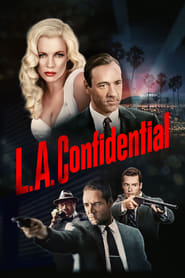
L.A. Confidential (1997)
8 more contributors
Release L.A. Confidential Blu-ray (Warner Home Video, 2008)
James Ellroy, Brian Helgeland, Michael Nathanson, Andrew Sarris, cast members, and department heads discuss adapting and producing L.A. Confidential. They explain condensing the novel around three leads, rehearsing, preserving suspense, and using locations, photography, costumes, and Robert Frank images to establish the period. Curtis Hanson is discussed but does not participate in the track.
- Duration
- 2h 12m
- Talk coverage
- 88%
- Words
- 18,705
- Speakers
- 14
Guided collection
Controlling information in ensemble mysteries
Bryan Singer and Christopher McQuarrie discuss misdirection in The Usual Suspects. The L.A. Confidential cast and crew explain organizing its three leads and withholding information. Both tracks examine how casting, performance, sound, and editing help audiences follow a complicated story without revealing its outcome.
Part 2 of 2
- 01 The Usual Suspects 1995
- 02 L.A. Confidential Now reading
Commentary density
Highlights
Topics
People mentioned
The film
- Director
- Curtis Hanson
- Cinematographer
- Dante Spinotti
- Writer
- Brian Helgeland , Curtis Hanson
- Editor
- Peter Honess
- Runtime
- 138 min
- Also on
- OneSheet ↗ OverBlack ↗
- External
- IMDb ↗ TMDB ↗ Find on Amazon ↗
Transcript
18,705 words · 141 flagged as film dialogue
Curtis and I had lunch and several phone conversations and probably a meeting or two and we found real common ground in how to mount the picture and the potential of populating it with different cast and that there would be a young cast and And even though that it was in a period of the 50s, it was going to be hip, a fast-talking movie. It was going to be bright in colors, even though it was in dark shadows. It was going to be enormously sexy. And each of the three main characters all had contemporary visions.
Become a movie star, or at least see one. Life is good in Los Angeles. It's paradise on Earth. That's what they tell you anyway. Because they're selling an image. They're selling it through movies, radio, and television. In the hit show Badge of Honor, the L. A. cops walk on water...
I really believe the best way to get the movie greenlit was not to have Arnon read the script. The best way was for us to describe this movie, and most important was to have Curtis describe it, because Curtis was the movie, the movie was Curtis. ...
color to the nth degree, and his number one bodyguard...
Arnon has great instincts and is an intuitive person. And it was clearly the only way to get him involved in the picture. And we knew we had to strike with that kind of force to get him into the picture. And he got it. crime exists in this
city with the best police force in the world. Something has to be done, but nothing too original, because, hey, this is Hollywood. What worked for Al Capone would work for the Mickster.
L. A. , you know, represents in a very gruesome sort of way the last frontier of American crime, and it has its own identifiable personality as a locale. It's a city in which everyone drives long distances just to meet other people. The famous story that attends me is the fact that my parents divorced and my mother was murdered in 1958. Unsolved to this day, she betrothed me to crime, damned if I didn't develop a big fixation with L. A. , my smog-bound fatherland in the 1950s. And when I became a crime novelist, I got the idea of creating four big novels that would cover 1947, the year before my birth, to 1959, when I was not quite 11 years old, starting with A Black Dahlia. That's number one. Then a big Red Scare novel, The Big Nowhere, and then the pivotal volume and the largest volume of the quartet, L. A. Confidential, covered the largest period of time chronologically, 1950 to late 1958, concluding volume white jazz into 59. A large influence in Bud is James Ellroy.
because they were always very affectionate towards Bud White. And, you know, every couple of days there'd be a new message on my answer phone, you know, Wolf, Wolf, hear the demon dog bark. He's got a 12-inch wanger and a close in the dark. And always finishing with something about Kansas City or some other little detail about Bud White that he wanted me to know, you know. Things, interesting things like, you know, Bud White doesn't drink beer. His beer is a social drink, you know. And if Bud White drinks, he drinks scotch and he drinks by himself. Because he doesn't want that drinking to become any part of somebody's access to him, you know? So he dropped little gems like that in conversation, which would just sort of set my mind alight, you know?
Go get yourself fixed up. Merry Christmas, huh?
The last part chronologically to cast was Kevin Spacey's part. And it was the hardest, quite frankly. While all three actors are co-stars of the movie, I think in terms of screen time, that part had the least amount of screen time, but also had the trickiest part to pull off because he... He's not necessarily liked by the audience at a certain point in time, and whoever played that part had to actually make decisions as a character to get the audience to realize that he changed by the end of the movie. All the actors, all the characters changed by the end of the movie, but his change was the biggest. He had to have sincerity. He was an empty character.
What's that about?
We did a piece last year, Ingenue Dykes in Hollywood. Her name got mentioned. Hey, Jackie boy. A friend of mine
just sold some reefer to Matt Reynolds.
He's tripping to life fantastic with Tammy Jordan. Sorry, I lost you for a second, Sid. Contract players, Metro. You pinch him, I do you up nice feet. Kevin had worked with New Regency before on Time to Kill and had worked at Warner Brothers as well. He was on board, and we had locked our principal cast. No, it's not. It's felony possession of marijuana. Actually... I read the book shortly after I saw the movie. I marveled at the astuteness of the adaptation. I liked the book. The book was a real page-turner. It dealt with a world that I had only experienced secondhand, and I felt the book captured a great deal of this psychological complexity. It dealt very much with the choices pretty much we all have to make in life. And here, the choices are made under the greatest pressure, threat of death lurking in the shadows. The married men have Christmas Eve off.
That's a good lead for the story.
Sure. Merry Christmas, Captain. The audition process in the States is very different than it is in Australia because obviously in the States there are a far greater amount of actors and there's a lot more to wade through. In Australia you go in and you do your audition and you get the job or you don't get the job. In America you have a meeting and then you go and do a reading on tape where they don't even expect you to know your lines, which is kind of weird to me. And then you might go and do a bit of a test on tape Then you might get called back to do a proper screen test, which is on film. So there's quite a long process, and that was actually really surprising to me. But funnily enough was, by the time we got to the point of doing the screen test, it actually just felt like a day at work because there was a full camera crew, we were fully made up, and it didn't feel like for me that I was on show. It just felt like we were all there to sort of work together to make a scene.
You're wrong, sir.
Would you be willing to plant corroborative evidence on a suspect... People talk about going to L. A. , you know, to answer all their prayers and, you know, to fulfill all their dreams and to get away from anything that was bad in their life and everything that's gonna be good in their life is gonna be here in L. A. And, you know, that's such a precarious kind of existence or such a tenuous sort of tightrope to be on because for the few that it works for, great, fantastic. But for those that it doesn't work for, it can leave you behind. It has an incredible sense of volatility about it. And I think the fact that it's kind of on a fault line says something. You know, there's a particular frequency, there's a particular vibration about L. A. that really, it's so heightened. It's either fantastically positive or it's depressingly negative. If I ever
get held up, you guys better be here.
It's such a well-crafted piece of filmmaking. From A to Z, actually. Casey, Joe, gin, rum, scotch.
That sounds like a hell of a party,
Lin. I'll be right with you. And I thought it was terribly brave of Curtis Hanson to cast Guy Pearce and Russell Crowe, two virtually unknown actors in the States, to play very American roles. I thought actually that their accents are really good. Merry Christmas.
Merry Christmas to you, officer.
That obvious, huh?
It's practically stamped on your forehead.
There you go, White. It also gave the audience an opportunity to see a film that you cannot make about modern times. You had to set it in another period because of the racism, because of the language, because of the bigotry. from some of the characters in the piece. And that's fascinating, too, because it actually seems like it is of the modern era, but it isn't. And I don't think you could make a film about the social situation now in the way that L. A. Confidential. And it was just a very well-crafted piece. Hey.
Get lost, why don't you?
This movie is a calculated gamble. in that none of the main players were, at this time, particularly big stars, although Spacey has a great many theatrical credits and is considered a very accomplished actor. And this is what makes this film less of a studio picture and more of an independent picture than would normally be the case, simply because of the casting. Certainly the filmmaking is as classical and yet as... original and independent as you could want. I didn't think he wanted an imbalance. For instance, if one of the detectives was George Clooney, the writing would be tilted toward the George Clooney character. But by using these three virtually anonymous actors, he was free. to give them equal roles and keep our suspense as to what's going to happen to each of the three. Whereas with Clooney, there's never any suspense, you know. He's going to wind up on top one way or another. But as the picture develops, you can see that it is too complex to have a single lead. Curtis Hanson and his collaborators honored Ellroy's book by not
building up one character at the expense of the others. If you know Danny, you know Danny is like a fire plug, an animated fire plug. I think he knows exactly what he wants to do. Danny's got very good instincts both as an actor and as a filmmaker. He understands his character. that he plays, his persona, really well. So he sort of upped it a little, to my mind. He sort of blew it up a little, but it was right for the guy, you know? It was, hey, here's one of these kind of guys, you know what I mean? Like this. So. The movie premier, Pat Busk. Take care of them right down at Hollywood Station. I'll get the evidence. I first heard about L. A. Confidential through Curtis Hanson, the director. I read the script. and then we met at the Formosa Cafe. I found it such an extraordinary screenplay. I hadn't read the novel yet, but I would later read the novel and actually be quite amazed at what they had done structurally to it and how many storylines they had cut out of the book and still made it retain its heart and that incredible noir, complicated storylines, you know, characters coming in and out. Yeah, subtle.
What took you,
Stensland? My partner stopped it. I said to him, all right, if it was really the 1950s and you were really directing this movie, who would you cast as Jack Vincennes? And I kind of expected he would have said, like, William Holden, you know, that. But he didn't. He said, Dean Martin. I thought, Dean Martin? And he said, well, watch Some Came Running. Watch Rio Bravo again. And you'll see the quality that I'm talking about. It is a man who on the surface has all this ring-a-ding, you know, he's slick and he's cool and he's on top of it, but up just underneath the surface is a man who is going through changes and going through a moral eruption that will ultimately lead him to the place where he realizes he can no longer behave. the way he's behaved, and I did watch those two movies. What I found so interesting about Jack Vincennes was that he, you know, was living in this world where he was almost the big guy himself. Everybody knew him, certainly they knew him in the film business and the television business and this god-awful TV show that he was the consultant on. You know, he was an amusing guy, but I think that in a sense his character represents the
the underneath, undertow, vile part of allowing himself to be part of something he probably shouldn't. And ultimately it leads to the death of some innocent guy and that in turn sort of made him realize, man, you know, this is a line I can't cross. And of course it ends up costing him his life because he doesn't have any idea, nor does the audience, who is as deeply involved in the whole corruption and and the whole scandal. James Ellroy wrote the book on which this is based. He doesn't pretend that he's exaggerating for effect. He says this is... how it is, this is how it's happened. I likened him to a modern Balzac, treating how people really live and what motivates them and what drives them. And he was a very effective writer. I wanted to write the single most ambitious historical crime novel ever written, and I think I did. I had one theme, LA in the 1950s. This is it. I understood the iconography, the three bad cops, William Parker's reform regime, race, interracial love story, sex, scandal rag journalism, the pervasive and invasive influence of Hollywood, Hooker's cut to look like movie stars, Jewish and Italian gangsters at war. It's an everything novel. Officer,
you should know this is bigger than
a police board. The grand jury is convening. Indictments may be handed down. Will you testify? No, sir, I won't. Cops and riders are gossips and anecdotalists of the highest order. These are guys who love to talk shit. Writers love to hear crime shit. Cops love to tell crime stories. They dig me because I dig them. I'm very order-obsessed. I'm an authoritarian. I would rather live in a world that errs on the side of authoritarianism than a world that errs on the side of permissiveness. You can't get too many people, especially people in the arts, to concede that. However, you can get a lot of cops to concede that, chiefly because they deal with a lot of personal disorder in their own lives. They like to impose order on the rest of the world. I'm like that myself.
I'm glad you feel that way, Edmund. Most of the men
doubt it. That's because
they think silence and integrity are the same thing.
Not exactly the image of the new LAPD. Guy Pearce, he's the straight arrow. He's coming into his own here as an authority figure, because he has an integrity that cannot be shaken. But he's very bookish, his unyielding seriousness. His intellect is sometimes a handicap. I think the screenplay is a fantastic adaptation. It compresses everything. but it also sort of has its own expansiveness. And you get this from the triple protagonists. It enabled you to cut always from one to the other, from one story to the other, from one confrontation to the other.
White's a mindless thug.
No, Edmund.
He's just a man who can answer yes to those questions
I've asked you from time to time. The department and the public need role models. Funnily enough, ironically, just as I got cast, just as I was told that I got the role in the film, I came back to Australia and Ellroy happened to be doing a world tour and he happened to be coming to Melbourne. And he was doing one of his sort of one-man, you know, he does like a one-man show where he reads from some of his books and there's actually a band and he performs stuff. It's a really interesting show. So he was at a theatre in St Kilda and I went along and I'm sort of sitting at the back and at the end of his show, It's sort of question and answer time from the audience. And someone asked him about, you know, about the idea of turning his books into films and what he thought about it and this, that and the other. And he said, well, funnily enough, you know, we're about to do LA Confidential as a book.
you know, I believe that, you know, Guy Pearce and Russell Crowe are going to be playing these roles. And all these sort of diehard Ellroy fans in the audience laughed and jeered, thinking that Ellroy was really making a joke, and he picked a few local names and tried to sort of make a joke out of it. And I was sitting there so humiliated, the idea of all these really sort of diehard Ellroy fans laughing at us having, or me particularly, having been cast in these roles. I'm sure those fans a year later watched the film and went, oh, wow, he was telling the truth, you know. Yes, sir, I am. So be it.
Well, Sergeant, we'll get right to it.
I was surprised that Curtis gave me the job. It was more about being surprised that I got this opportunity to play such a substantial role in such a good film.
I'd done a TV series in Australia for about three or four years from sort of 85 to 89. The show was called Neighbours, it was a soap, it was on in the UK and it was on in England and in Australia as well and it became hugely popular so anybody that was on that show really became a bit of a household name. The sort of recognition aspect of my life increased dramatically in doing that show and I think that's what everybody sort of knew me from initially. But funnily enough a couple of years after that I did a film called The Adventures of Priscilla, Queen of the Desert, which was really a huge success particularly compared to the budget of the film. and i think that was the the thing that really gave me an opportunity to then get an agent in the states and start seeing casting people and they like to kind of connect you with something you know
and so it goes
funnily enough Curtis Hanson hadn't seen Priscilla, Queen of the Desert, and didn't want to see Priscilla, Queen of the Desert. He didn't think he wanted to sort of bamboozle his idea of me with this sort of image of me and sort of drag, I think. So he stayed away from seeing Priscilla. And it's funny, because everyone knew that Priscilla gave him the opportunity to work in the States. But the first job that I got, which was L. A. Confidential, that was the one director that didn't actually see Priscilla.
What's the chief throwing you?
Throwing me? Yeah, actually,
what's the payoff? You're the payoff expert. I'm just doing my duty. Come on, you're playing an angle here, college boy. Right?
You're getting something out of this
so you don't have to hobnob with
rank-and-file cops who are going to hate your guts for snitching. Well, if they're making you detective, watch out. As an actor, you... I, anyway, you know, really sort of strive for versatility, and I'm fascinated in... sort of a variety of different characters and personality types. So it makes sense to me. And I mean, I've done a lot of theater growing up. So, you know, I was really used to sort of, you know, going from this extreme to that extreme, I suppose.
Bud White will fuck you for this if it takes him the rest of his life.
Captain,
what do you want? Call me Dudley. Dudley, what do you want?
It was actually a pretty heady time, because I had just gotten the nomination for Babe, and I was flabbergasted. And I just got a call from my agent to go down to the studio on Santa Monica and meet with this director, Curtis Hanson, who I didn't know, to do this. And they sent me the script, which had never happened before. I was the guy with the side sitting in the hall. You know, you didn't get the whole script. Now you got the whole script.
They had a change of heart. What about Stensland? Your partner's through. Departmental scapegoat on the chief's orders. A year from his pension.
And I walked in and I remember Curtis saying, Oh, I'm so delighted to have you here. So I felt so great that I really didn't pay much attention to the reading. I mean, I just... He said, do you mind reading it? I said, oh, jeez. That was okay. I felt great. Like you. Look, lad, I need you for an assignment. My dearest friend is Irish, and I spent time in Ireland with his grandmother, who lived in Drogheda, of all places, which, of course, is Cromwell decimated. And it just, I must buy osmosis from... Those days must have sort of out of guilt, you know, sort of ingested this. I once had a wonderful Irish actress say to me, do you call that an Irish dialect? You've got one word from Cork, you've got an expression from Dublin, half of it's from Galway, so it's not, it's just what occurs to me. I just love doing it because I love the sound of it and I know my guy, you know, I know
who he is so I don't have to worry about him. I can make stuff up in the dialect and never get lost. The other part is to try to figure out, you know, with a heavy why the character has turned. How do I justify this? How do I give it a reality? He's a wonderful character, beautifully written character.
Is he consolidating organized crime power?
I thought the music was a joy. Curtis gave me a tape, which is now worn out because it was played in my car so many times. It was an enormously helpful element of the film. It also had all this feeling of Curtis's influence on it and guiding it through. This is a period of music that I know he loves. Curtis, with that 100% concentration, was able to create and ask for the score that kind of matched these cues. Jerry Goldsmith did the score, and the source cues to me, well, the score was fantastic, and I have the CD, and I listen to it, and I play it all the time. When other people are around, they always go, where is that music from? And the thing about it was that It, too, is timeless. It's not like it came from the movie. It came from the era, and it brings back feelings. And if people weren't alive at that period of time, it makes you interested in thinking that that music was really cool and timeless, like you would listen to it today. And that's the thing about the whole movie, is that it's timeless that way.
When I was a kid, I had this photo of the L. A. town hall. It looked like a strange shape of the town hall. And there's something involved with the pleasure of doing a period piece, which also was related to photography. And there's something great about photography of the past, which is a collector's item, and it's also very intense in terms of evoking something else that belonged to the past, exploring a world which was definitely different But most of all, you know, I think it was the drama that was already on the pages. Because I think that's where the real language of the movie starts. The choice and the search of a language really starts on the first word that is written on the screenplay. That's what sets off your work on constructing the images. And I watched LA Confidential again recently knowing that we were going to be talking about it. And I was yet again sort of awestruck by how... Really what Kevin does is like a wonderful piece of choreography. There's a wonderful scene where he's in his office. Hi,
I'd like to get a delivery to Beverly Hills.
I don't think I know you. Well, look, a friend of mine just gave me this number and I just wanted to find out if... The sort of fluidity of his movement is so engaging and it's so fascinating to watch, which worked so well for that character because here's a character, you know, Jack Vincennes, who's sort of this Hollywood guy and he's a cop. He's the go-to guy for this TV show, you know, so he's sort of a hotshot. Sid, it's Vincennes. Jackie! Hey, you back on Narco? I need some good copy. No, but
I do have something going with Vice.
Something juicy for the Sid story? We ended up getting Danny DeVito to play Sid Hudgens because he was a star and he had a lot of recognizable quality. And his character was named Sid Hudgens, but we actually called him, amongst the producers and directors and the rest of the crew, we called him Hush-Hush, because his character on the up-and-up in Hush-Hush was how he was as a kind of gutter street reporter who trafficked in gossip and smut at the time. He brought a sense of humor to the picture, and he brought irony, and he has kind of this velvet way of the audience wanting to like him, even though he had represented a certain touch of evil that existed.
Good man. We're gonna miss you around here.
Broad deal, Stensland. I wish I had involved myself in the ensemble of L. A. Confidential more than I did, because it's an incredible ensemble of actors. Great cast, great story. Yeah, it's rare that you get that many gifted artists together. in quite a specific genre kind of film, and all contributing to the ultimate outcome. And there is sort of an equanimity of contribution there, which makes L. A. Confidential so complex and sort of meaty. But in my case, I just had three, four days that was pop in and out. I did get to work with Russell Crowe and sit in a car with Kim Basinger and work with Kevin and Guy Pearce, Kevin Spacey and Guy Pearce one day, and then untimely plucked. Hang on a minute.
I'll walk down with you.
Oh, cute. What the hell is he trying to impress, huh? I think that's sort of key elements of understanding Exley. He was somebody who, when we find him in the film, he's already got himself in a bit of a knot. And because of his ambition, which thrusts him into, you know, sort of a senior position of being a leading detective, when really he's quite young. Quite bound, I think. Repressed emotionally. So it's about a character who thinks he's very much in control and very quickly is kind of out of control and is trying to maintain that within a system that he doesn't really understand. I mean, his father is obviously quite a well decorated police officer who's been murdered and he's trying to sort of live up to that. So he's somebody who's sort of rushing into a room with a very particular sort of preconceived idea about things, only to discover that that's not the case at all. And I think that was really at the core of what I was sort of trying to understand. The beauty of the film is that those kind of qualities are allowed to be realised. It's one of those films that the detail and the focus on psychological elements like that
very much part of the film's kind of makeup. It's not just a sort of plot-driven film, it's very much a character-driven film.
I was really thrilled with the score. I mean, I knew, you know, we obviously had a sense of the variety of songs that Curtis was going to use in the film. But once we heard Goldsmith's score, I think that just sort of was the solidifier, you know, that great sort of lone trumpet and that orchestra that he uses really It just sort of encapsulates the style and the class, but also the sort of loneliness as well of the place. So I was really thrilled. I loved it, you know, and I still do. I still love the soundtrack. Sir, I took the call. It's my case.
You don't want it, Edmund, and you can't have it.
I took the call. It's mine. I wanted a hat so bad. I tell you, that was one of the things. Every scene, I would try to get a... It's a period of hats, for God's sake. I got to say, they wore hats. I got one hat. I must say, and the hat looks stupid. Jeez. I wear hats really well, but that hat looks stupid, man. I think he did that on purpose. So I'd look at it every time. I'd look at it and say, see, he was right. I shouldn't have worn that hat. My father always wore those hats, you know? So I knew it. It was an interesting thing about the period, because we don't wear them. So we're not used to it. We don't know how it changes the face, how you hold your body. That's one of the hardest things. I just think that was one of the points where Curtis didn't want to make the absolutely prototypical 50s movie. And, you know, hats are a real cliche of 50s movies. I think, in all truth, that any reference you see on the 50s, you see a lot of hats.
But you don't see every single person in a hat, and that's the sort of choice that I think Curtis made, which is he just didn't want to go at any time for the prototypical idea. Curtis came prepared with an incredible amount of stuff. Not only did he show me postcards and reference and all sorts of things, immediately afterwards as I got the job, we saw an incredible amount of 50s B-movies. which was a great pleasure because we spent many afternoons seeing films that I would never otherwise have seen. Again, he himself has such a passion for this period that he brought with him real treasures. I think it's an enormous help across the board. But, you know, we were able right from the beginning to be able to sort of consider things in a visual way before we even started fittings because things were drawn up and looked at and discussed, so we were able to keep within colour palettes. I worked very closely with Jeannine Oppewall too, which was lovely. We had a nice connection because she had worked with my late husband.
Captain Smith and myself, why?
The Night Owl Massacre. Hyperbole aside... I think it's true that you sense when you watch the movie that all of the people who are department heads and really major contributors to the style and content of a movie are all on the same page, feeding off each other in the best of all possible worlds. I really liked working with Ruth because she was very enthusiastic about the material. We would call each other every day at the beginning of the day or at the end of the day and talk about, I would talk to her about what I'd found and what colors I was thinking about using and she would talk to me about some fabrics that she had found or some silk tie material she'd come across that she was thinking of using and we just was constantly talking even if it was only a small conversation about the kinds of environments that we wanted to create and how we could make the characters either blend into those environments or stand out from those environments and bring the movie to life. When I saw the film, one of the things that really struck home to me was how perfectly the music suited the movie.
how brilliant the song choices were in the soundtrack. And they made the transitions from character to character really punch home. But I thought the actual theme was such a beautiful combination of something that was fresh because you hadn't heard it for a while, but it was something that was so completely influenced by the period that the film was set in. I'll take the results.
You got it from here. Between the two of you guys, you should bring along a photographer.
I need an address on a customer of yours. Her name is Lynn.
That's all I got to go on? Yeah. I think you already know who I mean, so cough it up. There's a billing address and a delivery address.
Curtis is a very easy-going guy, it seems, but he has a very incisive, insightful way, and I felt that I was in, you know, obviously in good hands, that he knew the world of which we were in and guided me through that. Go on down to the driveway. We'll talk there. Curtis had done, obviously, you know, a copious amount of research, and so his, you know, I was following his lead and his direction. What can I do for you? Where were you last night? I was here hosting a party. The scene with Russell took about three or four hours, one morning up there at the house. Mr. Officer White. How about
Sue Lefferts? You know her?
You know I do.
You saw me with her. How did you find me?
Nick's liquor. He was very focused, very intense, brought a lot of really palpable energy to the scene. um, formidable. You know, the character was, uh, his person was, his presence was very, um, you know, large. It was something to, you know, make your knees buckle, yeah. Fine, Philip, thank you.
What happened to the other guy? Buzz. Buzz Meeks no longer works for me. Lefferts looked beat up Christmas Eve, but didn't act it.
How come?
I think she'd been hit in the face with a tennis racket.
She is... was...
Big doubles fan. You're a known associate of a woman killed in a mass murder.
I'd never played a character like that, as styled as Pierce Patchett ultimately was, nor had done a piece in that particular time period. But Curtis painted a very certain picture and said it wasn't going to be any problem, so I trusted him. And I did get nice clothes to wear and a golf lesson. I had to do a little pitch, and so he set me up with a golf pro at a pretty reputable club in L. A. on a Sunday afternoon or morning. I don't play golf, so I forget everything I was taught, but apparently I did it convincingly enough. Sometimes I employ a plastic surgeon.
When the work had been done, that's when you saw us.
That's why your mother couldn't idea. Jesus fucking Christ. No, Mr. White, Pierce Morehouse Patchett. Now,
I sense you're on your best behavior, but that's all
I'm going to tell you. He is more or less a catalyst. He's about making money, and he's about doing this odd service. His whole thing was about beauty, or at least a perceived standard of beauty in that world. The beauty of famous people, beautiful women in particular, and the desire to... to be beautiful in a world that worships beauty in a certain way. And he had tapped into those desires of fame and idolatry and glamour and remaking oneself in the image of the world you want to be seen in. He was capitalizing on a lot of people's wishes and and dreams and all of that kind of stuff which can make one feel vulnerable. I think there are many themes in this film that it lends itself to many themes. One of the themes is the reality versus the illusion. The theme is the inner virtue and inner depravity of human beings. Maybe I will. Maybe I won't. LAPD shitbird, get the fuck out of here or I'll call your wife to come get you. The fact that their surface may not reflect what they really are, what they really are deep down, or who they really could be.
And it's opening strange doors into strange realities, constantly entering new worlds, if only for a moment, and coping with eccentric people. The Kim Basinger character is fascinating because she's been dolled up to look like Veronica Lake. But she's been manipulated all her life and turned into something that she isn't. And here she begins to face up to her own reality, who she really is. I think it's a great woman's part. Of course I am.
What kind of question is that? Do you know why Pierce is humoring you?
You
use words like that, you might make me mad. But do you know? Yeah, I know.
Patchett's running whores. Cut to look like movie stars.
Judging by his address, probably something bigger on the side. He doesn't want any attention.
That's right. I met him, Curtis Hanson, at a little cafe, a very well-known cafe in LA called the Formosa Cafe. Been there for many, many years, back in probably as old as maybe the 40s, 50s, where movie stars used to hang or whatever. And the funny thing about this place is it was in the afternoon, and I remember driving into the parking lot and noticing that there were parking spaces that had the names of very famous movie stars of yesteryear. Now, not one car was in the parking lot. So I remember driving into a parking space and said, I want to park here. Do I want to park in Humphrey Bogart or Spencer Tracy? And I thought, so I kept parking and backing up and saying, what's better luck? You know, what I was thinking at the time. And I remember, I don't know, it was between Bogart and Spencer Tracy. Not a bad duo. So I couldn't go wrong parking. So that's the way this all started. I parked there. I walked into the cafe.
And it was so bizarre. Not one person was there. So it was like walking back into time, walking back into the 40s. And I sat there, and Curtis was there. And this waitress even appeared. She looked like she was out of the 40s. And I thought about it later. This was such a setup. It was something that I think really Curtis would have thought up, you know, now that I get to know him. And it's so funny now that I've gotten to know him. And that was my, that was how I got involved. But the rest is me.
And that's all the news that's fit to print. It was nice meeting you, officer.
Most of my scenes took place in this one house. And most of my existence as Lynn Bracken really took place in this one house. So when Lynn Bracken was Veronica Lake downstairs with her gentleman friends, that's who she was. And she was very clear about that. When she went upstairs in that scene where she led Bud White, she knew exactly who she was as far as just being a vulnerable girl from a small hometown that wanted to open up a clothing store maybe. years from and i think maybe chris meant that i i've not really ever talked to him about that but um that was my take on it my character was a two-story existence oh i saw you fight kid gavilan i like your style
what do you want mr policeman
you got a brother up in folsom i know because i put him there until 1970.
how'd you like to make it
1960.
I know the judge and Lieutenant Exley here
is very good friends with the DA. Yeah. There are very few African-American characters in this film, and this is characteristic of the L. A. police force, which until very recently was largely segregated, dominantly white. This is perhaps one of the subtexts of the film. He's bad, so I'll just tell you. Sugar Ray Collins. Drives a maroon 49 coupe. Beautiful ride.
Don't know about shotguns, but he gets his thrills killing dogs.
You've got to picture me at 10 years old, big, tall, geeky kid, and all of a sudden I could see an entirely different malign universe, coexisting, concurrent, with the outward placid boomtown L. A. I hoarded this secret. It was the only precocity I ever evinced. It's the great theme of the motion picture, which is not the theme of the book. The theme of the book is this is L. A. for eight years. The movie is wonderfully compressed chronologically, and the story's compressed as well. And that's Curtis Hanson and Brian Helgeland's great theme, the distance between illusion and truth in Los Angeles. Somebody beat us here. Damn it. You're kidding.
Well, just don't shoot me.
Sometimes things happen when you actually put a costume on. Something changes. And I suspect that I began to discover, you know, as you do, when suddenly you have a prop or you have another actor or you have a set where it's no longer a concept. It's now flesh and blood and you've got to deal with the environment. So all kinds of things just occur. And very often my favorite... thing that happens in film is when they occur on screen while you're doing a take. That to me is, if you rehearse just enough, and you have just enough sense of where you might want to go in a scene, the magic happens when the camera rolls. Only one, up the stairs.
He's very serious.
He's a bridge between those two. He has his own elements of that people don't think he's up to speed when they say, are you willing to shoot a suspect in the back? Are you willing to do this? No, no, no. So he has an element of butt in him in that no one doubts his intelligence, but he's thought of as a guy who won't go the whole nine yards as far as what's required. And at the same time, he also has a drive and a corruption in himself as well as far as I'll do anything to get ahead. In a weird way, he's there, the two angels on his shoulders, and he takes elements of both of them.
How's it feel getting out of the office?
Since he really survives the movie more than either of those two guys does, I mean, Bud's alive, but he doesn't really survive the movie. I think it's Exley who, in a weird way, becomes the kind of focus of all those ideas. These guys killed Stensland.
These shots indicate something that's been running all through the film, that every person is a reflection of every other person. And the Pierce character has become very much a mirror image of both the Spacey and the Crow characters. Oh,
I'll break them, sir.
The decisive end of the picture belongs to character with the most integrity, character with the most seriousness. L. A. Confidential is on the side of James Ellroy, too, is on the side of morality. Good versus evil, however tarnished good may be. Oh,
I think you'd be surprised what the lad is capable of.
You're 22, aren't you, Ray?
One of the great qualities that Curtis has is that he's an incredibly intuitive man and sensitive, considerate and has a great ability to look at you and know what there is going on in there that makes up who you are and therefore what you then need in order to give him what he needs. You know, I've had directors before sort of say, you know, think of blue or whatever and you go, do you want me to do it fast or slow? That's all I need to know right now. And Curtis knows when to leave you alone. He knows exactly what to say to get you to do what he wants you to do. And is very specific with each of his actors. He's just intuitive and, as I say, sensitive. So he's really aware of what's going to work for everybody. And clearly we're all very different people. And it must be very difficult as a director to know... you know what to do when this actor wants to rehearse a lot and this one doesn't want to rehearse much at all like how do you how do you balance that out and he's uh he's very skilled at that oh
you feel the same way about people too
what you're trying to say we got the shotguns right i don't own no shotguns why are we throwing clothes in the backyard incinerator say what
a neighbor said she saw you throwing clothes in the backyard incinerator
The thing that really sort of stuck in my mind with Curtis and what we would discuss was not so much character stuff, but funnily enough, it was really just more about acting generally. I mean, working with Curtis was a little bit like being at acting school, drama school, having a sort of great teacher. And
I'll say Sugar Ray's not a punk like his sissy partners.
So he taught me a lot about film acting, really. The rehearsal process was quite funny, really, because it was Russell and I and Curtis and Brian Helgeland sitting in a church at the top of Highland in Hollywood for about seven weeks, while Curtis was also casting the other characters. So we would sit around a table and talk about character and really figure out the relationship between the two and this, that, and the other. Curtis would go and sort of disappear for an afternoon or a day or, you know, two days or whatever and come back with Kevin Spacey or whoever the next actor might be because he hadn't fully cast the film by the time we started rehearsing. So it was, we got a really extended rehearsal period and would be surprised, you know, James Cromwell would turn up and Danny DeVito would turn up. Wow, this is getting better and better. Give Jones the newspaper. I want him primed. I'll take the cuffs off so he can read it. Ray Collins just ratted you off. Said the night owl was your idea. I think it was Ray's idea. You talk, I think I can save your life.
Son, six people are dead, and someone has to pay for it.
Now it can be you, or it can be Ray. Lewis, he called you queer. He said at Casita's you took it up the ass. I didn't kill nobody! Son... I think my first reaction in reading the screenplay was probably a little confusion because it's clearly a dense plot and the beauty of the script really and the film and the story is that it doesn't clearly indicate, you know like so many other films do, the sort of black hat wearing bad guy and the white hat wearing good guy. It doesn't have that sort of delineation and the delving into the sort of the grey area or the sort of the murky confusion of good people doing bad things and bad people doing good things, I think is really what sets the film apart from other films and other stories. So I had to go back and look at it a couple of times and really try and understand who of these police characters, Captain Dudley Smith and Kevin Spacey's character, et cetera, had a questionable moral agenda or whatever. So it took me a few passes through it.
to really get a grip on it. I clearly knew, though, in reading it, that it was clever. It was dense and it was clever, you know? So it was pretty inspiring. Tell her out.
Tell me where she is.
Move! White? One and six. Where's the girl? White, I have this under control.
Put the weapon down. Where is the girl?
My friendship with Curtis is about music, and it's about movies. He introduced me to a lot of things that, at that point, you know, we're talking 1996, that I hadn't seen. Things like Stanley Kubrick's The Killing, you know? What a magnificent film. An efficient, glorious movie to be made in the middle of the 50s, you know? And the work of actors like Sterling Hayden, who, you know, is a persona actor, and, uh... but probably underrated. There's a sort of a misunderstanding, I think, about Sterling Hayden's work where some people can't gauge the emotionality, but I don't think you're watching closely enough if you feel that way. Yeah, so if we get together, it's generally because we're gonna go and see a concert or we're gonna go and see a 70 mil print of The Great Escape or something. That's our touchstone. There's been a few times over the last 10 years when it looked close to us working together again, but it hasn't come up yet, but it will at some point.
My Confidential, I think, occupies a special niche. It's a classic. It has the size and scope of a classic. I think it's the best of its genre. And I said in my review that I'm tempted to call it the Citizen Kane of noir movies, of American noir, certainly of L. A. noir.
Why I use Citizen Kane as a model is that Citizen Kane was thought to introduce a new era into films, a new form of filmmaking. Everything is pre-Citizen Kane and post-Citizen Kane. And I think Hollywood, or L. A. noir certainly, is post-L. A. confidential. pre-LA Confidential. Film Noir is a film that deals with the darker side of life. It's derived from a French series of books that were written that were on the dark side of existence.
It was then later applied, mostly by French critics, to a group of Hollywood films that were made in the 40s and the 50s. And almost unperceived by most critics of the time, a group of films that hewed to the production code, which meant that everybody who did something bad had to be punished. But back then, the noir films were not adequately appreciated. They were dark. The characters were very grubby, materialistic. Not at all the Hollywood types of heroes and sympathetic people. Here there was a dark side to human nature. And you get it here, this police brawl. You're supposed to stay away from a man when his blood is up.
His blood's always up.
Perhaps
you should stay away from him altogether.
Curtis is quite the cinephile, so at UCLA he would be putting on 50s noir-type films, and he might talk about how this one might not have taken the story as seriously as he wanted to. So through sort of looking at other work, you've got a real sense of how to sort of navigate your way through this noir genre.
Roland Navarette lives on Bunker Hill.
He runs a hole up in Salisbury at Devil's...
Anyone seen Jack Vincennes?
I appreciate film noir, and there's many film noir films that I really love, but I love 70s cop movies, and that's what this always seemed to me. It was set in the 50s, but the attitude and the violence, I always felt like we were making a 70s cop movie, really, that Bud White could be Popeye Doyle in another world.
Let's go.
Not to speak for him, but I would even say that Ellroy's, that's not his intent either. In fact, as he's coming off much more straight detective fiction, when he gets into the L. A. quartet, as he calls them, he's making his bid not to have those books stuck in the mystery section, but to be in the literature section of the bookstore. The spareness of the noir is always what's important. You don't overburden them. You lull them into the confidence that they think they're ahead, and then you turn it on them, and that's the gag.
Stay right there. You're under arrest. Don't shoot,
man!
Don't shoot! Don't move! Don't move!
I think it is a film noir. I think it could stand next to some of the great Bogart movies that is what he made.
I think L. A. Confidential is a variation on the theme of film noir. It's not classic film noir. It's not black and white. It's not harsh, dark shadows and harsh, bright sunlit. But it has a similar undercurrent and a similar tone and a similar willingness to explore the dark side of a place that everyone thinks is supposed to be sunny. relentlessly sunny, but if you look under the relentless sunshine, you're going to find the pitch black of the usual human evil intentions and sloppiness. I think if anyone were to see L. A. Confidential now, they might get a sense of what it was in the 50s more clearly than any 50s film would have shown it. because I think that it captured the quintessential glamour of the place without the feeling of sort of super wealth. And I think what it captured was possibly a more normal LA too. But I think it was a very warm look at LA and not many films have that sort of affection for LA. They either ignore it or or tend to want to bring it down, make it gray and grimy. Janine has this almost unerringly clean eye of being able to go and sort out exactly these gems of sort of 50s dwellings.
that I have no intention of changing my vote. It's not the norm to have the music that is eventually going to be in the film playing while you're shooting. It certainly informs the mood and the whole atmosphere. It's great. But it doesn't, in my experience, it hasn't been the norm that that happens. Sometimes they'll play music, will be played prior to filming the scene, and then the music cuts down just to give you a sense of the mood and the atmosphere. But I think that's a rare thing, but that's great when it happens, because it just gives you more texture. If it's specific to your character, or if it's just specific to a moment that they want to, in the film, it can be... that can be very helpful, very informative. Curtis had this traveling bag of 10 to a dozen period photographs that he had found, some of which, as I recall, were places and some of which were people in costumes and just general sort of dog and pony show photographs that he showed everyone when he was selling the movie.
So we talked about the photographs that he'd been collecting and what inspiration he saw in those particular photographs. And then essentially after that, I climbed in the car with the location manager and scout, and I don't think I climbed out of the car for another six or eight weeks. And also because I drove around myself on weekends, I decided There were five or six locations that I thought were going to be very problematic to find because the action that the story described was very specific. So I ended up making little post-its. I wrote six little post-its on my dashboard in my car. The name of the set, the action required, and any little descriptive elements from either the story or the novel or the script. It was a way of internalizing the story so that when you drive down the street, if you see something that feels right, you adjust your body response to it physically and you stop. That happened several times.
I wondered when you might knock on my door again, Officer White.
It's Bud.
Lynn Bracken's house is going to be Spanish-style, and there's going to be a palm tree in the background. And we had set out by looking at those typical, very well-known, all-in-Hollywood, Spanish-style, beautiful apartment complexes, all of which slammed the door in our faces, sent us away, yelled that they had been burnt out by television and they never wanted to see another filmmaker as long as they lived. And having exhausted all of those options, then we went to looking for something that would feel that way but wasn't one of those places. So we essentially had one location scout who, for the better part of three months, did nothing but look for those houses, those apartments. We found it, and we were very lucky. We managed to find it. This election
is about the future of law enforcement in Los Angeles. City Councilman Rogers represents that future.
Everybody was integrated. It was the department heads. I was aware that everybody took an extra bit of time and effort and care for everything. And so much of that emanated from Curtis, who was really specific about what the look of the movie was and how it was to, you know, where it was to shine and where it was to look worn. You know, there was this post-war attitude, post-World War II attitude, and those people who are history buffs of the 50s, you could appreciate that's so much of what carried through in the way Curtis and all the department heads then passed on their work through the system. Everybody started having the same kind of attitude and carried the same kind of care to the decisions that they made as their bosses had made, and their bosses above them. So that was what was unique about the making of the movie. I think we had 80-something locations in 65 days, something like that.
We were all over greater Los Angeles, and we were shooting lots of nights. There was inclement weather, both Ritten, where we created a few times, and there was inclement weather that we ran into and tried to make it work for the movie. And, you know, we would go from Baldwin Hills to Pasadena to Santa Monica to downtown Los Angeles. And, you know, a lot of us have all had made movies all over the world, And the idea of making a picture here in Los Angeles and being able to be with your family and all of that was really appealing. But as Curtis found location after location after location and looking at a map with a little pin of all the different locations we were going into and we had to hit them in the days that were scheduled, it was daunting to see how we had to move a company from the interior of the Formosa Cafe in the afternoon
to going outside Griffith Park six hours later. I dig him, but, you know, he, um, he scares me, too. Really. Oh. It was wonderful for me because I learned things about Los Angeles that I had never known and have developed a greater appreciation for L. A. because of the movie, quite frankly. I don't think all those locations still exist today from when we shot them. There was a question actually about the Formosa Cafe over the last 10 years about tearing it down, and thankfully it was preserved. The complexity of this movie with what we talked about is 80 locations shooting in a compressed period of time, most of these scenes at night. Very rarely were all three actors in the frame together, but their characters are all interlocking from each cut to another cut. was wholly dependent on what one actor said to another actor and where they were emotionally and physically in frame. So when you think of the time and energy that needs to be spent to explain all of this to an actor of what's really happening here, it takes an enormous amount of patience. And as I said earlier, the picture is Curtis, and Curtis is the picture. And he was the glue.
that held this together. This complex matrix of story and plot combined with the physical nature of the picture required 100% attention for every setup. And it was really Curtis who brought that to bear.
Meet me there at midnight for a little photo shoot.
Maybe we can work in a Hollywood sign this time.
What do you know about Pierce Patchett?
Patchett?
I know what you know.
He's very rich, and he
just invested in freeway construction, which is gonna make him richer.
Why you ask? Oh, I just keep hearing rumors, you know.
High-class porn, drugs, hookers that look like movie stars.
Patch is what I call Twilight.
He ain't queer and he ain't red.
He cannot help me in my quest for prime sinuendo. If you look at the fact that there were tabloids during that period, it's completely different now. to a point that I think is unhealthy. It's hard to have any sense of how people see Hollywood, but it's been going on forever. And I also think that there's so much about the studio system then that controlled press in a way that I don't think press is controlled in quite the same ways anymore, and particularly now with the internet. You know, the truth is now anyone can go online and say anything about anybody, and in five minutes it'll be a story in a real newspaper. Because we used to come from the idea that you had to have three reliable sources before you write a story. Now, you know, a waitress in a coffee shop can say something was said or happened and before you know it, it's a story around the world if anybody cares about it. And I think that as a result of that, there is a lot of anonymous things that are said. You know, bloggers and things like that who are willing to say the most outrageous things because they're anonymous.
And I think if they had to put their name on them, they might think twice about what they say. Man, oh man, I was raised on the Holy Bible and scandal rags. Hush Hush, Transom, Confidential, On the QT, all the great rags. Lowdown, I dug them all. I developed a style for Hush Hush magazine. in L. A. Confidential of purple prose and alliteration and lots of snide racial asides that I've taken on into some of my short fiction where I've written the entire pieces alliteratively. The style was wild. I dug it in the moment. It's just the outrageousness of the language, and I've been hot-wired to the outrageousness of language since I was a kid.
Thank you for what you did for me. For killing those animals who raped me.
Guy was on a TV show called Neighbours. He was a recurring character, which is one of the great soap opera success stories of Australian TV. And he got that job when he was really young. Because I'm probably about ten years older than Guy, aren't I? Probably seven, ten years older, yeah. And I was doing theatre in Melbourne and I got a a character role offered me on the show. And there was four stars of Neighbors, Kylie Minogue, Jason Donovan, Craig McLaughlin, and Guy Pearce. And I got to work with the first three. And I thought, well, you know, at that stage, I hadn't made any movies. I only did theater. And I thought, well, you know, if anything, if nothing else, this would be a good video to show the grandchildren when I'm older, you know? And plus for three episodes, which is about four days work. I'd get more money than I got for a full eight-week, eight-show week in the theatre. So I said, fine. And I met Guy in the green room on the first morning. And he may have been in one of the scenes that I was in, but we didn't really communicate that much or anything. We didn't do any dialogue, exchange any dialogue.
And then I went on and made some films and stuff. And then years later, I remember starting to see his work in films and things like Priscilla, Queen of the Desert and stuff. And I made a point when I saw him to tell him that I thought he was doing really well. So it was an interesting thing when it came up that Curtis was pursuing Guy. I know that Arnon Milchan said to Curtis at some point, you know, are there going to be any American stars in this movie or what's the story? So Curtis really made sure that, you know, the audition that I did was something that he was, you know, happy to be able to show. I'm sorry.
It's none of my business. He tied me to the radiator.
I watched him beat my mother to death with a tire iron.
They left me there three days before a truant officer found us.
Lynn is who you think is just this prostitute who looks like a movie star, has a whole inner life that takes a long time to reveal as she comes to trust Bud.
To get even.
Maybe. There's a violent streak running through him, but it's mitigated by the fact that it's towards men who beat women, which you also get the sense, I think, that it's ingrained in him from childhood. It's not a random thing he's trying to express. Nothing's what it appears to be, which I think is one of the ad lines or was on the poster or some version of that. The guy you think will do anything if the price is right won't at the end. And the guy who's dumb is not so dumb. I just can't prove it, that's all. I'm not smart enough.
I'm just the guy they bring in to scare the other guy shitless.
You're wrong. You found Padgett. You found me. You're smart enough. So everyone... gets kind of turned on their head one way or the other. I was always more interested in just those guys, especially the Bud character. I mean, it struck a chord with me because he's a guy who thinks he could be a detective, and no one thinks he can be a detective. And I always, as a screenwriter, I come from a blue-collar background and came out to L. A. to work in movies, and I think always felt like no one had too much expectation of me. I related to that character and wanted to prove probably I was a better screenwriter than anyone thought I was. That's just an element of the movie, but that's what grabbed me.
What more do you want? There's blood on the wall here.
Dante had studied the era and was very excited with whatever newest technologies in film that could be done today to make it look that way and have it all that more real for the era. His work speaks for himself. I mean, he shot a brilliant movie. Knowing Dante, his appreciation for life and his ability to work with people made the atmosphere on the set all that much more pleasant. and his crew and people. There was a combined feeling, I think. Nobody ever realized that the movie was going to be as successful as it was both creatively and commercially. I wouldn't say that we knew that, but we all felt that there was something special going on when we were making it. And Dante was a principal reason why. You're welcome. Mrs. Lefferts. Dante really
brought the film to life. I think everybody got their element right. I really do in the film. The cinematography, the acting, the costumes, the design. I think that's what's great about the film as well is that everyone got their elements right. To create that tone that is not only appropriate for the film but is such a cliche to say but it's almost a character within itself to establish that world is so important and it's amazing. I mean aside from the technical difficulties of shooting in a city, you know, 40 years after it's actually set and sort of avoiding cars and telegraph poles or whatever. Trying to get the vibe, I suppose, of the city was something that I think is what Curtis was talking about when he showed us those initial photographs and in what he sort of kept referring to in the tone of Ellroy's book. There's something quite surreal, I think, about LA.
Was it outside?
Inside? Outside.
And then Mrs. Jensen said they kept going under the house.
You have to leave now, officer.
What's through here? Just a room full of old things.
Well,
don't move that.
One day, Dante Spinotti and I both had been thinking about and looking at a book of photographs by a photographer by the last name of Frank. And he had been photographing in the 50s, and Dante and I, we both were responding to that work. People in dark, in light, people in shade, people in shadow. It just seemed that there was a special kind of view of Americans at the time, and for some reason it seemed to have a good feeling for how we were going to light and look at the movie. He had a way of taking away realism from his images with some devices which were either photographing through reflective material or touching the camera, but very slightly. as if he was saying to you, listen, this is a reality which I take away, and I'm giving you my reality, so look at the elements that I'm telling you to look at. You know, I remember translating for my Italian colleagues back in the days a book written by John Alton, who was the head of school cinematographer in the time of the film noir. But besides from that, I was not an expert in film noir movies, which made Curtis Hanson very happy.
Great big one.
Here. As I say, I think the inspiration from Robert Frank and seeing these old photographs and working with Janine and obviously with Curtis, one day I remember telling Curtis, hey, you know, Curtis, it could be maybe a good idea to imagine that we have a still camera in our hands, you know, like a Leica or Nikon. And once the scene are set, we turn around and we click in this direction, we click in that direction. We spent quite a bit of time going through the whole screenplay and discussing, you know, the way of lighting the movie. But basically it's sort of a routine that happens in other films too, except that each film has its own outcome.
Did he say where he was going after he talked to you? Let my daughter rest in peace.
Mrs. Lefferts, I just want to... We decided somewhere along the line, kind of naturally we came into it, that we didn't want the film to feel... as if it were a highly stylized period movie. You know, you're never quite positive or certain that you're going to be able to really pull that off. I need your help with something.
I'm busy right now. Why don't you just go ask some of your boys in homicide?
I can't. It was a very interesting process, very organic process. Panzer L and I, for example, spent one entire day in the building, I think it used to be called the Pacific Electric Building, I think it's condos now. Anyway, it was more or less abandoned and open for filmmaking at the time, down on Main Street and 6th or 5th. Anyway, we crawled from the top of the building, there were eight floors, all the way down to the basement to just familiarize ourselves with the entire contents of the place. And when we were done, we figured that we could do a police station there. And we could build one of the police sets in the gymnasium on one of the top floors. And we could use the corridors. And another floor would be good for the district attorney's office and another lawyer's office. And basically, we tried to put as much of the office-y kind of stuff in that building as we could. and take advantage of everything that it had to offer, and we built walls and repainted and stuff. It was hard work, but at the same time, it was exhilarating and it was really fun.
It was supposed to be about justice.
Then somewhere along the way, I lost sight of that. In the novel, the backstory of Exley, there's more time to be elaborate, to give him a whole family and his father and his brother. his brother having been the one that was killed in the line of duty. But what it came down to was trying to simplify that. And the important thing is that his family had an influence on him. He came from a police family. So we wanted to keep that intact because that was important as to who he was and why he had the drive that he had. Whether his father is alive or dead, he's doing what he's doing a lot of the time because he's trying to impress his father.
Even if it means paying the consequences?
Mm-hmm. All right, college boy, I'll help. If there's a case of your boys on homicide, don't care about it. But we don't have the liberty of introducing that guy as a character, so we end up with trying to boil it all down, and because it is something that happened before the movie started, you don't want to have too many characters telling stories about something you're not seeing in a film. It's to get the simplest version of that and combine the... Make it the father who died in the line of duty, and then getting across the influence of his dad, but having to simplify it so that we're not going into a long speech about his background. Johnny Stompanato. Officer Wendell White, house tricks paisano.
I ain't your paisano.
and
I ain't in the snitch business anymore. You know a guy named Buzz Meeks?
I'm very fond of the 50s. I was born in England in the war years, and I have real wonderful childhood memories of being incredibly excited when we were able to get a copy of Seventeen magazine. My mother was devoted to the idea of dressing me as an American teenager and it obviously has been an early memory that has stuck with me forever. I don't think I ever saw very many films about Hollywood. It was just a dream. I've wanted to be a costume designer since I think I was five or six. when my parents took me to the Manchester Opera House to see a production of Brigadoon. And they were so colorful. And Manchester was so gray. And I just remember looking and thinking, I would like to do this. And I think that there was always a dream of Hollywood. It was just the idea of Hollywood films. You're right. It's probably bullshit.
Ruth obviously is such an artist when it comes to costume design, so it is always a treat to finally put on whatever it is you're going to be wearing and feel that it really enables you to sort of, you know, step forward as that character, and clearly that was the case with L. A. Confidential. The wardrobe is essential to creating the whole sense of a character. The clothes that Patchett wore gave you a sense of a man who knew what he wanted and was very kind of elitist and a person who would command presence in a situation. And a kind of an egotistical specificity to his world was echoed in his wardrobe. When you watch Pierce and Spacey together, twin warriors, so to speak, you watch them and you feel a sense of equality and camaraderie just emerging. This would not be as effective if you had even two stars or one star and one non-star looking at each other in this way. Maybe why
it's not so dumb after all.
I didn't know Guy. I met him, I think, maybe once. And then again, we became friends after we filmed. We had such a good time. And again, I think he's an actor who continues to choose really fascinating, really good, really complex roles for himself and didn't allow himself to get boxed into the leading man, which he could have easily done and chose not to. And as a result, he's had a far more interesting, far more diverse career and challenging one. I think Guy's the best. The millionaire? Yeah,
I think we should go talk to him.
First, I want to brace Stompanato. No, please. I remember it was a great shoot and I remember I had a really, really good time. A great time with Guy. There was a scene where we have to laugh. I think it's after he makes the mistake of telling the woman in the Formosa Cafe that she's not Lana Turner and
she is Lana Turner.
And it was just, hey, that was such a fun scene to shoot. And then I think we have a shot in the car after when we get into the car and we just burst out laughing. I just remember shooting that scene and we were in hysterics. I don't remember what take Curtis ended up using. A hooker cut to look like Lana Turner is still a hooker.
Hey! She just looks like Lana Turner. She is Lana Turner. What? She is Lana Turner.
Here you have a funny clash between reality and illusion, which is apparently commonplace. In Hollywood, non-celebrity is mistaken for celebrity, and here, celebrity is mistaken for non-celebrity. I was sort of swept away by it because I had such a little part that I didn't have to worry about my own thing in there, so I could just sit back and get washed by this movie. And it was... really a great accomplishment because there are so many tributaries and corners and characters and inside that the world of LA and the confidential nature of what was going on and you know the underpinnings and the underbelly of it it just was just a very complex story and fascinating really kind of luscious and the world was very tangible And it was a great adventure story, mystery story, action picture. And the particular characters, their stories too, were very grounded, I felt. You know, Russell's character and Guy's character and their relationship with Kim's character. It was really, you could have just done a movie about that alone. It was really entertaining and engaging. I'll drop you at the car.
Where the hell are you going? Lynn Bracken's. I'm gonna find out why Patchett has her seeing Bud White.
I'll
see you at the frolic room. Oh, great. You get the girl,
I get the coroner. Kim Basinger, as being one of the most beautiful actresses of the time, and her ability as an actress became clearer and clearer that was who we wanted to play the part. I think it was really important that the essence of this character was that she had integrity. that what she did might have been a necessity, but the ends justified the means for her. And Curtis worked really patiently with her, and we tailored things in the script to have it have more authenticity, that she would only do things ultimately because they were the right things to do. I don't think there's anybody who saw the movie that wouldn't believe the choices that this woman made as a character in the movie. I'm very, you know, kind of shy to do, even like in rehearsals and things, I like to just get on my clothing, get out there, do my thing, and never see it again. You know? Have somebody say action and then that's it. You know, hopefully I won't ever have to see it again. I pray a lot. I taught you how to dress, talk, and think. And
I am very impressed with the results.
The scene between Guy and myself was a very long scene, and it went all night. It was a very powerful scene. There was a lot to be said, a lot of dialogue. I just remember cinematographer. I mean, the light that you walk into, and that's a lot 40s lighting and your beauty light and the way a lot of things are not done anymore. So that's so specific and so... You're so enveloped in this aweness, you know, from a cinematographer. And you don't ever really, you don't have those many moments in film the way it's really done today, you know? So that was spectacular in itself. I see Bud because I want to.
I see Bud because he can't hide the good inside of him.
I see Bud because he makes me feel like Lynn Bracken and not some Veronica Lake lookalike who fucks for money.
I see Bud because he can't hide the good inside of him.
Guy Pearce, I remember waiting in my trailer to see who was going to play that role one day. I forgot. And it was the first time I met him. And I remember the only thing I'd ever seen him in was Priscilla of the Desert or something. And I thought, oh, this is so bad. This is the worst casting. Oh, my god. Because he was so convincing in that role that I thought, my god, he could never play this tough guy, you know, the cop. And I thought, he's got to be genius then or something. Something's got to be really a miracle has to take place here. But, you know, I've been very blessed to have been in cast, ensemble cast, that are just tremendously, you know, talented people. But, I mean, he was a gem. I won it. very much to have my backstory. Everybody else had a backstory. You sort of knew what their deal was. You didn't know what my deal was.
What's going on, Midnight Jack?
I need two minutes, Dudley. It's important. That's a good thing for you. My wife and four fair daughters are at the beach in Santa Barbara. I really wanted somehow, not even if it was written, to indicate in some way his poverty and the reaction to his poverty. that he's overreaching and that's why. Why would a man at the top of his game in the Los Angeles Police Department and with a home with three daughters and a wife be doing cocaine? Anyway, charges were dropped, insufficient evidence. You were the supervising officer on that case and
I was wondering if you remember anything about it.
What's this all about, Boyer? Part of it has to do with the murder. I've been working with Ed Exley on it.
You're a narco, Jack, not homicide. Since when do you work with Edmund Exley?
Well, it's a private investigation. Noir is defined by the period that developed it in which those very issues were assiduously avoided. The interweaving of power in the city. Reality was not what Hollywood was interested in then. It was... The only difference was, first of all, you have to have noir where the sun shines. And secondly, it leaves the audience with the impression, unlike most Hollywood films of the era, that things are not as nice as they seem. That under the palm trees and the convertibles and the pretty ladies is this maggots. It's maggots. In fact, there are maggots in the film. Have you had valediction, boyo? Rollo Tomasi. I used to go on my father's sets, you know, so I... I didn't know how the process worked, but I was aware that it was this assemblage and that it was fictive. But then, you know, when you're that age, your whole world is fiction. So I was more fascinated with the theater part of it, the theatrical part of it, the performance part of it. That's magic, being other than you are. So it's just not true. Of course, that's the illusion. But that illusion fascinated me.
Our justice must be swift and merciless. That is all.
I just think Guy is so adept. I couldn't believe it when I met him that this was Priscilla of the desert. I thought, this cannot be the same man And I just think that during the course of things, he really started to settle in, you know, and think, hey, I got this. And that's probably what Curtis saw, you know, and he wanted it a little more. He wanted him off balance because in the book, he's really off balance because he never can live up to his father's expectations. His father put all his love on the brother, and then the brother was killed. And he always knows he's sort of the ne'er-do-well. Yeah,
I know it's unlikely, but suppose, just for a moment,
just for a moment, suppose
somebody did have that much heroin. Who would they go to to move it?
Wait! In my office. Captain, look, just give me your name. Mickey Cohen. L. A. Confidential, you know, I had a lot of calling cards prior to that with films like Proof and Romper Stomper and stuff like that, but L. A. Confidential was just different. Guy and I had a lot of conversations at that time, and... Because I'd made more movies in America, I said to him, I'm going to be really patient before I decide what movie I'm going to do next. And he said, I think I'm just going to work. I'm going to work again and just see what comes up. And I didn't end up working for the whole of 1997. I didn't make a film because everything that got sent to me was another policeman because they'd heard I'd played a policeman in L. A. Confidential. Every other major filmmaker that I've worked with
whether it's Michael Mann or it's Ridley Scott or Peter Weir, they've all seen LA Confidential. And it just put me into a different place. It put me into kind of an elite group. And instead of sitting around with a whole bunch of blokes who I didn't know for an audition, now I was sort of sitting in rooms with three or four guys who, as far as I was concerned, they were movie stars. And that's who was up for the role that I was up for. So it was a gigantic change. Start with the ID on the corpse.
An ex-cop. Leland Buzz Meeks. An ex-cop? What did Jack say? Did he know him? Only by reputation. Wendell, this is Sid Hudgens. I'm willing to cooperate. There's no need to tie me down.
Curtis, he was very, very prepared. He knew what he wanted. Why didn't you tell us about Sergeant Jack Vincennes?
Hollywood Jack, the big V.
I can tell you he's on a night train to the big adios. When I first met him, he had all the pictures and all the way the film should look and all the stuff laid out. So he gave you a lot of information about it. It was an information exchange.
I got him first class collars. He got me good stories.
We were friends, for Christ's sake. Well,
we'll drop that for the moment.
Would you
care to comment on Pierce Patchett?
Patchett? He trusted the fact that he was casting people who could be up for the task. So it wasn't a lot of, like, nitpicking and stuff like that. He kind of sent us on our way, and we went. And it was a good thing. It's a good way to work. I tried this one on.
He's rumored to be a periodic heroin sniffer. All in all, a powerful behind-the-scenes
stranger. And? And what? A lot of the stuff in prep for L. A. Confidential would have included a lot of reading. Curtis had a list of movies that he thought were perhaps good for me to watch in terms of influence. A lot of still photographs from the period. So there was just getting engaged in that on top of the physical stuff, you know, so... That's the thing with preparation, though. In the long term, when you look back, you know, some of the things you do are kind of crazy and weird and everything, but what you're doing is you're responding at the time from stimuli and, you know, a little fissure will open up and you follow that along and you see where it takes you. And, you know, quite a few times when you do that sort of stuff, it takes you nowhere, you know. But other times you find something that you weren't expecting to find or a piece of information, you know.
Emotionally, there's a certain sharpness. We talked briefly about Sterling Hayden and a mask over the emotionality that can be prevalent sometimes in tough guy movies from the 50s and 40s and 50s. But this was to be different than that. You wanted to see all the scars of the emotion in this film.
I wouldn't trade places with Edmund Exley right now for all the whiskey in Ireland.
Dudley! I think these characters are unusually complex. They're much more complex than the usual cop in movies. They have an inner life, and this is what makes this film a classic. This is my particular feeling. is that all films depend on narrative and character and on the interrelation between the two. Without characters, you don't have any narrative. And here, the characters have many tests. There are many ordeals, many moments of stress. And yet, there's a world outside that's largely indifferent, if not actively hostile.
That was a tough scene for us, for the both of us. You know, and I was so fully into the character by then and so into Bud White that... And I knew exactly the reason why I had done that. And I was so sure, and here came this... to the door, that, you know... It was just a very electric moment. I'll never forget the look on Russell's face. I mean, whatever you got on film, I don't think it will ever get what I saw inside him, whatever was going on. But that was a really true, honest, emotional, and very physically violent for the second that it was. And it needed to be that. I mean, we're only making a movie, so you don't ever want to hurt anyone. But physically, I'll just say we did that as clean as I've ever done it in a movie.
And one of the things we did in the records room in the police station was totally filled to overflowing with lots of boxes and lots of stuff and chaos and disorder. And part of that was really to give the feeling that these guys had no record-keeping abilities. But part of it was also to give people the sense that it was natural. It wasn't deliberately historical.
Guy came off truly as this uptight, clean-cut guy, more than I had envisioned. And the thing about Russell was this great physical nature that would leap out at you. And it was so important for the movie and the power of this guy that you believed once he... decided on something, there was nothing that would ever stop him from accomplishing it.
He showed you the photo, didn't he? Didn't he?
Fake! Goddamn you, fake!
Get the fuck out of here!
Once we saw what he could do, It was really exciting to get to those moments in the movie when we were producing them, when we were making them, to see how Russell was going to do it. Because it wasn't like there were great stunts in the movie. There was a lot of physical stuff. There was fist fighting and jumping and stuff. But Russell did it all himself. And you had no problem believing it, the credibility he brings to that element of the movie. And subsequently in his career, on a lot of the bigger movies he's done physically, it's always been... I haven't met a lot of actors who could do that as well as he did.
Stensland and Meeks, what the hell were they up to?
I don't know. But I think Stens killed Meeks over heroin. What heroin?
Johnny Stompanato told me that Meeks had heroin for sale. Meeks ends up dead. Stensland dies at the night owl.
It wasn't the Negroes. There were sort of moments within scenes that probably were more difficult than I'd anticipated.
Dudley's guys, they planted the shotguns and they'd have killed the Negroes too if Jack and I hadn't shown up.
The scene that Russell and I have together where he beats me up and then we have where we connect, that transition I found quite a challenge because there was a clear sort of motive i guess for the two of us to join up it was necessary for us to join up so that was clear but no and it was it's probably the same for russell's character and for russell as well knowing that our characters are so um at the opposite ends of the spectrum really and have such sort of hatred for each other you know him for me because of my sort of political you know agenda and the fact that he's just discovered that i'm you know i've been photographed with his girl etc and so for our two characters sort of come together was tricky for me, I found. The physical part of it, where Russell threw me around the room, that wasn't so hard. But making sure that the honesty of these two characters coming together was real was a delicate line to sort of tread, I think. May I?
Hey, you can't go in there.
Do you
want me to call the police, Mr. Lowe? Ask for Captain Dudley Smith.
Tell him we're having a discussion about the death of an unemployed actor at a Sunset Strip motel. These are it, please. I think it plays very well. This one lasts. It lasts because the situations it describes are still relevant to the world we live in. And
I want authorization to check their bank records.
On what evidence?
Call it a hunch.
Absolutely not.
Dudley Smith is a highly decorated member of this
police department. I'm not going to smear his and Pierce Patchett's name without... Without what?
Them smearing yours first?
I think a lot of people nowadays are of two minds about terror and torture. And I have seen it handled in various ways. Does the end ever justify... the means, brutal as means may be. I find that a very difficult question. I don't think the brutality exhibited by the Russell Crowe character invalidates him as a character. I have to look at the total man and the total context of what he's about. Come on,
don't pull that good cop, bad cop crap.
I practically invented it.
So what if some homo actor is dead,
huh? Boys, girls, ten
of them get off the bus to L. A. every day.
Pull him off me, X-Lade! I don't know how. Now, I know you think you're getting number one hot shot, but here's the juice. For me personally, when you actually make the movie, I have trouble enjoying the movie. Because I can watch a scene and I can think, well, that's the day when I got to set. This had happened and we had to do this. When they shot that, I was right around the corner there, up against the wall. That's the kind of things I remember. The irony is you make a movie that you can't sit back and watch and enjoy. So therefore for me, it's the work, it's the making of the movie that is important and how you conduct yourself and how you, what you create, what world you create for yourself in the making of that movie and the relationships you have and the people you meet and how you work together and everyone, you become part of something that's bigger than you are if it all goes well.
In fact, when the movie came out and started getting kind of uniform, glowing reviews, I was kind of just befuddled by the whole thing and didn't know how to interpret it or take it. And even the whole... We went on an awards tour where we basically just went... Wherever we showed up, someone was giving us something. And it just got to be surreal, but what I always took from the experience was that... It's a roundabout point I'm making at this point, but what I always took was that we went and did our job, and we tried to make the best movie we could, and it was just people trying to do a good job and do as well as they could do. And then you find out that you have the ability to rise to the occasion. Suicide note.
Says he killed Jack because Jack had figured out a pornography scam
Patchett was running.
Slicing himself open wasn't his idea.
Two of his fingers were broken. They must have held him there
or drugged him.
As the LA Confidential thing was unfolding, and as Curtis and I would go from one event to another, to another event, to another event about LA Confidential, I remember my dearest memory was looking at Curtis whether across the room or walking down a hall of the Four Seasons or wherever it was we did all these interviews, and coming out and looking at each other and saying, it's got to be something in the water. I don't know, because everybody, you know, they love this movie. People would come out and they'd say they love this movie. That's my fondest memory. She wouldn't say who.
See you, Exley. Sure. We should talk to Lynn. You do it. What are you going to do?
No matter how many times you watch the movie, you're learning something new or you didn't pay attention the first time and you realize that this is why that happened. And the great thing about it is that the characters evolve. They become heroic at the end. They overcome the obstacles placed in front of them. They face the adversity. And they do it because they join forces. And that, you know, going back to the original pitch where Curtis and I presented it to Arnon, that was the key to the movie, that they come together and overcome the bad guys in the movie. It wasn't that just one guy does it. They couldn't have done it without each other. And if we were able to communicate that in that meeting, we could get the movie made. And we were able to communicate that in the meeting. And if we were able to communicate that in the movie, we would get the movie made successfully. And we were able to communicate that in the movie. And I think that's what carried the movie all the way through, having been released in September and lasting through the awards and the 10 best pictures and the Academy Awards. And sustaining that amount was this sense of teamwork
and the pride and ethic that these characters evolved to that inspired the audience. What happened?
Somebody beat him to death and stole a bunch of files? Must have dug up garbage on the wrong guy.
We've got it narrowed down to a thousand suspects. There is a triumphant quality at some point at the end of the film, With all that's been exposed about the corruption in Los Angeles, you have to have this final struggle, this final battle of absolution. The Victory Motel shootout, which was really our final sequence on the film, was pretty intense. Russell and I, for two weeks, hauled up in a clapboard little motel that had the shit shot out of it, really, bit by bit as the days went by. You know, Curtis really took his time with stuff. He wanted everything to be right. And it really, I suppose, shows the two of us kind of working together, you know, sort of one-two punch type thing.
There was, what happened that went wrong? That's right, I have to jump up on a, I jump up on a sort of deck by a window to shoot out the window. And I, as I jumped up onto the deck, I sort of gripped with my hand, the wrong hand and fired three shots off in the actual, in the motel. So lucky it was, there were blanks and not real bullets. I don't think I killed anyone. It was really well orchestrated obviously from a stunt point of view and The nice thing about it really was that Curtis was very open in allowing Russell and I to make it work for ourselves. It wasn't that it was sort of choreographed and we turned up and we were told what to do. It has such great energy to it and the sound quality of it, which obviously makes a big difference in things like that. It just gives it an excitement that is hard to achieve. It's as spare and clean as the rest of it. And it's not gratuitous and it's...
You know, it has the feel of reality to it, as though if you were in one, that's what it would look like. The abruptness and the, I always think that violence, they always tend to, you know, the fights now, because they don't know what to do with it, they always string them out too long.
All I ever wanted was to measure up to my father.
Now's your chance.
He died in the line of duty, didn't he?
Years ago, I used to be able to write a bit after a picture opened so that I got a sense of the critical atmosphere. Now I can't do that anymore. I have to write it before it opens. And here, I had a sense of the general reaction to the film, which was mostly favorable.
Generally speaking, it's not that I want to know what other people think so much as I want to know whether I have to counter what other people think or not. Here I didn't have much job of countering because most everybody was impressed with this picture. But I try to explain why it is that I find these films interesting. I'm always looking for films that come up with something that I haven't seen before. I'm looking always for new facets of the same thing, of new variations in the same thing, of updatings of the same thing. Because after all, there are only so many plots and so many characters and so many players and so forth. And usually, in the best things, I find variations. I find new things. I find new things to write about. And that's what I concentrate on. And here, I've never seen Los Angeles quite treated in this way, in this mostly noirish way. And here, the climax is going to be at night. And it's, again, a completely brutal, bloody climax.
It's not a scenic film. It's not a film of sunsets and sunrises. It's not a film of beautiful foliage. It's a scene of grubby, dim, dark passages, both literally and figuratively. And therefore, I think it is a classic film noir. I use the term perhaps callously, perhaps inappropriately, but I use it in the sense that it's the darker side of life, and it also has a certain degree of violence in it. Those are the two essential ingredients. I think if L. A. Confidential is not a film noir, then there's no such thing as a film noir. It is one of the great films, that's all, being part of that. And then the serendipity of it coming after Babe after having waited so long in my, I call it a careen, because it wasn't a career. It was just whatever obstacle I happened to be bouncing off at the time to do Babe and have the response to Babe and then not do another farmer right away or a bumpkin or to do this completely other character. It made a big difference that way.
I learned a lot in terms of my craft from it, you know, about muscling things and trying to feel the flow. Jack knew it. So do I. The ensemble cast deserves very special recognition. And I was particularly impressed this time by the performances of David Strathairn, of Danny DeVito, and, of course, James Cromwell, who embodied pure evil, embodied pure goodness in so many other films. And the three leads, I think, is beyond calculation. I can't think of any triple protagonism that is as effective as this one in this film. After I'm done, I'll make you chief of detectives. At this point, there is no hiding the face of evil. Evil is there. It has to be overcome. What you get at the end is a sense of how widespread. the evil is, how many people were involved in it. So they'll know you're policemen. You finally have a sense that he's absolved himself, that he's refused to succumb to the temptation that was offered by the slick-talking police chief.
It's been a great pleasure for me to see it again and to marvel again at its hidden virtues, its beautiful cinematography by Dante Spinotti, its feeling for the dark shadows of existence. I was chosen to present the New York Film Critics Award, I think for Best Direction, to Curtis Hanson, and I met him at that occasion, and I've admired his work since and before. If I ever were to do another book, he would be one of the high-ranking auteurs. The opportunity of being in this film on a number of levels is something that I will always, you know, hold very dear to me. Luckily for me, Curtis was looking for somebody unknown. He didn't want a star in this role. He needed somebody that our audience wouldn't have a preconceived idea about whether they would be the hero at the end or whether they would die. So he wanted that mystery, I think. So I was just really fortunate. From a creative point of view, getting to work with Curtis and learning what I did about the craft of acting, film acting, really will always mean a lot to me.
To get to work with the actors that I worked with on the film will be a fine memory that, you know, can't ever be sort of taken away. And from the sort of, I guess, the ego career point of view, really, it was such an amazing opportunity and experience, really. I mean, it's such a solid film. It's one of those films that kind of no one can seem bad in you know and I think it felt you know for me I was going to LA and I people had sort of seen Priscilla and and I was kind of meetings and auditions and pretty much everyone said to me you know yeah yeah you Priscilla yeah but can you lose that Australian accent thing you've got going on after LA Confidential
It just alleviated a certain anxiety for me, I think. Not that I was really one to be sort of out there trying to prove myself, but, you know, you're out there slogging your wares and flogging your wares and trying to sort of get a job. I think I felt that... And consequently, in time, you know, you feel more confident with the sort of greater... The greater the body of work becomes, you sort of feel more sure of yourself, I suppose. And L. A. Confidential felt like a big step for me in that. I mean, I... I'd done a TV show in Australia and I was sort of trying to, coming out of that and sort of trying to find work in Australia and to have the opportunity to be sort of popped into a film like L. A. Confidential was just, it still really is something that I'll never take for granted. I mean, I don't think I'll ever take it for granted. I'll always owe Curtis one for that.
You want to
tell me what you're smiling about?
A hero. I'm not a visualist. I see things as I write them. And I've written movies, and I'm very good at it, but I don't know how to direct movies, and I know that I don't. Thus, I don't want to try. And so it's like hearing, and this is a big... passionate film, Beethoven or Bruckner or Schubert or Mahler, knowing that it's big and great, but you can't do it yourself. Curtis knows L. A. like the back of his hand. He sort of spread that around a little bit. I've never, you know, I've never embraced that part. of L. A. and L. A.' s history and everything. But everything that he told me was just, I love to hear stories, and I love to hear things people know. And the thing, he's an interesting, he's such an interesting man, that as he made this film, we would just talk about things on the side. And it helped me further deepen
the meaning of L. A. at that time and what it must have meant to someone like Lynn Bracken to get off that bus. And he made this fantasy happen. He made it all come alive. I must give the credit to Curtis here. I mean, it was... He drove the vision. There was a feel that this boat has got a captain on board that knows where He wants to go. And I think everybody aligned with his vision, including the actors. The rest of the production heads were actually doing what Curtis saw. Yeah. I'm just awfully proud to have done it, awfully proud that it's a film that's going to be around for a while. Incredibly pleased for Curtis because of what it did for his career. the work that brian and he did on the screenplay and that dante did and that that ruth and the costumes did who i ultimately hired for beyond the sea because i thought she'd done such a brilliant job in that era and it's just a film that i i think will be around a long time and you know when i think about my own body of work it's it's a film i'm very very delighted to have been asked to do
Keep exploring
Other commentaries on related filmmaking topics
-
8 shared topics
The Godfather (1972)
Francis Ford Coppola
-
7 shared topics
Red Dragon (2002)
Brett Ratner, Ted Tally
-
8 shared topics
Les Misérables (2012)
Tom Hooper
-
8 shared topics
The Lord of the Rings The Fellowship of the Ring (2001)
Peter Jackson, Fran Walsh, Philippa Boyens
-
7 shared topics
The Lord of the Rings The Two Towers (2002)
Peter Jackson, Fran Walsh, Philippa Boyens
-
8 shared topics
Red Sparrow (2018)
Francis Lawrence