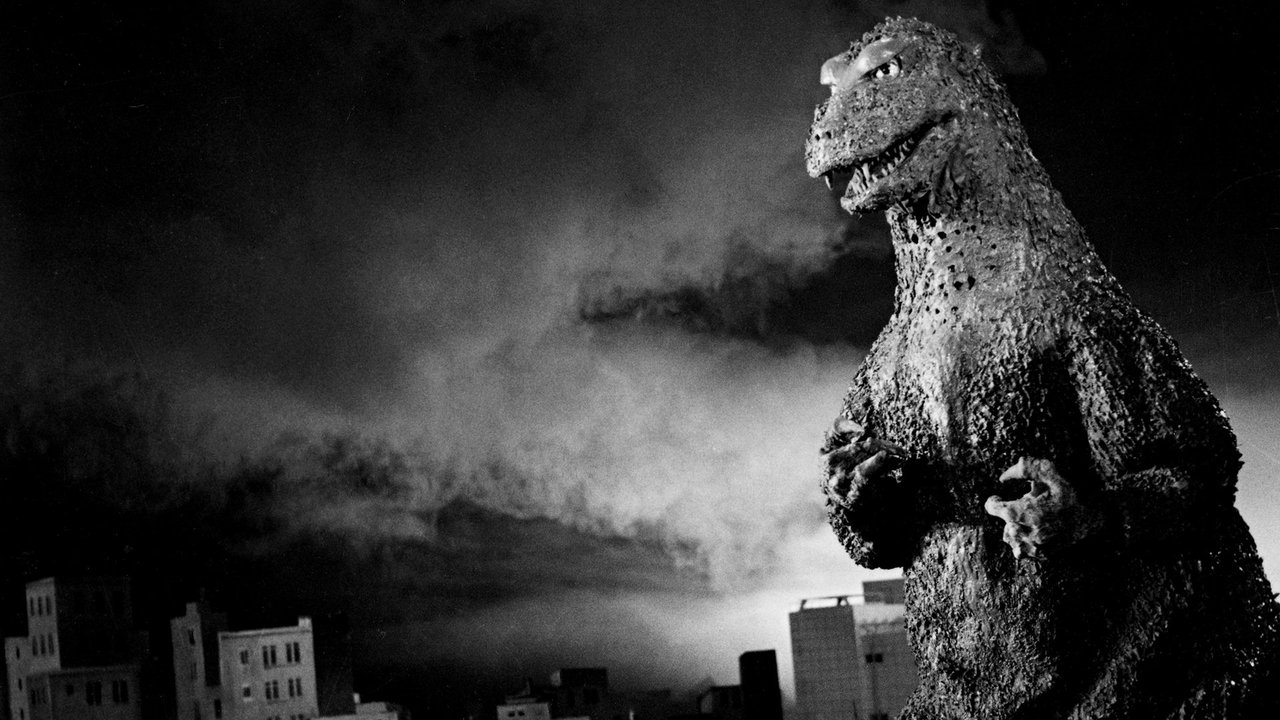

scholar
Godzilla (1954)
Release Godzilla 4K UHD + Blu-ray (The Criterion Collection)
David Kalat connects Godzilla to the Lucky Dragon No. 5 irradiation, postoccupation censorship, and debate about nuclear power in Japan. He discusses the contributions of Tanaka, Honda, Kayama, Tsuburaya, and Ifukube, explaining miniatures, mattes, multiple exposures, suits, music, and sound effects. Comparisons include King Kong, The Beast from 20,000 Fathoms, and the American recut.
- Duration
- 1h 35m
- Talk coverage
- 96%
- Words
- 14,873
- Speaker
- 1
Commentary density
Highlights
Topics
People mentioned
The film
- Director
- Ishirō Honda
- Cinematographer
- Masao Tamai
- Writer
- Takeo Murata , Eiji Tsuburaya , Tomoyuki Tanaka
- Editor
- Kazuji Taira
- Runtime
- 96 min
- Also on
- OneSheet ↗
- External
- IMDb ↗ TMDB ↗ Find on Amazon ↗
Transcript
14,873 words
On March 1, 1954, eight months to the day before the Japanese premiere of Godzilla, the United States set off its first hydrogen bomb. It happened in the Marshall Islands, tiny islands that had been passed back and forth between sundry European powers for hundreds of years, until the Japanese took them over after World War I. During World War II, they changed hands once again when relentless American bombing raids decimated the population, ravaged the countryside, and forced the Japanese to relinquish control. From that point on, the US military took to using the Marshall Islands as a nuclear proving ground. All told, 67 nuclear devices were detonated there, including the first H-bomb. In 1956, The year that Godzilla was exported to American movie screens, the Atomic Energy Commission declared the place by far the most contaminated place in the world. And it was practically a Japan's back door. The scientists responsible for the world's first H-bomb weren't 100% certain that it would explode correctly. Best case scenario, it would explode with a force a thousand times that of the bomb that destroyed Hiroshima.
Worst case scenario, nothing at all. Now, setting aside the irony of what constituted best case and worst case in this situation, the upshot was that the Japanese public was told to stay away from the island in question, but weren't given an explanation why.
The crew of the Daigo Fukuro Maru, that's lucky dragon number five to you, figured that they were being extra clever. By heading out to trawl for tuna, there's no competition, they congratulated each other. Then there was a flash in the sky like a second sun. The light was so bright, it could be seen as far away as Okinawa. The lucky dragon was so far from the blast, they didn't hear its accompanying thunder for another eight minutes. It was clear to them that they'd made a mistake, but the consequences were now impossible to outrun. They pulled in their nets, stowed their catch, and returned to the mainland as quickly as possible. They were sick. The radio operator, a fellow named Aikichi Kubayama, would die from radiation sickness. And let's be clear. Kubiyama received a lethal dose of radiation on March 1st, then spent nearly seven months slowly dying, eventually passing from this world on September 23rd. With his dying breath, he begged, please make sure that I am the last victim of the nuclear bomb.
The Japanese press noted that as the first human being killed by the H-bomb, he was Japanese, just like the only humans killed by A-bombs. Slightly over a month after the radio operator finally died, a movie opened in Japanese theaters that begins like this. A fishing boat at sea is afflicted by a mysterious and unexpected flash of light. The ship goes down. Its radio operator is the first to die. For Japanese audiences sitting in the dark that November 1st, watching this unfold on the screen, the message was clear. This isn't science fiction. It isn't even fiction. This is recent events recapitulated as a modern fairy tale, a contemporary folk myth for the nuclear age. Hello, everybody. My name is David Callett. I'm the film historian who wrote a critical history and filmography of Toho's Godzilla series. It's a mouthful, I know, but it was among the first serious studies of Godzilla movies published in English, and I'm gosh darn proud of it. So I'm going to be your guide through this film and its companion alternate cut, Godzilla King of the Monsters. As I hope my introductory anecdote makes clear, I take this stuff seriously.
I'm certainly not the only one who does, but we Godzilla nuts do tend to be at odds with a critical establishment that has long looked down on this movie and its entire genre as something to be embarrassed about. With your indulgence, I'm going to try to avoid taking a defensive posture in this commentary. I'm just going to proceed from the stance that this is a powerful and effective work of art made by some interesting and talented people that spoke very loudly to contemporary concerns at the time of its issue and that was reflected in its unprecedented international success.
I started out with that story about the Lucky Dragon as a way of demonstrating that this movie had an urgency and a relevance to current events for Japanese audiences. I'm going to talk more about this. I'm going to talk about the atomic bombings of Hiroshima and Nagasaki, about Robert Oppenheimer and the nuclear arms race. All kinds of big historical issues which have been deftly folded into the fabric of what has at times been misapprehended as just another monster movie. The idea of being just another monster movie presupposes some pre-existing genre of monster movies to which this could claim heritage. In 1954, monster movies were yet too sporadically made and too inconsistent in content to be considered such a genre on their own. The progenitor of the form was 1933's King Kong. It wasn't the first giant monster flick. Animator Willis O'Brien had brought dinosaurs into London in 1925's The Lost World, which would seem to be a more direct ancestor to the Godzilla trope, prehistoric reptilian monsters rampaging in a modern metropolis. But The Lost World didn't have half the impact that King Kong did.
Kong was such a huge hit, you'd have expected filmmakers to have immediately set to copying it and making their own monster-on-the-loose thrillers. Actually, there were a pair of Japanese-made Kong knockoffs in the 1930s. There was a 1933 silent short, Wasai King Kong, or Japanese King Kong, by Torijiro Saito. And then in 1938, there was King Kong Appears in Edo, Now, both of these films are believed lost. I know, I know. What I wouldn't give to see these 1930s-era Japanese monsters. Oh, boy. There are stray photos, enough to whet your appetite, that show that, like Godzilla, these Japanese King Kong knockoffs were actors in monster suits. But beyond that, I can't say anything about these lost films except that their impact was clearly limited. Even in the U. S. , though, sons of Kong were limited to the things Kong's own makers churned out, like... Uh, Son of Kong. The problem was the special effects technique in question was so time-consuming, so expensive, so incredibly difficult, there just wasn't anyone else in Hollywood in the 1930s capable of jumping that bandwagon yet. You needed to wait for those kids who'd sat in awestruck wonder watching Kong to be inspired to become special effects technicians.
grow up, learn their craft, and eventually settle into the film business where they could be exploited to make Kong-alikes a generation later. So you would expect to see Kong knockoff starting to show up in the early 1950s, which is indeed what we find. In 1952, the original King Kong was re-released in the United States. This was back before anything like home video, so all the people who'd thrilled to Kong in 1933 they hadn't had another chance to see the movie for 20 years. That's 20 years of pent-up nostalgia and accumulated word of mouth. An entire generation of kids had arrived and grown accustomed to hearing their parents rave about this awesome movie they'd seen in their youth. So the re-released Kong went absolute gangbusters. It beat the original release's box office figures and finished as one of the top grossing films of 1952. If it had been hard for producers to pass to rip off Kong's success back in 33, they weren't about to lose that opportunity a second time. And in the intervening 20 years, an animator named Ray Harryhausen had come of age and mastered the craft of stop-motion animation. Harryhausen was hired for a science fiction thriller written by Ray Bradbury called The Beast from 20,000 Fathoms.
Now, it came out in 1953 and worked some interesting variations on the Kong formula. This time, the giant critter was a dinosaur, revived and irradiated by nuclear bomb tests. It comes to New York, wreaks havoc, and is ultimately vanquished by a genius scientist. Here were the key elements of the genre, as it would develop throughout the decade. Nuclear radiation and nature's revenge, monsters as Cold War parable.
Now our story jumps over to Japan. Producer Tomoyuki Tanaka works for Toho Studios. He's handled a variety of war pictures and action dramas. Eventually, Tanaka would become responsible for producing more science fiction and fantasy films than any other producer in movie history. And if you're one of those prejudiced types who doesn't much like sci-fi and doesn't find that statistic all that impressive, Tanaka also produced a number of Akira Kurosawa's greatest hits, including The Bad Sleep Well, Yojimbo, Sanjuro, High and Low, Red Beard, and Kagemusha. But all that was still in Tanaka's future. On his plate was something called Aiko no Kagimi, or In the Shadow of Glory. Tanaka thought it would be a healing film to solve the open wounds that festered between Japan and Indonesia. Problem was, those wounds were ones inflicted by the Japanese during their brutal conquest of Indonesia during the war. So the Indonesians weren't as keen on letting bygones be bygones, and at the last second, the Indonesian government yanked the visas from Tanaka's team, effectively scuttling the whole project. Tanaka had a hole where a movie used to be.
So he decided to make a monster movie. He hired writer Shigeru Kayama, a popular mystery novelist with a penchant for science fictional and supernatural leanings, who'd written stories about mutant sea creatures before. Eiji Tsuburaya was working on storyboards for the project, and he was delighted. Tsuburaya had been dreaming of this day for close to 20 years. He was a King Kong fan, and he was ready. Tsuburaya's monster movie proposal involved a giant octopus, which, of course, he planned to animate with King Kong-style stop motion. Tanaka wasn't so sure and felt it was a better idea to let a professional writer like Shigeru Kayama cook up the script, so Tsuburaya's octopus idea was shelved. Harryhausen has nursed a lifelong grudge against Godzilla, but the fact is, Harryhausen has nothing to gripe about. There are surface similarities between the two movies, but in its final form, Godzilla isn't all that similar to Beast.
In Kayama's original story, this typhoon sequence would have marked the first appearance of Godzilla. Director Ishiro Honda's decision to delay the unveiling of the monster until 20 minutes into the movie was just one of his alterations, most of which were focused on character development and subtext. But while the instinct might be to get your monster on screen as quickly as possible, Honda opted to build suspense patiently to maximize the effect of the monster's first appearance. Whatever destroys the village in this typhoon is unseen and all the more terrifying for it. Notice that poor Masaji, the unlucky fisherman, is killed. He was the sole survivor of the second fishing boat destroyed by Godzilla. It's more than a mere ironic death. It's a sign that once you've come into contact with Godzilla, you're doomed. Just like people exposed to radiation, the death sentence follows you even if you appear to survive the original incident. It's akin to Japanese ghost stories where a person becomes cursed by a supernatural contact and can't outrun the avenging spirit.
Now, by the way, I know he's dead and off-screen by this point, but the actor who played Masaji was Ren Yamamoto, who was one of the farmers in Seven Samurai, and he was one of the Shiro Honda stock company of players for the next decade-plus worth of science fiction thrillers. There is, in fact, a significant overlap between the worlds of Akira Kurosawa and giant monster flicks, despite what you might expect to be a bright line between the respectable artistic pedigree of Kurosawa's cinema and the mass-market escapism of Monster Movie Drive The Venn diagram between them is startlingly huge. Honda himself is perhaps the reason for that overlap, but we'll come to him in a moment. For example, we've got this reporter character in Godzilla, Hagiwara, whose investigations help bring together some of the disparate plot strands. He's played by Sachio Sakai, whose work with Kurosawa stretched from the 1940s all the way to the 1990s. Drunken Angel, Ikiru, Seven Samurai, Throne of Blood, Hidden Fortress, Yojimbo, Sanjuro, Dreams, and Rhapsody in August. Meanwhile, he was a go-to guy for Honda making monster movies. Godzilla, Half-Human, Gorath, King Kong vs. Godzilla, King Kong Escapes, Godzilla's Revenge, Yag, Monster from Space. And then, of course, we come to Takashi Shimura.
the perfect exemplar of what we're talking about. Shimura wasn't just any old Kurosawa stock company player filling out the edges of his movies like Sachio Sakai was. Shimura was the star or co-star alongside Toshiro Mifune. He's the cancer-stricken government bureaucrat whose attempts at redemption are the stuff of Kurosawa's Ikero in 1952, a role for which the New York Times anointed him the best actor in the world. And then... Here he is as Dr. Yamane, a role he reprises in the sequel, Godzilla Raids Again. The Times sniffed at Godzilla's cast. Not a one of them can act. What's that again? Did you mean the best actor in the world can't act? Yowza. Not all of Godzilla's cast were experienced veterans of Kurosawa's demanding sets. Akihiko Hirata as the enigmatic Dr. Serizawa was a young up-and-comer.
The young lovers, Emi and Ogata, have been absent from the movie for nearly 15 minutes, which is kind of odd since they're ostensibly the main characters. And as we'll see, the American cut makes a point of restructuring events to fix that. Emi is played by Momoko Kochi, an extremely young actress whose inexperience made her nervous and self-conscious throughout the shoot. Her co-star is Akira Takarada, who at the time had been in movies a scant two years, but was on the on-ramp of a career that would turn him into the Japanese Grant, an A-list star of light comedy and amiable action films whose popularity would keep him a top marquee name for many decades. In contrast to Kochi's insecurity, Takarada swaggered onto the set and introduced himself as the star. The grizzled crew chuckled, Godzilla's the star. And since the monster is the star of the show, to talk about the cast, we really need to talk about the special effects director, Aiji Tsuburaya. Take a look at the upper right corner of the screen. That footprint is a matte painting, also known as a glass shot.
It entails painting part of the scene onto a plane of optically clear glass and filming through it to create an in-camera superimposition, as opposed to an optical effect or process shot in which different aspects are combined after the fact in the lab. Tsuburaya uses both techniques throughout Godzilla, and you have to bear in mind that neither technique had been used very much at all at that point previously. Tsuburaya's team was starting from scratch. There was no body of experience to draw on. In those days, a typical Japanese film would involve about 50 days of active principal photography. On Godzilla, the special effects alone took 71 days. He won the Japanese Film Technique Award for his work on this film, the first of many such honors over his illustrious career as indisputably the founder of Japanese special effects.
It is true that some of the effects in this film now look a tad creaky. There are moments where the wires are visible, where miniature models look like miniature models. But there are many more instances where his work is so seamless, it passes by almost unnoticed as an effect. And when you consider the fact that so many of these techniques were being invented on the spot, the level of achievement and innovation is staggering. Eiji Tsuburaya started off training for a completely different career. He went to flight school and then studied electrical engineering. And he put that training to use, oddly enough, as a screenwriter at what would become Kokatsu Studios. It was there during the silent movie era he started to learn the craft of special effects. Before that career blossomed, he was drafted into the Imperial Army. Returning to civilian life, Tsuburaya joined Shochiku in their art department in the late 1920s, and not long after was working at Nikatsu as one of that studio's more acclaimed cinematographers.
With his background in engineering, he was given to fashion his own equipment and jerry-rigged devices to achieve special pictorial effects impossible otherwise. His colleagues nicknamed him Smoke. But atmospheric effects were but tools in a wider arsenal, and he aspired to improve upon the still primitive art of special effects when he saw a film that shattered him. He acquired a print of King Kong for his own personal use and spent his nights examining it frame by frame to reverse engineer its secrets. He approached his employers at the studio and implored them to authorize a full-scale attempt to develop similar techniques. In the rigid hierarchy of the Japanese film industry, Tsuburaya was but a lowly cameraman, and the executives could not imagine that he had any business advice worth their attention. Conventional wisdom in the Japanese industry held that trick effects were just that, tricks, cheating. something dishonest. So his dreams were deferred. Toho Studios came into being in 1937 when a railroad magnate with a desire to be in the picture business orchestrated a merger of several smaller firms that once fused formed a formidable movie outfit.
With an official mandate of modernization in progress, the Toho board sought out Tsuburaya to head up their technical division. During the war years, Tsuburaya's special talents came into demand on propaganda films, and after the war ended, he was so closely associated with wartime propaganda that he was virtually blacklisted. His skill at recreating battles with miniatures was such that his miniatures depicting the attack on Pearl Harbor convinced the American occupying forces that they were watching documentary films shot by Zero pilots. It wasn't until this film in 1954 that Tsuburaya had the chance to marry his talent for miniatures with his dreams of monster movie havoc. As Godzilla makes his historic first appearance, Tsuburaya's games of scale are already underway. The giant creature, tall enough to peer over the tip of the mountain, is just a hand puppet, superimposed along with an equally miniature tree line over a shot of dozens of full-grown extras, a great many of whom were actual villagers more or less playing themselves.
This is another in-camera superimposition. The villagers in the puppet Godzilla were photographed at two different times, but on the same strip of celluloid. The result is a far superior looking image as compared to combining the plates in a lab, but it's a far riskier proposition. If anything goes wrong on either side and the film is ruined, you have to do the whole thing over again. But the art of Japanese optical effects was spotty at best, so the use of such opticals is very limited. The film stock they used was exceptionally soft and vulnerable to dust. Fingerprints and hair, any kind of foreign particle could permanently mar the picture. Every time you handled the film, you increased its risk of contact to airborne contaminants. In-camera multiple exposures, basically any time Godzilla or a model are seen in the same shot as a living actor or a real patch of city, magnified the dust problem.
You can see that the picture on this presentation exhibits more speckles than you're perhaps accustomed to seeing in restored editions of classic films. Rest assured, no expense was spared. The damage is a permanent feature of the film and always has been. This is what Godzilla looked like to Japanese audiences in 1954. The first time Tsuburaya met Ishiro Honda was on a 1943 film called Kato's Flying Falcon Forces. Honda was assistant director at the time. The two worked together variously in the late 1940s and early 1950s on war films, gradually cementing a partnership and a friendship. Honda was born in 1911, and he'd studied art at Nihon University. In 1933, he joined Photochemical Laboratory, the studio that later morphed into Toho. Honda was called away to war in China in 1938, the first of three times that he was drafted to the Imperial Army. Returning in 1946, he found his close friend and neighbor Akira Kurosawa had recently been promoted to director. Kurosawa took Honda on as his assistant director for films such as Stray Dog in 1949. Honda maintained his friendship and professional association with Kurosawa throughout their lives, and the time would come that he would return to stand alongside Kurosawa once again. That year was 1980.
and Kurosawa was hunting financing for his comeback film, Kagemusha. Francis Ford Coppola and George Lucas had talked 20th Century Fox into a co-production deal. Toho agreed to invest $5 million, the largest sum ever spent on a Japanese movie at the time. Kurosawa and Honda had been trading that trophy back and forth for years. At one point, the most expensive movie ever made in Japan was Seven Samurai. Then it was Godzilla. Now the mantle had returned to Kurosawa once again for Kagemusha, which would find Tomoyuki Tanaka overseeing things, Ishira Honda credited as creative consultant. Honda co-wrote all five of Kurosawa's last films, that's Kagemusha through Matadeo, directed most or all of the location footage, and co-directed in the studio. Another commingling of monster movies and Kurosawa art films. We'll return to Honda's life story later. I'd like to comment, though, on this sequence in which Dr. Yamane advises the Japanese Diet, that's the Japanese parliament, about Godzilla's nuclear origins. Similar scenes are to be found throughout science fiction films of this period.
Thinking of a scene in Them in which the kindly old professor played by Edmund Gwynn shows some 16mm film of ants by way of explaining to the nation's leaders why giant, killer, irradiated ants are a problem. In just a moment, though, the trajectory of this scene will be redirected, and instead of a calm, level-headed analysis of a scientific problem, we will watch a political free-for-all in which opposing viewpoints try to shout each other down. It's a curious sequence that was deleted from the foreign editions of the film, implying censorship. But censorship of what exactly? As we shall soon see, the crux of the debate is whether the public should be informed that the giant reptile threatening their nation is a byproduct of H-bomb tests. One faction wants that detail suppressed to avoid international controversy. The other side thunders, the truth is the truth. This debate mirrored what was going on in Japan at the time. The Lucky Dragon incident had become the focal point of anti-American rage, and a number of activist groups had formed to protest the H-bomb tests and Japan's continued submission to American aggression. So there was a tension between the politicians who stood for alliance with America and those who represented populist discontent.
Dramatizing that real-world political tension brought that debate into the world of the movie, and this would be as close as the film ever gets to directly naming the United States as the instigator of the H-bomb blasts, and by extension, then, the cause of Godzilla. It can therefore be argued that excising this scene, as the American cut does, skips over a potentially inflammatory moment. There's something else at work, however. During the post-war occupation of Japan, strict film censorship rules were imposed. Because there was an explicit goal of turning Japan into an American-style democratic republic, the rules forbade any depiction that would undermine public confidence in democratic institutions. This scene will conclude with a disillusioned Yamani hanging his head in frustration as the cacophony of voices fails to reach any consensus. The diet dissolves into partisan combat, an image that would have been forbidden just two years earlier.
And now we're off to yet another conspicuously politicized scene unique to the Japanese edition. Some commuters gripe to one another about the impending threat and draw direct comparisons between Godzilla and their experiences in air raid shelters during the fire bombings of Tokyo or surviving the atomic bombings of Nagasaki. Take a good look at the commuters. You'll see them again soon. Throughout the film, Honda makes a point of introducing us to Godzilla's future victims. When Godzilla attacks, his civilian casualties aren't allowed to just be nameless, faceless, anonymous extras. Honda gives each one a little backstory to make their suffering or death that much more poignant. This doom-laden atmosphere and repeated connection to real-world recent events was added by Honda and screenwriter Takeo Murata to the less political and less apocalyptic story devised by Shigeru Kayama. Many years later, Honda was interviewed about his work on Godzilla, and he said, quote, most of the visual images were derived from my wartime experiences. After the war, all of Japan, including Tokyo, was left in ashes. The atomic bomb had completely destroyed Hiroshima.
What wartime experiences is Honda referring to? Well, I said before, Honda had been drafted repeatedly into the army. While on furlough from one of these stints, he survived the fire bombings of Tokyo. Then, in 1945, he was captured in China and held as a prisoner of war for the better part of a year. It was during his imprisonment that he heard about the atomic bombings and Japan's surrender. He was released and returned home to a humiliated and ravaged nation. One of the first things he did was to visit the smoldering, irradiated wreckage of Nagasaki. These experiences left an enduring psychological scar on him, which would manifest a lasting pacifistic streak that would eventually color his own solo directorial style. But these preoccupations didn't just pop into place on the set of Godzilla. Honda had been ruminating on Japan's post-war zeitgeist for some time. When he served as Kurosawa's assistant director on Stray Dog, Kurosawa tasked Honda with directing the sequence in which the detective, played by Toshiro Mifune, takes his first walk on the wild side, exploring the criminal underbelly of the city, an extended, wordless sequence that stands out as one of the more memorable set pieces in that film.
This scene represents another of the transformative changes wrought by Honda on the material, casting such an admired actor as Takashi Shimura turned Yamane from an alienating kind of mad scientist into a heroic central figure. Yamane's upset that the government's response to the problem is to try to kill Godzilla. He wants to study it. What science and mankind could learn from examining this prehistoric thing is incalculable. This is the way the elderly scientific advisor in Beast from 20,000 Fathoms was depicted. But a better point of comparison would be The Thing from Another World, which opened in Japan in the spring of 1952. In that film, there's a deadly monster threatening the human race, a military expedition trying to kill the thing, and a dissenting scientist who wants to spare the monster for study. The scientist is an inhuman chump with badly skewed priorities. The movie demonizes him unambiguously. In this movie, Yamane's pro-Godzilla stance is not demonized if anything, we're compelled to sympathize with him. And then just as soon as Honda has a siding with Yamane, yeah, spare Godzilla, don't kill it,
He shows us the other side of that debate, the human cost. Now, the fellow with the cigarette, don't blink or you'll miss him, Kenji Sahara, the actor who would appear in more Japanese sci-fi flicks than any other. For years, his fleeting appearance here went unnoticed because he was still using his real name, Tadashi Ishihara, at the time, and so no credit for Kenji Sahara ever officially attached to Godzilla. Other familiar faces on this pleasure cruise include our unlucky commuters. Told you Honda likes to work up our sympathy for the victims instead of letting them be anonymous. It's all part of the larger strategy in which the film seeks to divide our loyalties and confuse our sense of right and wrong. on every issue, whether it's a romantic triangle or a political debate about what to tell the public or the central question of whether Godzilla should be studied or defeated. Ultimately, the question of whether to employ the ultimate weapon against the monster. On all of these, the film gives us compelling arguments for both sides and refuses to delineate a single right way. There are few movies that have been as adamant on the stance of moral relativism as this.
And so we get this kind of dramatic irony. Yamane walks past the destitute and the terrified, ordinary folk whose lives have been upended, to sit down in front of good-hearted people whose livelihoods are at risk and tell them to their faces he doesn't want to kill Godzilla. Bear in mind, we just saw in a preceding scene that Yamane has adopted the boy, Shinkichi, a survivor of Godzilla's raid on Odo. Yamane lives daily with a reminder of the human cost of Godzilla's menace. And Yamane makes a good point that since Godzilla has already survived H-bombs, there's not much left in humanity's arsenal to top that. Certainly the depth charges didn't do anything helpful. If anything, provoked Godzilla into attacking. Watch that involuntary shudder that he gives when asked if there's a way to kill Godzilla. He doesn't want there to be a way. But he's not like that cartoony, one-dimensional mad scientist from The Thing, a character so absurdly drawn that he cavalierly accepts the death of friends and colleagues as an acceptable cost for keeping The Thing alive. Yamane is not immune to the suffering around him, and that awareness hangs heavily on him, a burden he can't relieve.
So Yamane has pegged the problem. To stop Godzilla, you need something bigger than an H-bomb. The movie will now start introducing us to what that might be. And the first step in getting us there is reporter Hagiwara. In this scene, he's flanked by some other reporters, played by Haruo Nakajima and Katsumi Tezuka. Nakajima's the one with the pencil behind his ear. Tezuka plays the editor who just walked in. This is the only moment in the film where you get to see their faces, but they appear throughout the movie in another role. They're the actors who played Godzilla, trading turns inside the monster suit. The understandable emphasis on those monster-suited scenes of mayhem risks obscuring some of the more human-scaled drama, even though the majority of the film's plot is actually oriented around that human-scaled emotional drama. Even now, I feel the same way. Emiko. The characters of Emi and Ogata correspond to a long-standing Japanese archetype, with the tradition snaking back into ancient myth, Japanese literature, and theatrical plays. As described by scholar Gregory Barrett, the archetype is that of the all-suffering female and the weak, passive male. That's his terminology. Specifically popularized by the writings of Monzaemon Shikimatsu, in whose work Romantic Love Always Equals Death,
Romance is a force inherently in conflict with the social order. Boy meets girl, girl falls for boy, their love puts them at odds with their prescribed social roles and larger responsibilities, and so lovers are always doomed. The women in such stories are therefore destined to suffer, either suffer the heartbreak of losing their love or the consequences of pursuing it. It's a lose-lose scenario. And especially in Chikimatsu's formulation, the boy is a weak figure who cannot possibly match her suffering. Kabuki love suicide plays adapted Chikimatsu's form only slightly, and we see that template here. Emi is betrothed to a decent and honorable man, a man her father admires, a man who's fought bravely in war and carries the wounds of it forever, a man who will be shown to be a deeply moral and upright person, but she doesn't love him.
She loves this sailor, and so either she has to throw away her feelings for Ogata, or she has to hurt Serizawa. Lose, lose. Emi's in a trap, and she suffers. Ogata, the object of her affection, is, let's face it, a weak character. He's the ostensible male lead of the film, enough for Akira Takarada to entertain delusions of stardom for the part. But what does he do? Does he discover Godzilla? No, that's Yamane. Does he invent the oxygen destroyer? Nope, that's Serizawa. Maybe he deploys the oxygen destroyer? Nope, that's Serizawa again. At best, you can say, Ogata serves to stimulate Serizawa's conscience, to provoke him into deploying it, but even that's arguable. As a leading man, Ogata doesn't really do a lot of anything. Serizawa conforms to a different archetype, the one Gregory Barrett identifies as the nihilistic hero. This is a character type exemplified by Reano Tsuke Tsukue's hero in the great Bodavista Pass, a defiant dropout at odds with the authorities. The stuffed shirts are all wrong. He's right. But being right when all the authorities are wrong, that's a bad deal. That's not a recipe for success. That's a recipe for alienation, for tragedy.
And as we'll see at the end, just like the traditional nihilistic heroes of Japanese literature, Serizawa does die suicidally for his defiance. In some ways, both of our scientist heroes, Serizawa and Yamane, fit the nihilistic hero paradigm. They are social and political outcasts, railing at the idiocy of their rulers, rueing the worst aspects of human nature, kicking against the pricks. There are production stills showing that Honda had experimented with a more extreme set of facial injuries for Serizawa before dialing back on that and opting for the more subdued makeup used in the final film. The worry was that the audience would be put off by anything more repulsive and that it would make it hard to identify with, to sympathize with Serizawa, because we're meant to side with him.
He articulates most succinctly the moral quandary presented by the film, the impossible choice between doing right by your country and doing right by the human race. How do you save your people from Godzilla without dooming the world to an even worse arms race? This is the crux of the story. And to make that impossible choice even more impossible, Serozawa is also ensnared by this romantic plot. How do you do right by the woman you love if showing your love for her means letting her go? There's this ambiguity as to whether Serizawa or Ogata really constitute the male lead, because Serizawa is clearly the more complicated and interesting figure, and the more narratively important. Akihiko Hirata had been cast as Ogata. and Akira Takarada was cast as Serizawa. Honda swapped them at the last minute. Although it is now hard to imagine them in the reversed roles because they're so iconic in the performances they actually gave, if you watch Ishura Honda's earlier film, Farewell Rabaul, you can understand what motivated him. In that picture, Akihiko Hirata played a romantic young man opposite Ryo Ikebi as a brooding, deeply conflicted Serizawa-like character.
Having seen Hirata excel in an Ogata-ish kind of role, Honda sort of thoughtlessly carried that thinking over to here, before realizing that, in fact, Hirata has a nervous energy to him, a quirkier vibe that better suited Serizawa, whereas Mr. Handsome, as Akira Takarada was soon to be known, fit right into the Ogata role. So we're... coming now to the demonstration of the oxygen destroyer, except that we also aren't. This is a huge moment, but Honda's not actually going to let us share in it, not yet. Serizawa shows Emi something that scares the bejesus out of her, but we don't get to know what it is. Only when she reveals the secret to Agata will the secret be revealed to us. It's a clever trick by Honda to implicate us in the same secret. One of Honda's gifts as a director is his ability to introduce an idea or character not by what it is, but by how it affects others. In Farewell Rebel, the introduction of Ryo Akebi's character takes his point of view as we see a nightclub full of partying soldiers and loose women clam up, salute, and shrink in awe at his presence. We immediately see how feared and respected he is.
Similarly, the long, drawn-out introduction of Godzilla in this movie establishes his power by showing his effect. All these ships sunk, all these sailors drowned, these islands destroyed, these buildings flattened, this radioactive fallout left behind. We're almost halfway into the movie, we've barely had a glimpse of the title character, but we already know that Godzilla's a force to be reckoned with. And now we get this great what's-it, the mysterious thing in Serizawa's lab. We don't know what it is, but it terrifies people who are living in the shadow of Godzilla. Whatever it is, it's awesome enough to upset a woman who's seen Godzilla with her own eyes. This sequence... It's the calm before the storm, a moment of preternatural quiet in which for a full 90 seconds the soundtrack goes dead. There's a lot weighing on these people's minds, too much really to say. Emiko has failed to tell her fiance that she loves someone else because he distracted her with a demonstration of a doomsday device. Ogata is fretting from the sidelines about their illicit love affair. Shinkichi is an orphaned survivor of Godzilla who knows he hasn't escaped the monster at all.
And Yamane is being consulted on how to kill the prehistoric relic that he would rather study. Everybody's preoccupied. They're in the same building, but not in the same mental space. And so Honda stages this in deep focus with the characters as far apart as architecture will allow. Time to give proper respect to cameraman Masayo Tamai, who, along with Eiji Tsuburaya, was one of the founders of what is now known as the Japanese Society of Cinematographers. It's been through a number of name changes since when they banded together. Tamai is also the cinematographer behind Mikio Naruse's When a Woman Ascends the Stairs. Tamai is one of the few members of the production team who would not return for the sequels and would not be a part of the development of the cycle of Japanese monster movies that flourished in the decades to come. This is partly due to the fact that Tamai was already an old man by this point. He would retire in 1963, and by and large, the boom in Japanese monster movies didn't happen until, you know, until 1963.
Godzilla has been making slow progress towards Tokyo. The film began with unexplained sinkings of ships. Nobody knew what the cause was. Then came the attack on Odo Island, which made it more clear that the culprit was a giant animal. The expedition to Odo actually saw Godzilla firsthand. Then Godzilla surfaced in Tokyo Bay. And now, at last, he's coming ashore in mainland Japan for the first time. And it's going to be spectacular. This sequence is as fabulous as it is because Honda and Murata worked so closely with Tsuburaya during the initial planning stages of the project, running script ideas by the special effects team so that they could weed out anything that would have been impossible or just too expensive. Honda and Murata only put in the script things Tsuburaya said he could pull off. Well, in the very earliest stages of that collaboration, when Tsuburaya was first brought on board, before Honda was even a part of this, Tsuburaya had expected this was going to be his chance to do stop-motion animation, a la King Kong. But he did a calculation of the effects described in Kayama's story outline and decided that using King Kong-style techniques would take him seven years. Toho's Iwayo Mori laughed in his face and said, OK, what else you got?
And so they decided to do the man-in-a-suit technique, which was a bit of a comedown, but it did have one key advantage, aside from cost and speed. Having Godzilla be an actor in a suit meant that the miniature replica of Tokyo could be built. Indeed, it would have to be built at a much larger and more detailed scale than would have been the case with animation. Most of the replica buildings were made at 1 25th scale. although some were at an even smaller scale to create forced perspective effects. So get a load of this. This is an in-camera double exposure in which fleeing extras at the bottom of the frame and the top half is made up of a miniature set and a man in a suit. To get the synchronization between the bits entailed precision timing between two different scenes shot by two completely different production crews months apart. And any mistake would mean starting over from scratch. All of this for a double exposure technique that even at its simplest and most rudimentary was a novelty for a Japanese film.
Tsuburaya's biggest challenge, of course, was creating the monster itself. When planning first started, Shigeru Koyama consulted with manga artist Kazusuke Abe to draw up designs for Godzilla. Abe's work was quickly rejected. Among other things, he had the monster's head look like an H-bombs mushroom cloud. So instead, they turned to Akira Watanabe, a designer on Tsuburaya's staff who'd been a Tsuburaya ally since the 1920s. Watanabe mashed up aspects of a couple of different kinds of dinosaur and handed his sketches over to Taizo Toshimitsu to make a three-dimensional clay model that they could take to Iwayo Mori for approval. Iwayo Mori is an interesting figure in our story. He'd created the producer system modeled on Hollywood studios that gave authority to the likes of Tomoyuki Tanaka. He was also a war criminal. Specifically, he was a Class B war criminal. He was one of just 10 so classified. His crime was producing propaganda movies during the war. He was sentenced to be barred from the film industry, and the movies that he'd made were publicly burned at a 1946 bonfire ceremony.
Well, Mori didn't stay out of the film industry for long before the reorganized Toho Studios decided they really needed their Mori back, and rehired him, now forgiven for any past indiscretions. I've always thought that was an especially interesting context, given that Mori was so instrumental in getting Godzilla made, and for encouraging its overtly anti-war aspects. First of all, the coastline, 30 meters high, 50 meters wide, and the iron bars. through a powerful 50,000 volt current to measure the power of the Godzilla. Therefore, not only the outside of the iron gate, but also the inside of the gate will be attacked by residents within 500 meters of the iron gate. The Defense Force and the Maritime Security Force will act according to this security plan and will immediately take on each mission. Think of it, these scenes of the evacuation of Tokyo evoke very recent memories of Japanese citizens evacuating the city before American firebombing raids.
Now, maybe if you've seen a lot of Godzilla movies, scenes like this lose their punch. The evacuation scene became a cliché. But this was made before anything had had a chance to become a cliché. Here, it's just a raw, visceral reminder of the terror of being made to flee your home because you fully expect your city to be completely destroyed. ... to find a moving Godzilla. The Keihin Chikuen River has a particularly severe warning. And what did 1950s Japanese audiences make of the scenes of Japanese military deployment? To shoot these scenes, the intrepid crew cleverly set up to film an actual set of training maneuvers by the self-defense forces and then kept moving the camera down the road to film the same trucks and troops over and over again. During the occupation, American censorship forbade any depiction of the Japanese military. Now, when censorship was lifted, there was a rash of war films. We've already noted Farewell Rabaul and others. These things were very popular, partly because audiences had been starved of such imagery during the occupation. But when the formal ban was lifted, there was still a problem in how movies could depict Japanese soldiers. There wasn't much you could do that would be set in the present.
The new Japanese constitution placed strict limits of what the real life military could do. They could defend the country from invasion and that was about it. If you set your film in World War II, it meant your soldier characters were on the losing side of a conflict that you were now obliged to depict as deeply wrong. So a film like this created a unique opportunity to show the contemporary Japanese military doing heroic and resourceful things now in the present in a way that the audience could cheer for without any lingering traces of guilt. Nice mats here with the ring of high-tension wire, and this wipe shoving one scene off the other. Honda was a fan of such transitional effects. The nine-minute-long sequence he contributed to Kurosawa's Stray Dog is full of wipes and dissolves and such. I love how Honda has set this up for us. It's a three-part list.
Number one, we have this plan by the authorities to use high-tension wires to repel Godzilla. We've had a taste of how catastrophic it would be if he were to come ashore again, so something has to be done. The plan seems sound and efficient. They've done a bang-up job getting ready for Godzilla's return. Two, we revisit Yamane's objection to the whole thing. Study Godzilla, don't kill him. And Yamane really digs his heels in in this scene, kicking Ogata out for daring to voice a contrary opinion. Given Ogata's precarious position in all of this, his girlfriend is engaged to somebody else, you know, he really puts his foot in it. So, nice job tying the romantic subplot back into this and reminding us of how sympathetic characters don't want to oppose Godzilla with violence. And that brings us to number three, the actual arrival of Godzilla, which we'll see has a consequence even more terrible than maybe we were even expecting. And that high-tension wire stuff, no go.
I was talking earlier about Yamane's position as being something derived from American science fiction films, the trope of the mad scientist who values pure knowledge over human lives. Certainly the decision to make Yamane a kindly old gentleman played by such a warmly inviting actor takes that edge off of the characterization and makes it into something else. There's also the way that just by having this be a post-war Japanese film, that changes the inflection. All of our main characters are torn between the opposing poles of duty and personal values. It's what's driving the romantic subplot, the duty of fulfilling social obligations versus doing what your heart desires. For Dr. Yamane, there's the tension between what he personally believes as a humanist and a scientist and what's clearly in the best interests of his country. He can't entertain any illusions that keeping Godzilla alive won't cost human lives.
Serizawa's caught in an even more pernicious ethical quandary, whether using the oxygen destroyer makes things briefly better by ridding Japan of Godzilla or makes things permanently worse by inviting a new round of arms races. It doesn't take much to map these ethical arguments back onto the experience of World War II, the tension between doing your duty when your country calls you to war versus what you may personally believe. Honda's war films had ruminated fairly overtly on this theme of soldiers in World War II torn between their sense of honor and their sense of humanity, angered and disillusioned by being loyal soldiers for a country that had lost its appreciation of human life. What does it mean to be a good Japanese? Is it to do what your country tells you to do? Or is it to challenge what your country tells you? These things ripple under the surface of Godzilla. The next 13 minutes are a tour de force of special effects. Honda's had his chance to restate the basic human conflict at the heart of all this. Now it's Tsuburaya's turn to wow us with an orgy of destruction. Godzilla will systematically crush the entirety of Tokyo.
Every major landmark, important district, every aspect of urban life anyone would associate with Tokyo living, commuter trains, oil refineries, broadcasting towers, the most upscale shopping center, and many famous department stores, even the Diet Building. He'll trample tanks and soldiers, reporters, and innocent bystanders alike. Here is where we step out of the past, out of the World War II allegories, and into the new. The metaphors of the new atomic age, uncontrollable and ominous. Tomoyuki Tanaka put it this way, the theme of the film from the beginning was the terror of the bomb. Mankind had created the bomb and now nature was going to take revenge on mankind. In a 1991 interview, Honda phrased it like this. The number one question was the fear connected to what was then known as the atomic bomb. At the time, I think there was an ability to grasp a thing of absolute terror, as Shigeru Kayama himself called it. When I directed that film, it was a surprising movie with all its special effects. But actually, when I returned from the war and passed through Hiroshima, there was a heavy atmosphere, a fear the Earth was already coming to an end.
That was Honda's own hand that pulled the electrical switch and setting off the chaos that ensues. Honda had in fact become fixated on the idea of making radiation visible. It fascinated him that so much devastation could be wrought by something invisible. How do you make that unambiguous for the purposes of film drama? Well, you could give your giant monster a visible beam of concentrated radioactivity. the marriage of mythical fire-breathing dragons and modern-day atomic science. To pull off the effect, Tsuburaya fitted an aerosol nozzle inside the puppet Godzilla's head that could spray a smoky mist. The model towers were made of wax and then placed under the studio lights, which on the special effects set needed to burn even brighter than normally, whose extreme high temperatures melted the wax, and in that moment, a film icon was created. The model city that he's attacking took a team of 40 carpenters an entire month to construct. The streets were made of sawdust coated with a thin layer of plaster so that Godzilla's footsteps would leave noticeable footprints. Some of the buildings were pre-scored to crumble on cue. Others were soaked in gasoline and fitted with explosive charges. So you would want to move around on this stage very carefully.
Haruo Nakajima had been hired to play Godzilla thanks to his martial arts training, his background in stunt work, and his overall strength. You can imagine how being hired to play a monster in a rubber suit might cause you to maybe not take your job all that seriously. But not Nakajima. He studied Tsuburaya's personal print of King Kong, and then he went to the zoo to study how bears move. As far as he was concerned, this was an acting gig as serious a job as anything he'd previously done for Akira Kurosawa. Nakajima had been in Seven Samurai, and he'd also been in Stray Dog. Although he's co-credited with Katsumi Tezuka in this film, Nakajima has said that Tezuka almost never plays the role in any of the footage used in the final cut. as if we could verify that. What we can say is that Nakajima remained associated with Godzilla for a long time. His final time in the Godzilla suit would be Godzilla vs. Gigan in 1972, although he threatened to retire when Eiji Tsuburaya passed away in 1970.
It's a wonder he even made it that long. Playing Godzilla was no easy gig. At the end of each shoot, he would drain a cup's worth of his own sweat out of the costume. During the course of production, he lost 20 pounds. Both he and Tezuka suffered heat exhaustion, experienced blackouts, and that was on a good day. The costume was built by the Yogi brothers, who erected a frame of bamboo and wire mesh and then proceeded to layer latex rubber onto that frame until they built up the creature to match Taizu Toshimitsu's model. They called in Haruo Nakajima to do a fitting and a trial run. He came to the workshop and crawled into the costume through a slit along those famous dorsal plates. The instant he was inside, he started to stifle.
He could barely move at all and began to panic involuntarily. He managed to take just a couple of steps before he fell over and had to be extracted from the costume by anxious special effects guys. That first suit was just impractical. It weighed over 220 pounds, for Christ's sakes. Not willing to throw it out, Tsuburaya had it sliced in half. Top half used for scenes in the bay as Godzilla swims around, and the bottom half was fitted to a pair of suspenders that Nakajima could wear like a pair of giant clown pants as he trampled the streets. The Yogi brothers went back and made a second suit, this time using lighter materials. It was nobody's idea of light, but it was at least more mobile. The interior of the suit was a cotton lining that Nakajima complained abraded his skin, and that cotton would become so soaked with his sweat that it couldn't be cleaned and required perpetual replacement. Tsuburaya split his team into three units. The location photography, shooting things like the glass paintings on Odo Island. The second unit did the miniatures. The third handled optical effects, like this blast of Godzilla's atomic breath. That involved hand-painted cell animation in the grand Disney tradition, composited onto footage of the Godzilla suit in action.
Tsuburaya had taught himself optical effects and compositing techniques during the immediate post-war years. The occupation had all but shut down film production entirely. Tsuburaya had a lot of time on his hands during this period and spent it experimenting. Then the occupation authorities got hold of one of the films he'd contributed effects to. He'd shot some model miniatures of the attack on Pearl Harbor, but the Americans found the footage so convincing, they concluded it had to be genuine. And if it was genuine, it meant that... What Tsuburaya was passing off as special effects work was really his involvement in some kind of spy ring. So, like Iwai Omori, he was seen as a war criminal. But Mori returned, and once Mori was back, so was Mori's insistence on modernizing the film industry. He believed high-tech film production techniques were essential, not just to create special effects for their own sake, but to streamline the making of films. Even romances and dramas had use of special production techniques. So Mori promptly rehired Tsuburaya, but in the interim, Tsuburaya hadn't been idle. He'd founded his own special effects production company,
When he returned to Toho, Tsuburaya took his company with him, and he'd spend the rest of his professional life with his feet in both camps, commingling his work for Toho with the stuff he cultivated for his own company. The filming of these scenes was so complex and demanding that the usual working hours of a film crew were just ignored altogether, and Tsuburaya's team routinely worked into the wee hours of the morning. They nicknamed Godzilla Goji, which rhymes with the Japanese phrase for 5 a. m. to highlight how making Goji come to life meant being at work until 5 a. m now this moment here as the mother cradles her terrified children and calms them by saying don't be afraid we'll be with daddy soon has attracted a fair bit of attention from commentators far beyond the scene's apparent significance in the film it's only a few seconds long but it has become more conspicuous when the audio of the scene was removed from the foreign versions in the american cut the shot remains but you no longer hear the mother's voice
Because the American version entailed a number of cuts that blunted the overt political message, and because commentators became keyed to see these edits as examples of censorship, this line of dialogue was also perceived as having a larger political significance. And in a lot that's been written about Godzilla, you'll see references to that line made on the assumption she's talking about a husband who died in the war. Don't worry, children, we'll be with daddy in heaven. Sorry, I don't buy it. Rewind the scene, take a closer look. Her kids are young. One's a baby, the other's a preschooler. This is 1954. The war ended nine years ago. If these children's daddy's in heaven because of World War II, they'd have to be at least nine years old for that to make any sense. Now, so far, I've been explaining this imagery in terms of wartime references, but it's not the only thing going on here. When Toho screened the finished film for its makers in October 1954, a month ahead of the nationwide rollout, it had a profound effect. People like Shigeru Kayama and Akira Takarada were brought to tears, not by the echoes of Japanese pain. They cried when Godzilla dies at the end.
In fact, you go through the interviews with these filmmakers, Honda himself, Haruo Nakajima, Akira Ifukube, even Raymond Burr, whose involvement we'll discuss on the other track, they all identified with and sympathized with Godzilla as a character, a great, misunderstood, tragic creature. In Japan, everyone was a miniature Yamane siding with Godzilla. That same tension between duty and conscience that I was talking about earlier was working on the audience, too. On one hand, you side with your country and grieve as it suffers, and on the other, you feel a personal allegiance that defies patriotism. You want to attack your country, scream in its face for leading you into a stupid war. This movie offered Japanese audiences a cathartic experience of projecting themselves into the role of the thing that was doing the attacking, not being attacked. They're cheering on the destruction of the outward symbols of Japanese prosperity and modernization, the trappings of economic success, the buildings where their so-called leaders ruled. Godzilla's attack on the Diet was an especially rabble-rousing moment. For Japanese audiences in 1954, this scene elicited whoops of excitement. Right on, brother! Stick it to the man!
It was, in fact, the very first scene shot by the special effects crew. It was a pretty inauspicious beginning. As they were dressing the set in preparation for the shoot, one of the crew members broke through the floor of the set by accident and fell onto the miniature diet building, which had been pre-stressed to break on cue. Well, sure enough, it shattered. They spent hours putting it back together again and restoring the set. Finally ready to proceed, Nakajima put on the Godzilla suit and took his position, only to crash through the floor himself. Again, they rebuilt the set, this time reinforcing things to be less fragile. So the cameras roll, Nakajima stomps up to the building, starts to claw at it, but the reinforced, rebuilt set doesn't break. Eventually, he succeeded in destroying the building, but it looked fake, and Tsuburaya threw most of the footage away. Instead, they shot a composite mat with Nakajima, superimposed on actual footage of the real Diet, and inserted what clips of the model they felt okay using.
Godzilla's swath of destruction through Tokyo is the grimmest, most apocalyptic sequence in the entire history of the franchise. It is vastly more nightmarish than the comparable sequence in Beast from 20,000 Fathoms. The Beast came to New York and killed some people, trampling them, eating a few, damaged a couple of buildings, but you get the impression that rebuilding the city won't be a huge problem. The Beast is considerate enough to stay in the middle of the street and generally avoid knocking things over. A very well-behaved monster, really. By contrast, Godzilla seems to be deliberately destroying everything, methodically. There's no plausible animalistic motivation for any of this. It's just cruelty. He's not knocking things over by accident. He's tearing every building to its foundations, stomping on the wreckage and incinerating the ruins. He's like a conquering invader, burning the city behind him. By the way... For all of you who've been listening to me all this time, blathering on about Godzilla, and you're sitting there gnashing your teeth and grumbling, Gojira, it's Gojira, you idiot. I need to explain myself. There is no difference between the titles Gojira and Godzilla.
Japanese is written using a script of characters that represent phonetic chunks. The problem is those phonetic chunks in Japanese involve sounds so unfamiliar in English they don't have obvious, unambiguous Roman letter equivalents. The process of converting Japanese characters into Roman letters is called transliteration. And there are a number... of transliteration schemes. Each one's a little different because each one adopts a slightly different strategy for how to capture those unfamiliar sounds in Roman letters. The transliteration scheme most commonly encountered by English speakers today is the Hepburn method. It is but one of several commonly used systems, and even Hepburn transliteration has its own subvariants and periodic shifts in practice. There's no single commonly agreed upon method. The Japanese title for Godzilla is made of three characters. The first looks like a square with the left-hand side cut off and then a sideways colon up on the top right or a set of quote marks. Look at the movie poster, see it for yourself. That symbol in all the transliteration schemes is rendered as Go. So no matter what, the start of our title is definitely Go.
Then we've got what looks like a smiley face without the circle, also with one of those little colon quote mark thingies appended. This is where the difference in transliteration method starts to make a lot of difference. The Hepburn method renders this as G, J-I. But other methods render it as Z, Z-I, or Z, D-Z-I. Last is a symbol that you should commit to memory if you enjoy Godzilla movies as a genre. This character is a bit like an equal sign with a tail hanging off the right-hand side. You should get used to this guy because this has become like the suffix "-zilla." Here, the all-purpose stick-this-on-the-end-of-a-word-to-turn-it-into-a-monster-name suffix. The list of monsters whose names end in this character is suitably ginormous. Godzilla, Gamera, Ghidra, Mothra, Ebera, Hedera, Gabera, you get the idea. Hepburn turns this into ra, and so the Hepburn transliteration of the three symbols is go-ji-ra. But Japanese speakers don't distinguish between R and L sounds, a fact which has led to generations of racist jokes about Japanese mispronunciations. In recent years, the standard has been to opt for R in these situations when writing Romanized Japanese. But in the 1950s, an L would have been just as correct. So we... could transliterate the title as Go-Dzee-La.
And that is, in fact, how Toho themselves transliterated it for the English language documentation when they first offered the film for international sale. The name Godzilla wasn't cooked up by any American. That's the Japanese name. It's just mispronounced. You put those letters in that order, and the English-speaking tongue comes out with Godzilla. The emphasis on Gojira as a title is merely an attempt to incline people back to the Japanese pronunciation. And the irony is... There are all these American fans who make such a big deal about the supposed correct title, and they pronounce it Gojira, which is also wrong. It's just a different wrong. If we were proper and careful about getting the inflection right, Gojira. Maybe that would be worthwhile, but to stand on some kind of principle and insist on Gojira instead of Godzilla is just a pretentious kind of pointlessness. Godzilla may be mispronounced, but it at least connects to the vast pop cultural heritage and connotation already associated with that well-worn and recognizable name, so I will unrepentantly stick by it.
We're in the midst of a powerful aftermath sequence. This is actually where the American version starts. This is all that tension about irreconcilable viewpoints, the recurrent theme of the movie. We've heard the argument that Godzilla is a majestic creature who should be studied. We've seen the film treat Godzilla as a sort of metaphor for Japan itself, the war-scarred survivor. And then there was that element of schadenfreude in the preceding sequence, a perverse thrill we may have felt watching Godzilla tear Tokyo to shreds. But now here's the counterpoint. Here's the cost. Dead moms, kids dying of radiation sickness. Who's laughing now? This tension between irreconcilable viewpoints is about to break Emi's resolve. We're coming up on the second half of the oxygen destroyer scene from before. Remember how that scene began. Emi went to Serizawa's house specifically to unburden herself of a secret.
She didn't want to have her affair with Ogata remain furtive. She wanted to come clean with Serizawa. Her conscience told her to do that. But her sense of duty overwhelmed her, and she couldn't break his heart. Instead of unburdening herself of one secret, she ended up burdened with an extra one. Serizawa shows her the oxygen destroyer and swears her to secrecy. Another secret her conscience tells her to reveal, but her sense of duty insists she keep. And that's one too many. That tears it. She's about to blow both secrets. Now, I'm wondering, is it necessary to point out that the whole oxygen destroyer thing is completely ridiculous? If you removed oxygen from water, you wouldn't have a bunch of skeletonized fish floating around in the water. You just wouldn't have any water anymore. You'd have a bunch of hydrogen all by itself. Well, if you want to start a nitpicking party, this movie is full of scientific nonsense. Dr. Yamane gets up in front of the Japanese government to announce that dinosaurs lived two million years ago.
Well, that's true only in a Flintstones world where dinosaurs coexisted with cavemen because two million years ago, that's roughly when hominids first started to diverge meaningfully from apes. Sadly, this mistake was left intact in all the different foreign language versions. The various international distributors who dubbed Godzilla into English or German or Italian or French or Spanish all tinkered with other parts of the dialogue. But for all those changes, they always left that two million years ago bit intact, which is too bad. And then there's the whole idea behind Godzilla itself. Assuming a dinosaur did somehow survive the mass extinction, and let's say remain in some form of hibernation or suspended animation for millions and millions of years, and the H-bomb went off right next to it, the odds are the blast would just kill the thing, not turn it into an enormous fire-breathing monster. And dinosaurs didn't walk upright like that, dragging their tails on the ground. They walked like birds, with their tails used as balances. And another thing. Okay, shut up already. It's only a movie. Oxygen destroyer. In other words, it's a liquid oxygen destroyer. I've been thinking about studying oxygen from every angle.
Do you hear that low rumble in the background? That ominous bass line? Wow. Somehow I've managed to drone on this long without yet telling you anything about composer Akira Ufukabe. What's wrong with me? Ifukube's name is revered by generations of fans as the sound of Godzilla. His music continues to be the defining signature of the character years after Ifukube's death. When this movie was made, he was one of Japan's foremost classical composers. Ironically, his classical works have gone largely unnoticed abroad, and his reputation is in many ways maintained by his soundtracks for Toho's science fiction and fantasy films. Ifukube was raised in an area called Otofuke, which was populated by a lot of Ainu peoples. The Ainu are the Japanese equivalent of Native Americans, the indigenous natives whose land was appropriated and whose culture was suppressed. The same sense of national guilt and historical shame colors the Japanese-Ainu relationship as does the American-Native American relationship. Ifukube's dad was mayor of a city whose population was about 50% Ainu.
The Ainu had no written language, and so it was a very musically-oriented culture with a rich oral tradition. And young Ifukube soaked all these cultural influences up like a sponge. As a professional musician and composer, his music would be identified by short, repeating motifs, ostinatos, just like the Ainu folk music he grew up with. But it wasn't just growing up with Ainu folk music that turned Ifukube into a musician. In fact, at first he wasn't a musician at all. He was a professional forestologist in Hokkaido. His father scoffed at music as a defeat pastime, not a serious career. And so he'd studied wood. He spent ten years as a forestry specialist. until he was at a wedding where Jean-Français' concertino for piano and orchestra was played. And that piece of music crawled inside his head and rewired his brain. More or less on the spot, he decided to change the course of his life. I want to do that, he said. Hindered by his father's opposition, Ifukube never studied music formally. But as a self-taught musician, wrote an orchestral composition, Japanese Rhapsody, that won him the Cherub-9 Prize for Outstanding Musical Work for Orchestra in 1935. And this recognition led to a chance to meet Alexander Cherub-9 and be personally instructed by the Russian master.
Ifukube's compositional style is one of emotional extremes, operatic values on an epic scale. During World War II, the Japanese military commissioned him to compose nationalistic hymns for the Pacific Islands that the Japanese liberated from the white people. Here's a funny story. When General Douglas MacArthur arrived at Atsugi Air Force Base in August 1945 at the end of the war, the band performed a brass band march that Ifukube had originally written. to signify the liberation of the Philippines from American control. Fukube just had to laugh. In addition to composing nationalistic themes, Fukube spent the war years cultivating an interest in film music. The Japanese military had confiscated a print of Walt Disney's Fantasia and asked Fukube to serve on a panel to determine whether it could be distributed in Japan. The reviewers decided to ban Fantasia and Fukube later explained that the panelists feared that Japanese morale would suffer by seeing how refined and cultured American pop art could be. It was one more step, though, in mixing film and music into Fukube's fertile imagination. After the end of the war, one of Fukube's friends, Fumio Hayasaka, got a job writing film music for Akira Kurosawa, and the light bulb went off over Fukube's head. Hey, I could do that!
Although the Japanese public held musicians in low esteem and the composing community saw film composers as even lower, Ifukube had gotten as far as he ever had by never paying attention to other people's advice. Ifukube's first film composition was for Snow Trail, which happened to be Toshiro Mifune's first film as well. Ifukube later scored The Quiet Duel for Kurosawa and argued with the temperamental director, which was a no-no, so that was his last job, scoring for Kurosawa. When offered the Godzilla job in 1954, Fukabe sought an opportunity to address his own experiences with radiation. Wartime radiation exposure killed his brother, Isayo, and made Akira himself pretty sick. He lived until 2006. So as these things go, it wasn't all that bad. But, you know, in 1954, it was on his mind. His grand epic scores would bless a dozen Godzilla films. Even after his retirement, his memorable Godzilla theme would be re-recorded by other musicians on successive films, an indelible and inviolate ingredient in the Godzilla formula. At the peak of his career, Ifukabe scored as many as 15 films per year, eventually scoring over 200 movies. And here's the thing. He did all this blind.
Now, I don't mean he himself was blind, but here's the problem. Eiji Tsuburaya was A, a perfectionist, and B, doing things nobody had ever done before, at least in Japan, and C, doing them for a movie that was entirely going to rise or fall based on his work. So he was understandably paranoid and wouldn't let anyone other than his own staff see any of the rushes or unfinished work. He didn't want people judging him by his mistakes, of which there were inevitably many. Nor did he want poisonous word of mouth getting out based on seeing the wrong stuff out of context. So when it came time to show Ifukube what they had so he could start writing the score... The rough cut they screened only had Honda's live-action footage in it. Every time there was going to be a special effects scene, the film just cut to black, and Tsuburaya would stand up in the screening room and describe what was going to be shown later. He'd act it out, waving and gesticulating, all the while Fukabe's furrowing his brow and biting his lip and going, okay, okay, huh. Honda stepped in to helpfully add Godzilla will be, quote, one of the biggest things ever on the screen.
Fukube started thinking about how to visualize in music what he still had no idea what was going to be visualized visually. Drawing from his knowledge of Ainu folk music, Fukube incorporated elements of that primitivist musical tradition into his Godzilla themes. For example, his famous theme, Gojira, Gojira, an ostinato march in which you can hear the monster's name repeated like a mantra. Fukabe also created the sound of Godzilla's roar among many sound effects that he tackled as extensions of the musical score. Concerned that the roar should be organic and natural without sounding like any living animal, he created the sound by taking a contrabass, one of the lowest pitched musical instruments, loosening its strings to drop the pitch even more, rubbing the strings with a leather glove to get the basic sound, and applying an echo to that recording played back at a slower speed.
When Ifukube requested access to the instrument for use in creating the monster roar, he had not previously had any opportunity to practice the sound effect. His finely tuned sensitivity to the sounds of objects and instruments allowed him to deduce in advance what lesser musicians could only learn by trial and error. Apparently, the filmmakers began to realize what an asset they had in Ifukube, and this sequence was amended during production to take advantage of that. Now, as you can see, the footage that was filmed by Honda has Serizawa, Ogata, and Emiko distracted from their fight by something on TV. Whatever it is makes such an impression on Serizawa that he suddenly changes his mind and flip-flops. But they never speak of what it is that they're watching. The effect of it is entirely internal. Well, the song, the prayer for peace, was shot afterwards.
After the rest of the movie was finished, they went back and shot this scene and matted it into the TV screen, showing a chorus of schoolgirls singing for peace. Ifukube wrote the song and personally conducted the girls on the set. The reported figure is that there were 2,000 girls there. I don't know if what we're hearing is 2,000 voices, though. I would tend to doubt it. When recording the soundtrack, Ifukube conducted the NHK Philharmonic. He complained that he had to make do with a smaller orchestra than he was used to in his classical works. And to show how chintzy the whole thing was, he directed the musicians while the Foley artists recorded the film's sound effects simultaneously on the same track. The movie studios pinched pennies like nobody's business, even on a project as unprecedentedly expensive as this. The final budget is said to have been 62 million yen. That made it the most expensive Japanese film of its time. But to put things into perspective, I should point out that 62 million yen is less than $1 million in 1954 U. S. currency. Even so, it was...
30 times as much as the average Japanese film of its era. Add in the cost of prints and advertising, you're talking about over 100 million yen. So what did all that advertising money go towards? Well, some of it was spent on making a radio adaptation based on the shooting script, which was broadcast in serialized form on Japan Broadcasting. The 11 episodes aired on consecutive Saturdays from July 17th through September 25th, 1954. Hearing the monster made audiences anxious to see it, too. On November 3, 1954, with elaborate and enticing artwork gracing the theaters, the biggest Japanese movie event of the year exploded. Audiences waited hours in line for tickets. Opening day ticket sales were the highest in history and yet were only the tip of the iceberg. Godzilla went on to pull in 152 million yen from 9. 6 million viewers. The film placed 12th on the list of Japan's box office successes for the year after seven Japanese features, including Kurosawa's The Seven Samurai, and four foreign ones. In 1984, Kinema Jumppō called it one of the 20 greatest films ever made in Japan. A 1989 survey of Japanese critics placed it 27th on their list.
Now, with all the historical parallels I've discussed here, there's one I haven't gotten to yet, and it's the similarity between Dr. Serizawa and Robert Oppenheimer. As you may know, Dr. Oppenheimer was the man in charge of the Manhattan Project. He led a team of some of the world's greatest minds in cracking the atom and harnessing that power in the form of a bomb. Many of his scientists were leftists, many were European Jews. Facing the threat from Nazi Germany, they were keenly motivated to get there first. There was no question that the Nazis had their own nuclear program and had staffed it with equally brilliant thinkers. And the Nazis had the benefit of the steely focus and dedication that absolute fanaticism can bring. It was us versus them, and Oppenheimer rallied his forces to win that race. But here's where things get tricky. Nazi Germany fell before Oppenheimer's group completed their work.
The whole point of making an atomic bomb before Hitler did was moot when there was no Hitler. But the Manhattan Project chugged along. The sudden disappearance of the enemy didn't slow them down one beat. And Oppenheimer came to a terrifying realization. These weapons were their own self-justification. He and his team may have thought they were racing the Nazis, but in fact they were only ever racing themselves. Take away the Nazis and the race continues. The A-bombs were used. dropped on civilians even, and no sooner had that happened than Oppenheimer was told to immediately get to the next stage, the H-bomb. Oppenheimer was appalled. Where would this end? The A-bombs, at least, were deployed in the context of wartime. The war was now over. Why keep making doomsday weapons unless you're committed to bringing about doomsday just for the hell of it? He objected, and he quit. His boss, Edward Teller, was a paranoid anti-communist who could not understand Oppenheimer's moral objections. And I mean that literally. Oppenheimer was eloquent in voicing his fear, but to Teller's mind, it was all just gobbledygook. To Teller's way of thinking, the only reason anybody would ever stand in the way of the H-bomb was because they were a communist and wanted the Soviets to get it first.
As a result, Oppenheimer's objections were a form of suicide, professional suicide. He was now marked as a red sympathizer and blacklisted from all the kinds of prestigious work his intellect and experience should have earned him. Meanwhile, Teller didn't just lose Oppenheimer. He lost most of the A-list scientists who, in allegiance with Oppenheimer, also upped and left. Teller had to make do with a ragtag bunch of scientific misfits whose work on the H-bomb would be compromised and delayed because of the tumultuous turnover. In some ways, this is where we came in. The Lucky Dragon incident occurred because Teller and his team refused to let the world know what they were doing in the Marshall Islands, and so the Lucky Dragon No. 5 waded out obliviously into the danger zone. Teller kept his secret close because he didn't know if it was going to work.
If the device was a dud, he didn't want the world to know that American ingenuity had failed. He wanted to be able to go back to the drawing board quietly and without scrutiny. Dr. Serizawa's moral conundrum mirrors that of Oppenheimer. He was a gifted scientist who had made a legitimate scientific discovery, but that discovery had immediate application as a weapon. And it happened to have come about at a time when there was an immediate need for that kind of weapon. The cruel logic of blind circumstance meant that his humanitarian ideals and desire to make the world a better place had resulted in a doomsday device for which he would be blamed. A-bomb versus A-bomb, H-bomb versus H-bomb, and what next? Where does it stop? These things have their own self-justifying logic. Get ready for an oxygen destroyer arms race and whatever comes along next after that. His solution to the dilemma is suicide. Not a professional suicide like Oppenheimer's, but a real one. Now, think on that a minute. A real suicide as a heroic act. Just two years earlier.
the occupation film censorship rules forbade any depiction of suicide, no matter whether it was positive or negative. Just two years out from censorship, here you've got war criminal Iwai Omori and suspected spy Aijutsu Baraya conspiring with liberal humanist and neo-pacifist Ishiro Honda to celebrate a heroic act of honorable self-sacrifice. It's enough to make your head spin. This pro-suicide finale was kept intact for the American version, and sold to audiences who had lost loved ones to suicidal Japanese soldiers. And the very next year, Toho would come out with a sequel, Godzilla Raids Again, in which the heroic triumph of the human spirit over Godzilla involves a squadron of former World War II era Zero pilots flying their planes kamikaze style into a frozen mountain to bury Godzilla in the ice. This underwater finale echoes a similar moment from The Beast from 20,000 Fathoms.
In The Beast from 20,000 Fathoms, there comes a point about midway into the film where the elderly paleontologist figure that films, Dr. Yamane, goes out into the ocean to search for the reanimated dinosaur. He gets in a diving bell and is lowered into the sea where he finally sees with his own eyes the enormous reptile. And he dies down there. His lifeline is pulled back to the surface, severed, his body lost. The imagery matches with remarkable consistency. The anxious people on the boat, including the romantic couple, lowering the scientist to the ocean bed, the brave scientist in the deep water, the special effects scenes of the resting reptile. Foucault Bay's music here even sounds like the comparable music cue by David Butthoff. Comparing this to Biestrom's 20,000 Fathoms, of course, brings us back to the question of why. This is a true classic of cinema, and Beast just an enjoyable Saturday afternoon matinee. Sorry, Mr. Harryhausen, no offense meant, but seriously, Godzilla inspires a level of analysis and study that Beast never will and cannot. And for me, the bedrock reason, the reason I admire this movie so greatly, is that it is a perfect example of the collaborative nature of filmmaking.
Film critics fall into a lazy habit of speaking about movies as being the product of individual artists, usually the director. Even when we make the requisite noises in honor of the various screenwriters and producers and what have you, we still talk about Fritz Lang's this and Douglas Sirk's that and Ernst Lubitsch's the other thing. But here, with Godzilla, we have a film that simply cannot be expressed as the individual artistic statement of any single visionary. It is the end product of a great many collaborators, each of whom had differing ideas. And that's the most amazing aspect of all, because with so many other great films, even when you start to take collaboration into account, you find that some figure, the director maybe, had a very pronounced idea of what should be, and used that idea as the organizing principle to rally everyone else's contribution. Here you've got Eiji Tsuburaya, who wanted to make a monster movie,
and Iwai Omori who wanted to indulge him in that, and Tsuburaya wants the monster to be an octopus, Tomoyuki Tanaka wants a dinosaur, Honda takes the A-bomb allegory and runs with it, and on and on. The end result of all of this is a complex tapestry of ideas and contributions that's greater than the sum of any of the constituent parts. We have a mix of established thespians from Akira Kurosawa's company, and some up-and-coming Toho Marquis superstars. We've got one of the greatest film composers of all time with what he considered his best-ever film score. We've got every art department and technician working to pioneer new techniques and push the expressive envelope of Japanese cinema. Good luck. Good luck. Goodbye. And yes, at the heart of it all, we've got Haruo Nakajima as Godzilla, the survivor. Intimidating and tragic, dangerous and misunderstood, hated and feared and loved and admired. Talk about a great movie character. Change any of these pieces, swap out any of these creators for someone else, and you upset the delicate balance and end up with something else.
Think about this, for all that we can admire Honda's sensitivity and sincerity as a director, he was also a contract director beholden to the studio and obliged to make what he was given. Certainly in the years to come, we find him playing the loyal company man and filming some nonsense without objection. We can't lay all of Godzilla's success at his feet. If he'd come into the project with even slight alterations, no amount of sensitivity and sincerity on his part would single-handedly turn it into a masterpiece. Let's say for argument's sake that Iwayo Mori had never returned to Toho and that some other studio executive greenlit this with the giant monster Tsuburaya's octopus and with little overt Atomic Age subtext. What if Tsuburaya had been given the money to animate his octopus Harryhausen style? Would that version of Godzilla have been half as meaningful? You wouldn't have had to change much in the past to significantly alter the way this came out, but little changes could have had an enormous impact.
The enduring success of Godzilla was an accident, not a deliberate calculation on the part of Honda, Tsuburaya, and the rest. Godzilla lovers to this day still wonder precisely what attracts them. Part of the appeal is the surprising sophistication in what is often misjudged to be simple-minded genre fare. In the wreckage left in the wake of this awesome beast lies the tattered remains of human hubris, a moral lesson left smoldering in the ruins. As series producer Tomoyuki Tanaka put it, as long as the arrogance of human beings exist, Godzilla will survive. Or, in the words of the Blue Oyster Cult, nature points out again and again the folly of man. Godzilla! We've come to the end of the movie, but I haven't quite run out of things to say. For the last hour and a half, I've talked about the significance of this film as a Japanese creation. But there still remains to be discussed its larger implications in global popular culture. So if you're not sick of me yet, follow me on over to the American edition, Godzilla, King of the Monsters. I'm David Callett, and I've enjoyed this time with you. Thank you for listening.
Keep exploring
Other commentaries on related filmmaking topics
-
8 shared topics
Alien³ (1992)
Alex Thomson, Terry Rawlings, Alec Gillis
-
8 shared topics
Alien ³ The Legacy Cut (1992)
Oliver Harper, Rob Hill
-
8 shared topics
Aliens (1986)
James Cameron, Gale Anne Hurd, Stan Winston
-
8 shared topics
RoboCop 3 (1993)
Fred Dekker, Michael Felsher
-
8 shared topics
The Lord of the Rings The Return of the King (2003)
Peter Jackson, Fran Walsh, Philippa Boyens
-
7 shared topics
The Lord of the Rings The Two Towers (2002)
Peter Jackson, Fran Walsh, Philippa Boyens