
director
The Whole Nine Yards (2000)
Lynn discusses making a fast-paced comedy on a limited budget, including Montreal locations, the jazz-influenced score, actor timing, and an ensemble scene scheduled for the first day. He also explains how a test screening revealed that a declaration of love came too early in the relationship and how the scene was shortened and restructured.
- Duration
- 1h 36m
- Talk coverage
- 89%
- Words
- 11,825
- Speaker
- 1
Commentary density
Highlights
Featured in
Topics
People mentioned
The film
- Director
- Jonathan Lynn
- Cinematographer
- David Franco
- Writer
- Mitchell Kapner
- Editor
- Tom Lewis
- Runtime
- 98 min
- Also on
- OneSheet ↗
- External
- IMDb ↗ TMDB ↗ Find on Amazon ↗
Transcript
11,825 words
I'm Jonathan Lynn. I'm the director of The Whole Nine Yards. This title sequence, I wanted to be immediately arresting. I wanted it to have a lot of energy. And I wanted it to be about teeth. Matthew Perry plays a dentist, and the story revolves around his character as a dentist. And finally, the solution to his biggest problem, when he switches the victim's teeth, is totally in character for a dentist. This is not Matthew Perry's tongue. He didn't fancy standing there all afternoon while we shot shots of teeth and tongues and things. And the first shot of Matthew is the one when we pull out and see him. This music, which, as you can hear, has suddenly taken a kind of French turn with that accordion, is part of Randy Edelman's wonderful score.
And we wanted it to have a sense of France because the film was set in Montreal, Canada. And we also wanted it to have a kind of jazzy feel. And I wanted it to have lots of energy. I wanted the jazz because the French love jazz and jazz is a very big thing in Montreal. I wanted the energy. I wanted the music to set off with the kind of energy that the film was going to have. It goes at a terrific pace. And I also had talked to Randy Edelman a lot about Charlie Mingus's band Blues and Roots. We use a bit of their music later. Mitchell Capner, the writer, had suggested this in an early draft of the script. And we talked a lot about Gerry Mulligan and the baritone saxophone and all of those things come up in the score later. Thousand? For what? You know what your father would be proud? I'll see what I can do. In the meantime, you ladies have a lovely day. I would, if you'd do me a favor and die. This scene contains the first of many wonderful inventive moments that Matthew Perry brought to the film. Everything that you see here, the...
the outburst here with the wheel in his car, banging on the wheel and the mirror and everything. This was in the script. But what gets a bigger laugh with the audience is when he starts up the car, drives away, stops and does it again, which was a wonderful idea that Matthew brought in that morning. Here we go.
This song is by Mose Allison, a great jazz singer who actually I first heard at the Village Gate in New York in 1961, I think. This is a pretty old record. I love the title of the song, Nothing's Gonna Be All Right, which of course expresses Oz's view of life at this point. His life is just a disaster. And this song sums it up. That's the Jacques Cartier Bridge, which is a big landmark in Montreal. And here we are, seeing Montreal for the first time. The film was originally written to be set in Miami. Initially, the idea came to move to Montreal purely financially. But David Snyder, my production designer, had worked in Montreal before. And he said, it's a really beautiful city. Let's make the movie set in Montreal and show Montreal on screen for the first time in a mainstream American movie. I'm really glad we did that. This film has a different, cool look about it. And it's in a city that...
we hadn't seen on screen before. It also enabled us to have, you know, the whole French touch... ... which gave it texture. And the film reflects the kind of amorality... ... that you often find in a French or European comedy. We're not gonna have to pull the tooth. All we have to do is drill. Écoutez-moi, docteur. No drill. No drill? No drill. I hate the drill. So you just gas me, pull the tooth out, and we'll still be friends, okay? Good. This dentist's office was a location, actually. There are very few built sets in the film. Partly for financial reasons, the film was made for a fairly low budget. And here we are in one of the most famous squares in the old town of Montreal, and this is Amanda Peet. who handles this scene with characteristic skill. People who see the film for the first time just don't realize that she is offering, seriously offering to kill Oz's wife. And yet she does it. So when you look back on it, you can really see that she is a killer, but it nonetheless surprises people when they discover it. Background music here is jazz violin.
in the sort of style of Stephan Grappelli, the great French jazz violinist. And this scene, like every scene in the movie, had to be shot on the day it was scheduled. There's no room for worrying about the weather changes. And David Franco, the director of photography, managed to disguise the fact that in some shots, The square was heavily overcast, and in other shots, it was really fairly sunny. What makes you say that? Life insurance. I'm worth more dead than alive. You can see the same problem in this scene, if you look, where this is clearly a very hot and overcast day. This was the hottest day... I think this was a record-breaking temperature for Montreal. hottest day for 20 years or something on this date. And as you can see, Bruce is acting in sunlight. Matthew was in overcast light. No time for worrying about that on a 35-day schedule. And in fact, the audiences don't notice if you can disguise it well enough. There is a large silk, however, a 20-foot square piece of silk
held up on poles above the actors at this point, so that the direct sun is not shining on them, and so Bruce didn't have to squint into the sun quite so much. This sequence was done the old-fashioned way. We did this essentially the way you'd do it in the 30s. These newspapers are not created optically, they were just made, and they were put on a velvet drum, and when they spun... Or when we zoomed in or zoomed out, that's the camera moving, and there's a newspaper just spinning on a piece of black velvet. So we were able to do that sequence for about $1,000 instead of vastly more if we'd done it computer-generated or optically. And it was beautifully cut by my editor, Tom Lewis. That was an ad lib by Bruce, which is pretty funny, I thought. He just improvised that on that take, and only that take.
And then here's a moment where he added a real sense of violence... ... quite spontaneously on the first or second take. Ketchup! Or maybe some of that special sauce you like so much here in Canada! Which I think is very funny and led to some wonderful facial reactions from Matthew. I really, really didn't want to upset you. Who's upset? I'm just having a conversation here.
I'm gonna go home. Okay. Feel better. Thank you. I got involved with the project because Bruce asked me to. I went to a meeting with him and he asked me to direct the film and I was very happy about that. Bruce is one of the producers though, he's not credited. His brother David produced the film with his partner Alan Kaufman. In this scene, the dog belongs actually to our hairdresser, Peggy Semtop. The dog was not in the script, but Rosanna saw the dog in the makeup trailer of her day and thought it would be just the kind of dog that her character would have. I thought it was a very welcome addition to the scene. And he acted pretty well.
Oz's house and Jimmy's house are two real houses that we found on location in the suburbs of Montreal. If we'd tried to build two houses on the back lot, we couldn't have come up with anything more suitable. Oz's house is little and pretty and the sort of thing that his wife would choose to live in. Jimmy's house is bigger and stronger and tougher and slightly more forbidding. It's at the top of a slight hill. Oz's house is at the bottom of the hill. You can see Jimmy's house from Oz's house, which is essential. And incredibly, the owners of both houses just agreed to move out for location and prep for the art department and for 11 days of shooting. We were very fortunate. We had driven around for weeks looking at dozens of unsuitable houses and we were beginning to despair of finding the right thing when We got really lucky. Feeling better? Yes, thank you. Okay. Let's go for a drive. A drive? Yeah, a drive. Well, I don't know anyone else in town. This was a slightly complex, difficult crane shot. It doesn't look difficult when you watch it.
I did it because at this point, I had very little opportunity for any kind of interesting camera movement. And I thought, must jazz it up a bit visually. I knew it was gonna be followed by this scene in the car, which of course, shot the way every scene in every car is always shot. Okay. Yeah, totally oblivious to anything even related to Chicago. We had problems shooting the scene because bystanders kept shouting things out to Bruce and Matthew. I can't remember what they were shouting. Jersey's another place I know absolutely nothing about. You always this nervous? Yes. Well, like virtually everything else that's wrong in my life, it all started with the little missus. See, back home, her father and I ran a dental practice together. Yet again, we had problems with conflicting light during the course of this scene. This scene was shot fairly early in the morning when it was overcast. When we turn around and we see the city, you'll see that it's much sunnier, like that. You better get used to it because you're going to. Those are Bruce's children, which he wanted to have in the movie, and this was a very appropriate moment for it. Sooner or later,
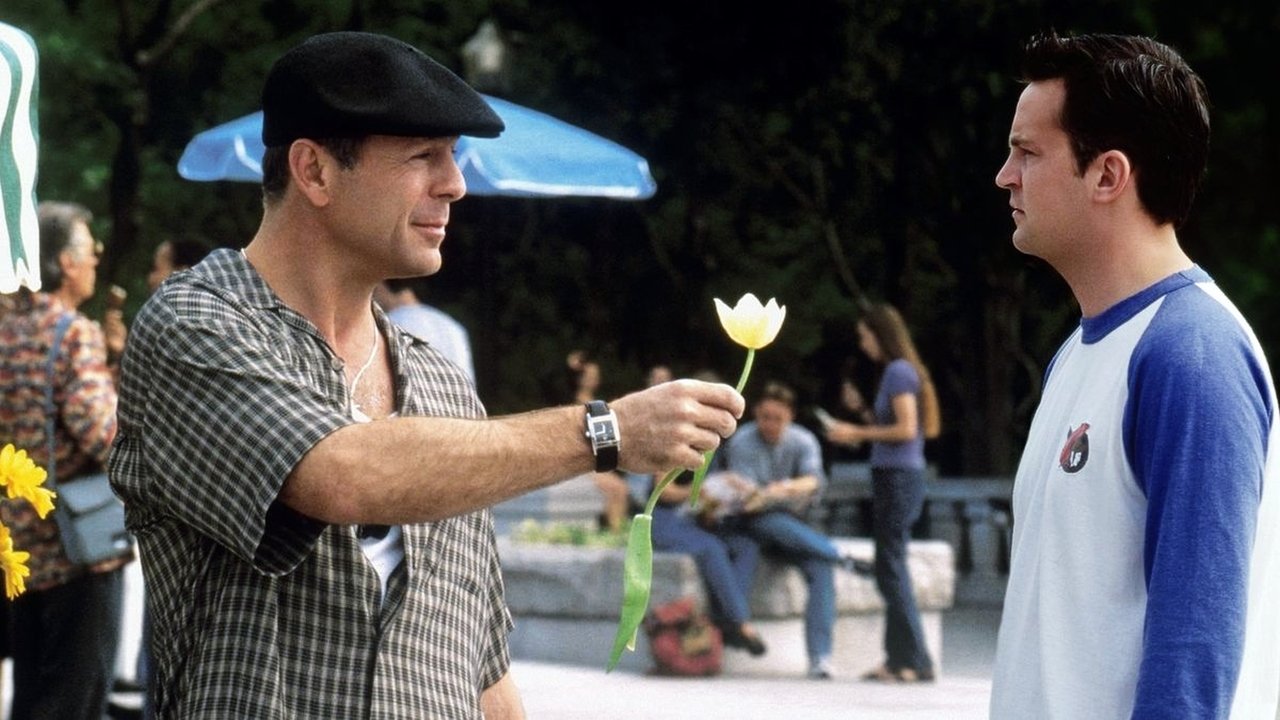
And the jokes with the tulip here I asked Mitchell to put in on the very first rewrite as part of several places where I wanted to boost Bruce's character and give him some more laughs. This scene was originally going to be shot in a little cobbled street in the old town. We couldn't afford to go there because all the shop owners got together and... agreed to charge us to such an extent that we couldn't afford to shoot there anymore. And then we found this location, which is just wonderful and shows a panoramic view of Montreal. I was really pleased that, yet again, financial considerations forced us into making a change, which turned out to be for the better. After the ensuing scandal and bankruptcy and embarrassment, my wife and her mother decided it would be best that we move back here. That's the St. Lawrence River in the background, of course. No, I live here with my wife. You sure you're a dentist? Yeah, why? Because I've never met a dentist I liked. Well, I try to keep things as painless as possible. Me too. Yet again, you can hear French accordion music in the background of that scene.
Hey, it's been good. I'm glad we got to know each other. This joke was improvised by Matthew and Bruce on the set. Me too. You can go now. Right. I love it. Oz! Yes, dear? Thank God you're home. Thank God I'm home? I had an idea. I figured out a way we can pay off Daddy's debt. Rosanna's Montreal accent is... really excellent to my ear. It's very different from a French accent or a Paris accent. But she seemed to capture the distinctive Montreal accent extremely well. I think she had an au pair girl from Montreal, or maybe she just worked with women who she met on the shoot. Other than the fact that would make me party to a murder. But he's a killer. He said so himself. That's another good reason not to do it, okay? And whatever he's done, he's been to prison, he's paid his debt to society. Well, now he can pay our debt, too. Look, I know this is gonna sound crazy, but... We tried to eliminate the complexities of the backstory where possible. And so this scene had quite a few little cuts in it, as did the restaurant scene in the beginning.
We discovered we didn't really need to know all that much about Rosanna's father and Matthew's father-in-law. A counter-killer or your wife? Do I have to answer that? Nicola! Okay, okay. Let's say that he did make a pass at you. The guy's been in prison for five years. He's desperate. He'd sleep with a meat grinder. You pig! We were really stuck for a joke there. Unfortunately, I came up with the meat grinder. Gagwitz always made audiences laugh. And you won't even lift a finger? That's right. I'm not gonna lift a finger because this is crazy. You do this for me? I don't know if Rosanna's ever played a villain before. I've always been a fan of hers, ever since I saw her in After Hours. and desperately seeking Susan. I've normally seen her in much more sympathetic roles. She really wanted to play this and I was just thrilled. 9 a. m. , you better stop pecking. Zoom. Okay, well, when are you coming back? Because I have to reschedule all your appointments. It should be more than a couple of days.
Are you going alone? Yes. Good. Can you do me a huge favor while you're there? Go out and get laid. Jill. And call me the second you get back. Better yet, call me right after. Call me during. I want all the details.
Don't expect too much. I'm not even sure... Some people have said that they assumed the Volkswagen is a sort of rather blatant example of product placement. In fact, Volkswagen refused to give us any money unless we showed a man driving the car, because they said they already had enough women who wanted to drive it. Good luck, my darling. And hurry home. We decided to use it anyway because it seemed to suit her. Do they have vomit bags on the flight? That was another of Matthew's ad libs.
The music you can see is really propelling the action. And Bruce underplays this scene with his characteristic skill. You're Jimmy Dudeski, aren't you? Jimmy the Dulep? Don't worry, your secret's safe with me, sexy. But you will never believe what my darling husband is up to.
These shots are the only three shots that we actually did in Chicago. David Franco went there with the second unit and went up in a helicopter and got these three flying shots. Everything else that takes place in Chicago in the movie was actually shot in Montreal. This restaurant is at the top floor of the department store called Eaton's, which I believe has since closed. But it's very much the kind of architecture in 1930s Chicago... ... and everyone accepted it without question. I have no intention of ratting anybody out, okay? The only reason I'm here is because I want Sophie off my back. You want to know the truth. All right, look, I've got a deadline. I'll come by your hotel room as soon as I'm finished. In the meantime, promise me you won't do anything stupid. Now, why would we even trade that? You married Sophie, didn't you? So I'll get the check, then?
Michael Clarke Duncan, who plays Frankie Figgs, is an old friend of Bruce's. They worked together on Armageddon. And when we cast him, he'd just finished shooting The Green Mile. You're in the right place. In which he plays a very different kind of role. Extraordinarily gifted actor with a presence that I suppose has something to do with his huge size and bass voice. For our immediate purposes, there is no Dave. Dave does not exist. So, just answer my question. He has to do very little to make his presence felt. Have information regarding the whereabouts of Jimmy the Tulip. I don't know what you're talking about, man. Really? This hotel room is actually a set. Must have been misinformed. Built on the stage. I apologize. It's okay. We had to pad Matthew a little for this fight, just in case of accidents. We understand you have information regarding... Who told you that? Why do you want to go cluttering your mind with the inconsequential? What's important is we know that you know where Jimmy Tudesky is.
I really have no idea. Aren't you gonna cry for him? Would it do any good? No. It's always a fine balance... ... trying to do a scene that's potentially ugly like this... ... in a way that's funny. The handshake... ... gives a clue to the audience they're meant to be laughing... ... as does the next time Matthew's hit... ... when he slaps his hands onto Frankie Figg's head. And... before a scumbag like Jimmy T. The audience gets a signal from us that they're meant to be laughing at this, even though it's violent. I may know where he is. Well, all right, but don't tell me. Let's go tell Yanni. Okay. You mind if I piss a little blood first? Please, by all means. Thanks. Woof! Woof! Woof! This is Yanni Gogolak's house, meant to be Chicago. The stars and stripes in the middle of the lawn is a nice touch by David Snyder. And Yanni Gogolak is the leader of a Hungarian gang. Mitchell Kampner made it Hungarian because I think he just didn't want to make it the same usual cliche Italian gang.
which is what happens in most films when there's gangsters. I talked to Kevin about how he should speak in some way strangely with a sort of Hungarian-Chicago accent. And we narrowed it down to confusing all the Vs and Ws and mispronouncing the Js as Ys, like Yimmy Tudesky. And Kevin had the idea of making him Napoleonic with a Napoleonic hairstyle. And so we put a bust of Napoleon behind him. And there's a portrait of Napoleon somewhere in the room. We wanted the scene to look completely different from most gangster films. Initially, we started off with a sort of deep, dark, shadowy look of The Godfather and Gordon Willis photography. And then we thought, this is how every scene in every gangster's house has been shot since the early 70s. So instead, we went for the opposite look. We went for a light, bright, sunny room. We had everyone dressed in light colors, beiges and creams. We had the room done in beige and cream. We went for a look that was completely in contrast to the tone of the scene.
so that it would look different from other gangster films. Unfortunately, on the day we came to shoot, it was raining heavily, and we weren't sure that we'd be able to get away with it. But in the way that David Franco exposed the film, he was able to sort of blow out the light outside the windows, and so you can't really tell that it's pouring out there. It did mean we changed a costume. Natasha was going to originally enter in a bathing suit, one piece bathing suit and a sun hat. And we thought we weren't sure whether people would see the rain or not, so we put her in a dress and in fact it was a good choice anyway. This was a scene that was six pages long and we had to shoot it in one day. And to complicate matters, it was our first day. Normally you
shoot big and difficult scenes a little later on in the schedule when the actors know each other well enough and when the crew will be working together, but we had no choice. Miraculously, we shot this whole scene within a 12-hour period on the first day. And we had rehearsed it first. The actors were just wonderful, remembered everything we'd rehearsed. Whatever. It seems that our dentist friend here knows where Yimmy is. Oh. Come to collect on the contract. No. Yanni, just so you know, since I'm the one that found this guy, I want it. The contract's mine. Just as long as I'm in on the kill. So long as I get full price. I want to see that spineless rat tank. I wanted Natasha's character to be a sort of combination of Grace Kelly and Lauren Bacall. I wanted it to be beautiful, tough, unapproachable. Sensuous. I think she managed to do all of those things superbly. And of course, you know, look at her. She won the Jean Poole lottery. The costume designer, Edie Jaeger, helped, of course, by dressing her in a sexy but elegant style throughout the picture. Kevin makes a huge impression in this scene. He's only got a couple of scenes in the film.
This is the big one. And he leaves an indelible impression. Finders fee? I tell you what. Tell your wife. We'll work something out.
Cynthia, don't rush off. We should chat a little. We use music to link all of these scenes. Leaving Yanni's house, coming to outside the hotel, and all the phone calls inside. Again, to increase the sense of momentum. What did you do? Who did you talk to? What are you talking about? You know a guy named Frankie Figgs? I know of him? Yeah. Well, when I came back from lunch, he was sitting in my room. Frankie Figgs was in your room? Yes, and somehow he knew all about my knowing where Jimmy the Tulip is. And what did he do? Well, after he played congas on my kidneys for a while, he took me to see Yanni Gogolak. Oz, tell me you're kidding me. Who did you tell? I want to know exactly who you told. No one, I swear. Well, then how... What am I gonna do? I'll talk to you later. I got to go. Room service. Yes, this is Dr. Osiransky in room 519. I'm going to need a bigger bottle of scotch.
That joke was contributed on the set by David Willis. We had a fairly kind of easygoing, relaxed, improvisational atmosphere. Anyone who came up with a good idea was welcomed. Oz, how you doing? I don't know what to do. I've done something terrible. Oh, come on. Oz, what could be so terrible? You've got to get out of town. Get out of Canada. Just get the hell out. Bruce liked to be seen with a martini in nearly every shot. Yeah, I heard about that. Which I thought made him chic and elegant. Otto was sort of a genius with his own costume. And I like the idea that as a Hungarian or Polish gangster, he has a crucifix around his neck. I'll explain everything to you when you get back, okay? In the meantime... He is, after all, a gangster with morals. Although his job is to kill, he certainly doesn't believe in divorce.
The script called for Matthew to vomit at this point, but Matthew came up with this uniquely funny way of doing it. And then when Cynthia arrives at the door, we wanted a sense of sort of old-fashioned film noir, as they say. Some people have defined film noir as a film made with a small or inexpensive lighting package. Yanni's guys are downstairs? Yes, come in. So we had music that seemed to suit that atmosphere. And Natasha played her entrance with tremendous style. Yanni sent me to see if you were on the level. Yanni's the trusting type. Somebody once described this film to me as a scruple noir. Do I or don't I know where my wayward husband is? This is Tedeschi. Cynthia, please, why be formal with the woman you're about to widow? You don't understand. What's not to understand? You want your 30 pieces of silver, right? See, my only question is, why didn't you just do the job yourself? Why didn't I? Why didn't you kill Jimmy and try to collect on the contract? What's the matter? You didn't have the stomach for it?
Where's your problem a little further? South. Have you vomited recently? A minute ago. I was just going to brush my teeth. I'll wait. OK. They played that so beautifully. And on every take, they were just as flawless. Here's another moment of character for Oz the dentist. He doesn't just brush his teeth. He also then goes for a bottle of mouthwash, which is pretty large. Larger than you need carry to Chicago for one night. Unless you're a dentist. Just tell them I'm acting exactly the way I'm acting right now. But you do know where Jimmy is, don't you?
This is Tedeschi. I don't want anybody to die. And that is on the level. What do you want? What do I want? I just want this all to end. I am so damn scared.
It's room service. Before I vomited, I ordered scotch. Here you go. Thank you. What would you say to a drink? I'd say no ice, no water, and a tall glass. What can I say? I was young. Jimmy was like no man I'd ever met before. This is the only scene in which we made substantial changes after our first test screening. In the original script, Oz, towards the end of the scene, made a long declaration of love to Cynthia. We had never questioned this, but when we saw it with an audience, we realized that it happened too soon. It was only his second meeting with her. Furthermore, I'd added some romantic music, a very beautiful theme that Randy Edelman wrote, but it seemed to turn the movie suddenly into something much more sentimental than it is, and that it should be. One of the things that's attractive about this film, I think, is its lack of sentimentality.
It was also not very good structurally because although Oz is in love with Cynthia, she doesn't realize it until much later in the movie when they're in the parking lot on the phone to Jimmy Tedeschi. And we felt in this scene the audience really slipping away from us. So before we did our second test screening, we simply... We chopped big pieces out of the scene and recut it and restructured it a little. And the scores in the test screening went up enormously to such an extent that it was clear that the film was going to be a hit. It was very satisfying for us to have seen the problem, diagnosed it correctly, and as always, afterwards you think, why didn't we see it first?
So how much would it take for you to kill your wife? I'm talking about you. Me, then. What would be your price? That's what I'm saying. I think you are the most beautiful thing I have ever seen in my life, and I cannot believe I am saying this out loud. I'm sure that's just the Scotch talking. No, it's me. This is the only part of the speech that's left. I've spent the last seven years of my life just sitting and waiting for something to happen. I didn't even know what it was. until you walked in that room at Annie Gogolak's house. I'm sorry. Oh, I've embarrassed you. I should go. No. Please. You're a nice guy. But I've got to go. Let's go. The scene that's just coming up in the limousine is what's known in the business as Poor Man's Process. The car is not on the street at all. We're in a studio with black velvet all around the car and two lamps on a stand behind the rear window. Did you mean what you said? It's much quicker that way. I've got till midnight. In the meantime...
There's a kind of a small point in the background here that a lot of people noticed. They've obviously been having some really great sex because everything in the room is being knocked over. The picture is crooked. The bedside lamps have been knocked over. There's been something pretty wild going on prior to this scene. Jimmy knows I'm here. Here with me? Here in Chicago, talking with Yanni. How? How did he know that? That's an example of the way music is used to create tension. in the opposite way from the way people normally think of. The music was going through until he said, Jimmy knows you're here. Then it stopped. So the really tense, important dialogue takes place... ... not with tense music, which would be the cliché, but in silence without music. He's gonna kill me, isn't he? And then, when he's done with that, he's gonna come after you. Well, I'm not gonna let that happen. I'm not gonna let Jimmy kill you. I'm gonna take Frankie to Canada.
And lead him to Jimmy. So Frankie can kill him. Believe me, if there was any other way, but better Jimmy than you, right? Oz, don't you get it? Either way, I'm dead. Why? Why? As soon as Jimmy's dead, why would Yanni want to keep me alive? He'd want to kill me, too, so he can... She can collect on the whole ten million dollars. The interesting thing about this script is that you could take out all the comedy and play it as a straight film noir and hardly change a word. I wouldn't like it as much. Continental gets a free ad there. That wasn't product placement either. What the hell did you do that for? I felt bad. I like him. I liked him. So you don't like him no more? Well, it's a little hard to maintain a friendship with somebody who wants to kill you. I love the joke at the end of this scene about the gap in his teeth, which Matthew ad-libbed on one take. You know, I can close that gap for you. Really? Yeah, you'd be in that one. You kidding? No, not a problem. Wonderful character touch.
Did you do what I told you to do? No, no, I'm not going to answer that. So you did. I can tell you had sex. Who was she? Come on, I want to hear all about it. Look, I got to go, okay? So in the next scene when Matthew meets Bruce in the hotel room, this is the first big total surprise in the film. It really surprised me when I read it in the script. And one of the reasons I wanted to do this film was because there are two or three twists that Mitchell Katner created in the screenplay that I thought would really surprise people. And there is nothing predictable about this script. When we came to shoot it, it was the one big piece of physical comedy that we hadn't worked out in advance. And when we got on the set, we really weren't sure what to do, and we had a very short time. I suddenly realized that when Matthew saw Bruce, he would turn to try and run and slam into Big Mike, Frankie Figgs. I suggested this to Matthew, and of course, he ran with it and turned it into not just slamming into Frankie Figgs, but rebounding, crashing into a lamp, disappearing behind the sofa.
We only did three takes of that. The shot in the movie is the third take, which was really the funniest. And he really sort of invented that on the spot. Bruce ad-libbed the last line of the scene, which I think is very funny and gets a big laugh. This scene was originally set when the film was written for Florida beside a swimming pool in a Miami hotel. That didn't seem to be right for Quebec. And one night, David Snyder and I, when we were in the early stages of prepping the scene, it was my birthday actually, and David said, let's go to Biddle's Jazz Club. I've been there before. You'll like it. So we went there and we saw Stephanie Biddle singing and her dad, Charlie Biddle, playing the bass. and we said this has got to be in the film and we didn't have a location for the scene that had been set beside the swimming pool so we moved it to a jazz club let me tell you something you are not fine you know your wife wants you dead how much i've figured out and i just thought you should know this was a hard scene to shoot we had to shoot
Another six-page dialogue scene, although it was easier because there was only three people and nobody was moving much. But we also had to shoot Stephanie and the band singing Autumn Leaves and the piece of music for the end titles. So this was a busy day. Charlie is a great bass player. And on the drums there is Gary Gold, who recorded the two songs that... And arranged, recorded and arranged the two songs that Stephanie sings in the movie. But you did turn her down, even though I went to Yanni. You didn't go to Yanni. Jimmy sent me to come to you. And I know that Frankie can be very persuasive. By the way, how's your urination? Oh, fine, thank you. So why did you want me to go see Yanni? So you could tell him where I was. So he could come back up here and you could kill him? Exactly. By the way...
I'd be happy to do your wife for you. One of the interesting challenges of shooting comedy is that you have to be able to remove anything that's meant to be funny but doesn't turn out to be funny. And so you have to shoot in a way that's a little more conventional and traditional than you might be able to in a drama or... or in a film where there isn't a kind of instant test of whether the audience is appreciating what you're doing or not. There really is an objective test to whether or not a film is funny. If you put it up on the screen in front of 500 people and they laugh at something, that something is funny. If they don't laugh at it, it's not funny. Sometimes you can find yourself alone in an audience of 500 people and they're all laughing and you're not. That doesn't really mean that it's not funny. It means it's just not funny to you. What you can't do is leave the actors hanging out there to twist in the wind because you shot something in such a way that something that they tried and is not getting a laugh can't be removed from the film. You have to be able to remove something that isn't working.
and that means you have to shoot a lot of what we call coverage, different sizes, different angles. I worried about whether people would be concerned about why they were visiting a jazz club like that in the middle of the day. Nobody's ever worried about it at all. In all the other takes, we had a sign outside the club that said lunchtime jazz,
Unfortunately, this was the best take and it didn't have the sign. So... I contemplated putting it in with CGI, but no one in the audience has ever raised a question about it. Jimmy, you were right about him. This is one exceedingly sweet man, wife like he got, and still he believes in wet and foul. So do I, especially till death do us part. Oh, quite deep, right? I gotta go to the office. The day at the jazz club was, as I've already said, very tight. And it was raining all the time. This scene was shot in the one hour when the rain wasn't coming down. And we knew it was going to start again any moment. So we set up the camera on its tracks and did three quick takes and hurried indoors before it started to rain again. We had a dental advisor on the film, Chantal Aubrey, and... She taught Matthew how to be or how not to be a dentist. You know what? On second thought, Mr. Tourette, I think we're going to have to pull the tooth. The running theme of the potentially suicidal dentist is repeated here.
I am your friend. Talk to me. Well, I have to talk to somebody, you know, because I'm just... Take your time. It's good. Well, first of all, I just found out that my wife is trying to have me killed. Who told you? A friend. Anyone I know? Oh, he's my next-door neighbor. And here's the funny part. He's a hitman, too. Ha, ha, ha, ha. Really? What's his name? Jimmy. Jimmy Tedeschi. Jimmy the Tulip? Jimmy the Tulip lives next to you and you know him? Oz, can you introduce me to him? Jill. The man's a professional killer. The insane sound effect there was not thought of at the time he was shooting. And the first time that Matthew did that, he genuinely forgot he had the rubber hose around his neck and fell over. Then we worked on it a little and perfected it. I'm one of your biggest fans. I've been following your career since I was a kid. You're the reason I'm trying to... Amanda plays this scene beautifully, but Matthew's reactions in the two-shot with her are also hilarious. One afternoon of your time. I know that I could learn so much from you. So come in.
This was a very difficult scene to shoot. We had one day to shoot this. This was another three-page scene. Sorry, six-page scene. What's all this? So you know this girl? She's my assistant. Did you know she was a hitter? And the actors really had to be on form and on top of it because we wanted it to go at a tremendous pace, as you can see. His wife hired me. That was you? I was supposed to make it look like an accident, so I went to work for him so I could, you know, familiarize myself with his habits. Good. Smart. Thanks. But then after I got to know him, I started to like him. First mistake. I know! She'd get close, but not too close. She played I know in a way that completely surprised me and, of course, is totally right for the character. Now comes a section of the scene which was added... As soon as I came onto the film, I was concerned that Bruce's part was neither big enough nor funny enough. Bruce had never raised this question. He's a very unselfish actor. But it seemed to me that we needed more for Bruce, and specifically we needed to cement the idea of the initial...
strong attraction that these two characters feel for each other. Chill. I really liked him as a person, you know what I mean? You got too close. So this whole story was interpolated. That thing with the fly... There was a fly. We had a plague of flies in the house. And Bruce just... I suppose it was irritating him. He went to catch it and he actually missed, but fooled us all. And that take of him right after he spits out the fly and continues talking, we've used up to the very last frame before he and Amanda cracked up and howled with laughter. I don't think he thought we were going to use it in the film, but he was delighted when we did. Of course, we added the sound of the fly. And then it became a kind of running theme. And there's a fly that lands on Kevin Pollack's head just as he's dying. And there are other flies around a couple of places. We decided, why fight it? If they're going to be flies in the house, we'd use them. Excuse me. Excuse me!
Not to interrupt or anything, but you were going to kill me? That was the plan? What are you doing tonight? No plans. You want to help us out? Me and Frankie Figgs? Wait. Are you offering me a job? Only if you're interested. It would be an honor. It would be like a dream come true. Who's the mark?
Yanni Gogo? Wow! Wow! Feel my arm. Goosebumps. We tried that phone ringing in a number of ways. And in the end, the biggest and broadest way, splashing the drink, was the funniest. And then after Matthew said, there's the phone, and then we cut to Bruce, he did that. Wonderful ad lib. There it is again. Bringing my wife with him. Your wife? Why? I'm sure Yanni figures he'll take care of her when he takes care of me. So what are you going to do? Bruce is the sort of quintessential tough guy. You got a problem with it? Why would I? It's not like I know him. With a sense of humor. He really is today's Humphrey Bogart. of a beautiful, innocent woman whose only crime, as far as I can see, is that she married you, Jimmy. So you know what? I'm not gonna listen to this anymore. You know what I'm gonna do? I'm gonna... I'm gonna... I'm gonna go! I'm gonna... Does this slide? After Matthew opens that glass door, in that take, he...
shuts it in a very funny, petulant way and runs off. But we discovered that gave us a problem at our first screening because when he crashed into the door later, it wasn't funny because the audience had seen him shut the door and so they thought he was kind of an idiot. Now, because we cut away before that, they laugh tremendously when he crashes into the door. Thanks for that.
That's my phone, thank you. Hello. Well, who was it? They hung up. Expecting a call? The two hoods... Explain to me how that's any of your business. ... known to us as the Hungarian Hood and the Polish Pug, played by Jodi Gore and Dino Clave, are both actually stuntmen. We didn't want to... hire stuntmen to do their deaths later, so we thought, or hire stuntmen to play the roles when they can fall down the stairs themselves. That moment when she comes down the stairs and hands her coat to one of the thugs and hands him the bag and she's being taken off by the villains. I shot with a conscious awareness of one of my favorite films, North by Northwest. There's a moment there with Eva Marie Saint where the same thing happens. I think that was the sixth take we did of Matthew crashing into the door. He was really game. We did it again and again until we got a take where he stood up
and came through the door and then nonsense words came out of his mouth because he was concussed. All the takes were funny, but that one was the funniest. But that's not the point. What is the point? You're still gonna kill your wife. Well... Yeah. I've got a very good reason to kill my wife. Bruce pulls off an extraordinary trick in this film. He's playing a hit guy. A man who wants to kill his wife, who we know is a perfectly nice, harmless woman. And yet he manages to make it likable and charming. And simultaneously a little scary. Do you see why I couldn't kill him? I love him. Come on. Relax. Just come on over here. Sit down in your favorite chair. Have another martini. Listen to me.
Tonight is going to happen whether you want it to or not. And you're going to help. Me? Help? Yeah, you help. You're going to help. You're going to go with Frankie to meet Yanni at the plane, because if you're not there... The end of this scene, the dialogue with the tomato plant, was improv by Bruce and Matthew. This is the way it's got to be, okay? When they pitched it to me, I thought they'd taken leave of their senses, but when they did it, it made me laugh a lot. If you screw this up... I would hate to... I would really hate to have to kill you. I would hate it. I hate it more than mayonnaise. You know how much I hate mayonnaise. In order to make the lighting go faster, we went for deep tones on the walls. You can see the deep blue behind them. It made it quicker for David to light the scenes. We were always in a tremendous hurry.
Damn it, Jimmy, why the hell did you have to go and move in next door to me? Oz, do you know what kind of soil they have in this backyard? I've been here two days and I got little tomato plants... Oh, my God! Yes. Yes. Yes. We spent one day at the shoot in Niagara Falls. And we did those shots of Niagara Falls from outside. And then, uh... This, of course, is not a motel overlooking Niagara Falls. This is a little set and Niagara Falls on a green screen outside. No, no, no. Listen, why don't we make it, uh, 12-5? I can live with 12-5. As long as my husband doesn't. He won't. I promise. You must be... Jill St. Clair. And can I just say, Mr. Figueroa, that I think the job you did on Kevin Vincent, that and the Ronald Abrams one hit, they were both just works of art. Well, I see you've done your homework. Well, I keep a scrapbook. Frankie! What's up, man? Honey, why don't you go get ours? We'll all run through this one more time. Amanda runs away down the hill now. He's a cute kid. He's got definite potential.
And that was a real fall. It wasn't in the script for her to fall over, but when she did that, I just laughed and laughed and changed the setup so that the previous scene ended with the line, she's got lots of potential.
This scene was designed so that music and aircraft noise would cover any conversation, so that we didn't really wanna have dialogue in this scene. But the aircraft noise made it unnecessary. We didn't wanna have dialogue because it's all about the look between Matthew and Natasha there, as they realize they can't say anything.
You know, I got this same car. Really? No. There you see the two houses together and see how perfect they are. And this night shoot was done at a horrifying speed.
Nights in Canada in the summer are extremely short. Everybody quiet. I wouldn't have known how to suggest to Matthew to put on an I've just farted embarrassed face, but he knew how to do it. God, I'm going to love this. I put the tires there because I wanted Matthew to have something funny to do at this moment when he sat down. And of course, you know, you give Matthew a starting point like that and there's no stopping him.
as though I'd given him a really nice present. Sweet dreams, Jimmy. Let's get started.
These gangsters seem to be chronically indecisive, and they come with a whole lot of guns to a gig, and then they make up their minds later. Anybody we know? Oz's wife and some guy. Probably your replacement. The new hitter. Well, I don't know what you can do about it now. Keep an eye on her. Okay. Love those pants on you. Bruce threw in that line about the pants, and it really does take their relationship a stage further. There was a certain amount cut out of this scene. It wasn't exactly explicit, but it was quite clear, somewhat clearer that oral sex was going on throughout this scene. Now there's only one slight reference to it. It somehow, Even in this film, it seemed to cross over a boundary into bad taste. Oh, God. Of all the times... You're married, right? Yes. Does your wife have any, um... Feminine products. Uh, yes. Yes, she does. They're right through there. I'll show you where they are. Right. Don't long. Don't long? Don't be long. Gotcha. You make a little noise, he gets out of bed, he comes to see what the problem is, and you make him dead. Okay? You understand me? The dead part?
Then you ransack the house a little bit so it looks like a bad burglary. And you get your ass back in this car. And we drive like hell back to Niagara Falls. Well, you're going to pay me my other $5,000. My mother's there waiting with it. Wait a minute. Your mother, she knows about this? My mother wants this to happen as much as I do. And I really, really want this to happen. They're going to kill you. What? As soon as they're done with Jimmy, Yanni's gonna come after you. That's why I came here, so I could warn you. Oh, that is... Yanni's not gonna kill anyone. Jimmy's over there right now waiting for them. Jimmy and Frankie, they're in, you know... Oz is in love with Natasha at this point, of course. She's not, so she was a little surprised by that kiss. It's time you two stay here.
I wanted there to be something slightly comic as well as unpleasant about this gang. You know, they're sort of the gang that couldn't shoot straight. You know these guys? No. Who is that? Is that Yanni Gogolak? From the Gogolak gang. It might be the guy they call Jimmy the Tulip. He lives next door. Jimmy the Tulip. Damn, this is a hit. Stay right here.
Who's that? I don't know. You smell great. So we decided to have an old film running on the TV. It's Key Lager with Humphrey Bogart and Oren Bacall. And when Randy's score comes in, is adjusted then, It's in the same key as the original Max Steiner score. So we've got the old Max Steiner music and the Randy Edelman score playing together here and intertwining with each other. Looking for a new way to have a shootout, I thought it would be really good if Bruce shot in silhouette. Of course, the script called for this surprising twist when Jill is standing there naked, and Bruce appears in shadow. Hi, Yanni. Watch your head. The watch your head thing was Natalie from Bruce, and now Amanda waves away the fly, and it lands on Kevin's head. And that's a real fly, even those two different shots. Sneaking into the house thing to try to kill me. You guys are really good. You really... Amanda's extraordinary in that scene. Pretty hard to be funny while you're doing a nude scene, but she carries it off.
That scene had to be shot from a variety of different points of view, and we somehow had to let the audience understand that they were seeing it from Sophie's point of view, and from Jill's point of view, and from the cop's point of view. You know what? Better you stay just like that. In 60 seconds, stick your head out that window. Hey. Nice work. Thanks, Jimmy. In the background, you hear Lauren Bacall saying, will we see you again, Frank? Which is sort of apposite because Frankie Figgs is walking in and Bogart says, I hope so. Which is relevant to Jimmy going out again to assassinate someone else. Can I help you?
Now you can get trust. I liked having that little bit of romantic music over the dead body. And now you've got Sophie running away, hysterically screaming. I love that shot. I love the way she played it. Where do you want this? Just put it over there. All right. The light in this scene is perhaps a little brighter than you would expect. For me, some of the comedy of the scene lies in the fact that it's not lit in a kind of spooky way, but the fact that these macabre happenings are all taking place in ordinary light as if it's ordinary daily activity. That's what Harry Lefkowitz thought. What happened to Harry Lefkowitz? I don't want to know what happened to Harry Lefkowitz. I know. It's Jimmy. This scene was shot at restaurant La Fleur, which amused me since the film is about Jimmy the Tulip. I'm sorry. I don't expect anyone to ever notice that kind of thing. You can't let me kill her. What do you got? This got nothing to do with you. Jimmy, I'm in love with her. Natasha's looks there... say everything about how she didn't realize that Oz was actually in love with her. Those two little looks. Perfect example of subtle film acting.
This is a big moment in the film when Bruce realizes that Oz has been shtooping his wife. The script used to contain a lot of obscenities at this point, the F word. But Bruce decided to play it very formally. You've been having sexual congress with my wife, which I thought was very funny. Unfortunately, this scene was shot when there was a huge Independence Day or Canada Day firework display. We had to wait till the fireworks were over, but we didn't realize that about 40,000 cars would be going past the garage on the way home. So we had to loop quite a lot of lines in that scene. Just tell him to stay where he is and I'll be right there. Okay, sounds great. I'm just gonna run it by the boys and I'll be right back. Okay, bye. Jimmy, when's the last time you went to the dentist?
As well as keeping obscene language out of the film, we also, although there's some violence in the film, we kept blood out of the film. Most films nowadays, when people are shot, gallons of blood burst out of their chests or out of their backs in a way that doesn't usually happen in real life. It was a sort of Sam Peckinpah technique from the early 70s that everyone has adopted. We didn't really want to have any blood. We wanted this to be a film that was, in spite of its subject, a sort of much more of a family entertainment. The violence is not supposed to really horrify people. So we don't have people with blood in this film. When they get shot, they just fall down and die. And that seemed to work... Just fine. It should be there. I know. Yeah? It's me. I'll tell you one thing. You got balls. Yeah. Who knew? Jill told me your idea. And I think it's worth a try.
Jimmy, thank you. But just so you know, I am disappointed, Oz. I am extremely disappointed with you. Believe me, you are the last person in the world I would ever want to disappoint. But everything I did was for love. Yeah, whatever. I'll see you at your office. OK, give me an hour. Oh, and don't forget the corpse. This piece of music is Charlie Mingus' Blues and Roots. And this was the sort of inspiration for much of the music that Randy wrote in the score. Stay on the boat. Take this. If you don't hear from me in two hours, just go. Disappear. Leave the country. Oz. Be careful.
Because there are no laughs in this scene, I was able to shoot it in a sort of a long, lingering crane shot. I didn't have to do any coverage because I didn't have to risk... I didn't have to, you know, envisage the possibility that something might be unfunny and have to come out.
I just wanted to make sure it was you. Everybody's inside. By the way, huevos grandes, amigo. There's a kind of bluey, greeny, fluorescent quality about the lighting in this scene. Something sterile, which I think is a good idea for the dentist's office and for the macabre circumstances that we're in. This whole montage, this whole dentist sequence is put together in about a day and a half of frenetic work. It's lots and lots of tiny shots.
So good.
We're good. Barbecue? Barbecue. When we got to this location, Bruce got out of his car and said, I've been here before. And I believed it was used in a film that he did called The Jackal. Of course, I hadn't known that when I picked it. And I imagine it looks very different in that film. but it is a very striking old mill, very close to the center of downtown Montreal. Disused mill. We went to the trouble of having dummies in the car. Look very much like Yanni and the cop, but actually in the end you couldn't see them. It looks as though this A sports utility vehicle is going very close to the exploding car when it explodes, but it wasn't all that close. It's the effect of a long lens which foreshortens the distance. It's one of the ways you can make actions look closer to each other than they really are. Doctor, these men need to see you.
Excuse me. Right this way, gentlemen. Dr. Oseransky. I'm Sergeant Buchanan. This is Officer Morrissey. I think these cops had originally been written straight. But when Sean and Richard came in to meet, I suddenly realized the possibilities of faintly comic cops at this point. Yes. Is there a problem? Do you know where your vehicle is, sir? I lent it to my neighbor. He went fishing. This neighbor. And they are very much in the style of the rest of the film, which is important. Jimmy Jones. We did a number of takes of Matthew nearly falling out of that chair and several when he fell out of it, which were hilarious. But somehow at this point we felt he was less of a klutz and we opted in the cutting room for the shot where Matthew nearly fell out of the chair. At last we thought he's learning something. He doesn't. Always forever. Established that the bodies were those of one Yanni Pitor Gogolak and James Stefan Tedeschi. Both of them were big shots in a Chicago crime syndicate. And you think this James... Tedeschi. Is the Jimmy I know? Well, that's what we intend to find out.
Hanson's car? Go have a look. Uh-huh. Who's Hanson? One of our men. He was on an undercover assignment. There was some concern earlier because he failed to check in this morning.
My mother wants this to happen as much as I do. And I really, really want this to happen. It's Hansen's car, all right, with no sign of Hansen. But I found a tape. We needed a big establishing shot here of all the police activity and the bodies being carried out. And, um... The police very kindly provided us with that helicopter. We couldn't actually do anything with it. There wasn't enough space for it to land safely in the shot or take off in the shot. But we thought, this is great production value, great set dressing, so we just put it there in the background. A hitman? Oh, my God. I think that virtually all the... Forensic people and police and... All of those people you saw walking around in that scene... Where is he, Mrs. Azaransky? ... were the real thing. They weren't extras. I think they don't have a terribly high crime rate in Montreal. You can ask me questions until you're blue in the face, but until I speak to my attorney. You spoke to your attorney. He doesn't want to have anything to do with you. Special Agent Hanson, Mrs. Azaransky, what did you do to him? Was it me? We have your voice on tape.
It's written reports. We know you tried to hire him to kill your husband. So what happened? He tried to back out. He tried to back out, and you killed him. None of this would have happened if that girl had only done her job. What girl? Jill, my husband's receptionist. Oh, yeah? Was she a contract killer, too? Yes, I hired her. She's the killer.
This would be sad if it wasn't so pathetic. Do you want to talk to her? No. No, I don't think so. I don't blame you. You guys know a good divorce lawyer. She did it. She's a killer. You've got to believe me. That little look at the end, which is just enough to make sure that we don't feel sympathy with her, as well as being funny. And that's very important, because she is the villain. While you and Jill are at the bank getting the money, Jimmy and I will be at the fine art museum. Jimmy at a fine art museum? There's people at a fine art museum. He's not gonna try anything. All right, if you say so. That's Montreal Cathedral. It's very beautiful inside. Tried to find a way to shoot a scene in there, but I just couldn't think of how to justify it. Then I'll beep Cynthia. She'll get in touch with you on that phone over there and tell you where to go. Listen to him, Mr. Cloak and Dagger. I'm being careful. I'm a dentist.
Boys play nice now. Take us to the art museum. You really think if Cynthia doesn't come through, you're gonna be any safer at the art museum?
There was nothing special you wanted to see at the art museum today. Why? Because we're not going to the art museum. We're going to the marina. The marina? Yeah. I rented a boat for the day. Isn't that right, Frankie? See?
This is the marina in Montreal. And this next scene is under the Jacques Cartier Bridge. There are a lot of low angle shots in the movie. Here we've got a very low angle shot contrasted with a very high angle shot as if it's from the point of view of the bridge and then back to a low angle again. The reason is it makes the characters look small against colossal background. In terms of graphic design, you can see the bridge always forms a diagonal line, first going one way and then going the other. And diagonals are always good in graphic images on a square screen. Sometimes you shoot low angle shots because you want to make the characters look bigger or more imposing. Stars are frequently, male stars are frequently shot from below. Women almost never because it's, you know, you've got a problem. You don't want to emphasize people's chins. Let's go banking. Nor do you want to actually shoot up anyone's nose, but you do want to make them look bigger and tougher and, you know, especially, you know, little stars like...
Alan Ladd was, for instance, not to name anybody contemporary. It's always a good idea to shoot them from a little lower. We also have a number of angles in the film... ... which people describe as kind of crooked or off-kilter or whatever... ... and are known, I think, or used to be known as Dutch angles. Who knows why they're called Dutch angles? So, what do you think? But that's what they've always been called. I use them just to create a sense of unsettlement, as it were. A sense that things are not quite right. Audiences don't generally notice them. There's a great many. Some are really almost too subtle to notice. You're a lucky guy. This scene on the boat was shot in one day. You're about to find out if the woman you love really loves you. And... We didn't have any real backup. The camera was not on another boat We had with us apart from the actors we had the camera Handheld because there wasn't room for all the equipment to support the camera and dollies and things he had a light we had a piece of polystyrene to bounce light off and we had the sound mixer and the boom man and that for me and the ad that was it and
So we were able to shoot this scene in one, all of these scenes of the boat in one very busy day. Let's just make sure we got the money first. Boats aren't like cars. Shooting cars are slow. Shooting boats are even slower because you can't break quickly and go back to where you were before. You take quite a bit of time to stop, turn around, go back. You're fighting the tide. The weather keeps changing. The light changes in a very obvious way. We did very few takes that day, but we did get a take of everything we needed. Let's not forget who you're talking to, okay? And the handheld feel of the camera here is good... ... because it sort of goes with the motion of the boat. Just drive the boat. Think about it, Cynthia. We're talking about... The first scene when these two women met actually was the scene under the...
Jacques Cartier Bridge, the last scene but one. Very late in the film. And they form a sort of instant relationship. Jimmy's wife and Jimmy's new girlfriend. And this scene in the bank between the two women became one of the most popular scenes, funnily enough, when the film was tested. I think it's because of the great warmth. That's the right answer. that we see between the two of them. Yet again in this scene, you'll see that when Frankie Figgs dies, we don't actually use blood capsules, and it doesn't make any difference. Some people expressed disappointment that the film didn't have a dark ending. in which Oz got killed and Frankie Figgs and Jimmy went off with the money. We could have done that, but I think the audience would have been rather upset with us. I think the critics would have liked it. I think the general public would not have liked it. Why did you kill him? Well, I had to kill one of you. This joke with the beer bottle happened spontaneously
when we rehearsed. And then we spent about two hours discussing exactly what had happened so that we could reconstruct it correctly and shoot it. That little moment took a very long time on the day, but it almost invariably gets a round of applause when it's seen with a big audience. The other reason we were able to shoot the film fast is because we rehearsed for a couple of weeks with all the cast. And because as a result, I was able to have a complete shot list in my head before we started the movie. We didn't storyboard anything. It wasn't all drawn out. But I think we began the movie on day one with my knowing effectively every shot in the film. And that saves an awful lot of time. One of the reasons films take so long to make is because directors spend a part of the day standing around scratching their heads, wondering where to put the camera next. It's a big help if you've worked it out in advance. It's hard to work it out in advance if you don't rehearse with the actors in advance. Because you're limiting their input, you're limiting their ideas and their talent.
But if you've had the advantage of rehearsal, you've seen roughly what they're going to do, and you can plan everything. In the old days, I would have definitely killed you. Don't be so hard on yourself. Or... I don't know. Maybe I have changed since my death. I don't think that's what it is. What do you mean? You love her, don't you? Cynthia?
That scene was somewhat longer, but we decided it wasn't necessary because this picture told the story. Hi, Oz. Cynthia's waiting for you. She said you'd know where. Say hi to my widow for me, will you? Take care of yourself.
This scene was originally followed by a scene with Rosanna Arquette in prison, which tied up all the loose ends and in which she learned that Oz was now divorced from her and we knew that she was in prison for a long time. Unfortunately, it seemed one ending too many and we really needed to go from this scene to the shot of the two of them at Niagara Falls and the end credits as soon as possible. As you finish a film, it's a kind of race between the filmmakers and the audience. You don't want the audience to get to the end of the film before you do. And this is finally the moment in which she tells him that she loves him, having realized it in the scene with the bank with Jill. So you wouldn't mind spending the rest of your life with a poor dentist? Something tells me we'll get by. And as the audience laughs on something tells me we'll get by, we felt we couldn't have another scene in the prison and we had to go straight to this and to the end of the picture.
Matthew's style of dancing here is unique. And I was really happy that we managed to find the time to record this song too at the jazz club. So instead of the the roller of end titles, which lasts about three minutes, just being on a black screen. We have some jazz to look at as well as to listen to. Well, thank you for listening, and I hope you enjoyed the movie as much as we enjoyed making it. Bye-bye. They all laughed at Fulton and his steamboat, Hershey and his chocolate bar. Ford and his Lizzie kept the laughers busy. That's how people are. They laughed at me wanting you. Say, Able B, hello, goodbye. And ooh, you came through. Now they're eating humble pie. They all said we'd never get together. Darling, let's take a bow. For ho, ho, ho, who's got the last laugh now?
Keep exploring
Other commentaries on related filmmaking topics
-
8 shared topics
The Mummy Returns (2001)
Stephen Sommers, Bob Ducsay
-
8 shared topics
The Way of the Gun (2000)
Christopher McQuarrie, Joe Kraemer
-
8 shared topics
Home Alone (1990)
Chris Columbus, Macaulay Culkin
-
7 shared topics
Dr. No (1962)
John Cork, Ursula Andress, Eunice Gayson
-
8 shared topics
True Romance (1993)
Tony Scott
-
8 shared topics
The Godfather (1972)
Francis Ford Coppola