cast
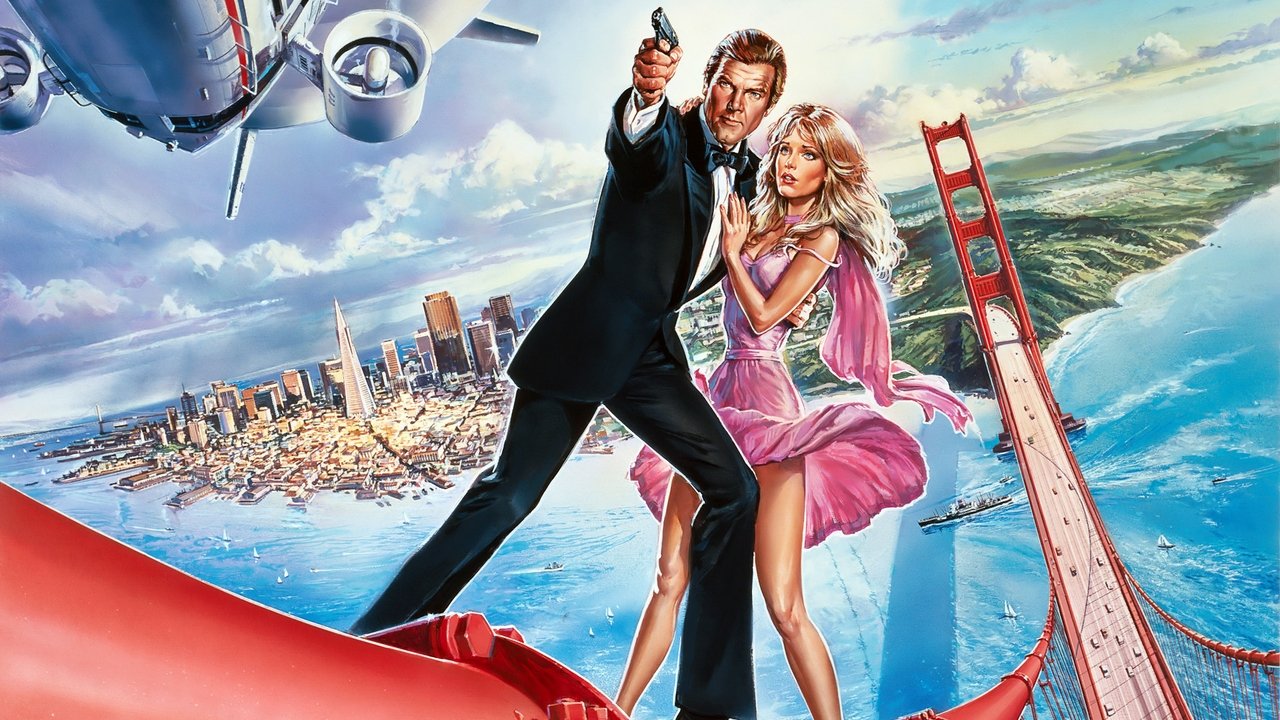
A View to a Kill (1985)
Release A View to a Kill Ultimate Edition DVD (Sony Pictures Home Entertainment, 2006)
Roger Moore discusses his collaborators, his approach to Bond's humor, and the division of action work between actors and stunt specialists. He recalls working with Christopher Walken and identifies stunts he performed himself. He also describes his fatigue during production and explains why the film's mass violence made it his least favorite of his seven Bond films.
- Duration
- 2h 10m
- Talk coverage
- 70%
- Words
- 11,269
- Speaker
- 1
Guided collection
Changes in Bond's action and humor
The edited Diamonds Are Forever production history and Roger Moore's A View to a Kill commentary discuss villains, humor, locations, and stunt specialists. Compare how contributors describe Bond's action and violence across the two films.
Part 2 of 2
- 01 Diamonds Are Forever 1971
- 02 A View to a Kill Now reading
Commentary density
Highlights
Topics
People mentioned
The film
- Director
- John Glen
- Cinematographer
- Alan Hume
- Writer
- Richard Maibaum , Michael G. Wilson
- Editor
- Peter Davies
- Runtime
- 131 min
- Also on
- OneSheet ↗
- External
- IMDb ↗ TMDB ↗ Find on Amazon ↗
Transcript
11,269 words · 63 flagged as film dialogue
My name's Roger Moore and I sort of attempt to play James Bond. This is not so much a commentary but rather a discussion. It's not so much sort of what actually happened during the shooting of the film in a chronological order because I quite honestly do not remember after this number of years. So rather I'm going to treat it as if we're having a conversation. Thoughts that come to mind while I'm watching but other things that happened around it in other films that I made during that time and before. These pre-title sequences I just loved because I was never involved, was never there. So you then go and see a pile of this stuff. Boy, I was brave. These things, you know, you usually shot wearing parkas. I did a television series of Warner Brothers, The Alaskans, in which we shot in 120 degrees of heat, no shade on the bank lot at Warner's in Burbank. And wearing a parka and great heavy boots and gloves. I don't know how I did it.
And obviously when I was doing this, I wasn't out in the cold. We were shooting this on a soundstage. The close-ups, that is. Willy Bogner did the ski sequence. After finishing Bond, I did a Willy Bogner film. It's called Fire, Ice and Dynamite. Willy Bogner is the most extraordinary skier and director and photographer. The first time I worked with him was for Your Eyes Only and he could ski backwards looking through the lens of the camera and he's photographing you going downhill and I have no idea his instinct that he knows where he's going and how he's going to turn, going backwards is quite extraordinary. But he was along the same lines as John. Kill the actors. We were shooting in a blizzard on top of the Corvatsch in St. Moritz. The helicopter had to come down and my son Jeffrey was in the film. And a girl, I forget her name, we had to get in the helicopter. And he is teetering on the edge of this precipice.
And Willie's saying, yeah. I mean, you know, he's jumping into death. And I literally had to fall in this helicopter. And we took off the doors wide open. I'm not strapped in or anything else. And the pilot, very smartly, to do a little thing and came down and settled out of the wind so that we could then strap ourselves in. And Willie is on the radio. Come back. I want to do it again. I did not go back. With this type of sequence, it was a second unit that went off and a number of units within that second unit of cameras. Because some of these are one-off stunts, you don't want to have to do them twice.
There would have been a helicopter crew on that, you know, helicopter cameras. Probably three or four cameras on this. It would be impossible for the principal actor to be everywhere. The film would never get finished if you were going to do everything.
This is a lovely Swedish lady who was... I think she was Miss World. Yeah. Yeah, Bond was a lucky fella. Got to work with all these nice ladies.
Vodka, rather shaken, and one microchip. Good. I'll make a signal to M.
Be a good girl, would you, and put her on an automatic?
We could do with a couple of glasses.
They're in the overhead rack.
Commander Bond. Call me James. It's a rotten job, but somebody's got to do it. Ah, no, no, we start the wonderful. You know, I look at titles and I think fondly back to Maurice Binder, who was such a great title artist. Funny, sweet man.
Face to face in secret places,
feel the chill.
It was actually the only nudity in the Bond films was in the titles. They were shot very carefully. Morris never had the title right until we were ready for the first screening in the theatre. We were sort of stuck together with chewing gum. But they're quite extraordinary.
Once he had a girl, a big wind machine going, so her hair was blowing. But unfortunately, it was also blowing other parts on the body that had hair on. I saw Maurice with a jar of Vaseline smoothing down. Tough job.
I can always remember the great thrill I had in 1954 having been brought up as a kid seeing MGM movies and going to a sneak preview of my first film at MGM. The last time I saw Paris. John Barry, One of the world's greatest composers and arrangers worked on a great number of bonds. Wonderful, wonderful music, John. And I've known John for... It was a week... My daughter was born. She is now 41, so 41 years. His daughter was being born at the same time. He did a Persuaders, which I... It's very sad. I had a collection of Barry's scores the other day, and Persuaders wasn't on it. And it is played quite often, particularly in Europe. Richard Maibaum did a number of screenplays.
Now, of course, Lois Maxwell, Miss Moneypenny here. We have known one another half a century. We were in the same class at Rada together. It was the Royal Academy of Dramatic Art in Gower Street. Lovely lady, Canadian. And she'd gone there with a scholarship, I think it was called the Iris Mountbatten Scholarship. She'd been in the quacks.
So I was able to do seven bonds with her. We did, she did a couple of episodes of The Saint with me. And you, Pat Q? If 007 you'd ever bother to read any memo sent from my... Dear Desmond Llewellyn... You realize that this is a prototype of a highly sophisticated surveillance... And the most difficult amount of dialogue any man could ever have. Gentlemen. And Bob Brown, who is playing M in this, Robert Brown, he and I also went back a long way. I did a television series in 1956, 57, called Ivanhoe. And he was my serf that I had freed from serfdom. I think his name was Girth. Girth, my serf. Through life, if you can... sort of get your mates around you to work, it's always much more pleasant. So I always have a list I give a casting director of people I like and it would be nice to be working with. Of course Cubby Broccoli was the producer and Michael G. Wilson, who produced together with Cubby, would always
be the man who would find out these extraordinary mumbo-jumbo, to me, mysterious objects and bring them in, and great stunts find them. Very good at it. I don't know where he went, but he would find out all sorts of things. I remember one of the episodes we... I think it was a spy who loved me. Somebody had to jump off a cliff, presumably me, in parachute. But he had found this man. I don't know what research he had going for finding all these things. Quite amazing. Heaven's sake, let's be discreet about it. Well, of course, Minister.
You have exactly 35 minutes to get properly dressed, 007.
Oh, here we are in Ascot. I seem to be looking the wrong way. Royal Ascot is a hassle to get to for me. You've got to get dressed up and everything else. I think I might rather watch racing on television. This is the first time we see Christopher Walken in this film. most interesting actor. Christopher Walken and I had been discussing sort of our backgrounds one day, and we probably were in the same Robert Montgomery Presents in 1953. Robert Montgomery Presents was produced by Harris Holtzman. I did not meet Harry until I came to England. I didn't know he had an involvement with the Robert Montgomery Presents.
the butt of humour was always Desmond, invariably Desmond Llewellyn, because he had such a load of rubbish to say, technical jargon that really didn't make sense. But if you say it with great conviction, you can convince the audience that you know everything about this subject. So he would have a terrible job learning all these non-sequitur lines and... technical jargon. And I would go with the script lady and rewrite the whole paragraphs and get her to type it up and then get the director to give it to him just before the take and say, oh, we have these changes. And watch Desmond. So the panic would come into his face. And then we'd have to say quickly, no, no, it's a joke. but he was willing to go along with it. Now this restaurant here on the Eiffel Tower, unfortunately we never went, we went to the Eiffel Tower, we never went to the restaurant. This was all constructed in the studio until the month set. I remember one one interview, a girl in Paris writing for Time. And she said, I remember we were sitting at the studios in Paris. And she said, don't you ever want to make a serious movie? I said, they're spending $35 million on this. I think it's very serious.
She said, you know what I mean. I said, okay, it's not Strindberg. More people will see this. Carol Ashby, beautiful girl. There weren't many actresses that came back into other Bond films. In terms of leading roles, of course, there was Maude Adams, who was in Man with a Golden Gun, and Octopussy, and what was in Italian, Bond Girls. They very rarely came back in one or two, even in two. As I said before, tough job for Bond.
Later this month, Zorin will hold his annual sales at his stud near Paris. Security is formidable, but the key to this mystery is there. And I, Achille Aubergine, intend to find it.
There's a fly in his suit. A view to occur was the first time that I'd worked on the Eiffel Tower. I'd been to the Eiffel Tower before. Looking at Grace running up those steps, I have this terrible memory of having to walk down from the central part of the Eiffel Tower because Cubby and I didn't want to wait. The lifts weren't running. They wouldn't stop at our floor. So Cubby wanted to go to lunch. He said, let's walk down. Neither of us could walk for about a week afterwards. It is so tiring on the inside of the leg, walking on. That's the best way of doing it, just jump off. But you must remember to take a parachute if you're going to do it.
I can't believe the energy I had running up steps. Bond is so brave. That, of course, was Martin Grace. Beautiful, beautiful shot. Half the talent of playing Bond is finding people who look like you to do all the dangerous stuff, like love scenes.
This is all Rémy Julienne's work. I like Paris, but we went there on a number of occasions and, of course, shot Moonraker. We based out of Paris.
That was very pleasant. I like shooting in France, in the studios, because the French don't start till midday. And they don't have tea breaks. They just shoot from 12 till 7. 30. And then you can go out to dinner. And you don't have to get up at six or five in the morning. And so Lewis Gilbert, when we were working in Paris, would say, we'd be called, he'd say, I give Claude, director of photography, a long setup and we can take longer for lunch. Congratulations.
I remind you that
this operation was to be conducted discreetly.
Here's my old friend Patrick and me. We have worked together a great deal in the past. You see, I'm surrounded by friends, Patrick and Bob Brown. But Patrick I have first worked with in Hollywood, in live television. We did a couple of matinee theaters together. He may have done a Lux video. In one I remember Patrick was the villain and I played an old Scotsman. And it started off, it was live television, and it started off with me being a 98-year-old Scot. So I had one hand that was made up very old. and all these prosthetics on my face. And they had 35 seconds to get them off so that I could then be 30. And then they had 40 seconds to get them back on. And by the time we'd done two dress rehearsals, they'd taken all the skin off my face. I had the one hand that was made up old and the other hand that was made up young. So when I had to do a fight with this hand that was made up old, would I use the left hand?
Very confusing for an actor. The only way I could get the sound of the old man being toothless was to suck my lips back in between my teeth and I ended up having blisters all the way across my hair. Can you remember when a young lad would be out in the green? Very uncomfortable. But it's all for art. Patrick Bauchau. was in the whole stealing there. Patrick also, Patrick Macnee also was my Watson when I played Sherlock Holmes, which we shot at 20th Century Fox with a wonderful all-star cast. John Huston playing Moriarty and Gig Young. David Huddleston, Jackie Coogan. Amazing, amazing cast. Produced and directed by Boris Segal, whose daughter, Boris's daughter, who is so wonderful, the crass American series that I love, The Al Bundy Show. The lowest form of human life. A woman shoe salesman. I don't know why it should be the lowest form, but they always say it is. But Boris Segal, he tragically died directing a film when he stepped back into a helicopter blade. Absolutely awful. To play Sherlock Holmes was
sort of as much of a challenge, I suppose, as playing Bond or playing Hamlet. Thousands of actors have done it. They all have their own way of doing it. You just have to forget what you've seen, you forget everybody else, and you just do it. And I'm afraid I do it exactly the same in everything. The silver rose, actually, belonged to Cubby. It was Cub 1.
This is the most beautiful location, the Chateau Chantilly, which belongs, I believe, to Aga Khan. The beautiful girl in riding clothes is Alison Doody. She married a friend of mine.
Oh, my dear, I take it you spend quite a lot of time in the saddle. Yes, I love an early morning ride. Oh, I'm an early riser myself. A wonderful name. Jenny Flex. Miss Jenny Flex. Chantilly, the new market of France. As you say, they look the same. Almost the high streets.
We did a month's locations for a film called Diane, which I played Henri II of France, Henri Trist, he was known as, whose mistress was Diane de Poitiers. And I was the only principal who was taken over to Paris to shoot the locations. We had a wonderful director, the second unit director, Yakima Canutt, who was... the world's number one cowboy. Later on, his sons would double me in movies. Remember, we stayed at the Hotel Raphael on the Avenue Claiborne. And every night would be the same routine. We'd sit down and Yak would say, waiter, bring me a steak and make it bianqui. and the waiter would come, put it down, he'd cut it, of course it would be rare, and he'd say, bring me liniment and I'll get it on his feet again. And he would regale us with tales of when he was the world's number one cowboy and his marriage that ended when his wife shot him. He said she wasn't a very good shot, she was the world's number one cowgirl.
He said she just missed, got him in the shoulder. Another time Yakima was in Chicago and he would take his ropes back, you know, his lariats, back to the hotel with him to wash them out. And he's got his chaps and his guns on, he's complete, covered in dust, and he gets in the elevator in the hotel and there are people going up to him. you know, the moonlight roof or something, black tie. And so they'd be sort of sniggering at this dirty cowboy, and Yank would pull his gun on the boy taking the lift up, pull his gun and say, now drive into my room. And he'd say, listen, it goes up and down, doesn't go left or right. On a mission, I am expected to sacrifice myself.
This type of scene, the director is going to rely on his first assistant and the first assistant's assistants to get the crowd in the right place. Is it politically correct to say the crowd? I don't know. The artists, the non-speaking artists, to move and also to remember For continuity, which we had a wonderful lady, June Randall, who was continuity lady on this, or this script lady, I think they call them now. Used to be continuity girl. And she was wonderful. And, of course, they have to know where everybody, where everything is, so that you can match when you're cross-cutting. Enjoying our little party, Monsieur... St. John Smythe? Oh, immensely, immensely. St. John Smythe. Looks as though you'll have a good turn-up for the sale tomorrow, doesn't it?
That's a little bit of commercial tie-in, I think. Louis Vuitton. Welcome, Mr. Zahn. Main strike all set? Well, no, after the 20 seconds. Enjoy yourself.
I like the way Bond has the white dinner jacket. They wear the black ones. The man playing Dr. Carl Mortner, Willoughby Gray. I believe, if I remember correctly, he had a great collection of toy soldiers. Because I worked with him. In television, in the good old days of live television, back in the late 40s, would it be great? It's funny, when you haven't seen a film for a number of years, and I haven't seen this since the premiere, and I don't know how many years ago that was, So many of the things you've forgotten and so many of the faces. And then you say, wow, they all come back. I don't remember him. Oh, that's me. There was an American actor... very good actor, who became a producer. He produced a Shirley MacLaine show in England. Sheldon Leonard, who was really famous for sort of playing Runyon-esque gangsters. And his speaking voice is exactly the same as Christopher Walken. I don't know whether anybody else has ever noticed that. Chris hadn't when I asked him. In the saddle. A fellow sportsman. What about fishing? Fly casting? I'm neglecting my other guests. Enjoy yourself, you'll find the young lady's stimulating company. I'm sure they will.
I never would have guessed. I thought she had remarkable eyes.
Well, are you buying or selling?
Selling. Horses. Oh,
no, I'm not interested in horses.
You came to the wrong place, didn't you?
Get her away from him. I'm sure I've seen him somewhere before. Have security keep a good eye on him.
Oh, by the way, you didn't say what part of the state you come from, Miss, uh... No. The comedy that I heard comes off in the bonds I did was... principally because... action heroes, I didn't really believe in them. of this type. I didn't really believe Bond was a spy. Because he was known everywhere. You can't be a spy and walk into a bar everywhere and the barman knows that you like a vodka martini shake and not stir it. Spies are faceless people. You can move through a crowd without being noticed. I know I wanted to play The Jackal, Day of the Jackal, and Zinnemann wouldn't have me at any price, despite the fact that John Woolf, the producer, had wanted me. And I, when I eventually met with Zinnemann a year or two later at Jean-Pierre Armand's house and Marissa Pavan's house in Paris, and I asked him why, and he said, because you've A spy is somebody, an assassin like this. You don't know them. They can walk through a crowd. I said, you're too tall and you're too well known as the saint to be an assassin. I said, well, I'm flattered, but I would love to have done it.
Two men working together, which is, as I did with Tony Curtis in The Persuaders, you build up a rapport, particularly if you know one another, and you can find sort of little odd quirks in the other behaviour, performance, pattern, way of speaking, you know, that you can bounce off one another. Laurel and Hardy. I'm not saying which one Patrick is.
I think that you have to have an attitude, you have to set an attitude towards people that sort of amused superiority. And as I've read the script, and I know that I'm going to win, I have to be very amused by it all. I worry sometimes that explosions are going to be a little too close.
but the stiff upper lip is the trick. A stiff upper lip and a tongue firmly placed in the cheek. I went many, many times to the horse races with Cubby and Cubby then bought horses and had some success. Cubby and Dana, they had a number of good winners. of horses that they owned. Cubby was a great gambler. He loved it, he loved Shemmy. But we played, every day we played backgammon on the sets. Cubby Broccoli was married to Dana, and their daughter, Barbara, is now producing the Bond films. with her half-brother, Michael G. Wilson. I like horse racing, but I think I prefer to watch it on television rather than go through the whole business of getting to a racetrack. And in England, it invariably rains.
I can't remember how far we deviated from what was written or requested. I always said that making a Bond film was sort of going with friends and family. Most of the crew were the same people that worked before. So you have an easy rapport. You don't have to be on your best behavior because you're amongst mates. And so it's a question of discussing. I remember Lewis Gilbert, when we did a couple of films with him, and he would always say at the beginning of the day, what are you going to say now, dear? I'd say, well, what's in the script? He says, well, let's try something else as well. And I think the improvisation sort of just, well, for me, helps me get through the day. I found that unless the atmosphere is light and you're having fun, Bond didn't work for me.
A director's job, a lot of the time, is adjudicating. You get ideas coming in from all sorts of people, particularly the actors. Actors are all invariably thinking people. Well, most of us are. And we come with our own ideas, and a director is very grateful that if it's not fitting in with what his concept is, then it's up to him to work it out with you. It's a question of being able to communicate very quickly. I remember I was working with a director called Jim Connolly, and television had been what we can use as a director. who had directed Peter Finch in Man with the Green Carnation, in which he played Oscar Wilde. We started talking. The night before, I'd been watching an interview with a BBC erudite interviewer. Very deep and sort of lingering questions. And Jim said, he said, Ken Hughes did one of those when he was doing Peter Finch, Oscar Wilde film. And the interviewer said, this is extraordinary how you've got these wonderful tones. There were underlying throbbing tones of homosexuality from Mr. Finch in this. How did you achieve this? And Kent said, when I go up to him in the morning and say, poof it up a bit, Pete.
He was the man at the Eiffel Tower. We must find him. I'll get dressed.
There is a story going around, and apparently not only around, it's in print, I like to play jokes, practical jokes on people. Had the tables turned on me when I was doing the bed scene, shall we put it, with Grace Jones. She approached the bed and dropped her robe. The camera was behind her, of course. This was a Bond film. and the robe did not fall immediately to the floor. It was hung up on the point of this practical joke, which I can't really say what it is, not on tape. But it caused a great deal of amusement at the time. Except this.
It is in the wrong place. Bring St. John Smythe to my study first thing in the morning.
I find watching Christopher Walken an extraordinary experience. I think he is such a rounded actor. There's so many things going on in his mind and his body language, his attitude. It's very good. It's wonderful to work with somebody like that. It's like playing tennis with a good player or playing with a bad one. You improve your game. I know people who say, so why didn't you improve? I'm used to those barbs.
A stallion sounds right to me. I find a computer indispensable.
I don't take any of them really seriously because they are not real. When I did, as I spoke before about The Man Who Haunted Himself, It was a real character. I think the character I played shot of the devil was... It wasn't that wild schoolboy hero. But I think the schoolboy hero is... It is a bit of a joke. I think the vanity I'm sending up... Well, a little of both would be ideal.
If my memory is correct, I think Christopher Walken was one of those people who didn't have to go more than once. If you had to do a take, it was for some other reason than his performance. Very well prepared. Very well prepared. Oh, tip it. Get into town, call M, and ask him to trace on this check. Be as quick as you can. Those guards we laid out identify us. We're gonna have to move fast.
What shall I say if they ask where I'm going?
Tell them you have to get the car washed.
He's going to town to get the car washed. This sequence, of course, I was doubled. part of the time, because they wanted to put a jockey in. And the jockey was a jockey's height. Two feet shorter than me. And they put my jackets on him. And they were like overcoats. And Martin Grace, who doubled me, and I said, Martin, why aren't you doing the writing in this? He says, oh, he says, they want, you know, because he's Irish. He says, they wanted a real jockey. He said, but I think it's, looking at it, he says it's Darby O'Gill and the Little People.
I was very lucky when I did a television series, Ivanhoe, and I had a wonderful 17-hand grey called Shane. He was a bit of a camera hog. He'd be galloping across screen and he would go sideways when he saw the camera. But he would always hit his mark. I could always rely on being centre screen because Shane would get me there. I came off him once, which was the cinch went in the saddle in the middle of a fight with horses milling all around and swords waving all over the place. And I ended up underneath the horse and there's shouts of Ivanhoe, Ivanhoe. And somebody says, well, where is Ivanhoe? I'm down here. Get the horse off me. No. I was badly bruised. I lost the tip of a finger with a sword. But I still come back for more. I, having... I've done Ivanhoe and westerns, western features and also Television Maverick. And also in the Alaskans I probably rode horses in between standing on the back of dog sleds. I've ridden a horse all my life actually. But you have to learn everything as an actor from fencing the rudiments of ballet. It's all part of the learning nexus job to make everything look easy and natural.
Arthur Wooster was the second unit director on this film. A very nice man, Arthur. Second unit directors have a terrible job because they're never quite sure that they have got what the director wants. And so they'll go far more takes, many more takes than you'll do with a first unit. Because they want to make sure. John Glen did a second unit on a number of pictures that I was in, and he would go many more takes than he did as the first unit director. You lost 007. Killing Tibbett was a mistake. I'm about to make the same mistake twice. My department know I'm here. When I don't report, they'll retaliate.
If you're the best they have,
they'll more likely try to cover up your embarrassing incompetence. Don't count on it, Zoran. You amuse me, Mr. Bond. Why, it's not mutual. Other side. Open up. Oh, Chateau.
those few moments in the making of film that I actually had time to have a rest.
It's what time of the year that you're filming in water. I've done a lot of films in water when it's been winter and they cannot really warm the water because steam comes off it. So you get into cold water. This we were shooting in a tank.
stage at Pinewood. People said, does this really work, being able to breathe from a tyre? I have to say it did work because I did it. It does work. I was quite amazed.
General Gogol,
this meeting is ill-advised. A calculated risk,
but necessary since you refuse to answer your control.
Come to the point, General.
You disregard procedure. Grace Jones, at the time we made this, her boyfriend was Dolph Lundgren. And in fact, he got our stillsman to do stills of him. This is Dolph Lundgren. standing behind Walter Gotell, stills of him in boxing poses. From that, he got the Rocky film.
We cannot tolerate that. The issue is irrelevant. I've made new associations. I no longer consider myself a KGB agent.
We trained you, financed you. I worked with Walter on a great number of occasions, not only with Walter Gotell, that is. on a number of episodes of Saints. I think he was in The Persuaders. Enough of this! Control yourself! Our little group of English actors all stick together.
You will come back to us, Comrade. No one ever leaves the KGB.
Gentlemen, for centuries, alchemists Cubby Broccoli made a big contribution to the film industry. He employed a vast number of people, and he was always generous. He was much loved by his crews, and he cared for a crew. He would cook, make a spaghettata for the crew, which he loved to do. But particularly when we were shooting, and Cubby was a gambler, and knew the dangers of gambling. And he would, if we were in places like Macau where there were casinos, Cubby would go around and he would hand the boys chips, give them money. And he then on one film said, they cannot draw all their money out here on the location and lose it. So don't let them draw their money. And he would give them money so they could gamble. Very generous man. Good man. I was proud to call him a friend. Cubby and I never discussed business. The closest we ever got to discussing business, Cubby and I used to play backgammon from morning till night.
If he were losing, he would get very angry with the assistant director for calling me in. He'd say, I've got to get my money back. This pigeon is going to give me my money back. But one day, we were playing, and the negotiations were going on with the lawyers and the agents. And Cubby was just about to roll the dice. And this was the closest he ever got to discussing business with me. He stopped the roll, and he said, You can tell your agent to go shit in his hat. That was it, we never discussed it again. Mayday. I'll provide you with a drink. This way.
There should have been a line there about he was a sucker, he'd fall for that. Wow. What a view.
We were shooting down the wharf in San Francisco and this man just going up there was Steven Zaks, who at that time, he and Maude Adams were together. He's Dr. Zaks, one of my best friends. The first time I met Steven Zaks was when we were shooting Octopussy. in Udaipur. And Maud would speak to him every day on the phone, and then he finally arrived. And he said my first words to him were, you don't by any chance happen to have a Hershey bar with you? Desperately missing Hershey bars in India. But they were visiting the set, so... That's how he came to be in the shop. The check hasn't been cashed yet. Mortner? You got a real winner here. His name is actually Hans Glaub, a German pioneer in the development of steroids.
That ties in with the horse injections.
During World War II, he experimented with steroids on pregnant women in the concentration camps
in an attempt to enhance intelligence. With any success? Virtually every mother aborted,
although a handful of children were produced with phenomenal IQs.
But there was a side effect. They were psychotics.
It wasn't this Morton or Glaude tried by the War Crimes Commission. The Russians grabbed him, set him off in a laboratory. He spent several years developing steroids for their athletes and then dropped out of sight about 15 years ago. About the same time that Zoran came over to the West. Could Zoran be one of the steroid kids?
He's definitely the right age and he's certainly psychotic.
You certainly don't feel as if you're making a television series when you're making a big feature film. The big difference with television, because you film for television and you film for the cinema. The difference is budget and time. So with an episode of The Saint, we'd have eight or nine days shooting, and the same with The Persuaders. And the luxury of going on to a film where you have four months of principal photography, five months sometimes, you say, well, don't you get bored? There must be a lot of sitting around because lighting things take a little longer. Well, they never let me get bored on Bond because the publicity department would wheel in another interview. At one point while we were filming, they said that we'd had 180 visiting journalists, all of whom wished to do an in-depth interview with me. At one point I said, we can make up our mind what we're going to do. We can just do publicity or make a movie. There's no point in having the publicity unless we've got something to show for it. At the end of the day, I really didn't have time.
I love working in San Francisco. I made a film there before. I made an Italian-American production called The Sicilian Cross. It was one of those unlikely bits of casting where I was the consigliere, anything less Italian as me. But it was wonderful shooting in San Francisco. When we were shooting the Sicilian cross, we had a little problem with controlling traffic until we had a little chat with the chief of police who happened to be Italian. And then all of a sudden we had a lot of motorcycle policemen who were all in Italian. They said, come on the set. And the great thing for us shooting in San Francisco was that when Barbara Broccoli, before we went there, went to speak with the mayor to get permission, Dianne Feinstein, at that time, was the mayor of San Francisco, and said that she liked Roger Malsbaum's, which was very useful. We actually became quite good friends. She and her husband, Dick Bloom. She now, of course, is a senator.
My eldest son was eight years old when I was about to play Bond. And I took him for lunch at our favourite place, the White Elephant in Curzon Street. And we're sitting having lunch and kids always, you know, want to know whether their father's stronger than anybody else. And he said, he looked round the restaurant and he said, do you think you could beat anybody up in here? And I looked round, they're all fairly old. I said, yeah, I could. I'm not going to, but I could. He said, what about if James Bond came in? I said, but I am going to be James Bond. He said, I mean the real one, Sean Connery. My son Jeffrey never grew up. To describe the character of Bond though, he's a super spy. who dresses exceptionally well, who knows everything, gets into the most incredible adventures, and has the most beautiful women. Of course there are people who've not seen Bond. I was flying to America on British Air, of course, and sitting
In the configuration, the first class, the two bed seats next to one another, and then there are individual ones on the side. And there was a man sitting over in one of the front seats. I'm in the center. And he kept wandering back and just staring at me. And then going back to what he was doing, then finally came and he stood in front of me and looked at me and he said, You are, and I thought he was going to say Bond. He said, you are Donald Rumsfeld. I hated to disappoint him.
This is Fiona Fullerton. Pola Ivanova. James Bond. Check the beach area. Make it fast. Bond catches on very quickly, you notice.
Would you like it harder? If I'm not mistaken, Fiona Fullerton was Alice in Alice in Wonderland. Very, very pretty girl. Well, we were very lucky. We had lovely girls all the way through the Bond films. Oh, dear. This is another one of those tough jobs, dirty jobs that one has to do. as Bond.
Now that was a performance.
It was odd, wasn't it? My wife would turn up when I was making love scenes. But she did say, you know, she knew that it was my job, but I shouldn't enjoy it. For instance, us running into one another like this.
Come on, tell me the truth. Let's not talk shop. Let's put on something more
inspirational. Why not? I can remember this day. I didn't need a bath when I went home. No wonder my body became wrinkled. I spent so much time immersed in water.
Are you all right? The bubbles tickle my... This is no time to be discussing politics.
Tomorrow, I shall buy you six dozen red roses.
How lovely, darling. I can't wait.
The tape?
Well, here we are inside the... City Hall. Well... We're actually inside the set on the studio, which is supposed to be inside City Hall. I can tell the London Financial Times. Yes. My readers may like to know why Zoran is pumping seawater into his pipeline
instead of pumping oil out.
Seawater is used to test the integrity of the pipeline. When you go in and say, well, we're going to show you the Bond film, it's not like we're going to shoot a film X. And we'd like to use this. The town's going to say, well, is it going to bring prosperity? Are we going to get good publicity out of it? Well, they know that with a bond, it's going to attract a lot of attention. And so it might be good for the tourist board to sell San Francisco. It might be good for Chantilly to be sold. Mr. Howes. I have some prosperity tests I want to show you. I'm running late. I can only spare a couple of minutes. Well, OK. Sorry. This, of course, is the real thing. The interior of the offices we shot in the studio, but this is the real McCoy. We're looking for a low tonight of 57, high tomorrow, 75.
Well, we're coming up on half past the hour and our news summary. Then I'll be back with some more smooth sounds to soothe those computer blues. Beautiful house. Beautiful house. Oakland, California. Very nice.
So many, as Bond, you have to have so many suits. You not only have to have a suit for your double, but you also have to have one or two standing by because you may get it torn or something spilt on it, more likely blood. So it's quite a big job for a tailor. My tailor, Dougie Heywood, in London, did most of the Bond films with me.
The great thing about playing Bond is that you did get to keep some of the suits. In one of the Bond films, I had a beautiful, I mean, silk, light blue suit. And it was the last day of shooting. And I remember feeling, It's not that. So we're shooting in a little tiny set. And I looked up and I saw that Cubby had got up a ladder the other side of the set and was looking down at me. The last shot. And they said, cut. They couldn't wait to say print because they then let fly Cubby with a bucket of paste. They were for this wonderful suit that I was looking forward to taking home. And they all stood around laughing their heads off. And I took the jacket off. Of course, it was absolutely ringing with this paste. And I swung it and got everybody. Mind the camera, mind the camera.
To do a fight, you have to choreograph it the same as you would a dance routine. You can't just go in there and sort of wave your arms around. You have to know where you're going. You set points to move to. So, first of all, the camera's got to be able to photograph it, the second camera, because usually in a fight, you have it covered by two or three cameras. And you rehearse. And hopefully, you... rehearse enough so that nobody gets hurt. It's not always the case. Oh, hell. Sorry, Granddad.
Hey, wait for me!
I never really liked, you know, it was odd. somebody who's been playing these heroes who waves guns around. I've never liked guns. I think it stemmed from after my army, so two and a half, three years after the war. We then had to go back after about three years for a two-week refresher course, what they called ZED training. and we were shooting there was rifle range and then shooting in the butts behind which with small arms and with stem guns and the sergeants had a pool and had been commissioned at this point and one of the sergeants said you want to come in this sort of pool for the with stem gun shooting and i said yes and i was handed a gun it had a blocked breach there was a bullet up there already and when I squeezed the trigger and firing from the shoulder, it exploded. And I had a sort of black face and deaf for about two days. And so now when I pick up a gun, I am absolutely petrified it's going to explode. And so I blink. The problem is with cutting is that they have to
cut the blinks out when I'm holding a gun, because I blink before the gun goes off. The trick, of course, of firing a gun is that you sort of squint your eyes together a little bit, which Gary Cooper used to have a little yip when he was, yip, and those eyes would just tighten up around the edges so you didn't blink. Bizarin sent along his gorillas to help you make up your mind. They have.
I'd sell everything and live in a tent before I give up.
The only time we used real alcohol in a scene was when we made the Persuader series with Tony Curtis. When we drank champagne, we always drank champagne. Which is why I went from 160 pounds to 180 pounds during making the series.
I think I should be able to find that.
No, in those glasses, it's usually Coca-Cola or tea.
It was in one of his chaste moods when this sequence was shot. Why, I wonder, do I not take advantage of it? I think because it wasn't the end of the film. I had to be ready for anything. Good morning. Morning.
Oh, I say. Breakfast out of bed.
What's wrong with your pets? We had an earth tremor.
They're extremely sensitive to seismic activity.
Let's see what the earthquakes... I've been in earthquakes. I was going to have surgery, some hopefully minor surgery in Los Angeles a few years ago. And I was sitting in my study, it was about 10 o'clock at night, and I had to speak to the anaesthetist. And I was... talking to him and I suddenly looked and I saw everything was shaking in the room. And I said, is this happening in your house? Oh my God, said this doctor. Oh my God, the kids, get the kids. And it was the end of the conversation. It was one of those four and a half, five tremors.
We had two houses in California across the valley from one another, you know, out of the garden. My daughter, Deborah, was living in one. She had just come back from England. I wasn't there. And she came back and she was in the small house. And there was a big earthquake. That was when all the power went out. All the phones went. And also, she wanted to get out of the house and all the electricity had gone and the gates were powered. she couldn't get out. By the time she found a phone that she could make a call on, she got a friend to come over, get her out. She moved back to England the next day. Deborah was in one of the bonds with Pierce Brosnan. Yeah, she was an air hostess.
And on this film, my son Jeffrey was sort of working as a runner.
Good evening, Jack. Evening, ma'am. Won't be long. Okay.
Hey, I know that place.
That's an abandoned silver mine by the San Andreas Fault. Alive and well, I see. And still bungling in the dark.
Well, then why don't you enlighten me, Zoran? I remember when we were shooting this sequence. You, sudden. You should have accepted my... Grace and Tanya, uh... between takes would go to their handbags, their purses, and they would take off lipstick and a mirror and they would add to their makeup. And I watched them do this about three times. And so I just went and took their lipsticks and their mirrors and they came back to their bags and they reached in and they found other mirrors and other... I did it about four times. God knows how many lipsticks they carry and how many mirrors. And I don't think they ever noticed that I'd taken them away.
Ask them to get here as soon as possible.
You're being used, Mr. Howell. Do it. Hello.
We've had a break in here.
City Hall, Office 306. Come at once. What have they done? You discharged her.
So she and her accomplice came here to kill you. Then they set fire to the office to conceal the crime. But they were trapped in the elevator and perished in the flames. But that means I would have to be...
Dead.
That's rather neat, don't you think? Brilliant. I'm almost speechless with admiration.
Bond always has lots of suits. Whoever's designing the costumes would say, you know, I think in this, you know, we should have a dark gray and you have a light gray and then you should have a brown and maybe a blue. We'll be shooting against this and so that color would be better.
the leather jacket that was made. It was rather nice to find out where that went. Not that I would get into it today.
The people in charge of special effects on these films, they really are quite amazing because it's not easy to do a controlled fire. And you always have so many firemen standing by. and spray it all down very, very quickly afterwards. Hold tight!
I know at the end of this sequence, I have to... ... carry her upstairs. And at the other end of the stairs, all the stuntmen are standing, looking at me... ... and laughing their heads off. We have the sequence where... City Hall is on fire. And Dianne Feinstein had sent a memo around to all offices saying there will be fire hoses being played on the front of the building, so please close your windows. One man didn't. Had a sort of a soggy desk. It's not easy working with fire.
I want to talk to you. Captain, if you can get through to Howe's office, you'll find him dead. There's conflicts like Simon Templer. Always at loggerheads with the police. Have their own way of doing things. Chuck Lee of the CIA.
You're under arrest. Wait
a minute.
This is James Stock of the London Financial Times.
Well, actually, Captain, I'm with the British Secret Service.
The name is Bond. James Bond. Is he? Are you?
Yes. And I'm Dick Tracy. You see? He is famous. He said, I'm James Bond. I'm the Secret Service. I'm James Bond. Oh, you are? Oh, are you? They're amazed. It's quite funny, isn't it? Which is why I can't say. I had the best time driving around in a fire engine in San Francisco. Is that true what he said back there? And being able to make the clanks and go. Big thing on the floor. I was able to drive some shots. And when we were shooting outside one area, they were racing around. Very fun.
Put your hand on this.
The wheel, the wheel, take over. Well, I drove everything in the army, so I was in transport.
James, where are you going?
The army sort of taught me a lot of things. I'd never ridden a motorbike before until I joined the army. You have about one hour on the bike. They tell you about changing up, changing down, one up, three down. and do this and do that, and you're going around in a circle and then all of a sudden you're taken out on the road. I remember it was Wrotham Hill in Kent. I didn't know anything about braking. I said, I don't know, I wasn't killed. One point I ended up going into Woolworths in Chatham on my bike because I turned right, police brought his hand up and I turned right. I went through Woolworths.
whether they went to see this film saying they're in it and took their families. When you're on tour with a play in England or in the old days, you could go to the cinema because you were in the local theatre and so on. The days when you didn't have a matinee, you would go and present yourself with an ABC or an Odeon and show your card. But there was a film playing, One Wild Oat, that I was in. I had a spit and a cough in it. And somebody said to the manager, you know, he's in this film. It was red carpet. I was up somewhere like in Bradford, in the north of England. And I was ushered in like I was Clark Gabor visiting the cinema.
Keep going! Keep going!
And oddly enough, Audrey Hepburn was also in it. She had two spits more than me in it. It was back in 1949.
When, I think it was, might have been Goldfinger, one of Sean's bonds, and they were shooting. They were in America and they were going to, that's right, crunch up a car. And people in the town had heard this, a brand new Cadillac was going to be crunched down to the size of an attaché case. And so there were all sorts of people there and the police standing there controlling the crowds. And when it actually happened and this great thing just crushed this Cadillac that represented some people's entire life savings to buy, the policeman looked at Harry and he said, you sadist.
Wake up, we're there. There's a lot of activity for an abandoned mine. That truckload of explosives should last them for months. Here comes next year's supply.
Get down.
Where's the fire? On your rear end.
And I think that I look like a hero, I suppose, with a straight nose and blue eyes. When I joined the Army, after six weeks basic training, or primary training it was called, everybody was posted away to regiments and corps, and I stayed there, and Sergeant said, I call for you, lad. And I go, I call? Why would they put me into something medical? I thought it was ophthalmologists or something. It meant intelligence corps. Sheesh, how dim I was. But I was sent to WASBE straight away, War Office Selection Board, for commissioning. Because I looked like a leading man, I suppose. I didn't know anything. I was just very lucky. And I think that's the same with films. You look like a hero, that's it.
I should take a closer look at that mine.
My mother was very particular about the way I spoke. And she, her English was, she just had a slight flat A because it was slightly north. Bath, she would say bath instead of bath. But if I would say ain't or drop vowels, a quick cuff across the ear. And I was taught to speak proper, I was. But all around me, it was a mixture. trying not to think about it. Yeah, this is the Bond stage. 007 stage of Pinewood Studios.
The opening of the stage, I was making Spy Who Loved Me. And Harold Wilson came. And I had to get off my sickbed and come into the studio. Because I had a terrible case of shingles, which was the most uncomfortable thing I've ever... Well, it's not the most uncomfortable thing I've ever had in my life, but it was extremely debilitating.
of construction. The inventiveness of Peter Lamont and his team is quite amazing. To sit with a drawing and then make it all come to life is incredible. And it must be very satisfying to them for an art department then finally see it dressed with people. and all the things happening, and it all happening as a show. Of course, when Ken Adam, on his sets, every bit of material used was the best. Mahogany, it was mahogany. And you said, it's going to be destroyed. It has to look good. It has to be absolutely right. That was the great thing about playing Bond. It's no good being a perfect stone. in a lousy setting. You've got to have that great setting and then it's wonderful, wonderful to pay a pond. People have often asked me why Bonds have gone on for so many years, and I think the answer is that the producers never cheat the audience. They spend the money and they put it up on the screen. You see it. Great sets, great locations. I'll send the large bag. OK. Bring out those pigeons!
Kill millions.
These green lights, they're Zorin's oil wells.
The ones he's been using to pump seawater into the Hayward Fault.
What are these tunnels for under these lakes? These lead straight into this section of the San Andreas Fault.
You know,
Zorin just has to blast through the bottom of these lakes to flood the fault. And create a double earthquake? Yes. Except... Except right beneath us is the key geological lock that keeps the faults from moving at once.
All right, let's go!
All those explosives, would they be enough to break the lock?
If they go off, both faults move at once.
Silicon Valley. And everything in it submerged forever.
If it happened at the peak of the spring tide for maximum effect...
Well,
that's today at 9. 41. In less than an hour.
We have to go in one piece. Wait!
Close up the entrance. I met Cubby... ... across a Chemin de Fer table in Curzon Street. That would have been in the early 60s when I was doing The Saint. He had already been in England for some time. He had a company, Warwick Films. He and Irving Allen... They were making films for Columbia, Warwick. In fact, Columbia were offered Bond at the beginning and they thought it was too expensive. Heads should have rolled if they hadn't. But I don't think United Artists had any hesitation. First Bond, and their million dollar budget. Amazing. You too, that way. As part of my career, the 14 years I spent doing Bond, making seven movies, of course it's very, very important. I was well-known, having made The Saint and The Persuaders and sort of Maverick. Over a period of years, you do a lot of things, but Bond is just mega, mega in terms of the amount of exposure, coverage it gets. You don't have a Bond film show all the time on television today. Here we are 20... years after I think I finished this one. It's time to flood the fold. They're still playing. I'm happy to say. Mayday and my men.
Yeah, a convenient coincidence. Mr. Zorin, those men are loyal to you.
It's amazing how many stations will take them as an event. I did something for a company called Starz. I think they were having a month of bond. And they spent a lot of money on promoting them. So apart from the money they spend to acquire, they then have to spend a lot more saying they've got them.
Spectacular stuff. There's a plus and minus with having played Bond... ... that producers think that that's your category. That's what you are. You're an action hero. films for a long time, as I was offered, were all of that genre, which I didn't want to do because I've done them. Why go and do something where they're not going to spend as much money and make you look as good as they do in a Bond?
You know, I see on some things I'm credited with being in all sorts of films I wasn't. There was another Roger Moore. I think he was Robert Young's brother. And he would, you know, did small parts. And they somehow, my credits, I'd be 984 instead of 900.
Hang around. It really is incredible the amount of time I spent in the water. I spent more time in the water in bonds than Esther Williams did in her entire career.
Good. Right on schedule. Let's go.
Not the only one he double-crossed.
All outboard valves fully locked, sir.
Funny enough, the phones that I think apart from Bond that I did. I particularly liked a film called The Man Who Haunted Himself, which not that many people know about. I made it in 1969 or 70 at Elstree Studios, ABPC. It was the last film to be directed by Basil Dearden. I would play a dual character. I played myself, my doppelganger, an evil me, an evil Mr. Pelham. It's how this sort of spirit or this other person takes over a man's life, takes over his family, takes over his business, and then confronts him at the end, and his children don't recognize him. The man is standing, it's me, I'm standing there, It was made long before they do the special effects they can today. But it worked very well. I liked that as a film. I liked it as a performance of sort of about as close as they'd ever let me go to acting. I made some good, I think, action films with Burton. and Richard Harris, and Hardy Krueger, The Wild Geese. Perfect. Hold position here. I made three films in South Africa, one being The Wild Geese. A shot at the devil with Lee Marvin. And gold, which we shot in the gold mines.
I think they're all creditable films.
I have to get down and defuse that detonator.
You can't! I made a few stinkers. I don't have to name them.
Then we have to bring the whole thing up. But how? Get on the rig. I'll lower you down. Get on!
I was making one of the films I did with John Glen who was directing second unit, Shout at the Devil, which Peter directed, Peter Hunt. And in this sequence, first unit's at the top of the hill, or over on the side of the hill, native bearers are pulling these giant wheels carrying plates of steel to repair the blucher of the German battleship that is holed up up the Umzivubu River. And Lee Marvin and Barbara Perkins are firing rifles across at... And I'm at the bottom of the hill with John Glen in the second unit. And they say, you know, we're setting up here. And I said, just a moment, when I look up the hill and I look at these great things that they're gonna come rolling up. I said, now where's everybody going to go when the wheels start going? They said, oh, they're going, we're sending them under the trees. I said, that's where the wheel will end up. No, you think so? I said, yeah. Well, John says, don't worry, we've sorted it out. I used to call him John the actor killer.
He said, right. He said, well, when we start talking, he said, I want you to walk in front of the camera. I said, what's it? He said, take your time. You know, it's when you think you should move out of the way. So I rolled them, boom, whistles playing. Right, everything rolling. I walk in front of the lens. And I stand there. And I think, now is the time I should look around and make my way out of here. And I look, there's no camera crew. There's no John Glen. They're halfway up the hill going. They're on their way. Everybody has left me. Oh, dear Lord. And where did the wheels finish? Right in the trees where I said they were. John the actor got up.
John, I see from time to time, sort of functions and he lives part of the time in Australia. We email occasionally. Of course, I spent a lot of time with John Glen.
Of Utica, I enjoyed San Francisco. I like the atmosphere in San Francisco. Good restaurants. And as I said, Dianne Feinstein became a friend of ours. We'd go out, and her husband, Richard Bloom. We had a good time there. I went up there when I was at MGM, but I think I just went to see it. and have a ride on a streetcar. They had the world premiere of A View To A Kill in San Francisco. That could have been one of the reasons that we had more or less the freedom of the city. Duran Duran were there. Memories of any premiere are, oh, you're gonna have to smile a lot. You'd have to walk a red carpet. You're gonna get blinded by flash bulbs. And you're gonna be asked, what's it like to be James Bond?
Are they your own teeth? You know what I mean. You get the same questions. Who's your favorite Bond girl? I know an interview is going well when they say, who's your favorite Bond girl? I would hope that they would say, well, He looked as though he was having a good time. We don't mind because we did. Not everybody's going to like you. On the other hand, not everybody's going to hate you. It's like being half empty and half full. So you take it or leave it.
You always know when the last day of shooting is because you do have a call sheet and you say, where are we going to have the wrap party? You always know it's going to be the last day of shooting when your name has been taken off your parking space.
few films that can compare with the spectacle and effects such as Bond films. Of course, there have been many imitators of Bond. I think Bond has only ever sort of been on the verge of imitating a trend, and that was when we did Moonraker with Space. But otherwise, they've led the pack.
Where would Russian research be without it? Is Commander Bond here? I'd like to thank him personally.
Sadly, he's missing. We are continuing our search. I had a feeling that it was about time I hung up my Walther PPK I do think that around Octopussy time I was getting tired. Because physically they're tiring. I suddenly realize when I look at it, and I say, well, that wasn't Martin Grace. That wasn't Bob Simmons. That actually was me. And I realize I did quite a lot. And you don't just do one take. You do it and do it again. I enjoy doing them.
Hello? Grandfather calling Q.
What's the position? 007 alive. Where is he? What's he doing? Just cleaning up a few details.
Oh, James. Well, there you are. I think of all the bonds that I did, I liked A View to a Kill the least. And I don't know why I would, because I liked San Francisco. I think one of the reasons, I was probably getting a bit tired, I did not go to rushes every day to the day list to see what we'd shot the day before, which I normally did. And so it came as a surprise to me when I saw the premiere, or the first screen version of it as I saw the screening, to see so much violence. It seemed to me a much more violent film than any of the Bonds I'd done up until then. I preferred the old-style Bond. Not so many people were killed at one time. I'd like to see them knocked down one at a time, not all together. Well, I certainly hope that you've enjoyed the commentary on this thing. to this one on my last Bond film. And it was nice to look back after 20 years and see that I was as old as I think I was.
city of San Francisco. James Bond will return, but it won't be with Roger Moore. Be Timothy Dalton next time around.
Keep exploring
Other commentaries on related filmmaking topics
-
8 shared topics
The Godfather (1972)
Francis Ford Coppola
-
8 shared topics
The Lord of the Rings The Two Towers (2002)
Peter Jackson, Fran Walsh, Philippa Boyens
-
8 shared topics
The Lord of the Rings The Return of the King (2003)
Peter Jackson, Fran Walsh, Philippa Boyens
-
8 shared topics
Red Sparrow (2018)
Francis Lawrence
-
8 shared topics
The Lord of the Rings The Fellowship of the Ring (2001)
Peter Jackson, Fran Walsh, Philippa Boyens
-
7 shared topics
Demolition Man (1993)
Marco Brambilla, Daniel Waters