director
Blue Thunder (1983)
Badham, Morriss, and Yeatman explain Blue Thunder's helicopter photography, rear projection, aircraft lighting, aerial units, and safety limits for stunts and explosions. Yeatman joins around the midpoint to discuss Dream Quest's motion-control work, model kits, ultraviolet mattes, and optical compositing. The contributors describe how effects and editing made the models appear full-size in the finale.
- Duration
- 1h 49m
- Talk coverage
- 77%
- Words
- 13,426
- Speakers
- 3
Commentary density
Highlights
Topics
People mentioned
The film
- Director
- John Badham
- Cinematographer
- John A. Alonzo
- Writer
- Dan O'Bannon , Don Jakoby
- Editor
- Frank Morriss , Edward M. Abroms
- Runtime
- 110 min
- Also on
- OneSheet ↗
- External
- IMDb ↗ TMDB ↗ Find on Amazon ↗
Transcript
13,426 words · 104 flagged as film dialogue
Hi, I'm John Badham. I'm the director of this picture. And sitting with me... I'm Frank Morriss. I'm the editor. Lucky enough to be the editor of this movie. It's a very interesting picture because though a lot of people... ... thought it was science fiction... ... we always looked at it as science fact. And so the message here is mostly true. And many of the things that are not quite true... ... were not quite true at the time... ... such things that we'll run into as "whisper mode" and so on. And yet, a lot of these innovative things... ... weren't actually happening at the time. Reiss. Maloney. The Los Angeles helicopter squad... ... is one of the best in the country... ... and it's the only way that they're able to cover this huge area of Los Angeles. They're up in the air almost 20 hours a day. Where we're shooting right here is a brand-new facility... ... that they had not moved into, and they let us use it.
Sir, Lieutenant Kress wants you on the pad.
Yes, this was the actual location for this. Well, actually, we had built this part. We built this on top of their location. We added it in. And this was my own Casio watch... ... where I found it would come up with that little weird countdown. And it was always Dan O'Bannon's idea... ... that somebody trying to test his sanity would... ... see if he could tell time with his eyes closed.
Murph, feeling any pressure? Yeah, about 15 pounds per square inch at sea level.
Where's Montoya?
Don't you check the duty board? He's on days.
We were very lucky to have what was the last performance... ... from Warren Oates, who's on the right of Roy Scheider. And then a very young Daniel Stern here, who's, you know... ... a wonderful comic influence.
If it was me, I'd ground him. He'll be all right. Personally, I wouldn't fly with him for a bull that pissed Jack Daniels.
Is that right? Warren was so terrific in this scene. Oh, yeah. Warren had a wonderful, dry humour. With the other actor, Jack Murdock, I wanted somebody who sounded like... ... he could piss Jack Daniel's. Like he had had so much... ... go through his system with that gravelly, gravelly voice. Now, at the time that we did this picture... ... computer technology really did not exist. So that almost all the day footage... ... that we see here in the helicopter, was shot up in the sky. And our guys are actually up in the sky... ... as we fly along with them. And we're looking not at a computerised background here... ... but shooting from the little control tower that we had built on top of... ... what's known as the Piper Tech facility in Downtown Los Angeles. And it's where the city of Los Angeles keeps all of its vehicles... ... and including its helicopter that's on-- Helicopters, that is on the top pad.
So... Then we have to make a transition to night here. And at that point, it really was not safe to be up trying to fly around... ... in the sky and work at night... ... so that we actually did use what is an old-fashioned technology... ... called "rear projection." And what's behind the guys here is film that's running-- That you could see with your eye as you were standing there. And Jim Gavin, the helicopter pilot, and Frank Holgate... ... would go out at night and film all of these backgrounds. The ones that you see sweeping past them here. The points of view down at the drug dealers... ... who are in Westwood Village, which we all know to be a haven... ... for drug dealing. If you want any crack, or anything like that... ... just go to the corner of Westwood and-- Never mind. That's for us. -
He's armed and has a hostage. Well, call it in. Air-12 to Central. Proceeding to the 211 at Burbank and Vineland.
A lot of the shots we actually used were test shots... ... that turned out to be very useful. As we were trying to figure out: How do you photograph something at night... ... and it doesn't look like it's got huge spotlights all over it? It was a very tricky, technical challenge because the film... ... at the time, was not nearly as fast as the Kodak film that we have now. So John Alonzo, the cinematographer, was stretching it to its limits.
Hit him! Hit him with the light.
I got him.
The light on the bottom of the helicopter... ... is popularly known in the helicopter squad as the "midnight sun." And it puts out a tremendous light. And this particular incident that's happening right here... ... we learned from the helicopter police as something they had spotted... ... with a cop stopping somebody on the freeway for a ticket... ... and then somebody snuck up on him. And the observer in the helicopter was able to radio down... ... to the ground unit and save the guy from being shot by this guy... ... who was sneaking up. And when I was riding in the helicopter... ... we actually watched them do this to another guy... ... who was really misbehaving and building a fire out in the woods... ... where he shouldn't be building a fire. And when the police told him to put the fire out... ... and get out of there, he shot them the finger. And the helicopter just dropped down, right 10 feet above his head... ... and completely drowned the guy in dust. That also put the fire out.
Sir, what was the business with the watch?
Back in the Ready Room, with the watch? Sort of a test. If you think you're going over the edge... ... you lose your sense of time. With your eyes shut, you can't tell 25 seconds from 5.
We were able to take a trip on the helicopter... ... and one of the police pilots told our guy that they get shot at... ... and all kinds of trouble from the street. Yeah. And helicopters are very delicate little beasts... ... as you probably know. They really are high-maintenance to the ultimate. A fixed-wing airplane will run like an old Toyota, forever. But helicopters, you have to be constantly... ... constantly maintaining them. So the idea of somebody shooting at them from the ground... ... is very, very dangerous. The incident that happened, relating to the movie the Twilight Zone. .. ... happened after this movie. And that was an incident where the helicopter... ... had an explosion go off underneath it... ... and its rotor blades broke off, and it came down... ... and killed Vic Morrow, who was underneath the helicopter. So the danger of these things is very real... ... and you have to be very careful around them... ... because they're finicky beasts.
I suppose you deserve the full initiation.
You might as well have your picture taken.
Here's a house that's way out in the north end of the San Fernando Valley. And we had to look for the longest time to find something... ... that we could fly the helicopter outside the building and look inside... ... and be able to watch this young woman doing yoga.
Oh, my God! There she is.
And we had to keep the pilot of the helicopter... ... as we're photographing this-- Keep him from looking over at her as she undressed... ... and was doing her yoga poses. Ten-thirty, right on the dot!
If there's one quality that I admire in a person, it's punctuality.
Over in one of the corners of that room is her boyfriend... ... probably with a gun, to protect her... ... as she did all of this yoga posing. She was a very flexible, flexible woman.
Would you look at her tan?
It's so... Oh, it's so even! Gee, I forgot we got this close. I had remembered it as this, like, long shot. But obviously not.
One of the things about working at night... ... is that you have to deal with all the people that live around... ... where you're shooting. Where the liquor store was, about three or four minutes ago... ... in the movie, was in North Hollywood... ... and the police made us shut down by midnight... ... because otherwise we'd be keeping people up. And as it was, a lot of people go to bed much earlier than that. So this particular part... ... where we were gonna have to shoot for two or three nights... ... was done on the Warner Bros. backlot... ... now called the Warner Ranch. And this is one of their regular sets that eventually... ... became the house that's in the first Lethal Weapon. Danny Glover's house. But we set it up so we could do this flying overhead... ... and shoot this very elaborate sequence... ... with a killing of a city councilwoman. So we'll say goodbye to our yoga girl... ... and go back to the backlot of the Warner Bros. Ranch.
Oh, shit! Come on, let's go, man!
Around the back. Hold it! Freeze!
He's bought it. Get on the other guy.
As we're starting to film this movie, we realised... ... that we were having to shoot every scene several times. We'd have to film it from the helicopter, like this angle... ... and then we'd have to film the close-ups of Roy Scheider... ... and his buddy on the stage. And then we would probably be down on the ground... ... actually shooting the sequence from down on the ground.
Yes, we actually threw this guy out of the helicopter. Bill Ryusaki, who is a sensei master... ... was roped on to the helicopter, and harnessed and everything... ... so he could fall out and drop down about 20 feet out of camera. And then we'd have to haul him back up if we needed to do it again. We only had to throw him out three or four times. And even though he's a stunt guy, and skilled and brave as anything... ... it'll upset you. And I think it made him pretty sick. But he did such a good job there... ... that we brought him back on Point of No Return. .. ... to be teaching martial arts. You remember that, Frank? - Yeah. That's where you told me, "That's a sucker punch."
Air-12, wind 150 degrees at 22, clear to land. Air-14, 1150 degrees at 12, clear for takeoff. The old man wants to see both of you. Right now!
I like your haircut. - I like yours too.
So a couple of things here of interest: This is a set that we built. Philip Harrison, the English designer... ... who did Outland with Peter Hyams... ... and several movies with me afterwards, built this set. And we wanted to see the background of Los Angeles... ... so we shot photographic plates at night... ... and we could project them during the scene. ...
while Commissioner McNeely was getting beaten... ... in her own front yard in fashionable Brentwood.
Warren Oates said something so interesting to me. As we were doing this scene, we were having trouble... ... with the background plates. And sometimes they would run out, or the film would break... ... so you'd just see a white screen behind him. So that wasn't any good. We have to do it again. So I apologised to him. At one point, I said: "I'm sorry, Warren, that we're having to go through this again." And he said, "Listen, son, I'll do this stuff all day long. I love doing this stuff." And that's the kind of professional actor he was, you know. Just brought all of his energy and all of his enthusiasm. All of these guys did. You know, what real pros are like... ... and how they can keep their enthusiasm take after take... ... and keep it fresh, so it doesn't sound robotic.
That rapists don't travel in pairs? What bothers me is, some son of a bitch may ask what you were doing... ... five miles out of your patrol area!
- Sir-- Sir--
When I talk to you, I'll look at you. It was my fault. I talked Murphy into taking us there. You're supposed to be stupid, son. Don't abuse the privilege. You think I haven't heard about that silly twit out in Encino?
I just saw us change a word there. Broadcast Standards got on us for one little word.
Remember, Officer Murphy, there are people who don't like police officers. They do not like the idea of helicopters flying over their homes... ... peeking in their windows. You know what they'll do? They'll burn you... ... me, your idiotic friend here, and my whole damn division. I don't want my division burnt!
So here's the way it's coming down!
You're grounded. Both of you! - Grounded? I gotta figure out where to hide you until this crap blows over. Get out of here, Lymangood.
The Daniel Stern character, Lymangood... ... was just a guy who was seen in one scene... ... so we had somebody for Roy to talk to while he was up in the air... ... and somebody else who we could use to explain things to... ... and a character that we could get to like that, later in the movie... ... he gets killed, which propels Scheider into the whole action... ... of the last third of the movie.
Morals are good for you. I love morals. And the moral of this story is: if you are walking on eggs, don't hop.
That's it. Scheider brought the humour of the piece up... ... so that it wasn't quite such a dark kind of mystery. Now, listen to what Scheider says here.
The script development process on this particular movie... ... was quite complicated and protracted. I guess they always are. Because Dan O'Bannon and Don Jakoby... ... had written a very exciting adventure... ... and it was quite thrilling. But there were all kinds of possibilities. And people at Columbia Pictures, at the time... ... kept saying, "Well, we need more of this kind of an adventure." Or, "Maybe this doesn't work as well. Try something different." So right as that happened, there was a big writers strike... ... that went on for several months, as I remember. And so we were stymied because Dan O'Bannon and Don Jakoby... ... weren't allowed to write. I don't know whether a postcard from Laguna means we're speaking again... ...
but call me when you get in, okay?
Even if we're not speaking, call me. Please? Okay, huh?
Hello. I'm back.
Is there no getting rid of this chick?
The reason I'm pressing is that I've got a really big favour I need. I'm desperate! Desperate!
No matter what time it is, call me.
Please. Bye.
Freeze!
For chrissake, Murphy!
You wanna get yourself killed? You bozo! How many burglars come in the front door with a key? You scared the shit out of me. - I'm sorry. Came to make friends.
Here's your key.
Well, I guess that makes that official. Where's my blender? I need it. At 3:00 a. m.? You have this problem. You don't return phone calls.
In the kitchen.
Hold him for me. This kid must be deaf.
You coming? - Where?
The Shocks' anniversary party. You remember. Annie's been open for a year now. We're gonna have guacamole... ...
and margaritas... ... and chilli rellenos-- Fat chance, huh?
That must've been some leave you had in Laguna. What did you do? Spend all your time on the pistol range?
Here it is! What's this?
When we were casting this woman, there were lots of possibilities. But I had always liked Candy Clark from American Graffiti. And there's just something slightly, you know, wacky... ... and kooky about her. She just had kind of a fun thing about her. So she was the one that wound up with this part.
Maybe you ought to trade me in on a surfer. Well, I tried that once, but it didn't work. Come to think of it, neither did he.
Good night, Murphy.
Good night, you little faker.
Watch your legs.
This particular location is real near to Dodger Stadium and Chavez Ravine. It had a nice look over the city of Los Angeles. Little tiny, tiny house. But still, you know, even little tiny houses can have great views.
Frank, I'm gonna have to get tough on you. Are you ready for that?
I'm ready.
Roy Scheider always said she was a great kisser. I never got to find out myself, but...
Nor did I.
Five, four, three, two, one... Cue Mario, take one. The top story is still the assault and attempted rape of Diana McNeely... ... of the mayor's Task Force on Urban Violence.
I could see a director in a yellow shirt there, sitting on the far end. Somehow, I managed to sneak myself into the movie. At least I'm not trying to act... ... which is a mercy for you. --
Which was stolen from a Santa Monica parking lot. It is unclear what impact this incident will have... ... on the minority community and the increasing racial tensions that
-- I think you did a wonderful job last night, too, by the way, with the-- Oh, yes. Yes, I-- New series, Blind Justice. Well, here's where I got in terrible trouble... ... with this particular shot right here... ... standing in front of Saint Joseph's Hospital in Burbank. They didn't want to let us shoot at that particular location... ... but I thought that's where we were going to go. And when I got there, I lined up the camera there... ... and then I hear on the walkie-talkie from Jerry Zeismer... ... the assistant director, that the head of the hospital... ... won't let us shoot there. And I said back to him on the walkie-talkie-- I said, "Jerry, you tell that head of the hospital where he can go. I'll shoot this thing and be out of here before he even knows... ... we're doing anything." And Jerry comes back with a kind of gulp in his voice: "I'm standing right next to the head of the hospital here. He just heard everything you said." So I said, "Well, we better roll fast." So we did it a couple of times with the actor and got out of there. If I ever get sick, I guess I'd better not go to Saint Joseph's Hospital. "That's the guy."
I wanna say something about the music here. Electronic music really didn't exist in movies... ... very much at all. High-tech music was pretty low-tech at the time. And Arthur Rubinstein, who did the score... ... was actually trying to mimic a German group... ... who did wonderful electronic scores. But the equipment that we had in Los Angeles at the time... ... was very, very primitive. I mean, they were literally putting microphones in 5-gallon glass jars... ... putting the glass jar underneath the piano and playing it... ... to get, you know, wacky sounds. And they would record all kinds of things... ... that we could never really hear in combination. We would hear just a bass track, or a treble track, or, you know... ... assorted noises, but have no idea what the whole score sounded like. Only Arthur knew what it sounded like. And so we didn't know till we got on the final mixing stage... ... in the weeks before release what this music score... ... was gonna come out like. It could've been terrible. It could've been good, you know. But it was anxiety-making. --
But your city's been chosen as the testing area... ... and your mayor is anxious that his people participate.
And actually, when we did mix the sound... ... I was working on another film called WarGames at the time... ... and had to be shooting on that film. So I would come by late at night to the mixing stage... ... and Frank was working there. Frank had his own opinions about this music. Do you remember? - Oh, yeah. It wasn't something that I think you were crazy about. It was not your favourite-- Well, Frank has been a music editor for a lot of his life... ... before he became a film editor. So he has very strong... ... powerful opinions on music. Well, I think Arthur did a terrific job on this... ... but we lost a lot of it due to the fact that it didn't quite work... ... with the action, or whatever and... Or it just didn't fit the character of the movie. Two or three cues is all it was. - Yeah.
Every nutcase and terrorist... ... and crazy with a pipe bomb and a cause is drooling about it. That's what this detail's all about. The potential for catastrophe.
We don't want any Munich massacres out here.
Are you talking about crowd control from the air? Give that man a cigar. That's been tried. It didn't work out so hot.
Here's an interesting plot that Dean Riesner came up with... ... as to what exactly was going on, what was this plot. With the Olympics coming to Los Angeles in 1984... Certainly a very significant kind of year... ... for people who have read George Orwell. And with the Olympics coming here... ... if somebody could create the impression that the... That the black ghetto, if there's any other way to refer to it... ... was in an uproar, that they could bring this helicopter in... ... and start to use it to put down the riots. So they were looking to stir up trouble in order to justify spending... ... the millions of dollars of development money... ... on this particular helicopter.
What? - Somebody hung a nickname on it.
Blue Thunder. These amazing shots, we actually did at dawn. And we had two helicopters that would get miles out from the camera... ... and line up with the sun and fly right straight toward us. And it was so exciting to watch the pilots... ... be able to line up with the sun and fly.
Gentlemen, take your seats. Here she comes. This is a big set for the movie, to build all of these false fronts... ... and something that an Army training field... ... or an Air Force training field would build out in the desert. And this was up near Lancaster and Rosemead, a little airport. This whole ship is heavily armoured... ... with Nordoc NATO armour one inch thick.
This ship is equipped with a forward mounted 20 mm electric cannon. Its six barrels are capable... ... of firing 4000 rounds of ammunition per minute.
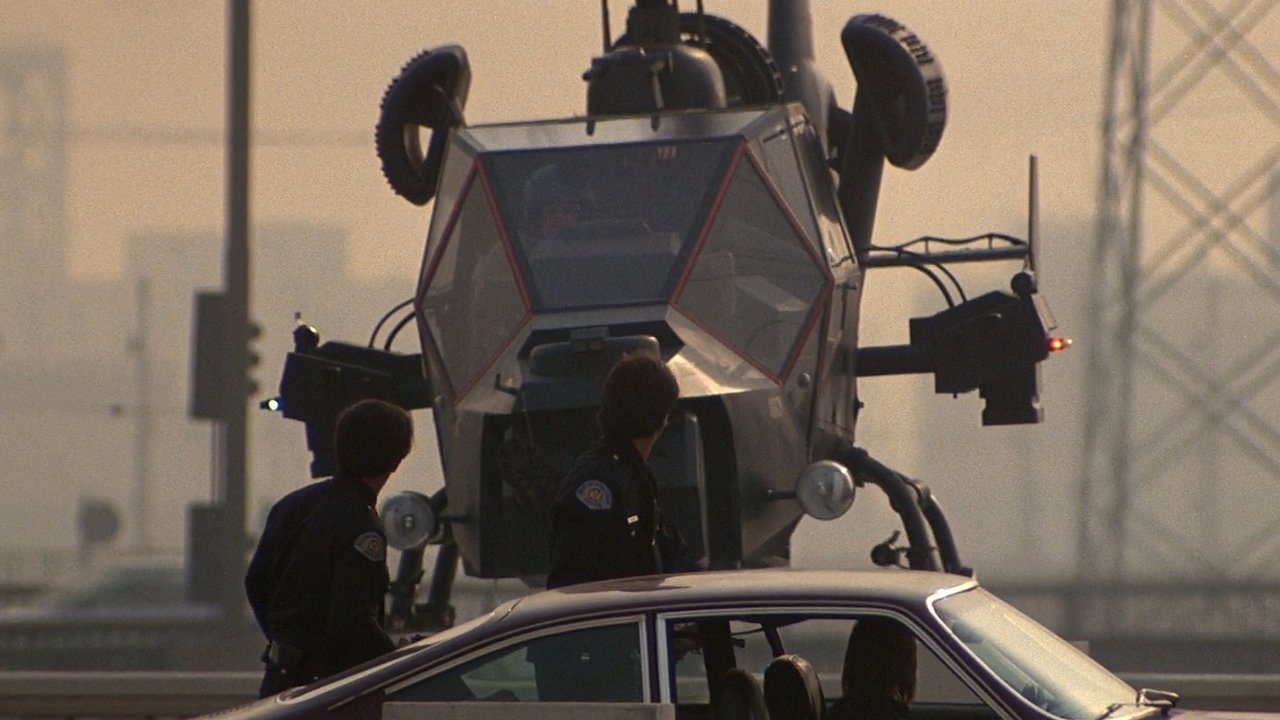
This was actually a prototype, wasn't it, John? The copter? Well, the Army and the Air Force have attack helicopters now... ... that look a lot like this particular helicopter... ... that Philip Harrison designed. He took a French helicopter... ... made by Aerospatial, called the Alouette. And it's actually a very feminine line. It's very sleek. And Philip hung all kinds of blocky, choppy... ... kind of things on it, and rockets and guns and so on... ... and transformed this sleek look... ... into something much more militaristic and tough.
Here's an area where our shooting was held up for a couple of days... ... because our head helicopter pilot, Jim Gavin... ... wouldn't allow the helicopter fly in low over those explosions. And he kept making the special effects man, Chuck Gaspar... ... do various versions of the explosions. And he'd look at it-- He'd say, "Too much gunpowder. Too much gunpowder." And only when he got it to the right amount... ... did Jim allow the helicopter to fly in. Because as I said earlier... ... the explosions could have damaged this helicopter... ... and caused it to crash. Not just down on the ground, which would have been bad enough... ... but as it flies over this whole audience that we have watching.
Lots of extras and our actors... ... none of whom were real happy to have this helicopter... ... flying over their head with all of those explosions going off. And I've always been so grateful to Jim Gavin... ... for being so tough on us and making sure that we were safe... ... and that we did not have any problems, as other people have had. I just saw the script supervisor in there. As many times as I've looked at this movie... ... I didn't realise that there was the script supervisor, standing-- Writing her notes, right in the shot. - Oh, yeah, right behind. Yeah, right behind him.
We haven't told our pilot about the bus.
Let's see if he can pick up on what's wrong with it.
We wound up within the neighbourhood of half a million feet, wasn't it, John? Half a million feet of film? - Yeah, about 450,000. Yep. Now, that's a lot of film for a movie to shoot, and-- A lot of it was test material, but... But, still, expensive. And we had, easily, eight or nine cameras out-- Going while this sequence is going on. We had them planted in the ground behind some of the cars. We had them on the actors. We had them on the helicopter. Lot of times, we mounted right on the tail of the helicopter. And you'll see some shots later on... ... where we're way back on the tail end, looking forward. And it's a very exciting angle.
Terrific shooting, colonel. It was beautiful. Beautiful, was it? Goddamn it! I had another stoppage. Interesting that... This is in the early days of Steadicam, which was being used a lot. But John Alonzo felt that he could operate hand-held... ... better than any Steadicam. And so what we're watching here, for the next several minutes... ... is all completely hand-held by John Alonzo, out in the desert. It no more looks like hand-held than something on a dolly... ... but he always felt that he had a flexibility to it... ... and he was able to manoeuvre quickly. So I would just turn him loose on these scenes. Stage the scene and say, "John, you shoot it." And he would go along and shoot the scene beautifully... ... get all the coverage. I almost could've gone home or taken a nap... ... while he was doing this. John said he was built for hand-held. Because he was not very tall... ... and he said his centre of gravity is low to the ground. And a taller person has real trouble staying as steady and stable... ... as he could do. But this is-- It's just wonderful, as I'm watching here... ... how steady the hand-held is and how manoeuvrable it is. We're on a rough desert floor... ...
and no special kind of plywood floor laid down for him... Twelve sharp. On a hard surface, he had his little apple-box dolly too... ... that he would scoot around like a monkey with. Yes, apple boxes are kind of hard wooden boxes... ... that we'll use on a movie set for all kinds of things: For people to sit up higher or prop something up. And they're used all the time. And John attached casters to an apple box... ... and he would sit-- if it was on a concrete floor or a hard surface... ... he would sit on what he called his "silly dolly"... ... and push himself around with his feet. And it was another kind of wonderful operating trick that he had.
I gotta log in, but I'll get back to you later. Keep it under your hat. Right under the hat. Look at this! I gotta get dressed. I'll see you in a second.
So this is a terrific set. This is the one I pointed out to you earlier that we built-- Philip built right on the site of Piper Tech, up on the roof. And it looks-- It's totally believable, and yet, very flexible for filming. They actually didn't have anything like this that we could use... ... and we needed more space than what they had... ... so they let us use it. And then when the filming was done-- There's the building, right there, that we made. --We had to take the building away... ... because it really wasn't built up to code. Yet, we could give them all the aeronautics equipment-- The helicopter police-- --Give them all the aeronautics equipment that we had had to buy... ... for the movie. And they were delighted to have that... ... because the city budget wasn't so great. And a lot of their equipment was kind of out-of-date... ... and they couldn't afford it.
Now, you take the Ranger and I'll be in my bird.
Malcolm McDowell came onto the film kind of late. We thought we were going to have an actor named Bryan Brown... ... who is an Australian actor. And he had conflicts in his schedule. He couldn't do it, so we brought Malcolm in. He showed up on this day for the scene that we've just seen... ... and I said to him, "We're gonna do a liftoff... ... with you getting in the helicopter. And it's gonna take off, and you're gonna come set back down." So he said, "Right." He got a little pale. And yet, the helicopter lands, and he runs out and he jumps in it... ... and it takes off and circles around. And then it lands after we've got the shot. And Malcolm gets out, goes over to the edge of the building... ... and throws up. What I didn't know was that his agent had made a deal... ... that he never had to fly in the helicopter. And they didn't tell me this. I'm glad they didn't tell me. Malcolm was terrified of flying, and helicopters and anything like that. But when he got to the set... ... and he saw Roy Scheider and Daniel Stern doing it... ... he didn't have the nerve to say that he was afraid.
So he actually went ahead and did it. And his wife at the time, Mary Steenburgen, said: "How did you ever get Malcolm to fly in the helicopter?" And I said, "Because I didn't know. If I had known... ... I don't know what I would've done." And I can't imagine why we ever made a deal where we said: "Oh, no, he's not gonna get in a helicopter." Because, as you see, he's actually up in the air here. This is no computer background.
There's Malcolm flying. And I can assure you... ... he was terrified in all of these shots... ... but such a pro, such a good actor, that he was able to cover it. And then the minute we'd say "cut," he'd go: "Oh, my God! Oh, my God!"
Damn! Damn it! - Oh, shit!
We got a runaway! Jeez! What was that?
Grab your ankles and kiss your ass goodbye. We're going down. Shit!
So all of these close-ups in the helicopter... ... we actually did right there in the helicopter... ... so you could see the city and see the background. And Jim Gavin is flying these guys all over the place. Shut the fuel off! - What? Fuel?
And here we're coming close to one of the most dangerous things... ... that we did in this movie, which is bringing the helicopter down that low... ... and then landing it on this building... ... because, again, that's really, really dangerous, what we're doing here.
Central, this is Blue Thunder. It seems that we have a ship down, somewhere in the Watts area.
And thank heavens we didn't hurt anybody.
Get the hell off me!
Well, that's what makes it real, with the-- Yep. One thing about Roy Scheider is, he loves his tan. And he takes care of that tan all the time. I keep telling him he's gonna turn into an alligator purse... ... if he stays out in the sun as much as he does. But he's sitting down here in the Watts area... ... while we're lining up these shots... ... and he's stripped down to his underwear... ... and sitting in a lawn chair... ... with one of those aluminium foil reflectors underneath his face... ... and people coming by and getting his autograph. You know, the guy from Jaws, the sheriff from Jaws signing...
Rather a near thing today. I heard your turbine failed. Or was it your flying?
Back off, asshole.
What's that I hear? Threats? Well, what a change. We are acting brave nowadays. Are you threatening me, Murphy?
You know what? The dialogue in this scene is terrible... ... and I know why. This is dialogue that I wrote... ... and I'm listening to it now, 20 years later, and I'm saying: "Who wrote this junk? This is the worst stuff--" And I'm remembering I did, and I didn't like it when we shot it. It reminds me that I should not try writing as a profession.
Can I see your watch? - Sure. You know where it is, don't you? Are you losing weight? Getting older too. I think you have to turn up here.
Getting enough sleep?
Are we having two different conversations or I am going nuts? The train ride. The train ride. I'll find it. If you don't run out of gas first. - What? When that needle points to empty, it means you're out of gas. That's broken. We got plenty. Mommy! You missed the train ride.
Hang on.
Now, Candy Clark actually was a pretty wild driver. And she didn't do that particular stunt, but she did some that come up later... ... and I'll point them out. And I was foolish enough to get in the car... ... and ride with her while she was driving. Scared me to death. I'll tell you one thing, it's hard to read.
Yeah, I know. - It's part of a letter. It says something about strangers in the barrio making trouble. I don't know. Something like that. Here's a word... ... that isn't in Spanish: "Thor." T-H-O-R.
Thor? - Mean anything? If you know Los Angeles, you'll recognise this... ... as being in Griffith Park. Travel Town. And it's kind of a fun place. And on Sundays, it's got all kinds of people there. You know, there's Hispanic people coming up and... Every kind of person, all over Griffith Park... ... and they just love this Travel Town. So it's a good location for us to work in. --
Who was tragically murdered several days ago.
Food's up!
McNeely, who chaired the Commission on Urban Violence... ...
was an outspoken critic of police department policies. The chief was in evidence, as were many of his aides.
As temperatures stay high and tempers continue to fray... ... fires continue in the Watts area...
You know what, Frank? This reminds me of some kitchen stuff... ... that we did in Short Circuit with Ally Sheedy in the kitchen... ... and the skunk up on the counter, eating food. Right. - Boy, that's-- I'm using the same old ideas over and over again. Frank?
Frank, are you okay?
Frank?
Is this something kinky?
Goddamn your black Irish heart... ... Frances McNeil Murphy, if you've left!
The character of Murphy that Scheider plays... ... started in a very different kind of-- Had a different tone to him... ... a different kind of character than what we have here. Dan O'Bannon wrote him as much more disturbed... ... much more negative, much more on the edge for sanity. And as we kept working on him, we kept bringing him closer... ... to somebody who is troubled, but not as insane... ... as he was originally pictured. We felt, at the time, that that was a better bet and more interesting... ... and we could keep the character more likeable-- There goes poor Bill, out the door again.
This was a way that Scheider liked too. He liked playing it in this little more positive way. Somebody who is a little off, but not-- You know, not wildly crazy.
Infrared filter. Target system.
This helicopter, as you've seen-- I mean, it actually flew. And we had two of them as backup in case one was not working... ... because with movie props, you have to always be prepared... ... for them to break down. Things are happening all the time to them... ... and they're not coming from Toyota or Honda or General Motors... ... with 100,000-mile guarantees on them. They're fantasy things... ... so our job is to try to make them look real.
You can zero in on any target you want.
But flying in these helicopters was not much fun. They were so laden with stuff that when they took off, they had this feeling... ... like when you take off in a loaded 747... ... that it's never gonna get off the ground. Whereas, the Bell Rangers, which you see in the background... ... the blue and white helicopters, are just sprightly... ... and bounce right up, and you feel the difference. I mean, they're the most mobile kind of things... ... and this poor guy was just, like, wheeling a whale around.
Each reel is code-numbered.
This little bug erases the tape on a signal from Central Command. The tape's gotta be inside the case to erase. It only erases in the case? That's great. Adjust for your eye until the red dot rides on your tracer line. Then press the cannon button and zap! Where you look is where you hit. Sunshine! Just blew your gizzard away. What's all this shit I hear about you threatening Cochrane?
Thank you, sergeant. What?
In the police garage. After your crack-up. Feeling a little hostility? I told him to back off, that's all. That's all? Well, it's enough.
Okay, Warren Oates should actually be complaining about the bad dialogue. They don't want to see it totalled.
Some kind of bullshit.
Hey. Now, why we let this go, I will never know. But Warren Oates says that they spent $5 million on this helicopter... ... and I'm thinking that's cheap. I mean, it should've been $100 million.
Yeah, that did get quite a bit of comment. Yeah.
We got a test flight to make out there.
From the editorial staff, that is. Oh, yeah. Yeah, from the editorial staff. But you try to get details right... ... and then these little things jump out at you as-- Like, "Oh, that doesn't work."
The cabin mike. It records everything we say. I think we can lose that. I got the fuse right here. Get your hat off those circuit breakers. Tell me what JAFO is. I'm putting the fuse here. You'll find out. Just be patient. Night vision. Checked, okay. Target systems checked, okay.
Let's see what's on HBO tonight. Now, this movie is filmed in widescreen. Sometimes that's called Cinemascope, or anamorphic. And 35 mm film is not wide enough to contain this frame. It wouldn't fit. So Panavision and some other people... ... invented lenses that actually take this image that you're looking at... ... and squeeze it to the width of a 35 mm frame... ... which is almost half as wide as what you're looking at. If you hold up a piece of anamorphic film to the light and look at it... ... all of these guys would be tall... ... and skinny and mushed together. The whole image would suddenly get all squinched. When you project the image, then you have to have a similar lens... ... that unsqueezes the image. But this was an effort to make big, widescreen movies that-- Not necessarily in Cinerama or techniques like that... ... but that you could make on ordinary film, and have an experience that was... ... different from what you're seeing on television. It had a different aspect ratio, real wide screen. And the challenges of shooting it are quite interesting... ... because those lenses require a lot more light... ... and give you a lot less depth of focus. So you're always kind of struggling with it.
It's a very special kind of look that I actually prefer. And it gives you some real challenges in composition and so on. But you don't see too many pictures shot in anamorphic nowadays. They have another process called Super 35... ... that isn't quite so difficult to shoot. I think, Frank, we did Bird on a Wire in Super 35. Right. Well, from the standpoint of coverage in this movie... ... it was an editor's tour de force almost. It was covered so well. You mean, in terms of you having the footage that you needed. Yeah. We had very, very, very few problems. Well, thank goodness we had enough time to shoot this movie... ... so that we could get the coverage that we needed... ... because it was so tricky to tell this story along the way.
I dig this police work. Yeah. You're breathing heavy. All right, here goes the whisper mode. Whisper mode.
That's a check. You shot, what? About 75 to 80 days on this, or something, didn't we? I think so. It seemed to go on forever. I was just exhausted. I think we started in late September... ... and finished mid-February. So it went all through the Christmas holidays. That's a long schedule for a movie. And I remember that we also had to go back several times... ... and get shots like this, that were close on the instruments... ... and things that everybody needed.
That's 221 Bravo 6. I know that cycle. Jack Moran. Double Dork.
The photographic process here: We're actually on a stage... ... with the rear projection that I pointed out to you earlier. But John Alonzo came up with a fairly clever idea. He got 16 mm prints made of the background plates... ... and then had a 16 mm projector projecting the background plates... ... right onto Roy Scheider and Daniel Stern's face. So you got the same sense of movement inside the helicopter... ... that you could see outside the helicopter. And that helped a lot. As you can see, the moving around is in-- That's on their helmets and their faces... ... is pretty much in sync with what's going on in the background... ... as though it's reflected off the bubbles. Yes. Yes. No, no!
Not yet. Not yet.
I'm not ready! No! I wonder who these people were. Well, they sounded very happy.
We recorded all this? - It's all on tape.
Locked in the memory in the belly.
I think old Double Dork's entitled to a quickie. Don't you?
Photographing this helicopter at night was a serious challenge. Because the normal way that they had done it... ... was to have another helicopter fly along... ... and spread light all over the chopper. But it looked just terrible, you know. It looked all lit up and phoney. And Alonzo came up with the idea-- He said: "I'm gonna make this helicopter light itself." I said, "What did you mean?" And he said, "I'm gonna put lights all over it that are hidden... ... and wherever it goes, it will have light on it." So he and his electricians built lights that are... ... hidden along the bottom of the skids of the helicopter. They're hidden up in the tail, all over the place. Just little tiny guys spreading light along the body of the helicopter... ... so you could see it against the real night sky. And it took them a long time to develop it. And they would keep coming back with test footage... ... where I'd say, "Oh, this looks very nice. When do we get to see the helicopter?" And they'd say, "Well, it's right in the middle of the frame." But it was so pitch black. Because we had to make a helicopter... ... that was, like, midnight blue. And, of course, that was terrible.
The only thing worse than that... ... would have been if it were painted black. Then we never would have seen it at all. Well, we're actually very lucky, because right now... ... we've just been joined in this session... ... by an absolute genius in the area of special effects. Hoyt, would you introduce yourself?
Hi, I'm Hoyt Yeatman. I was the Visual Effects Supervisor for Blue Thunder. And this was the very first film that Dream Quest Images... ... the company I founded a number of years ago, worked on. So it was our big break. And John was so nice... ... giving a chance to show what we could do. Does Cochrane drive a grey Corvette? Yeah. Why? Check 9:00. At the time... ... the shots that we needed done-- And there were many shots needed for this movie. --Were very expensive. And when we got a quote on them... ... they were in the area of $25,000 a shot. And a shot may only last for two seconds or something. So Columbia said, "Oh, that will never work." And... And so the Columbia guys went out and they found some guys that said: "We can do this for $5000 a shot." And that particular group, that will remain nameless... ... came and did some test shots, and when they finally came back to us... ... they were unwatchable. And the producer, Phil Feldman... ... would not even show them to me. I said: "Well, Phil, I can see it. I'm a big boy. I know what stuff looks like." He says, "I'm not showing you these shots."
So at this point, we discovered Hoyt. And Hoyt, if I remember right, you, or you and your company... ... was working in kind of a garage in Culver City. That's right. It was a very small little room where we had built... ... our first motion-control system. And on this show, what we did, instead of building exotic models... ... we went down to the hobby store, basically, and bought a Tamiya... ... a very finely made, you know, model of an F-16... ... and Greg Jean, a renowned model maker, built it for us. And so that was the first real model shop that we had. It was Greg building a standard, off-the-shelf model. And that's what we used for the model work in Blue Thunder. So the shots that came in from Hoyt were just fabulous... ... and at an amount that we could afford... ... a little bit more than the $5000 that Columbia wanted to spend. But on the other hand, thank goodness we were backed by Ray Stark... ... who was powerful enough to tell Columbia... ... that we had to have the thing look right... ... and not cheesy-- - Right. --like some old horror movie. Right. Believability, I think, in this picture, was of prime importance.
Yes, we always wanted to have things very, very believable. And with the helicopter... ... to do as much real stuff with the helicopter as possible. But then when we get into areas with F-16s... ... and some trick things the helicopter did... ... we would have to rely on, you know, some new technology. Right.
We're coming up on a scene that's an interesting special effects scene... ... as they find some people inside this building. They're using heat-sensing technology for the helicopter. I'm holding you responsible for that man's behaviour.
Dr. Haycock strongly recommended he be grounded. For your information, Mr. Icelan... ... there are no paranoid schizophrenics on duty here. He checks his sanity with his wristwatch!
That's my favourite line in the movie.
He's finished as of now. If there's a scratch on that aircraft, so are you.
Try the thermograph. - Yeah.
I told you it was cool. Lovely, lovely!
Park here. - I'll bring it around.
I got something!
So this was an extremely complicated scene to shoot. Here, we're on the stage doing the actors... ... against rear projection. And now these images here, there was-- It had to be done in a very low-tech way. All the actors were put in white suits and had white makeup on. So we shot them in this room, doing all of this action... ... in their normal wardrobe. And once we had finished shooting the scene, we sent them off... ... where they put on the white suits and the white makeup. They came back and we reshot it... ... on a black stage that duplicated the same office. And now you had these weird images... ... that were run through all kinds of video process... ... to make them look like the way they are... ... reflecting, supposedly, the heat of the bodies. This is in kind of a pre-digital era, too, when we're doing this. We had television effects, but we really didn't have digital technology for film. If I remember right, this was done at Warner Bros... ... in one of their little video studios that the man built... ... who kind of invented 24-frame video for movies.
We're in deep shit! Let's get the hell out!
Tower, we have 330 degrees and 15. Altimeter still 3000. Clear to land?
Air-12 traffic, 1 o'clock two miles north-eastbound. It's a Cessna 182 to 5000 VFR. The air traffic controllers here-- This guy is an air traffic controller... ... who was also an actor. So I got the benefit of both skills. And he could sit there and make this stuff up all day long... ... and provide chatter for us so it sounded very real. And Lord knows what the planes would actually do... ... if they followed his directions.
All right, sir. I will.
Yes, thank you.
Did you have a nice flight? - I enjoyed it. I hope so. It's your last for a while. Now listen, Jack-- - No, you listen. That's how it is from now on: Me captain, you cop. Me talk, you listen. If I don't have an ass when I get out of this chair... ... it's because the old man chewed it off.
This is more of that great Dean Riesner dialogue.
You're beautiful when you're angry, but let's talk privately. We don't have any secrets from Mr. Icelan.
You're off the programme. You and your buddy Lymangood.
I'll be lucky if I'm not in Pacoima tomorrow... ... driving a black-and-white.
Captain Braddock speaking.
Yes, sir. He's here, colonel.
Icelan.
Guys, don't forget to check under the hood. Just gonna get my cuff links.
Yeah. Who are you conning with that phoney radio shit? For chrissakes, that went out three days after Marconi invented it!
Captain Braddock speaking.
Yes, sir. Yes, sir.
It's taken care of.
Who unlocked the memory bank? That tall numb-nuts cop.
I understood you weren't really able to fly the Blue Thunder... ... over populated areas? Is that correct too? Because it wasn't really FAA approved. So you had to clear areas out... ... when you flew. That's why you flew on weekends. Was this a rumour, or was that true? - Well, it's-- That's a partially true story. When you fly below 1000 feet... ... you have to be in an area that is controlled. So the Blue Thunder helicopter flew all over Los Angeles. I mean, everywhere, but above 1000 feet. But when we got to Downtown Los Angeles for later sequences... ... that we'll come up on, we were sometimes only at 50 feet... ... flying around. And so those areas were locked off... ... and we could only shoot in Downtown Los Angeles on Sundays. So Sundays in Downtown Los Angeles, unlike New York-- I mean, the place is deserted, and... You know, nobody is down there. Or at least at the time. So we could clear out eight or 10 blocks... ... and just work in that area... ... and control the pedestrians and the traffic going there. John, when you remix this, do me a favour. What? - Put the finger snaps in. Put the finger snaps in.
Oh, yeah, this was a big argument with Columbia, constantly. The crack of the fingers that you just heard: How loud should it be? It seemed no matter how much we turned it down... ... people were still horrified by it if you could hear a little bit. They just go: Because everybody knows what that must feel like... ... even if you've never had it done.
The guy who just went out the door-- This is Terry Leonard... ... one of the great stuntmen of Hollywood. He was our stunt coordinator. And he's a phenomenal guy who's done... ... the most amazing stunts in Westerns where he's being dragged... ... by a stagecoach, right in between the horses. Terry directs a great deal, so we were very lucky to have him. And one reason I bring it up... ... is he's got a lot of broken bones and hips and pelvis and so on... ... he's accumulated over the years... ... and yet he insisted on doing this stunt where he falls down. And the reason he insisted on it was, he felt bad... ... because the guy he hired for the job couldn't show up... ... was stuck on a movie at Universal that went over on the day. And he said, "Well, I'll do it. I'll do it." And I said, "Terry, you can't. Your bones won't stand for it." "Oh, no, it's fine." That's how nuts these stunt guys can be. This car was being driven by great stunt driver, Carey Loftin. Carey Loftin did all the driving in Bullitt. .. ... that Steve McQueen did not do. And he was a phenomenal, phenomenal driver... ...
and he was pretty elderly at this time. He was almost 70... ... but he could still whip that car around like nobody's business.
These stunts on the ground, like just getting that kind of rolling, you know-- I don't remember how we did that. So the guy looked like he was run over, but he was not run over. I've always felt that I made a huge mistake at this point in the movie... ... that we killed Lymangood. There's my daughter, Kelly, right in the centre. So I always thought that things would've been happier... ... if we had him taken off to the hospital... ... but maybe he could recover later on. But at the time, I insisted on, "No, he's gotta be dead... ... that we have to see him go in the body bag." And I found that it depressed people in the audience a great deal. They got so upset. But my thinking was that... ... this was gonna give Scheider's character, Murphy... ... the motivation he needed to do all the crazy things he's about to get into. But I think that it would've worked just as well... ... if the guy was severely injured but still gonna live. California licence 909 King-Edward-Boy. Frank Murphy. Detain and hold for questioning... ...
in connection with the death of Officer Richard Lymangood.
Well, this is right close to your neighbourhood, Hoyt. This is right across from old Hampton's... ... now called Mo's, in Toluca Lake. - Right. There's a Bob's Big Boy across the way.
Call me if you want to talk.
Los Angeles police did not want their insignias used... ... and so the "Astro Division" was a phrase that was made up... ... because they really didn't want connection with us on the movie. They were very helpful and cooperative... ... they just didn't want their name all over the place. I forgot that.
Here's your tea, colonel. - Thank you. Why don't we just blank the tape? That's what it's designed for, right?
This set really worked. The mechanics' shop out there-- Was that the same location as built on this--? Same location. And actually, that is an actual garage... ... that's up on top of the Piper Tech, and we were able to use this set. This is a practical garage... ... and it had been built for servicing these helicopters. So that was really, really nice for us to have the ability to use this space. And plus, the mechanics could actually take the helicopters inside... ... and work on them when they needed to.
Here we're trying to pass a lot of this off as... ... you know, possible to happen and actual. And by today's standards, it certainly is possible. Yeah, it is. Yeah. - It's old-hat stuff now. Yeah, I know. It's gotten closer and closer. We even have some forms of "whisper mode"... ... where the helicopter will be a lot quieter... ... than it is in its normal, noisy self.
The way we would do some of our aerial shots... ... in Downtown Los Angeles, for example-- We were down there for 10 Sundays in a row... ... and would meet at about 7:30 in the morning... ... in some parking lot, Downtown Los Angeles... ... where the caterer had some hot coffee and so on. And I would sit down with Jim Gavin... ... who acted like we had all the time in the world to do this. And I'm nervous and scared we're not gonna get our day's work done... ... because this was being done in December and January... ... where you had very short light. It wouldn't get light enough till 8 in the morning... ... and by 4:00, you're out of business. But we'd sit there at one of the little picnic tables... ... and leisurely discuss the shots that we're doing... ... and I couldn't hurry him up in any way at all. But we would get it really down. He wanted to know exactly what I wanted... ... and exactly how it was supposed to look. Then he would leave, go get his helicopters ready... ... and I would get my cameras ready, that were on the ground. And he had cameras up in the air.
So when we were all ready for that particular set of shots... ... he would take off from the helicopter pad that we were using at Piper Tech... ... and we would start to work and just keep going like that all-- Without lunch, just straight through the day and use every hour we could. Shit!
Los Angeles mobile. This is how things have changed now. Every television show, people are walking around with mobile phones... ... and little cell phones that they're carrying around. There are millions and millions of them in the world... ... but at this time that this movie was done... ... you had to get the mobile operator on and wait your turn. You know, if there are other guys online, talking on the phone... ... it was like having an old-fashioned party line. And you needed to know the number in your mind that you were calling... ... because you say to the mobile operator: "Get me such and such a phone number"... Did you shoot those shots air-to-air? Were you actually airborne and then had a--? Yes, there are a lot of air-to-air shots that worked. Now, this is the heli-- The camera is mounted right on the helicopter. But we would also then go up and do the-- Fly the pattern with one helicopter watching the other one. And that was the best way to do it, and very efficient. So Jim Gavin is flying above the Blue Thunder helicopter... ... right there, and having it do the manoeuvres.
Where is he now? Over the Hollywood and Ventura Freeway interchange. Get the mayor's office on the phone. We're gonna get the Air Force, and now!
Were you up there much? I got to go up there lots and lots. I really love flying in a helicopter. It's quite exciting... ... and Gavin was actually teaching me how to fly, a little bit. Roy Scheider really did learn how to fly it. I'll show you some shots where he was actually flying the helicopter... ... and not just being a passenger pretending to fly the helicopter.
I regret I didn't take a free ride with him... ... other than the fact that we could've been shot at, but... Well, that's true.
Here's another almost-- Antiquity. You have to really go a long ways to find drive-in movie theatres. And I think Frank and I laughed a lot... ... about the idea of burying a tape inside a dumpster. You know, this-- - This is stretching it a bit. We're really, really stretching it... ... that Lymangood would put this stupid thing inside the dumpster. I mean, it was a lot of fun because, here, look what-- Candy Clark getting to flip upside down and so on. But it was not the smartest place in the world to do this. When Columbia later decided to make a Blue Thunder television series... ... this truck is the very one that they decided to use... ... because they couldn't afford to fly the helicopter... ... so they had to do it all on the ground, which was another brilliant decision.
I mean, what was he thinking? "I'll put it--" And they don't dump this thing out till Monday. I mean, this is, like, nuts. How does he know that? Oh, well.
This is the part I told you about where Candy Clark... ... is actually driving the vehicle here. And the silly director, who doesn't have the sense God gave a billy goat... ... is actually in the car with her... ... which is kind of nuts. Like, for this shot... ... and this shot... ... I'm in there saying, "Okay, drive faster." And look at that car bouncing all over the place. Eventually, flying through the gate.
This shot, right there-- We almost killed a young Japanese guy who was observing John Alonzo. And John said, "Here, you can operate this camera." And that police car went into a spin right there. You saw how close it came to the camera. And he was only saved because the key grip had a hold of his belt. And he was a small Japanese guy so he was able to pick him up... ... and, you know, save him, because otherwise... Otherwise, he would've been toast.
No shit, pendejo!
Set that thing down, man. We got two choppers full of SWAT guys.
So here we've got four helicopters up in the air now. It's getting real cosy up here.
Return to base or we're gonna open fire.
Come on, will you, Murphy?
All right, knock him down.
Were you up here? - No, this part I actually-- I sent Jim Gavin up, and let him direct some of this.
A couple of the shots, I would do down on the ground-- The close-ups in the helicopter-- --But most of them were done up in the air. We had so much work to do that we were spread out... ... sometimes as many as five or six different camera units working... ... you know, getting this footage. And things like this I would give to Jim Gavin and say: "Here, go and get this started." I remember there were very few action scenes that did not have six cameras. Right. Because doing things like this... ... as we go into the Los Angeles riverbed... ... which is actually a big flood-control channel... ... for the occasions when it does rain. This is the only thing that keeps Los Angeles from washing away. And we got permission to fly down inside the flood-control channel... ... for a length of about four miles... ... to go in and shoot this whole chase sequence.
And you can see that Scheider is actually in the helicopter... ... and we're down in the riverbed with him, and he's being flown through. We're getting these close-ups, actually, as low as you're seeing them. Fabulous stuff. Very, very exciting things. Amazing sequence. - Amazing. It is. Well, they're all amazing. And there's so much special effects work here... ... with squibs that have to be mounted onto the helicopters... ... and smoke that you want to have coming out of them... ... and broken windows, and so on. And here, this whole crash was an amazing thing... ... with a combination of almost a balsa-wood helicopter... ... that was pulled along a track and crashed into the abutment there... ... and then substituted with this helicopter, so... Very, very complicated footage to get.
And this is where Terry Leonard's stunt guys... ... really started to outdo themselves. We'll see a lot of phenomenally good stunt driving coming up here.
Okay, lady! Pull over!
We're probably coming up to one of the most famous shots from this movie... ... and one that's been often imitated... ... as they've stopped Candy Clark here, and she's trapped. Now play it very cool. I need your licence and your registration. Sure.
I think I left them-- - Get out of the car.
So here, to achieve this shot... ... we had a 1000 mm lens... ... that was almost a mile down the riverbank... ... shooting that shot to get that effect. And on a platform. It was the craziest thing.
And now, watching here, we have to have a car that's made to break apart... ... and yet can still drive-- So it had extra wheels in the back. --Once the car had split apart, and that's just quite something. Going 40 miles an hour, it's gotta become two cars. Now watch this motorcycle in this little chase. There's Candy Clark still driving the vehicle. And this stunt guy did not have good luck. He has to lay the bike down deliberately... ... but here, he crashed. And actually I think he broke his ankle. Oh, my. Our producer, Phil Feldman, is on the right. Balding guy in the uniform. He really wanted to do a part in this movie, and he said: "Oh, I could be the Air Force major."
A couple of F-16s are standing by at March Field.
Phil had been in The Godfather. Francis Ford Coppola had put him in The Godfather. And he said he could do this. He loved acting. We can surgically remove him. Like a tumour. We're not talking about a tumour.
You gotta make a right there!
No, Kate!
This is where we dropped one of the scenes out of the movie with-- Well, we probably have it in our outtakes. We're hoping so, because it was a really good little sequence... ... where she's going through the alley. But at the time, we thought, "Well--" We had to trim some things out of the movie.
Thattagirl. Good work!
The scene that was cut out was her driving down the alleyway... ... and as she got to a very narrow-- - Here we go. Yeah. Here we go. Hoyt, you better take over. On this one, it's interesting. We're not using blue screen... ... which is the reason it looked as good as it did... ... back in those days of photo opticals. As opposed to shooting the models on a blue-screen stage... ... with blue-screen pylons with motion-control... ... that model actually is coated with an ultraviolet invisible material... ... that isn't photographed during the production pass. So in other words, the F-16 model... ... is shot against black using motion-control... ... and then the motion-control camera-- The film was unloaded and replaced with a black-and-white film... ... and then the model is illuminated with ultraviolet light... ... and special suppression filters are put on to the camera... ... that prevent the black-and-white film from seeing the ultraviolet. But the model would glow. And then the camera, it reproduces the move... ... and we get a first-generation matte. That was the secret why we were able to pull mattes against blue sky... ... where everyone else was using the blue-screen techniques. That was a thing we came up with.
Where did you come up with this technique of the ultraviolet? It was at the same time Apogee was playing around with it. It's a very unique substance that is a very high-fluorescent material... ... that is literally invisible to the eye... ... but is one of the strongest fluorescent materials... ... when illuminated with ultraviolet light. So the advantage is that you get a first-generation black-and-white matte. It's more difficult to shoot... ... and requires you having a black-and-white department... ... and getting perfect exposures. But once it's done... ... the mattes go together like never before... ... and so it gives a much superior look... ... when you're doing it photographically on an optical printer. Well, it's true, the difference is amazing... ... because here, we see these images and we can't see a line around them... ... which we always used to see. Apogee, that was John Dykstra's company. That's right, yeah. John, he called it the "reverse blue technique"... ... which was a little different. Their system used a blue fluorescent material and a red ship. Ours was shot against black and a first-generation matte was pulled. There's the test shot that-- - Yes, we did. That one, I think, that Hoyt did and several companies did in competition. Right.
That's a little 16-inch-long Tamiya model kit that's used together, so-- Has that F-16 in the background of the cockpit. And that's all that you inserted. Right. Correct.
There he is. He's all yours, cookie. Now, we're hearing the voice of Frank Morriss, who's sitting next to me... ... who played the F-16 pilot here. So I just want you to know. - Yeah.
This sequence, I was told by the assistant director... ... would never wind up in the movie because it was too silly and too crazy. But it is definitely one of my favourite, favourite scenes in the movie. And, yes, it's silly, but, you know, it's just great fun. This is-- Hoyt, you were there shooting. - That's my first day of shooting. Kind of woke me up, because after the explosion... ... we looked at our matte box and it had melted the front element of it... ... so it got pretty hot.
Holy shit! Now, these are actual barbequed chickens, honest to God. Everybody thought they were rubber chickens. But the actual chickens were cheaper than the rubber chickens. You could go to Ralphs supermarket... ... and buy them for $2. 50 apiece for the chicken... ... and the rubber chickens cost, like, 20 bucks apiece... ... and we needed thousands of these things. And the whole street was covered in chicken fat. And we had homeless guys coming out of the woodwork... ... you know, grabbing hold of chickens, running around. It was one of the craziest things I've ever done in filming.
Here they come. - More plates over Santa Monica. Right? We shot those from the rooftops. Isn't this the area where you had the flameout and...? Yeah, that's coming up. The flameout is shortly as we go around these buildings. This is the Arco Towers in Downtown Los Angeles. Twin towers that were among the first... ... modern skyscrapers built in Downtown L. A.
Now, we're looking at a lot of stunt people running around... ... because they all participated in this sequence that came up... ... as the F-16s lock in on the heat source... ... of our Blue Thunder helicopter. And Scheider gets his plane where it's up against the sun reflection. He's hoping to decoy the helicopter into this. That was the miniature helicopter, too, going across right there. There's the miniature helicopter. Certainly the idea of it going into a building like this... ... was viewed by us as complete fantasy. And it never, ever occurred to us... ... that somebody would actually do something like that, you know. It's just beyond the range of thinking. At the time of 9/11, you couldn't have shown an image like this. Everybody got so sensitive. And then, suddenly, they realised... ... that people weren't as terrified of it... ... as we were saying they were going to be. Remember, people were saying, "We'll have nothing but Doris Day movies." Or, you know, whatever today's version of Doris Day movies is. But then, suddenly, the video stores started telling us... ... that every terrorist movie they had was gone from the shelves... ... that everybody was suddenly fascinated... ... with the very thing we said they wouldn't be... ...
which proves William Goldman's old adage of, "Nobody knows anything." And you'll remember, when I talked about the first shot... ... with Malcolm McDowell. Well, here it is. This is the one where he comes... ... and has to jump inside the helicopter and take off. We probably won't be able to get permission... ... to do practical work like was done on Blue Thunder. In other words, I think the laws have changed... ... and people's concern for safety has increased. So we won't be seeing the same kind of amazing, live stunt work... ... which is really, you know, just some of the best ever done. They would depend on visual effects, other methods, to achieve the look... ... but it wouldn't be the real thing, which is what we got here... ... which is a real treat. So he didn't know he had the option of-- No option here. No, no option. But it looks really good. I mean, it looks like he's taking that helicopter off. And the pilot, Karl Wickman, was-- I don't know where Karl was, but I couldn't see him. At that point in Los Angeles, in the early 1980s... ... lots of new, giant structures were being built... ... and here we got to use one where we could shoot through it.
And this is where we lost this helicopter... ... this little Hughes 500 helicopter. Its engine blew up. And the helicopter auto-rotated down to the ground... ... onto those parking lots that you see. And only because we had cleared the lots out... ... and had no traffic down there and no cars, no people, was it safe. And we thought we had killed Karl Wickman... ... because the engine blew up. But he was a Vietnam helicopter pilot... ... and he had rehearsed auto-rotating to the ground hundreds of times... ... and he took his helicopter down to the ground... ... and it only bent a couple of skids. And as it hit the ground, he actually was jumping out of it... ... right simultaneously backwards with a fire extinguisher... ... in his hand to put out the flame. But now you can see, we're down 40, 50 feet... ... above the Music Center in Los Angeles. That was not Bill Ryusaki. Good for him.
But we wanted to get these helicopters right in the middle of things.
Rough her up? Is that a euphemism for "assassination"? She had street informants, and she'd connected our project to the trouble...
Lollie, you ought to hear this stuff.
They sound like cops and feds. They're stirring up the barrio to prove what that chopper can do.
A bit of lost language there. - Yes. You think that we changed something? It wasn't just a sync problem? That we changed the dialogue? I think we changed it. - Yes. Well, we did a lot of that. This movie is like a, you know, an Italian movie for sync. An old sword-and-sorcery movie.
But getting these helicopters down in the streets-- It's so exciting. Now, those are all our cars, our traffic. And we've got at least eight cameras up in the air... ... photographing these as they go by... ... and do these various tricky, tricky manoeuvres. And nobody had ever tried anything this dangerous. It's amazing. And I don't think they'd let us do it nowadays... ... because of the accident that happened on the Twilight Zone movie. You had to cut down wires, too, didn't you, to clear areas to fly? Yes, absolutely. Because wires are the enemy of a helicopter. I mean, that will ruin a helicopter quicker than anything. I wanted to have a big camera crane inside this parking lot... ... but Jim Gavin would not let me bring one in... ... because he said if I hit the building with these rotor blades... ... you'll kill everybody on the camera crane. So we had to back off down the street, and... While they're doing these tricky manoeuvres... ... you know, we're blowing up the building across the way.
And you didn't have a camera ship in here? In that parking lot? - Yes, here are the pictures. Well, we had it down the street, and then we're-- Now we've got a helicopter following the other helicopter. This is amazing stuff. - It is amazing. This was a kick to edit, trying to figure out which was the best... ... because I had at least six angles on every shot... ... and they were all terrific. Well, we wanted to cover everything. The close-ups that you see here of Malcolm McDowell... ... he was scared to death. We were actually flying up in the air through these traffic patterns... ... and, I mean, it's very scary when you come close to those buildings. And his eyes were wide as saucers. We had to actually go back and reshoot his close-ups for this... ... because he looked so terrified in the first version we did. That's beautiful right there. Gosh. They just did a great job.
You can see his eyes. They're way too big. He looks petrified. - Yes. Oh, absolutely. Not evil, at this point. - No, no. Very little evil.
Now, Jim Gavin and Frank Holgate did this whole sequence... ... all by themselves as a separate second unit... ... and were able to get the flying started... ... as these elaborate stunts are going on... ... with things breaking and the big chimney being blown up, and so on.
And now, watch this helicopter doing an impossible manoeuvre. To do a flip, a 360-degree flip-- It's not designed to do that aeronautically... ... and yet we had to bring it off. If we couldn't do it here, then Hoyt would've had to do it. And the way we managed to do it... ... was with a 1/4-scale helicopter that was remote control. And it's one of the few models that's in the movie. The remote-controlled small helicopter would actually flip into a loop... ... but a full-sized one... There was no way that it would do it without falling apart.
Amazing. Another terrific sequence. This shot here, we nearly killed Frank Holgate... ... who was standing on the skids outside. He's strapped to the outside of the helicopter... ... and his straps started coming apart. And this is where Scheider was flying the helicopter himself... ... because Jim Gavin had to let go of the controls... ... and grab hold of Frank Holgate, and then hold on to him. And he had Roy landing the helicopter.
Now, why the train company let us do this, I have no idea. But we landed a helicopter right directly on the tracks... ... in front of this big train coming toward us. John Alonzo and I are standing down on the tracks, right here. We're standing here with this helicopter landing on us. We've got the camera right here and a train coming toward us... ... and I said, "John, what in the world are we doing standing on the tracks? We can be killed right here." And it was also a rainstorm going on that night. You can see the water on the helicopter.
Needless to say, we got out of the way-- For this, yeah. - -when we got to this part. And we only had one take. We had one helicopter to blow up. So all of these angles had to be shot simultaneously... ... and Scheider's reaction there was a very honest reaction. I don't think he expected the explosion to be as loud and as big as it was.
That was the end of the helicopter, but not of this story. On the strength of a tape that Murphy delivered to this reporter...
I think this is one of the first times... ... anybody ever blew up a train four times. Yeah. Oh, yeah, you had the explosion go off four times, right? In editing. It was all too good to throw away. Yep. Coming up, weather... ...
and a preview of a bullet train soon to be seen in the Southland.
Maybe. "Japanese bullet train soon to be seen in the Southland." There we go. 1982. Now it's 2005... ... no Japanese bullet train yet.
Not likely soon, either. - Not likely soon. But we do have some trains that we didn't have at the time.
This film is dedicated to Warren Oates... ... who died about a month after we finished shooting... ... of a heart attack. And it was a great loss for all the movie-going world... ... and all of us that loved him so much. Interestingly enough, it took me a while to convince Columbia... ... into letting us put the dedication on... ... because they thought that it would bum people out so much... ... at the end of the movie. But his wife, his widow, was very grateful. And we always thought that it was wonderfully appropriate... ... to dedicate the movie to Warren... ... who had given us so many fabulous performances... ... in the Wild Bunch and Westerns and Two-Lane Blacktop and so on... ... for just years and years and years.
The Landakers, that's who-- The video guys at Warner Bros. Right. - Hal Landaker, yeah.
This music has been used over and over and over... ... in various commercials along the... - Oh, yeah. Well, Arthur Rubinstein told me that-- First of all, he got a lot of work on other movies out of this movie. And he would go in to see the other movie he'd been hired for... ... and they would've used this score... ... to put temporarily on to their movie.
I mentioned that he did a lot of work with electronic music... ... but here he also had a full orchestra... ... that he could get, you know, big, big sound combining the two things... ... of an electronic sound and then an orchestral sound at the same time. Gives it a wonderful life to it.
Thank you so much for bearing with us here... ... and we're glad that you could listen to this commentary. And here's our dedication to Warren. Hope you've enjoyed it.
Keep exploring
Other commentaries on related filmmaking topics
-
8 shared topics
Mission Impossible Dead Reckoning Part One (2023)
Christopher McQuarrie, Eddie Hamilton
-
8 shared topics
The Mummy Returns (2001)
Stephen Sommers, Bob Ducsay
-
7 shared topics
Mission: Impossible - Fallout (2018)
Tom Cruise, Christopher McQuarrie
-
7 shared topics
The Lord of the Rings The Return of the King (2003)
Peter Jackson, Fran Walsh, Philippa Boyens
-
8 shared topics
The Blob (1988)
Joe Lynch, Chuck Russell, Mark Irwin
-
8 shared topics
The Mummy (1999)
Stephen Sommers, Bob Ducsay