director
All Quiet on the Western Front (2022)
Release All Quiet on the Western Front 2-Disc Limited Collector's Edition 4K UHD + Blu-ray (Capelight Pictures, 2023)
Writer-director Edward Berger frames All Quiet on the Western Front as a specifically German anti-war film, one that cannot turn combat into pride, honor, or a completed heroic mission. His solo track explains how the camera, hard sound cuts, Volker Bertelmann's harmonium score, recycled uniforms, practical mud and snow, and Paul Bäumer's face keep the audience trapped inside one young soldier's experience rather than admiring the production from a distance. Berger is equally attentive to performance craft, from the long search for Felix Kammerer to the spreadsheet Kammerer used to track pulse, the urge to kill, and the will to survive across a story filmed out of sequence.
- Duration
- 2h 19m
- Talk coverage
- 96%
- Words
- 18,869
- Speaker
- 1
Guided collection
Reconstructing history at scale
Edward Berger and Robert Eggers show how research, physical builds, performance, sound, and shot geography turn inherited history and myth into lived cinematic worlds.
Part 1 of 2
- 01 All Quiet on the Western Front Now reading
- 02 The Northman 2022
Commentary density
Highlights
Featured in
Topics
People mentioned
The film
- Director
- Edward Berger
- Cinematographer
- James Friend
- Writer
- Lesley Paterson , Ian Stokell , Edward Berger
- Editor
- Sven Budelmann
- Runtime
- 147 min
- Also on
- OneSheet ↗
- External
- IMDb ↗ TMDB ↗ Find on Amazon ↗
Transcript
18,869 words
Hi, I'm Edward Berger, the writer, director and producer with my friend Malte Grunert on this movie, All Quiet on the Western Front. I'm so happy that you decided to listen to my commentary of this DVD. I've never done it before, so this is my first DVD commentary, so please bear with me if I make some mistakes or I correct myself. But I actually love the fact that I get to watch the movie after months and months and can talk to you about it. So come up with the first shot here. Landscape in the Czech Republic. We shot this movie two years ago in the spring of 2020, winter spring of 2020, 2021. I'm messing even up the years. And you see the landscape here. It's in the Czech Republic. We shot it in the Czech Republic. and this is part of a pre-shoot that we did in January because we wanted some snow on the ground and wanted a foggy landscape and a cold landscape. Anyway, here are the foxes. This is one of my favorite images of the movie. It was really hard to get because obviously we were afraid that this fox, they weren't really a family. The cubs were from a different mother, so we had to separate them, and we actually...
They were never really in the same room together. So that's what I love about movie making, how you can create the feeling of family, the feeling of warmth, the feeling of belonging together without actually having the foxes in one room. I can tell you a little bit more about it later, but the images are rushing by, so I keep talking. So we cut to this battlefield. It was a really hard shot to get here. We rehearsed it a couple of times in a parking lot at ARRI in Prague because we wanted to get the exact height and the lens right. And then on this day, we just shot it just before sunset and probably took about four or five takes only. in this case, and felt like an opening image that was a transition from the nature shots and slowly getting us into battle feeling. But also you realize that you don't hear the real sounds yet. We really only set in with the real sound, with the reality of the sound here. And this was a shot we probably rehearsed. You notice how it's uncut. You know, we run through the,
we run through the trench here and land on a guy who we think might be our hero, you know, because we land in a close-up on his face, Heinrich Gerber. We notice very quickly, or we hear very quickly that he's called that way. Notice it's still uncut, and it's really difficult to get out of this trench with the camera and with no cut. And so we developed it. You should watch the behind-the-scenes footage there. You can probably see... how we did it, we put the camera, we had this device called a Stabileye that we carried, that we hooked the camera up to and two grips carried it and then eventually to get it out of the trench we had to hook it on a techno crane who then lifted it out of the trench and then we created this diversion because it takes a bit of time for the camera to come off this
come off this crane, this techno crane. So we hooked it up. So we created this diversion, this explosion. And in order to gain three, four seconds in the time Heinrich Gerber could in the time sort of duck and be afraid of the explosion. And that was the time that the grips needed to get the camera out of the techno crane hookup and then carry it with this kit. across the field because we really wanted in this opening sort of an uncut, real time, be with this person feeling. You don't get the feeling that we're leaving anything out. We wanted to have this kind of relentless buckle up, throw yourself, be with this kid and throw us right into the battle. And I love hard sound cuts, by the way. So we're building up the sound here. Silence. And the title comes up. This opening sequence here came, I think Lesley Paterson, our writer, our co-writer, came up with it while she was on a run. She's a triathlete. She runs miles and miles and miles. She trains like four hours a day.
And so she went in the... She's from Scotland. So in the Scottish Highlands, she went for a run. And during this run, she thought of this sequence that then later James and I sort of expanded with our images and sort of found a way to explain the war machine, the relentless war machine where kids are sort of just thrown in the mud. and the uniforms become actually more important, a more important resource than the kids. And we wanted to, what the book is really about for me is there are a bunch of kids who go to the front, you know, are basically lied to by demagogues and populists, and they go with enthusiasm and youth, and very quickly they realize that all of their ideals and their youth and their enthusiasm is worth nothing here in this machine. And they lose all their innocence and become these killing machines and they get, you know, sort of caught up in this war machine. And this is, we tried to find some images for the endless machinery of war and the constant recycling and that the uniform is actually more worth than human life.
and so that's the montage we came up with and that became sort of uh we did it was it was basically an idea the idea was to create uh to a sequence that encompasses that capsulates the meaning of the book for us very subjective interpretation you know everyone probably has a different one but for us this was the interpretation of the book and we wanted to create a sequence that encapsulates that in three, four film minutes. And that's what we came up with. That's what we had to offer. Oh, this is interesting too, sound work. You know, I love the extraordinary sound work. So we actually, for these sewing machines to symbolize, again, the machine of the war, we mixed it with machine gun fire. And if you notice, if you listen to it... the sewing machines are actually, they're actually machine gun fire. But as you put, as you see a sewing machine, you kind of think it's a sewing machine, but it is, I promise you, the sound effect is an actual machine gun. Again, a metaphor for the war machine. Oh, a very interesting
thing also is another sound you heard that muffled sound when the kid Heinrich Gerber was diving behind the tree trunk our sound designer Frank Kruse he actually dragged microphones through the mud again to create a metaphor in terms of this is Prague by the way we shot this in Prague standing in for northern Germany Prague is a great city to shoot in felt very welcomed by the crew there. And this is the German embassy in Prague who let us shoot there. But... Oh, I got to continue with this shot. So this is a shot that I wanted to do in one again and show all the kids in one. I felt like if I cut this up, I would have to see, you know, everyone gets a close-up. It's too short a sequence. And I just felt it's a group. I want to show them as one. But I was nervous about...
if this could work, if this would work, because I also want to see them all. Very soon they're in uniforms, and so I want to see their faces, I want to get to know them. But it just felt more as the group, and I rehearsed this in a gym with the kids before the shoot because I was nervous if it would work, and Felix, he had never been, Felix was the guy who plays Paul. in the second guy from the left, our hero. He'd never been in front of the camera and he constantly stepped in front of my iPhone and blocked the camera until I told him, you can't step there, you're going to block the other ones. And he immediately got it. And from then on, he always was like a dancer with the camera. And I really loved his sensibility towards the camera, sensitivity towards his colleagues, the way he...
He embraced the camera and played with it without being vain towards it. Because you can, there are people who are just very vain and play towards the camera. Felix never did that. But anyway, the stuff I wanted to say, this is an interesting shot here, also shot with a tower cam. You see it's a 360 pan while the camera cranes down. It's a very complicated shot to get. But again, it felt to us that it's important to get these sequences in one shot without editing too much. I'll later tell you a little bit about editing. But what I wanted to finish was the sound effect that Frank used, the sound recording he used when Heinrich Gerber in the beginning dives behind the tree. And you have this... muffled sound and it's actually microphones that he drags through the mud and that's the sound he records a dragged microphone through the mud and it's almost a metaphor again for the earth that these boys are trying not to become you know we all become earth at some point and these kids don't want to be that and how they slowly become part of the earth and part of the mud you'll see it
In the course of the movie, their faces get caked and caked more and more with mud. And so they slowly turned into mud themselves. But at the beginning, of course, it's still sort of, we're not trying to become mud. We're still trying to live. We're trying to hold on to life as much as we can. And look at their enthusiasm and their faces. I mean, they're all, you know, fresh out of acting school, fresh out of drama school. And I really wanted these kids to have an innocence in their face. And so we really cast a lot of kids that you don't know yet, that you haven't seen in any other movie. By the way, Wiesengrund 53, the address, that's my best friend's address when I grew up. So it's a little Easter egg I put in there just as an ode to my best friend as a kid. and as a childhood memory also because that's the time when I read the book first, when I was 15, 16 in high school and my friend lived around the corner from us. So the sequence comes to an end with the uniforms, you know, the war machine, the recycled uniforms and here you see the end of that and the name tag
that gets thrown on the ground. And we read the name of the kid that got disposed of. But luckily for the German army, they had another uniform. That's the cynicism of it. I mean, you've heard the music by now. This amazing sound that Volker created. He recorded it. I showed him the movie when it was pretty much locked in this state. And Volker Bertelmann, our composer. And I told him four things. First of all, I wanted something that sounded different from anything else that I've ever heard before. And also anything else that he'd ever done before. Secondly, I wanted a sound... I told him, I want to destroy the images. I don't want to beautify them. I don't want to sentimentalize. I don't want to make them pretty. I want to destroy it. And this is what he came up with. And the third was, find a sound. You know, this should be a sound that, you know, everything is there to, you know, whatever it is, costume, makeup, production design, camera, VFX, music.
Everything's there to explain or to help express what is in Paul Bäumer's stomach. So I wanted to create music that expresses what is in the stomach. And that's our take on this. So the fear, the rage, the love, the hatred, the wish to kill, the will to kill, the will to survive, all these sounds, All these emotions we tried to find a sound for. And Volker went home and recorded this on his great-grandmother's harmonium. And then I'll talk a bit more later about it, the way he recorded it, when a nice cue comes up again.
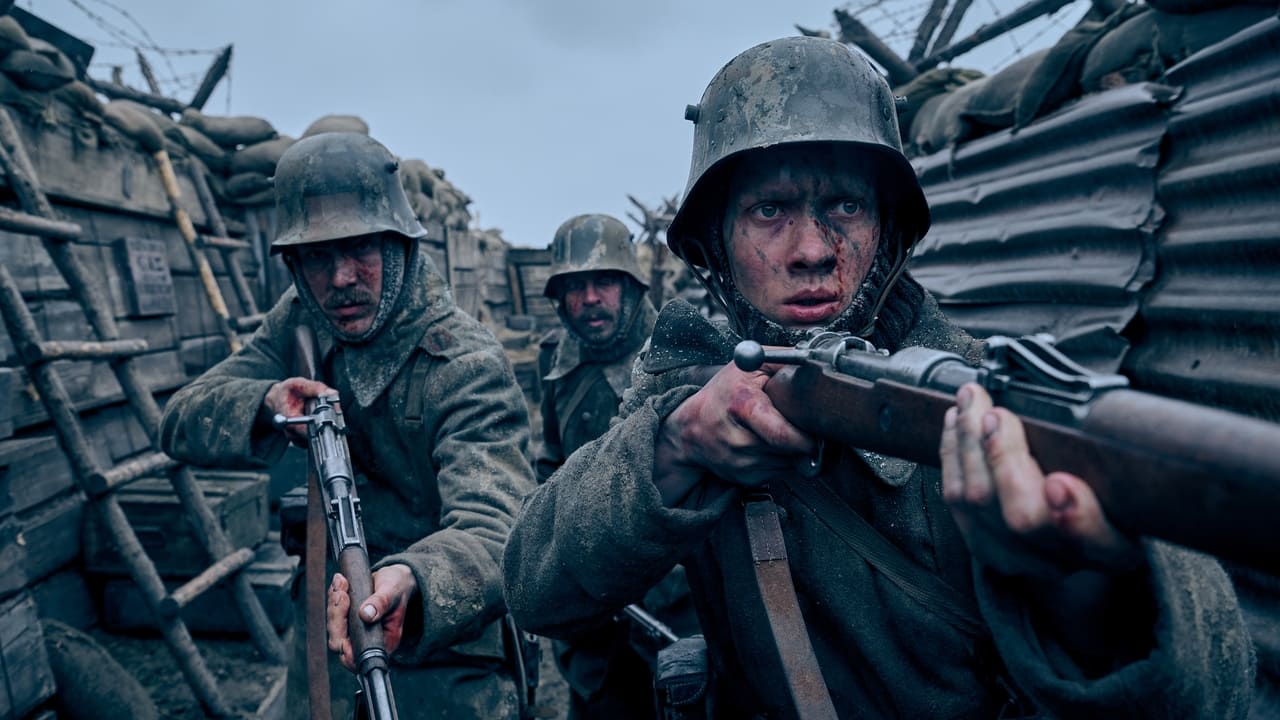
Again, you see, we concentrate a lot on Felix's face. A lot of it is off-camera, a lot of the dialogue. The most important thing of this movie is Paul Bäumer's face. That's where the action takes place. I love to experience everything through his sentiment, through his emotions. We also try to... create a movie language that doesn't show off the period. Like, yes, we have four trucks here. Very hard to find, by the way. I think these are the only four trucks still driving from that period in all of Europe. They broke down at every second and they drove very slowly. So it was a nightmare to shoot with these things. So we try to, as you see here, we try to not show off the production design, the production value. We try to play a lot on this kid's face, his fear. Sometimes we have wide shots like here, but we try to stay on him as here. We're behind him, walking up a hill. Again, all in one shot here. Camera goes around.
and pans with the lieutenant and just try to stay as uncut as possible, as precise as possible with our cuts to follow the actors and let the edit be guided by what they are doing. See, it's still in one shot here and it only changes when the explosion comes, when they're attacked. I also tried to, you know, pace the edit quite slowly and use shots only once. And not so often, you know, not, you know, how you, in a lot of movies you have to because there's a lot of dialogue. This movie, unfortunately, doesn't have a lot of dialogue. And so we don't, we're not, we don't need to cut back and forth all the time to get the information across. But we wanted to, For me, it was very important to create specific shots for specific moments. And I feel this is a moment where we do cut back and forth a couple of times. But we always actually try to, you know, now it's a little bit closer. So actually one, we really used pretty much...
every shot just once in the scene to get the impact, to create the right impact. Because every cut, every new image is a new piece of information. Again, this is all outside of Prague. Probably 45 minutes drive each morning. And we arrive at the battlefield now, which is an old Soviet airfield. And we had a lot of luck finding it. So this is like, I don't know, 150 square meters and 10 football fields. I don't know how big it was. I think 4,500 yards of trenches we built. And it's an old Soviet airfield, which has a perfect north-south. or south-southern facing way so that we were always able to shoot against the sun, if there was any sun. Because my biggest panic actually was that there would be sun in this movie. I didn't want there to be any sun. I wanted it to be as miserable an experience as possible. In fact, I had a fight with Malte, a friendly fight with my wonderful producer Malte and friend,
about this because he had said, we got to start shooting in March. And I always said, I want to start shooting in February because my biggest panic was that the summer would come and that I wouldn't have these awful weather conditions because I couldn't bear the thought of having any sun. But in case there was any sun, this airfield is perfectly south facing. so that we were always able to shoot against the sun. In the morning, we shot towards the west. Then we turned with the sun and started looking south during noon. And then in the evening, we shot the other way towards the German trench, which was towards the east. The French trench was towards the west. So it was always important that we would have the best possible light conditions and shoot it against the looming sun.
the sun, the rising sun or the setting sun. Obviously this day here, there was no sun, even though we created the rain. It was the most miserable shooting day. These five, six actors here, they gave everything. And can you believe it? We shot 12 hours, I think, in this rain, in this manufactured rain. And in the last take, I said, all right, we need one take, one more take. They just started singing to... give themselves courage, but I'm sure they froze. And Aaron here hurt his finger on the left and really had a hard time, you know, bailing water out of the trench because of his hurt finger. And I love this, by the way. This was in the script. They put their hands down their trousers to keep their hands warm. And you'll notice later, I'll tell you about it, Kat, the actor, Albrecht Schuch, the oldest guy, he invented something that I'll show you later that wasn't in the script, but that gave a perfect closure to this, to this theme of keeping your hands warm. This was another miserable night.
where it started snowing and we probably stood around for two hours until the snow was gone and we were able to shoot again. This is actually a scene from the book. The first night watch, they arrive and he gets shot in the helmet. I think it's pretty much like that in the book. The book, by the way, meant a whole lot to me. I read it when I was 15. I read it again when I was 24 or 23. And then when Malte called me and asked me if I wanted to do this, I knew immediately I would have a very hard time to make it, to say no. And I went home and discussed it at the dinner table. And my daughter, who's usually pretty uninterested in what I do next, got up from the table and didn't want to listen to my future plans. And then she heard the title, and she was 17 at the time,
And she heard the title and said, whipped around and said, all quiet on the Western Front. If you have a chance to do that, you absolutely have to do it. I just read it in school. It's a book that touched me most. And I cried seven times and there's no way out for you. And then there was no way out. You know, I felt it had a lot to do with how I grew up in Germany with the responsibility of our history, the shame and the guilt that comes with it. And I felt I had a great opportunity with this movie to talk about all that. And so it's almost a calling, you know, a responsibility. I couldn't say no, even though I didn't want to say yes, but I couldn't say no. And it's partly due to my daughter, who said that I had to do it.
And I think it's also our collective unconscious, the DNA we've inherited from our ancestors that makes us respond so much to this book. I mean, I think there's still, the publisher of this book was at my premiere and he told me they sell, you know, basic bestseller level book like of this book every year, like 50,000 or 70,000 copies, which is a lot in Germany because schools read it, every new generation reads it. And so it just felt like almost it's a necessity to make it for the first time in German. The other movies were in English by American filmmakers or British. I don't know the second one exactly, but the first is a Russian immigrant to America with a German producer, but it's still an American movie. And so we felt for the first time it's, necessary to tell this in German by Germans. By the way, these are real flares that we're setting off there to light the battlefield. Okay, here you can see they run into the bunker and there's another wonderful sound experience that Frank and his team
implemented beautifully or the idea was or our idea was that they're underground and they are you know it's claustrophobic and you're scared of that this thing i wanted it to be scary that this thing is falling down over their heads that they'll be crushed by it the bombs would make it collapse and they'd be buried alive so you hear the creaking of the sound and that makes it so claustrophobic and the creaking of the beams. Listen how they listen to it now. And it's a little bit dust boat if you've seen it. The creaking of the submarine and at all times you're afraid that the metal walls will burst. And this is the feeling that we wanted to create here.
Now, in a second, the bombs will hit the shelter here. And...
Paul will, in fact, get buried alive. Here you see one of the soldiers losing. It's also a scene from the book, by the way. Pretty much verbatim. It's very hard to shoot. We shot it in Barrandov Studios. This is a studio set. Barrandov Studios in Prague. This is one of our only studio sets. One of our very few. This is the VFX, how this kid explodes. Just to... understand the danger that they're in. And it's also from the book how he hits his head against the wall in panic. So many details are from the book. The book is really rich, incredibly modern, incredibly visceral and physical, and incredibly subjective. It puts us really into Paul Bäumer's shoes. And here's a nice Again, I'm really into sound. Actually, I'm really into camera and I'm really into sound. And every technical aspect of the filmmaking process, as well as the emotional aspect, is again focusing on his face. And I love how he is caked in mud here. Look at the makeup, the wonderful makeup here. And this one slither of light on his eye. And I love how we're with him and he slowly turns his face towards us
And now we see what he sees, but only on a focus. We're actually on him. You know, in the background, we see this guy with a head wound and his face buried in the mud, which obviously means it's a very strong image for immediately, it means death beside him. And here, the sound, we stayed in Paul Bäumer's sort of inner perspective, his breathing, for a very long time and only came out of it quite late.
So, Volker... Eating. Eating is a very, very important theme in this movie. You'll see Paul now... walking down into the trench and meeting Cut in a minute, basically his big brother. And they share a piece of bread. Because from the book and from other research, I learned that eating was actually the most important thing for these kids. And Cut has found a piece of bread and he shares it with Paul. And I like... We have a lot of eating scenes and they become, you know, sort of a hunger for life. Because also the story is very much about these kids becoming beasts of survival. You know, and to survive in a war, you have to, basically you have to kill. That's the only way you can survive. You have to kill or you have to, and you have to eat. And if you won't kill, you will be killed. And through the killing, your soul dies and everything inside you dies and your innocence, your youth, it all dies. And so the eating sort of became a symbol of the will to survive. And these kids become killing machines or beasts of survival. That's what I call them.
So the eating, the visceral eating, they're just sort of gulping it down. They'll be seen in a minute where they steal a goose. It's a celebration of life, of holding on to it. So that's what we try to do with this eating. This, again, is a very long shot, coordinated shot, with the Stabileye. It's, again, that piece of gimbal or Ronin equipment where two grips carry it in front of... our actor and pan down at the right time. There's someone, the operator sits at a wheel and operates it from the wheel. Again, I think you can probably see it in the making of footage, how it works. And if not, Google a YouTube video of Stable Eye. They also used it on 1917. And that's where we actually sort of had the idea from to use this piece of equipment to be able to follow our actors in this mud. It's not a Steadicam territory.
So obviously, you pretty much immediately know these glasses. Very important. We didn't... This is a pickup shot. These two shots, the glasses on the ground, just to tell you what you can do. Glasses on the ground and this from Loewings, actually shot in a parking lot on a shoot, on a pickup shoot. We had one day of pickup, two days of pickups where we thought we didn't get it quite right. We were missing something. And so we shot this in the parking lot because we were... We had only shot the stabilized shot, and it was just a little bit too wide. People just didn't get what he was holding. He picked up the glasses, but people didn't know they were the glasses. So we really needed this close-up, this insert of the glasses and his face from below just to understand who he was finding here. It's really interesting how you can shoot these small shots, really small shots that were very cheap to get in a parking lot, as I said,
with one by one meter of mud on the ground and him shot against the sky. So we didn't need to build a trench again. And you know immediately, oh God, this is his friend. He's dead. And it just puts the audience more with Paul. And before that, you kind of question it for a little bit too long. Who was he looking at? Who was he finding? What was he holding in his hand? So it was really important to take the audience on the journey, on his inner journey here. And again, wonderful makeup that just caked with mud. You know, these kids are becoming mud immediately. It's just only 20 minutes ago they were at home, right? And still sort of protected and like the foxes with their mom. This music theme, you hear the same three notes, was, it's the same as in the beginning, just slightly muffled with a filter to, because I always felt if it was, we had it unmuffled at some point, and I felt that it was too, trying to be too emotional.
I felt the manipulation. I felt like, oh, the filmmaker, the musician, they want to manipulate me into feeling for this kid. And so we always, I'm afraid of that. So we muffled it to just put it a bit more distance, to put a distance a little bit between us and the music. Because I always feel like if I feel the music, if I get manipulated, I'm pulled out of the movie. So these nature shots were beginning, were always important for me as a counterpoint to all the death and destruction. To keep it, to understand, just like with the fox, what we would be losing. You know, what we are losing by destroying everything. It could be so simple, a serenity, a melancholy. yearning, a place we call home, a place where we belong, in the cave, in the den with the fox, and the place that we lose and that we can never get back to. And so that's what it was standing for and creates a sense of melancholy that I liked as a contrast also to all the death and destruction. Anyway, the movie is a lot about contrast, about...
Loudness and quietness, you know, there's a lot of hard cuts and sound there about peace and destruction, about dark and light, about, you know, upstairs here, we have the upstairs, the generals, the diplomats, and the trenches. So that contrast was important. I'll talk about the storyline later, the Daniel Brühl character. He plays Matthias Erzberger, a historical figure. He's not in the book. but to me it was very important to include him. But I'll talk to you about it later, why and for what reason. And again, it's a subjective interpretation. And this was ours. Here you have the drum beats. You hear the drum beats, snare drum. I used to be a drummer. And I wasn't a very good drummer. I remember I had very tense hands when I played the drums. So I told Volker, I'd love to have a snare drum because it sounds like a whip. Again, to me, it doesn't beautify the images. It goes against them. It destroys them. It's like a slap in the face.
And I wanted a drum that is not like a beautiful marching military drum, but almost like a guy with two left hands. A person that can't play the drums was supposed to play the drums. Of course, we never found one. It was the most difficult piece of the score to record, this drum, because I was so specific about it. And I think we recorded about 50 different drum sounds until I finally was like, OK, this is the one. I want this one. This is the second shooting day, the first shooting day. This is the actual first shooting day. This farm, it'll have a wonderful closure at the end of this commentary, at the end of the movie. If you stick around for that long, I promise there's a good story in it. And you see in a second a shot, I told you before how Felix stepped in front of my iPhone camera when I rehearsed that shot in front of the school.
And he didn't know yet how to deal with the camera. And here you see in this shot, this is again one handheld shot, unedited. Kat is climbing over, we help him. And Felix does a wonderful dance with the camera. As small a movement as it is, it always fascinates me. You have to remember, this is his first shooting day. And just because of that one comment I made to him with the iPhone camera, he... He... He knew it. He knew from then on how to deal with the camera. He's like a dancer with the camera. He's so sensitive to it without catering to it, as I said. Look at this look. Boom, boom. Look back straight, yeah? So just this one movement with it, like looking towards the camera briefly. I get his face. I never told him that. This is all him. So immediately sensing the camera. It's my partner. I'm going to play with it. I'm going to dance with it.
without being vain. And the movement, it was the exact perfect rhythm with the pan up and the tilt up and the tilt down. And look how a lot of this here works through sound. We only hear French. We only hear a gunshot off camera now in a minute, like someone screaming. We don't see anything. We always stay with Paul. And that was a very important part of perspective for me. to make it a very subjective movie and be always in Paul's shoes and in no one else's. And that gives you the opportunity to hopefully go with the character. And by the way, laughing was really important. We knew this movie would be dreadful. So I said to the actors, Whenever you find the opportunity or whenever we have the chance to laugh, let's please take advantage and do it. And here again is another visceral eating scene where they, you know, where they like, I mean, they're hungry. They love this food. They need this food. And look how, it's like a celebration and the way they devour it.
On here, again, makeup, the teeth. Did you see Felix's teeth? We painted the teeth because one of our pet peeves is white teeth in American movies, when they're too white in period movies. And these kids, if you watch Peter Jackson's movie, They Shall Not Grow Old, it's a great documentary about the First World War. You should look at the teeth of the kids. They're so crooked. They're so bad. Ours look like, you know... Perfect against those. But we darkened all of the actors' teeth here to make sure it feels authentic to the times. Authenticity was a big, big point of ours. And I love this song that Edin here, Tjaden, the actor, sings. He made it up in the rehearsal. It's in a very old German song and he just made it up in the rehearsal and I loved it and I thought, great, let's take the singing. It's beautiful. If our characters sing and celebrate life, it's important. It's also from research, by the way, that behind the lines, these soldiers, I forget the exact times, but they went to the front maybe for 10 days in a row, seven days in a row.
And then they went behind the lines to, you call it, what was it called? I forgot what it was called in German. But behind the lines, this camp, they were there maybe then four days or a week. And it was like holidays to them. They were celebrating, they were eating, they were whoring, they were, you know, writing letters, just relaxing. This was like a holiday camp. And so we wanted to celebrate that too in our images and give them the chance to express it, express that celebration, and express that feeling of relief to not be in the mud anymore. I'm ashamed to say, but this is the only female appearance in the movie. These girls that walk over, like a mirage almost, like a dream, that walk across the field. I can't wait to make a film that has many, many more women in them because it was really, really hard to sustain the story and also just to deal with all these guys all the time. So this is the only time we see them, as I say, like a mirage. I found Felix. Felix, the main actor, as I said, we wanted...
Guys we hadn't seen that much before. Franz, the guy who runs away, has never been in a movie before, is straight from drama school. I think he was still in drama school. Felix is in the background there, our main actor, is from a theater in Vienna. And my producer's wife, Sabrina, she sent me a picture before. This was actually the first picture I saw. of an actor. She said, you should look at this kid. I'm working with him in Vienna at the Burgtheater and he's the best actor and he's a major talent. You should look at him. And of course, I immediately liked his picture because he looks studios. He doesn't look like a typical Hollywood movie hero, a typical war hero, because we're not into telling hero stories. You know, in Germany, if you make a movie like this, you cannot have a hero. This is a country that started two horrible world wars. You cannot have a hero that is glorified. He can't fulfill the mission. It's just not in our DNA. We're not allowed to tell that story, and I don't want to tell that story. I could never. I could never tell a story of pride and honor about war. And so Felix has this transparent, innocent face.
quite old-fashioned, not typically handsome. Don't tell him that. And he... I immediately liked that. So we flew him in into casting, but I'm not the type of person who jumps at the first decision, because I really want to see everyone. So I saw a couple hundred more, and we kept inviting him back. And our wonderful casting agent, Simone Bär, I asked her about Felix. She said, this guy's really special. You should invite him back because I was insecure. You know, I'd never been in front of a camera, so I didn't know. And so we invited him back and she said, you know what, to make him change his, you know, to make him maybe more of a soldier because Felix is also a dancer. You know, he's quite light and very beautiful in his movements and very agile. And he's not...
typical soldier so i was also worried about that you know like the first question was like do you think he can do this and simone said you know what why don't you put some boots on him and a uniform and then you'll see and you'll see how it changes and you know how you when you walk on the street and you wear um sneakers instead of or boots hiking boots instead of sneakers um you walk very differently suddenly and felix immediately changed his the way he walked, the way he behaved, and he grew into this uniform. And after four castings and four months or five castings and six months, I forget, it was a long time, I finally called him and said, would you still want to play this role? We really tested everyone and we know we put you through the wringer. And I was so happy that he said yes. This is one of my favorite sequences. It came from a Netflix note that I didn't want to do because the scene was not in my original script. And I found this letter in an online archive. I had read a lot of archives of letters from soldiers from World War I. And I found
parts of it you know not obviously not the death of the child and so forth but like the language of what the woman wants to send or what she sends and so forth that was all in that letter and i found it and i found the language so it's such a farmer's language and i found it so beautiful and cut is such a potato guy you know he's from the earth and so that language just seemed really fitting and we included it so netflix wanted a bit more personal personal stories Just to distinguish everyone. And I didn't know what to write. And also the rhythm of the movie was perfect at that moment. And I said, like, I can't make it any longer. I really got to get back into the story and so forth. And then I found this letter and I knew, oh, this is a good idea. And it became my favorite scene. So, you know, there you go for studio notes. They sometimes can be really helpful. So I found this scene.
Carl Lemmer, by the way, is also an Easter egg for the original producer. Carl Laemmle was his name. So we got inspired from his name. He was a southern German immigrant to America who was the head of Universal Pictures, who then bought the rights to the book and made the movie out of it, which then was later banned by the Nazis and the premiere was disturbed by Nazis and they put white mice in the audience and everyone had to flee. So this is a little homage to him for having the courage to make this movie first. But look at how long the shot goes. And look at Kat's face, how he listens to the letter and how Felix reads it kind of off the cuff. And Kat gets tears in his eyes when they talk about the dead son. And such a beautiful long shot. I love holding on it and just letting these actors play it out.
because their faces are so good, the way they play it, that I just couldn't cut it. You know, I just had to... But this scene I included because there's a sequence in the book that I couldn't put into the movie, which is when they go home, which is when Paul goes home to see his mom, and he realizes that he's lost connection. And since I changed... a bit the second half of the movie became, you know, there's an addition of Matthias Erzberger, the Daniel Brühl character that I'll talk about later. And so that relayed, that sort of delayed the entire second half of the movie to the end of the war. And in that section, there was no space, no dramaturgical space anymore for Paul to go home because the story takes place within a week or so in the second half. So Paul... reads this letter, and to me, he can't go home now in our story, but this letter sort of stands for that, for the home holiday, for the Heimaturlaub, they call it in the book. So he goes home. So we don't have the Heimaturlaub, we don't have the homecoming, the holidays at home, but we have the sentiment of it that was important to me to preserve. The sentiment of...
you know, not, I like this moth, filmed it, found it and filmed it. The sentiment of not, you know, not, of the fear of not belonging anymore, not having a home, of having lost your home, of being, of, of being lost, you know, of the war having changed something within yourself that you wouldn't be able to connect anymore with the people that they're talking about something else. You know, life has changed for you and you'll never be the same anymore. And so that sentiment, I wanted to keep and we put it into this letter. This is a... This is a... You see the scarf again and again. It kind of pulls us through the movie. It gives us a little bit of... I try to give every actor, every character, something small and personal. You saw a beetle earlier for Kat. This scarf here is something for Franz. The smell of roses, the smell of women that he doesn't have in all this dirt. So that will accompany him for the rest of the movie. He'll wear it proudly.
And here again, a little bit of laughter. And again, we focus on the foreground. We just focus on Paul. Everything is told through his perspective. Everything else is kind of out of focus in the background. We're back to Daniel Brühl driving through the countryside on the way to the peace negotiations. And there's a sequence now coming up which came from actually just one sentence in the book. It talked about Paul being, Paul and his friends, or that they were looking, they were trying, they had a mission, they were trying to look for 60 young recruits, 60 kids. And eventually they found out that there were gassed, that they had taken their gas masks off too early and that they were all dead. But it was just one sentence in the book and it sort of inspired me to this mini mission here that ends with complete failure and death. And so we created this atmosphere of doom here with this crater field and the guy hanging in the trees.
and then the factory where they get to. And so this 10-minute sequence was actually just one sentence in the book, but sometimes it tells you how you get inspired by small things in books. And since we had the rights to the book, it's a gift to use a book like that with great imagery to get inspired from turnip, by the way, turnip bread. It also came from research. Apparently they ate a lot of turnips in the First World War, the soldiers. Felix, by the way, was an actor. He was 24. when he made this movie. And the main character is 18. And in the beginning I thought, this character has to be 18. You know, this actor. I've got to find an actor who can play it. And then I cast a lot of 18-year-olds. And I realized after a while, they're too young. They just don't have that... Because Felix needs to play the arc from, you know, youth and innocence and enthusiasm, the laughter that you saw in the end, in the beginning, to complete...
dead eyes in the end, a dead soul, someone who doesn't believe in life anymore, who's dead inside, whose soul has died, and soulless cold eyes. He needs to have those in the end. And he, at 24, he'd moved out, probably had some disappointment. You probably have, all of us have some disappointment at that time, whatever. Didn't get a job, failed at something, failed movie premiere, failed movie making, failed love affair. And Felix is able to play that arc from complete innocence to jaded beyond his age. This is a character piece I gave to Aaron's character here. Aaron Hilmer is the guy's name, the actor's name. And he will keep this poster with him for a long time. Absolutely. This is something we gave him, again, to distinguish him, to give him something beautiful. This is the second female appearance in the film, and this is also a scene from the book, that poster of the young woman.
We had a wonderful costume designer. If you look a little bit at the costumes in the movie, they're really worth a look. You might think, well, they're uniforms. They're not. They're really... Lisy Christl is her name. Wonderful, beautiful costume designer from Bavaria in Germany. And every character wears their uniform differently. Felix, first of all... We researched the regiment where you see on the shoulder flaps is the number 78. This is the regiment that is from Osnabrück, from the area where Mark grew up. So we researched the area where this regiment fought. And everyone has a different uniform. Like Kat has a uniform that is from the beginning of the war because he's older. He's been there for four years. And the kids, the other kids have a different uniform. because they have a newer one, or Felix has a recycled one, and everyone wears their uniform differently. Someone wears stuff that is knitted by their mother, and Lisy made it happen that they all could express their personality via their uniform.
You see it when they, when you see them again, just look at the uniforms and sometimes the frost on their uniform. All that has to be made, by the way. It was never, you know, it was never, you can't rely on frost to be there. It was frosty and sometimes it was real frost, but it was actually most of the times it was manufactured to, and again, this is to make the actors feel, the character feel cold and to have us understand how cold it was for them and to make us suffer with them. and the mud and the frost and everything. And then you also have to understand, you have to, most of you will know this, but you have to create, it's not one uniform. She created 10 or 20 uniforms for one actor. Even though it looks like one, it's in different stages of disrepair. It falls apart. It gets worse and worse. The fabric gets thinner.
the mud gets stronger, it gets dirtier, it gets bloodier, it gets destroyed and more destroyed. And that had to be, you know, that had to be pre-made because we're not shooting chronologically. So you obviously, you know, take, okay, for this phase of the movie, you take that destroyed part, destroyed uniform. And I love, mostly I love how she is able to express the personalities in the uniforms. And I really feel they all have their distinct personality. So in a minute, Daniel Brühl is coming up again. I'll tell you a little bit about the Erzberger story. Erzberger was a... This general is fictitious. What's not fictitious is what he did, what they did, what Germans and Americans did at the end of the war. I'll talk about that later. But Erzberger was a character, a real-life person in history who signed the treaty in Compiègne in the north of Paris, the armistice, not the peace treaty. And here's Erzberger coming out of his room, going to the toilet.
So he was a guy that signed the treaty that was sent there by politics, no, by the military. The military, he was a politician, a conservative politician, very Christian, a very good character. And the military used him as a patsy, as a scapegoat. They basically picked him, said like, you know what, under the pretense of that the French didn't want to see any more Germans. in uniform. They said, you better go. You're a diplomat. You can get us a better treaty. And so at Daniel Brühl's character, Erzberger went. And later, after he had signed this armistice, the military turned around and said, he betrayed us. Politics betrayed us. Diplomats betrayed us. We would have won the war, which was, of course, utter nonsense. we would have won the war. And if they had not signed this peace, this war away, this peace away, we would have won it. We would have, you know, just three more months and we would have won it. And Hitler later used a legend called the backstabbing legend to create, you know, to rile up the masses, to create an anti-political movement feeling.
that then later helped the Nazis to rise to power and then gave them pseudo legitimization for the World War II to get back at the people that betrayed them. And Erzberger was actually killed by German nationalists in the 20s. And because of that history, we felt it was important to include. because we wanted to shed a light not only on the First World War, because with our perspective on history, that we know now that the Second World War happened, that 17 million people died in the First World War, but that didn't keep us from starting a second. And I felt we can't talk about the First World War without including the second, especially from a German perspective. And that's why we felt... it was necessary to include this Erzberger character because he does shine a light on what happened later in Germany, that he was killed and that the Nazis used him to rise to power and to start the Second World War. And we want to say this was not the end of it. This was actually just the beginning. It continued, unbelievably so.
And these carriages, these train carriages, we put them again outside of Prague. We built this. This was shot again in the studio. This was one of the very few scenes that was shot in the studio with an LED screen outside the window. And these train carriages, the outside, they go outside in a second, is shot outside of Prague. And you see... One carriage is real, the one on the left, and the one on the right that you see in the background is VFX, because there is no place in Prague with two train tracks next to each other, and this is how it was in Compiègne. From photos you can see how two train tracks stood across from each other. I'm very, very happy, if I can ever be happy with anything that I did, in a movie because mostly I'm critical about it, but I think this atmosphere, this morning atmosphere of the looming attack is turned out quite all right. I really like these slow shots, the sense of danger that is coming, that this attack is going to start.
And I really enjoy that part before they run out. Here you see the poster again, you know, reminding us of his character and also adding a little bit of humor. Because humor can't ever hurt, right? Especially in a movie like this, where we don't have much of it.
A lot of this dialogue is taken from, as I said, it's not in the book, but I felt, by the way, also that I had the legitimization to use it. As much as I adore the book and as much as I was panicking to add anything, I had read an interview with Remarque where he said that he encourages the filmmakers who are taking his material to add their own interpretation because if you don't, why do it? It was already written. And so we felt, I felt that gave me a big legitimization to do it. You know, if you keep it the same, also it doesn't really interest me. If I kept it verbatim, also the book is not really, you can't film it page by page because it's not a drama. dramatic story, it's more like little incidents left and right. And he describes it very, very laconic. And that's the strength of the book, that it doesn't over-emotionalize. But if you take everything from the book and put it in a movie, it wouldn't interest me because then I might as well just read the book. I'd rather see a new interpretation.
And a lot of this dialogue is taken from transcripts. Everything that was written down in this train I studied and took quite a bit, almost all of it, from written transcripts that you can find online and in history books.
Daniel plays this character, by the way, with a southern German accent. His wife is from southern Germany, and his father-in-law recorded him how to speak. Daniel is great with accents. He can do any accent he wants. And he plays it beautifully with this wonderful Swabian accent. Again, we're back on the battlefield. The battle is about to start. I like these atmospheric shots. I'm very much into atmosphere anyway. So Volker created these two sounds. This I call the Neil Young sound. He has this... the strange sounds that he creates with his instruments. I'll tell you a little bit later when the next time when this, when the steam comes up, there's der, der, der theme. Or I can tell you now also. Well, after this battle is over. And he creates these strange sounds with simple, simple, but that are very, you know, they burn themselves into your ear. And...
So this is Neil Young's sound. The other sound is the Led Zeppelin sound. I called it always the Led Zeppelin sound. And whenever I said, I want the Neil Young sound here, this was it. Again, we run across the battlefield for a long time. Again, this is on a Stabileye and on the back of a golf cart or some kind of quad. We drive in front of them. This scene, as opposed to the first one, yes, we have very long tracking shots here, and here's a long coordinated shot, but as opposed to the first scene, it's a lot cuttier. I just wanted to create a different tempo with this scene, a different feeling, and so we came up with this approach.
This is a VFX shot with blood sort of... We had this idea in the hotel room where James and I planned the movie to create a wide shot where there's so much blood in the air that the fog is sort of dyed red and to create an image for the destruction. And... Yeah, the blood is obviously, it's a VFX enhancement. But a lot of what you see is not VFX. Actually, when I showed the movie to the post-production, our guy, our VFX guy in Prague, wonderful guy called Viktor Müller, he said, you don't need any VFX, it works like this. So a lot of it is sort of everything that's in the foreground. Midground is all real. And sometimes we added explosions in the far background. This is all real. This explosion is hand grenade in this thing, in this shelter. Here's some VFX because we obviously can't hit someone with a shovel in the arm. So there's a little bit of VFX there. But a lot of it is we can't hit someone with a shovel in the neck either. So that's VFX.
The stuff on the lens is post. I like just sort of putting that mud on the lens. But everything else is real, really shot for real. This is mostly real. Some background is like diving fog because obviously the battlefield is a bit too, you know, like the shots are too big to... to really cover that kind of ground, that kind of battlefield, but a lot of it is real. Again, here, theme of eating. They found the French canteen. It's a scene from the book also. This whole sequence is a scene from the book. On the morning attack, in one direction, and only a couple hours later, they're sort of hit back in the other direction, and they have to flee back. They have to retreat to their own trench. So the attack on the French trench, couple hours later,
they attacked back, the French hit back, and they retreat to their own trench. And that is symptomatic for the First World War, of the back and forth between the lines, and then end, and actually you see it in the end credits, after four years, a lot of the front lines basically hadn't gained anything, a couple hundred yards, it was for a couple hundred yards, so it went back and forth, morning attack, afternoon retreat, and they ended up in their own trench. And that was the entire war. And the French had better food, much better food. That's also in the book and in a lot of research. And so, again, we pushed this theme home of the hunger, of the voracious eating, becoming sort of beasts of survival. You just want to gulp down that food, you know, when you're really hungry. We have probably never been that hungry in our lives. to gulp it down, to voraciously eat anything that comes into your fingers and shove it into your mouth and survive of it. And here, the tanks and the mist. So we wanted to create this yellow, mysterious mist. There was no yellow fog in First World War, but it felt like to create this sense of mystery. So we took license with that.
We wanted to create the sense of mystery, almost UFOs. You know, these kids had never seen tanks before. It was a French, the French had it. Not many, and they were not very fast, so it was more of a weapon of intimidation. And these big metallic monsters that stop at nothing. Again, the relentless war machine that just keeps on going no matter what's in its way. And so we built two tanks. There's only one tank in the, French tank in the world, it's in the museum, and it doesn't drive anymore, so we couldn't shoot with it, but we rebuilt it on top of caterpillars, a caterpillar. That's what we, so we built the chassis on top of it, on two tanks, and the rest is duplicated VFX. Those tanks in the background, the one on the right is duplicated shots, but they're made, they're made from our, they're duplicated from our real tanks, so they're not CG.
and they're just copied. This is also, the big wide shot is obviously also extended via VFX, but all the explosions, all of that is real because I always felt that the dust in the air coming in front of the sun, changing the light color, it just changes, you know, it's different than VFX. And so we wanted that to feel as real as possible.
Again here, the contrast between behind the lines and in front of the lines, the guy looking from the window at the distance. Tanks rolling over us relentlessly. This scene was really hard to shoot, took me weeks, and sometimes I went to set and said to James, I'm gonna break down, I don't know if we can finish this, you know? Because it was so complicated to shoot. and to create this feeling of that we are there with them. And then James gave me the wonderful, James the cinematographer gave me the wonderful tip to let's just concentrate on one shot at a time, because otherwise we're gonna go insane. And that really helped me to not get bugged down with the whole of it, just to say, all right, this is the shot, we'll do this, and once we have it, we take it off the list, we'll do the next. And that was very, very helpful. Again, you'll see a lot of the shots are only used once. The shots are only used once, all specials. A lot of special shots that make the film
hopefully feel like each shot has a purpose to drive the story forward and it's not just random something we grabbed. The flamethrowers, similarly to the tanks, was a French invention to intimidate the Germans, the enemy, and It was a scene that we had help, obviously, from a lot of stunt people and VFX. And we wanted to create this sense of hell, utter horror.
By the way, also look at, here's another sound cue when Felix blows up. We go into, and the typical thing would be, I think, again, another, we wanted in one shot to have him run and then be thrown into the air. That shot where he explodes is a VFX shot. It's actually a stuntman that gets thrown into the air, but we stitched it together with Paul running. so that you get the impression that it's just one uninterrupted take and that it's really him flying into there. If you look at the makeup, it's not here, I forgot it earlier, but when he's in the trench looking at the tanks coming, it's a beautiful makeup job. There's almost a tear of blood running down his cheek. And I really... I really love how Hayek, our makeup designer, painted with makeup onto our characters' faces and really gave, enhanced the ability to express themselves. Again, what's in their stomach and she, what's that feeling, that growling, that fear in the stomach and she expressed it with, she really helped express them with her work, with her And I absolutely love how she put the innermost soul of these characters, the innermost fears onto their faces. It's like a painting to me.
So this battle is almost coming to an end. And it was endless to shoot. James and I had locked ourselves in a hotel room and planning it for probably three months in Berlin. It was the height of the pandemic. I flew him out to Berlin, put him up in this hotel that was empty otherwise. No one was there, no room service, nothing. And I pretty much locked him in this room. I came at eight in the morning and at eight at night I left. And we drew all day. And so I photographed him on the floor again with my iPhone. It's wonderful. You can do anything with it, like framing up. I shot him on the floor, and I was lying on the floor. He did a shot, and then we drew it and put it up against a wall and created a very, very deep... All these shots, if you put the storyboard next to the movie, it's pretty much the same, especially in these battle sequences. And...
That's a big wide VFX shot as they run and flee the scene, you know, are beaten back by the French. And we're back in the train carriage now, but I'll continue with the storyboards. So that really helped in, first of all, as a basis of knowing what we needed. And we also, we didn't have much money for this movie, believe it or not. I hope it looks... like it was expensive. Actually, I don't care if it looks that way. The main thing is if the story works. But it was not very expensive. We didn't have much money for this movie, so we really, really needed to meticulously plan it. Otherwise, I think we would have wasted, I know we would have wasted a lot of money. So we storyboarded every shot. and storyboarded every shot, put it up against the wall in this hotel room, re-edited and edited on paper on the wall and threw away a picture, drew a new one, until we were finally happy and thought, this might be a good sequence. This might work. And that really helped me, first of all, in prep,
talk to the HODs and sit down with them and talk to them how, you know, what we needed for each shot, how much smoke, how many bombs, how many explosions, how many squibs, how many bullets in a gun. We really defined everything. Okay, he's going to get four bullets. That's it. The tank, how many tanks do we need? The tank is driving. You saw how it drove over the trench. And that couldn't be the real trench. First of all, it's too dangerous with people underneath. And secondly, our trench would have collapsed. So we needed to build a small section of 15 feet of a fortified trench wall. and for the tank to drive over. So it helped us with the HOD to discuss what we needed for each shot. And everyone was able to weigh in. And we had Zoom meeting over Zoom meeting of HOD meetings to talk about each of these shots. How much mud? Is this a real knife? Is this not a real knife? And to define it. And that helped, first of all, everyone to know what was coming. And for me, at the same time,
to concentrate only on one because the AD and everyone else was, okay, the shot afterwards is the next. But I was able to just concentrate on this next shot. And that kind of kept us sane, James and I sane. I think otherwise we would have probably caved under the pressure. All right, the crater scene. For me, this is the centerpiece of the movie. He's stabbing the Frenchman now. Duval. It's a... Big, big epic scene in the book. For me, the centerpiece where he realizes that he stares death in the eye and he realizes that he's killed someone who's just like him. It's the same kind of, same person. Could be a brother. He's just wearing a different uniform. Actually, that's also a line from the book.
And this Duval scene is very famous. In fact, it's so famous that my daughter, and so impactful in the book, that my daughter mentioned it in that first meeting in the kitchen where she said, you have to do the movie. And there's a scene with the Frenchman, Duval, that is so moving, I couldn't... By the way, I'll finish this in a second. He stuffs this guy's mouth with earth. Obviously, there's all these little details that you have to work out. You can't put real earth in this guy's mouth. So there was a little box with clay, sort of edible, like birch muesli, basically, hidden in the earth, and Felix had to grab exactly that to stuff it in his mouth. So all these details take a long, long time to work out and to shoot. There's a blood pump underneath this guy's uniform that is hidden in the crater, and that's complicated to shoot. And all the time, these guys are lying in the mud,
And the guy who's playing the Frenchman, who's playing Duval, I cast a lot of people. And you know who I took? I took a stuntman in the end. Because I knew, okay, I want to concentrate again. I want to have the time to concentrate on Paul's face. Check out this makeup in this scene. And to be with him and not to worry about the soldier. And if you have an actor, if you have someone, first of all, he needs to fall down that crater hole and lie in the mud. You know, you can't let an actor lie in the mud for 10 hours. A stuntman, that's his job. And he also needs to fall down this little crater when he gets blown up in the beginning. And so that gave me the ability to concentrate on Felix and just let this guy lie in the mud for 10 hours. We try to take good care of him. But I think he did such a fantastic job of playing this dying. And it's really hard.
And so I'm, it's a Czech stuntman who's playing a Frenchman. And so my daughter had said, so I just want to commend his performance here. So my daughter had said that this is a really, like this is a scene she loved most, that touched her most. So I knew I couldn't fuck this up. So on the day we rehearsed the scene, it's 10 minutes long. And the script is three pages long. You know how you say three pages is three minutes. So we had scheduled it for maybe a day and a half. And so we rehearse it. It's 10 minutes. Benedict, the AD, comes up to me and says, can you simplify this somehow? Because otherwise we need four days. And I knew. I had to listen to either my daughter on the left ear or Benedict on the right ear. And I had to shut one of them because both of them are not combinable. If I shoot it in the schedule that we had made, it would have been mediocre. And I just found the performance in the first rehearsal so moving, so powerful. And then my daughter's voice in that left ear. I thought, I can't simplify. We have to film it.
And then we actually did take three and a half days to shoot it and had to save it elsewhere. But the scene was, is and became the centerpiece of the movie, the heart of the movie. So I think we had no choice. So here's the blood pump again, you know, under the shirt and all that takes forever, forever. And it's in the cold and his hands are cold and he almost can't cut off the... the buttons. By the way, I'll tell you a button story in a second from Lisy Christl, but first of all, I wanted to talk about this makeup here that Heike Merker created. It's almost like an elephant skin. It's like a two-faced kind of, you know, he's schizophrenic. He's torn apart between, do I help him? Do I, now he's dying, like sympathy or enemy and, and, And these two things that tear in his soul, like I'm supposed to fight in this war, but I also feel for this guy. She expressed wonderfully with his two colors in this guy, in Felix's face. And here he takes his wallet and in a minute you'll see that he's called Duval. And that's a really important detail for me because it's a very famous name for me from the novel. Lisy Christl,
the costume designer, I wanted to explain the buttons. So she is so thoughtful. She thinks like, all right, he's gonna have to cut off these buttons. They're sitting in a crater for 10 hours a day, four days in a row. I can't sew these buttons back on. It's going to take forever with cold fingers. The seamstress can't sew them and the wardrobe person will not be able to sew them and the others have to wait. So she developed and she created a test and developed the system of these buttons that you can cut off, but immediately you press back on. And that really saved our lives. It saved ours in those days. And here another sound piece is coming up. for me, one of my favorite sounds in the movie, my favorite sounds in life is the swifts flying in the air. And for me, that's the sound of summer. This is November 1918. It's probably one of the worst winters in European history. And we put the sound of summer there because it's just, again, it's Paul's yearning of going home and listening to the sound of summer, the sound of peace. And I just love these.
Little swifts, I'll shut up to let you listen to them. So that was the swift in the sky and the last shot of Paul looking up with his two faces, two colors in his makeup. It was actually born also out of the moment because he buries his face in the mud and I kept pressing his face in the mud. And Heike Merker, the makeup designer, was standing next to me looking at me and thinking, oh, now my plan for the makeup is gone because, yeah, he stuck half his face in the mud, but she always went with it and then used that and created this two-face structure in his face. So here's a shot coming up. We shot with four different cameras, just to explain in a second. There's a wide shot coming up. I think it's, when is it? I think now, like where the two sit across from each other at the very long table. And this is a 65 millimeter ARRI camera. And just, it gives you that width, that depth of field. Literally the camera was up against the wall in our backs. And that was the only camera we were able to shoot this width with and to get this kind of scope.
We used that camera maybe on 11 days or 13 days or something to create sometimes the wide shots here, but sometimes also close-ups, just to create a special feeling for certain shots. It gave you that depth. Otherwise, we shot with the ARRI LF and the ARRI Mini in the trenches to get it mobile, to put it on the Stabileye to be able to carry. And the Sony Venice for nighttime scenes, because it's very, very sensitive to light. And out in the trenches in the wintertime at night, there is no light. So we didn't have a huge amount of light. So to be able to capture that in low light levels, the Sony Venice was the perfect tool. And I think for the VFX stuff, we shot it on the RED because of its sensor size. So I think actually five cameras and they mixed them together and each fulfilled their purpose. I think mostly on Tribe7 lenses that are made by Bradford Young. the cinematographer, the wonderful cinematographer. So Tribe7 lenses, and we had another set, I think another set of Panavision lenses. So there's a lot of mixing going on, but each had its purpose. This is a scene that very much symbolizes the Prussian sort of war ethos, the Prussian soldiers.
inheritance, you know, that, you know, David Streisand, the actor, inherited this sort of this complex from his father that he had to be a good military man. So even though he's the evil guy in the movie, I tried to explain where that came from with this scene. And here's a wonderful... I like this newspaper here because it sort of symbolizes also, it encapsulates also the craziness of the time. You have to imagine the war ended, the government was thrown out of office, like left office, the chancellor left office. Meanwhile, they were like a thousand miles away in France in Compiègne trying to sign an armistice. The Kaiser abdicated, or was forced to abdicate, and fled the country. He sort of, like, his cousin, Max von Baden, the chancellor, sort of kind of made him resign. Basically, they put him, you know, they put the facts to him that he didn't want to resign, but then they put it out, they put a press release out, then he had to, and then he fled the country. And basically, the country was...
had no government, you know, but then they had a new government. And actually the French in Compiègne didn't quite know, is Erzberger, Daniel Brühl's character, is he allowed to sign this treaty or not? Like, what is he, what is he, you know, do we need a new guy? Like, what does his signature mean? If he signs this, is this going to mean anything? because maybe he's not even the diplomat anymore that has the authority to negotiate any of this, because the government changed within four days. Almost a communist revolution broke out, so it was complete chaos in the country, in the entire continent, brought on by a German war. So in a moment you'll see again A theme that reminds us of one of our main characters. The scarf is coming back. Just try to take these streams throughout the movie to weave them into the movie and keep it part of the storytelling at all times. So Volker...
and just talk about the music for a bit, even though there's no music here, but you've heard this theme of and which we use basically in every cue. And so I told him those four things that I talked about earlier, destruction, do something I've never heard before, sound for Paul's stomach, and forgot the other one. Oh, not historic, you know, I didn't want something that like makes a period movie out of this. But that's sort of part of the theme of destruction, destroy the images. And he came up with this theme, sent it to me a day after, and he'd actually, I played it for my family, and I called him and said, like, this is Led Zeppelin, I love it. So this is exactly what we need. And he recorded it on his grandmother's harmonium, and he put, if you listen to it on Spotify or here more clearly, He put microphones into the harmonium. The harmonium is basically an organ, a piano, an organ where you pump air into it and it has bass registers and everything. So he pulled out all the bass registers, put microphones inside this piano so that it sounded a little bit more...
again, like a machine. You hear the inside of this piano as he plays, of this organ as he plays. You also hear the air being pumped into it. And that sort of later became, in the movie, became like a theme. You hear it when the Frenchman dies. And later, at the end of the movie, when Paul dies, the last breath is taken. And this organ is sort of, that air that's in that piano is sort of, the way Volker recorded it and the cracklings of the inside of this machine again. Again, it became a metaphor for the war machine again, this instrument. And that became part of that too. So I very much love that cue. And as I said, Led Zeppelin couldn't be a bigger compliment from my side because I think that is sort of that element of revolution and destruction in there, that rock and roll element that I think is really essential for this movie. Just imagine you put strings on here and a music that is sort of beautiful and it can get cheesy very quickly. And then also suddenly looks much more like a period film. And I think I wanted something also against this period.
And that breaks the period, that doesn't make it like a period movie with beautiful production design. Something that destroys it. And for me, that music was the perfect fit for that. See on Cut's uniform, these little details, he has a... That's a medal that he has, but because they couldn't wear medals in the field, they wear little bands, little bands for being courageous or whatever, that little black and white band in his collar. And it's, again, a little detail that Lisy had picked up. And this, obviously, when he stabs himself in the neck, it's, again, a big mess with complicated blood pumps and VFX. because obviously he couldn't stab himself in the neck with a fork. I wanted to make this movie pretty gruesome. First of all, the book is very gruesome. It's very brutal. It's very physical. And it's very, very modern. It really could have been written yesterday. So I felt anything less would have been... Well, you know, we can never be real. I'm sure reality is much worse. I haven't been in a war, luckily. And we have a war very close to our homes now in Europe. And so I felt...
even though we never wanted to make a commentary on the Ukraine war, and we are not making one, I felt... But there's always a war in the world, so this topic unfortunately never seems to get old. There's a war in Syria, but we've unfortunately kind of forgotten about it because the Ukraine war is so much closer to us now and so much newer. And... So this topic never gets old. But I felt like we had to be visceral and horrible and brutal in order not to... not to do propaganda. And a big goal, here's Kurt Spiegel again, a big goal was to have a... We shot this movie single camera, by the way, with different cameras, but... Usually there was only one camera on the field and on set. And the other one maybe prepped somewhere off to the next side or maybe shot a landscape shot somewhere. But this is all shot single camera because one of the big points was subjectivity. We wanted to drag you
grab you by the lapel. We wanted to grab the audience by the throat and drag them through the mud with Paul. We wanted to make them feel what he feels. The music was supposed to underscore that. The costumes, as I said earlier, the makeup, everything was there to make you feel what he feels and to put you into his shoes. Because that's the tone of the book. It puts us into his shoes. And yet the book is very descriptive and laconic. and takes a step back and just looks at the tone of the book, looks at the story from a tiny bit of distance, like a reporter, because that's also what Remarque's job was at the time. He earned some money doing advertising, but also reporting, and tried to write these novels. So he was a reporter. And the tone of the book is very, that's why it's so powerful because it lets us put our own interpretation into the story and lets us add our own emotion. He doesn't do that for us. He doesn't tear jerk. He describes it, takes a slight step back. So if you notice the camera has that symbol. So we try to translate that into a visual language.
And it has that single camera approach because Paul has only one set of eyes. So either we're going to see his face or see what he sees. That's all we see unless we show Daniel Brühl or the general. But if we are with Paul, it's always the North Star is always, all right, what does he see? What does he feel? It's either his face or what he sees. Sometimes maybe a wide shot. to make us feel lost with him. You know, again, it's only to express, not to show off the set or anything, only to express his loneliness at that moment or his lostness. And yet we took a slight step back with the camera and observed also, and we're a little, maybe not super close, just a little bit wider to, yeah, to... to not get us, to have that feeling of the book, to not over-manipulate, to not over-sentimentalize, to just look at it a little bit from a step away. And, yeah, that was basically the visual concept that we had besides...
you know, looking at a lot of documentaries, finding a lot of images that we assigned to scenes, colors that we assigned to scenes, the yellow that you just saw in the fire scene. We also didn't want this movie to be monotonous gray, green, brown, because that's usually the color palette you find in the mud. And so we tried to introduce a lot of color, yellow, blue morning, the red flare you just saw, the yellow smoke, in order not to get too monochromatic. These drum beats you hear is my left-handed drummer idea, cramps in the hands, to make it sound, again, to destroy it, to whip us in the face.
A lot of this is taken from transcripts again. And this hints at the future. What Daniel says here, please don't... Please don't try to dictate too harsh terms, because otherwise the people will hate this treaty, and that's what happened in Germany. But also, again, you have to ask yourself, that's why this captain says, just, is it really just what you're talking about? Because, you know, who invaded who? was Germany on French ground. And of course they weren't very happy to see them there. So a complete understandable reaction. Again, you see a lot of times we only use a shot once. And every time the camera's put somewhere, it tries to express the feeling. Here, the high angle over Daniel Bruegel's face. Every time it's something new. that is going on inside of him. This scene took a long time to shoot, many, many hours in this train, because so many details, like the tip of the pen here, and not signing, It just took a long time and small ground. Eleventh hour on the eleventh day on the eleventh month. That was obviously a symbolic time. And by the way, this train carriage
was so symbolic and so hated by the German nationalists that Hitler later brought this exact train carriage to Paris to have the French sign their surrender in the exact train carriage just to get back to them, just to get back at them, to take revenge, to humiliate them as he felt the Germans had been humiliated in Compiègne. which of course was completely untrue and completely understandable from a French perspective that, you know, Germans who had invaded and destroyed their country, that, you know, you're not going to embrace them with open arms.
So we're coming towards the end of the war and to the finale of the movie. This radio message is also from historic transcripts.
I love Kat's face here, the way he listens. He's a wonderful listener, Albrecht Schuch, a fantastic actor. Just feels everything he plays. You'd see him, you'd never recognize him. He's actually a really handsome guy, but here he is actually just crooked teeth. He's a very well-known actor in Germany, very successful, wonderful actor, very transparent, very kind. And... You can just feel everything he feels. That's his ability to pull you into his performance. Oh, this was a very special day. I think this was shooting day two. And you see how they cross this field and everything is green and started snowing in the shot. We wanted to get the shot in one. As you see, it's a long shot. They walk towards us. We pan around on a techno crane and it starts snowing. And in the next shot, you'll see suddenly it's completely white. And so within three hours, this entire valley had been snowed in. And not within three hours, within an hour. And then three hours later, it was gone again. Everything was melted. And that, of course, we shot this, you know, at this farm for two to three days. I think the sequence was probably two days. Them walking up, stealing the goose, running away. It's all coming up.
And so you can imagine that creates a big continuity problem. And I was panicking because some of these shots were the most beautiful shots I've ever made, ever done. And it was fortuitous because snow, you know, when does it ever snow? Like in a movie and in that wide a valley. And so... we really wanted to take advantage of it. So while I was shooting these next shots that are coming up now, so they're walking up to the farm. Here, you see the field is completely white already and it keeps getting whiter and whiter in the next few shots. And while it was snowing, I was thinking, oh God, what are we doing if this melts? And in fact, three hours later, as I said, everything was melted. And I was panicking because I was thinking, I'm going to have to reshoot this. If tomorrow there's no snow of this afternoon, I knew in the afternoon we're shooting inside the barn. So we were safe. But the next day, if it didn't snow overnight, we would have to reshoot this. I can't sort of shoot in the snow and next day everything is melted and you're outside.
And so the entire afternoon, while I was shooting in that barn, you see now Felix, Paul Bäumer, Felix Kammerer, the actor, is running up to the barn. And while I was shooting, I was thinking that this became, by the way, cut standing. No, while he was shooting inside the barn, I was thinking, I'm gonna have to shoot this. But luckily, Malte, my producer, and Mark Nolting, the line producer, had thought of a solution for us because they witnessed what we had shot and they said, this is so beautiful, we can't cut it, so we're going to have to keep it. So within those five hours, remaining hours, they came at wrap and I thought, oh, they're going to come. I saw them coming and I thought, oh, they're going to tell me tomorrow we're going to reshoot this. But in fact...
They came and said, we thought of this, we don't want to cut this. So we ordered the SFX company to come for tomorrow to snow it in and the rest we're going to solve it with VFX and snow in the valley. And that really, I was so relieved that I was able to keep the sequence. And you have to imagine, this is day two of a 53-day exterior shoot. And to take that risk as a producer of a shoot that is completely outside is a massive step. It costs money and probably part of the contingency that we had for the movie. And I was so grateful and I thought, these are the best producers I've ever worked with. That they took that out of my mind, you know, and wanted to keep exactly these shots that you now see with Kat standing in the snow. That's the shot with a lot of headroom when he leans against the wide shot, when he leans against the...
the gate of the farm. It's my favorite shot of the film. And I would have been devastated if I'd had to cut it out. And this is all still real snow. And we wanted to preserve that. And this piano piece, it's a Bach piece. It's the only source music in the movie. Everything else is by Volker. And I just wanted to keep this because also this, by the way, now when Felix runs out of the barn, when you get shot by the farmer, this is all VFX and SFX snow. This is not real. This was all green. The entire valley was green. So this is what Malte and Marc, the solution they brought to the table, is to snow this in, as you see. And also this field that they're running across, that's all SFX and VFX snow that was brought in the next day, overnight.
So I'm incredibly grateful for that. But anyway, this Bach piece and the snow, especially the snow, the image of the snow, felt to me like a premonition of what's about to happen. And what is about to happen, I assume, since you, you know, listening to my commentary, you've seen the movie already, so I'm not going to spoil it. What is about to happen is Kat's death. And so we use this... as a premonition, as sort of a sign of that Kat almost knows that he's about to die when he stands there in the snow. And also, did you notice how he put his hands in his trousers? This was not in the script. He knew he would have to play this. So as I said, this is day two of the movie. He knew he would have to play this further down the line and teach the boys to put their hands on the script. So he just closed that circle and found this beautiful moment to pick up that theme again. And now here's one of my favorite scenes of the film in the forest when he...
goes away to relieve himself against a tree. My favorite moments of the film is this editing sequence when he looks up into the trees. And they're almost like, they're a little bit, they're beautiful, but we always wanted to use it, also wanted to use it as, again, as something dangerous by the cutting rhythm. As you notice, the cutting rhythm completely changes And we probably cut the longest on this sequence. It's odd the way it's cut. It's just suddenly, it's strange cuts. And you see these trees like dead tree stumps on battlefields, almost like tombstones going into the air. And they felt suddenly like, even though it's beautiful, they were supposed to feel like, again, like a premonition of death jarring you. And to be honest, I was inspired of this editing sequence by a sequence in Luca Guadagnino's A Bigger Splash, when Matthias Schoenaerts, I loved getting inspired by the filmmakers, by good movies, by great filmmakers like Guadagnini is. And he has a sequence
where Matthias Schoenaerts goes to the beach with... God, what's her name? I'll tell you later. You know the movie. And somehow he looks at rocks and it's oddly edited. And that's what jarred me. And I thought, hmm, this guy, nothing good is going to happen to him. And I wanted to recreate that feeling or pay homage to the movie. to Luca's work and use a similar device in ours. And again in a minute we'll have the jarring drums and it's strings, snapping against a bass, a big bass or cello that create these jarring sounds or hitting with a bow against the strings of a cello or a bass that creates those jarring sounds. And for me, they were always like, again, like whips that sort of jar you awake and tell you nothing good is going to come out of this. By the way, there's a wonderful anecdote
that Felix told me, Felix Kammerer, the actor here that helps his friend cut up off the floor, about his acting technique for this movie. He's a theater actor. He'd never been in a movie before. I told you that we cast him many times, and finally I found the courage to really call him and give him the role, and he was at a picnic at the time. He told me later it was a picnic with friends. And of course I wasn't at the other end of the phone line, but he totally, he was so joyous and so happy about it. And then he hung up and he celebrated, but 10 seconds later, he suddenly thought, oh damn, I'm gonna have to do this now. And the weight of the responsibility for this role and for this movie and for this legendary character, I think really sank in and he thought, oh, I'm going to have to work on this. And I can tell you in a little bit how much work he did in terms of preparation. But during the shooting of the movie, so he's a theater actor, straight out of drama school, and he's only been on stage, never been in front of the camera. And on...
So he was worried about not playing a performance chronologically because he knew, okay, we're going to shoot this out of sequence. So he thought, how am I doing this? I'm not living this A to Z. I'm not living this chronologically. So how am I not losing track of my role? So he created an Excel spreadsheet and he assigned values to certain words, certain emotions and certain states of minds. and to create a graph that would help him through the movie. And it's an incredible technique, and I have to share it with you. But first I have to point out the shot when Paul puts cut, like tries to get help for him, and it's all in one take again. Because, again, we didn't want to manipulate time. We wanted to experience every moment of this momentous... event that your best friend, your last friend dies. And with him, everything else dies inside you. We wanted to share every second of it with Paul and live it through him. And so there's no edit in this sequence here until he, you know, opens, cuts beetle box and the beetle is gone.
It's gone to heaven. Anyway, so Felix created this graph, this Excel spreadsheet, and he assigned values from 0 to 100, numbers from 0 to 100, to three words. Pulse was word number one. Urge to kill was word number two. And will to survive was word number three. You can see how intelligent, how smart he is by picking those three words. three words to create his state of mind in this war. And because that's the essence of what he's going through, you know, those three things, will to survive and urge to kill. And with that comes pulse. And so he assigned numbers to it. And then to understand that, let's say in scene 47, the final number of those three accumulated numbers or the average of that was 28, right? And in scene 48, suddenly he has to defend himself and kill. And the value was at 97. And he was worried, how do I get from 28 to the value of 97 within a minute? And so before each scene, he apparently didn't tell me. He only told me this during a Q&A many, many months, more than a year after, when the movie was finally finished. He...
he looked before each scene, he looked at this spreadsheet and thought, all right, in this scene 47 where my value, where my number is, where my total number is only at 28, I'm going to seed some of that feeling of the next scene in so that it doesn't come out of nowhere. And that's what he did. And that's how he was able to track his performance so closely.
We're coming up to a scene where General Friedrich, the antagonist of the movie, holds a speech. By the way, this kid jumping off the truck is my son. I really thought it would be a great experience for us both to put him in the film. And also, he was 15 when we shot it. and it just felt I needed someone much younger than the other kids because that was the cannon fodder that came at the end of the war. There were kids and he looks distinctly younger and it just was a good bonding experience for us but also he was actually the best actor of all the kids that I had cast and he just felt truthful and innocent and young. And that's why I put him in the film. So this speech is taken very much verbatim from speeches that the Kaiser or other big officers in the war gave to egg on the troops and to infiltrate them with their nationalist propaganda and hate speech in a way. And you see in Paul's eyes here,
that he's completely dead in his eyes. I'll tell you in a second about that journey that he made, you know, from complete innocence to dead inside. His soul is gone. Everything else, everything he believed in by now is dead, and he's able to play that. Because Felix also, as I mentioned before, has certain life experiences that an 18-year-old can't have. And it really comes through in the performance of the scene here, how everything is dead. And I wanted the audience to feel exactly that, that dead and exhausted and tired and empty inside at this point of the movie. The speech here is taken from protocols, from transcripts of the time. But it's really also taken from... It's not in the book, actually, this sequence, this last battle, but it's a direct consequence of the fact that we wanted to include the armistice negotiations with Daniel Briel in order to shed a light on the future. And so this... So the speech is... is very much the result of that because also we knew that at the time, in research I found out, in history books, I found that many, many German officers, but also American officers, did send their troops into battle two, three hours before the end of the war and actually
I don't know how many thousand, but I think two, three, four thousand soldiers died in that last day, in those last two, three, four, five hours. An offensive, like the last attack, in order so that the officer could go home and say, I won the last battle. I straightened that little line on the map, and I actually, I won a medal for that. So they were career officers, and that's all they lived for, and they didn't care about it. And actually in America, there was a Senate hearing about it, about how that could have happened, that so many soldiers died in the last minutes of the war. I think the last victim of the war was actually an American soldier who just got killed at 11. 01, even after the war ended, officially ended. so wonderful actor here this French actor Anthony Pagliotti came just in for three days and delivered a great performance with a very with quite a small role but he left on me an indelible impression and so by now Paul is just going completely
with no will to survive. So his will to survive, if you look at his graph, is probably zero by now. His pulse is pretty low because he doesn't get affected anymore. And his urge to kill is at 100, if you go by Felix's graph, his Excel spreadsheet. And Felix said, that he had moments in this 120,000 square meter of mud. One evening he made, or very often he made photos of his hands, and they looked like, you know, paper that, sanding paper that you used to, you know, sand off, you know, They were so rough from the work, from running in the mud. And also you have to imagine these uniforms. So one day he weighed himself with the uniform. And it's felt, right? It soaks up the water. And the boots soak up the water. It's leather, but it's of course not waterproof. It's old fabric.
It's their old boots, they're not waterproof, they're gonna soak up all that water. He weighed 45 kilos more after a day on the battlefield. You have to imagine, running, I like to do quite a few takes until we get it right and these shots were complicated and something always went wrong. And so, you know, running 600 meters one way and then 600 meters back and that all day long, was an incredibly physical challenge. But this shot with the helmet was one of the, when he strikes the French soldier with the helmet was one of the hardest shots to achieve. And we couldn't shoot it for the longest time because the sun was setting and it was setting in the wrong direction. It wasn't backlit. And so just, and we did three takes and then never were right. And then
minutes, you know, just minutes before 7 p. m. when we really had to wrap because people were exhausted, we got a last take in and we made it. And you can't believe the relief, the feeling of relief that goes over you, that comes over you when you finally have that shot in the can because we knew we couldn't do it again. It would have just been a missed opportunity and I was so worried about not getting that shot.
Here you hear now when, obviously you have the theme again, very stripped down version of the theme, of Volker's musical theme, the do, do, do. And it's the remnants of it, basically. It's been dissolved, like Paul's life's been dissolved. And now as he's drowned in the mud here, you hear his last breath. that he takes in the harmonium again, what I spoke about earlier. You hear the pump of the harmonium drawing his last breath. Felix prepared himself also by running every day with a 10 kilo vest. 20-pound vest for 10 kilometers because he knew it would be a physical challenge. We shipped a gun to him. We drove a gun across the border from the Czech Republic to Austria so that he could learn how to clean it, learn how to load it, learn how to, you know, basically went to bed with it for three months until he knew, until he could clean it and take it apart in his sleep. And he wanted that kind of We're not gun people. We've never touched a gun before. Felix definitely doesn't. But he felt like to get an understanding of this role, he needed to have the relationship of the soldier who was in the trenches for two years.
And by the way, this field of mud, this 120 square meter mud was so wet in the spring, was so, when it rained and rained and rained that sometimes when we rehearsed, like people sank in when we prepped and you'd lose your boots, you'd lose your rubber boots in this mud. And one night I remember after after we had done a tech recce or after we'd done some tech checks there, I wanted to drive home and I couldn't find my cinematographer. He wouldn't show up in the car. And so I get out of the car and suddenly it's getting dark. Suddenly hear this voice going, help, help, help. And we go to the field, we go to this battlefield and oh, I love this shot. This is some VFX. of floating sort of ashes into the air. It's like almost, it's again, Paul's last breath. And I think those ashes are made really well. I'm very grateful to the VFX company for making that possible. But, so I hear this help, help,
and we suddenly, and here, I'm sorry, I'm seeing the poster blowing in the wind that one of our characters has left on the wall. And so, and I go out to the battlefield, and we find James, the cinematographer, sunk up to his hips in the mud, and he couldn't get out anymore. He almost drowned, basically. It was so wet. And so we had to get a crane to get him out of this mud field. Otherwise we couldn't get him out. Like I tried to get him out, but I sunk in. So we just got a crane and got him out. And so that made us decide. This was luckily a month before the shoot because we thought, how are our actors or extras going to run across this battlefield without drowning? And if they can't do it, how are we going to do it with equipment? We had no idea how we would be able to achieve it. So we essentially built roads. We planned exactly where we had to run or drive with our quads to track the actors when they were running. We planned exactly where for how long. And for those stretches, we sort of packed the mud really strongly with a caterpillar and then dressed it again with fresh mud.
But so we had certain places where we knew we could walk, run and shoot, where we knew we wouldn't sink in. And those certain places we used extensively and anything else in the field was very hard to shoot on and would have actually been impossible without these roads. And here we slowly come to an end of the movie where... The only surviving character, the 15 year old kid that came fresh to the war, my son, is collecting the dog tags. Again, it's an uninterrupted take. We wanted to witness this with him every second. And the theme of the necktie, the theme of the handkerchief that Franz got from the French girls is picked up when he finds it on Felix. And we close with an image that we had in the beginning, uh, the nature shot. We wanted to end on that nature shot to, um, just, um, Remind us of it and close the circle to the beginning of the foxes. Well, coming to the end of the film, I hugely enjoyed speaking to you. I'm very grateful that you listened to this. And thanks so much for listening and for watching our movie. Thank you so much. It was a great pleasure.
But one thing I have to add is the last music. Again, you hear it quite muffled, quite low. We didn't want to... It's a fine line between mixing the music too loud and sentimental, making the end sentimental or over-emotional. I wanted to leave you pretty much alone. with your feelings and not over manipulate you. So we left this music and this theme that we pick up again and again, this three note theme, fairly low, in order to just leave you alone with it. And over the credits, as you hear in a second, there's no music. I tried it many times to figure out what piece of music, and then we decided it should just be silent, because no music would be appropriate. Music would try to do too much to you. And while I was mixing this movie, I really thought, you know what? I want to do the next movie where I can put a pop song in the end. The lights go on, and you may say, this was just fun, and that's it. But this time, it was this type of movie.
And I really said the last word now. And so enjoy your day and thanks so much for listening. Bye-bye. This was Edward Berger talking to you about our movie All Quiet on the Western Front.
Keep exploring
Other tracks with shared craft concerns
-
7 shared topics
The Lord of the Rings The Two Towers (2002)
Peter Jackson, Fran Walsh, Philippa Boyens
-
8 shared topics
Les Misérables (2012)
Tom Hooper
-
8 shared topics
The Lord of the Rings The Return of the King (2003)
Peter Jackson, Fran Walsh, Philippa Boyens
-
8 shared topics
The Lord of the Rings The Fellowship of the Ring (2001)
Peter Jackson, Fran Walsh, Philippa Boyens
-
8 shared topics
The Mummy (1999)
Stephen Sommers, Bob Ducsay
-
7 shared topics
Aliens vs. Predator - Requiem (2007)
Colin Strause, Greg Strause, John Davis