scholar
Videodrome (1983)
Release Videodrome Limited Edition Blu-ray (Arrow Video, 2015)
Film critic and historian Tim Lucas turns his weeks on the Toronto production into a scene-by-scene archaeology of Videodrome. He maps its locations, shifting drafts, analog video experiments, Carol Spier's sets, and the practical effects built by Rick Baker's team while recalling a film greenlit before its script or ending was secure. His close reading connects those unstable production conditions to the finished film's central unease: screen identities become ordinary life, private video becomes intimate and bodily, and Max Renn's hallucinations turn a hostile corporate takeover into a struggle over who gets to program reality.
- Duration
- 1h 28m
- Talk coverage
- 82%
- Words
- 13,588
- Speaker
- 1
Commentary density
Highlights
Topics
People mentioned
The film
- Director
- David Cronenberg
- Cinematographer
- Mark Irwin
- Writer
- David Cronenberg
- Editor
- Ronald Sanders
- Runtime
- 88 min
- Also on
- OneSheet ↗
- External
- IMDb ↗ TMDB ↗ Find on Amazon ↗
Transcript
13,588 words · 44 flagged as film dialogue
Hello, I'm Tim Lucas, film critic and editor of Video Watchdog magazine. In December 1981 and March 1982, it was my privilege to be the only journalist allowed to visit the set of Videodrome, whose production I covered for Cinefantastique magazine. My research ultimately took the form of a book on the making of David Cronenberg's film, which initiated Centipede Press's studies in the horror film series in 2008. I'm here to share my insights about the film, as well as some memories of the time I spent on set.
Civic TV is Channel 83. Videodrome was written and produced with the intention of opening in theaters in 1982, so the number 83 was meant to point to the future. However, the film was not completed by the end of 1981 as intended, and reshoots continued well into June 1982. The film was ultimately released in February 1983, which advanced the even more frightening thought that the future is now. It's my theory that Videodrome is circular in design, that when Max commits suicide at the end, he reawakens here. Bridey, played by Julie Khaner, does say it's that time again,
time to slowly, painfully ease yourself back into consciousness,
as she provides a wake-up call for her boss, Max Renn. She mocks her appearance, saying that she's been called a vision of loveliness. Well, maybe she's no Farrah Fawcett Majors to drop the name of a sex symbol of this era. but she is attractive in her own way, and in other ways the most real and caring woman in this film. Her name Bridey evokes traditional marriage, which isn't dangerous enough for Max, and he discards her with a flick of his remote. Bridey's message was filmed on October 22, 1981, the second day of shooting. Max Renn, played by James Woods, is cleverly introduced as the proverbial hand on the remote. the hand that pulls the trigger, the man in control of all this. The ticking of Max's watch, the steam of his espresso machine, Cronenberg is underlining Max's reliance on machinery, as he will throughout the film.
These are stills from the tasteful Oriental Sex miniseries Samurai Dreams produced by Hiroshima Video. In Cronenberg's 1988 film Dead Ringers, there is a line about a drug that makes people come on like Nagasaki. So it is a thread that continues through his work. The pizza sauce stain that Max leaves on the still was no accident. It was a deliberate visual conflation of sex and bloodshed. This exterior was the Palace Hotel at 950 King West. The interiors were shot in Toronto's historic Selby Hotel at 592 Sherbourne Street on October 28th. Ernest Hemingway and his wife lived there for a while in the 1920s when he was a reporter for the Toronto Star. It was pretty run down by this time and shared its address with Boots, a popular gay night spot, and Bud's, Toronto's first gay video bar. When I was a guest of the production, they put me up at Toronto's luxurious Park Plaza Hotel, where I remember seeing Black Emanuelle for the first time on pay-per-view. The angry man in the hall striking the door while shouting the word fuck was another deliberate merging of sex and violence. These Hiroshima video reps are played by Harvey Chao and David Tsubouchi, who later became Ontario's Minister of Culture, of all things.
Wikipedia reports that his opponent tried to use his presence in this controversial film against him politically. Samurai Dreams was the very first thing shot for Videodrome on the afternoon of October 21st. It was shot on one-inch tape at Global Television Studios, located at 81 Barber Green Road, along with three Brian O'Blivion spots and the Apollo and Dionysus material. This was the first experience that David Cronenberg and his DP, Mark Irwin, had of shooting on video, and they both told me they were very uncomfortable working with the medium, and they were very relieved to move on to 35mm about a week later. A $20,000 Barco monitor allowed Mark to light his shots for video with greater precision, and I know he was very proud of the end result. The name of the actress has not been passed down to us. The shot revealing the wooden dildo was cut from the initial theatrical release.
Civic TV was inspired by Toronto City TV, launched there in 1971 on UHF Channel 79, very much a progressive maverick station. One of their early distinctions was a Friday night broadcast called Baby Blue Movies, which ran softcore erotic features after midnight. Because of the City TV connection, it's often said that Max Renn was based on its founder, Moses Znaimer, but that's not really true. Max's partners, Moses and Raphael, are played by Reiner Schwarz and David Bolt. Reiner Schwarz, who was seen on the left, embodies one of the film's many nods to Toronto's history as a telecommunications capital. Born in 1948, his voice served as host and companion to decades of cutting-edge music on Toronto radio stations CHUM, FM, and CFNY, and he also worked on City TV, as what would later be called a VJ, years before the founding of MTV.
A lot of people were saddened when Reiner Schwarz died on August 30, 2014, at the age of 66. If you want to know more about the man, he left an interview with himself on YouTube. Kind of a Videodrome thing to do. Just search his name. The Civic TV boardroom scenes were shot on location, in an office at 70 Crawford Street. This elegant rooftop satellite reveal, shot on the rooftop at 7 Wellington Street West, follows Max downstairs to his source for subterranean material, an employee named Harlan. Harlan was likely named after science fiction author Harlan Ellison, who once wrote a book of McLuhan-esque essays about television entitled The Glass Teat. However, Cronenberg once admitted in a production meeting that he had based the character of Harlan on Michael Lennick, who worked on this film as its video effects supervisor. Michael had been a producer and director of the All Night Show over at City TV,
It had starred an actor named Chaz Lawther as Chuck, the security guard, who allegedly took over the station by night to broadcast forgotten programming from its vaults. Shows like The Outer Limits, The Twilight Zone, Men Into Space, Supercar. Things that are easily found now, but in the late 1970s, were hard to track down. Michael was the guy who found 16mm prints of this stuff to show, so he acquired the reputation of someone who could find just about anything. Harlan Ellison was Michael's favorite writer, and when Michael passed away in November 2014, Harlan spoke at his memorial service the way Brian O'Blivion would have done, by Skype. Harlan is played by Peter Dvorsky. He had made some TV movies prior to this, but Videodrome was his first feature. He went from this to a less conspicuous role in Cronenberg's The Dead Zone, and his career since has mostly been in Canadian TV movies and live theater.
In 1988, he was reunited with Videodrome co-star Sonja Smits in an episode of her series Street Legal with the curious title Murder by Video. Peter gives one of Videodrome's richest performances, and I regret that he completed his role by the time I arrived on set in December 1981. We've never met, but because of this role, I feel like I've known him for half my life. You'll notice that Harlan never looks at the video monitor.
That's it. Grotesque, as promised. Okay. Can you hang a search on it next time it... Already working on it. I was pretty insulted when it just shrugged us off in less than a minute.
Well, Patron, interested? Yeah. Yeah, Harlan, can you do something about these labels? I mean, this is supposed to be a clandestine operation.
You know what I mean? Si, Patron.
This scene introduces Deborah Harry as Nicki Brand and Lally Cadeau as TV hostess Rena King. Debbie Harry, of course, was and remains world famous as the lead singer of Blondie. In 1981, she and her partner Chris Stein were taking a year off from the band, during which time she went back to her natural darker hair color, as you can see on the cover of her solo album Cuckoo, which came out shortly before this film went into production. Its cover art by H. R. Giger may have influenced some of this film's ideas. This was practically Lally Cadeau's first feature film, but she became a major Canadian television star in such shows as Hangin' In, Road to Avonlea, which won her the Genie Award for Best Actress in a Continuing Leading Dramatic Role, and Five Years of X-Men, episodes before the feature franchise was launched. Her character of Rena King is said to have been inspired by Dini Petty,
who had a talk show on Toronto's City TV. Videodrome was the first film that David Cronenberg made after going on his first press junket in the United States to promote scanners for Avco Embassy. David told me that this scene was written directly out of this new experience of appearing for short bursts of publicity on local talk shows, where he often had to field aggressive questions about whether his gory movies might be contributing to a climate of social malaise. He came to Cincinnati in the course of that junket, and that's how we first met in January 1981. I was 25 years old, obsessed with horror, and researching an essay for Heavy Metal magazine about the current generation of horror film specialists. The finished piece, which I called The Shape of Rage, filming the new mythology, appeared in their September 1981 issue. In the hour I had with him, David and I talked about his past work.
But we also got off onto tangents about Vladimir Nabokov, William S. Burroughs, Thomas Pynchon, and even Claude Levi-Strauss. So we found we had a lot in common. He gave me his home telephone number and invited me to keep in touch. And I did, pretty much for the next ten years. Nicki Brand has obviously been booked to offer contrast to Max Renn, but she turns out to be cut from complimentary cloth. As their chemistry threatens to disrupt the taping, Rena turns to
Professor Brian O'Blivion
to restore balance to the broadcast. In 1983, the notion of a character who lived only on television, who was known by a patently absurd name, seemed the most outrageous black comedy. But hasn't this come to pass? Professor O'Blivion says that someday we'll all have special names. In 1981, even in 1983, this idea seemed preposterous. But when I first came online in 1985, AOL required me to adopt a screen name. It encouraged anonymity, which, as I soon learned, also encouraged frankness or hostility, depending on one's personality. What Brian O'Blivion is saying here persists today in social media forums like Facebook. I'm on Facebook under my own name, but some of my friends there... go by such names as Wes at Plutonium Shores and Johnny Batshit. I checked, and sure enough there are people there operating under the names Max Renn, who claims to be a president of Civic TV, Bianca O'Blivion, and there are no fewer than seven Brian O'Blivions. Brian O'Blivion is played by Jack Creley, who had previously appeared in Stanley Kubrick's Dr. Strangelove.
I never heard Cronenberg speak about Kubrick in any way other than disparagingly, but Creley's presence tips the film's intentions of black comedy. Videodrome began as a 1972 screen treatment by Cronenberg entitled Network of Blood, which was going to follow an anti-hero through a maze of events to an eventual board of executives who took pleasure in having remote control over torture. Cronenberg's powers of prophecy were particularly keen here as well, looking forward to Guantanamo Bay and America's sanctioning of torture under U. S. President George W. Bush and Vice President Dick Cheney. I should also mention that Cronenberg has always been a great fan of the writings of William S. Burroughs, and you can find a logline for Videodrome in the title of a pamphlet of experimental writings that Burroughs published in 1967. The title of that pamphlet? Who Owns Death TV? Canadian radio stations all begin with the letter C, but in the context of this film and its sex-violence conflations, the C in CRAM may imply the first letter of a censored word. Max's following up on his pending romance with Nicki Brand reintroduced as the host of a radio call-in show called Emotional Rescue, which in 1981 was the Rolling Stones' album of the moment.
These scenes were filmed in the reception studio area at Toronto station CKEY at 1 Yonge Street, slightly redressed by Carol Spier's skilled art department. Debbie Harry enjoyed doing this scene, she told me. It gave her a chance to show something of her chops as a live performer. Born in 1945, Debbie had actually worked at BBC Radio as a secretary in the late 1960s while moonlighting as a background vocalist in a group called The Wind of the Willows. By the time this film was made, her group Blondie had already recorded their first five albums and was winding down. She was interested in becoming an actress. There had been talk of her starring in an Amos Poe remake of Jean-Luc Godard's Alphaville with King Crimson guitarist Robert Fripp, as Lemmy cautioned. It never happened, but she got some good notices for her work in a picture called Union City. She told me that Videodrome was her first real movie, because on Union City, she hadn't even had a real dressing room.
Universal probably weren't too happy about getting an un-blonde Blondie, and I believe some test marketing screening cards complained about her hair. Universal ended up soft-peddling Debbie's billing in America, while in the UK, she was pushed as the film's star. Max's apartment was built on an elevated stage in a schoolhouse-type building that stood on the corner of Bathurst and Adelaide streets in Toronto. The elevation of the set was necessary to accommodate the special effects scenes that came later in the production. But let's take a moment to admire the production design of Carol Spier, who is working here like DP Mark Irwin and editor Ron Sanders on her third Cronenberg picture. The glass blocks suggest television screens and the open slats of the Venetian blinds emitting blue light evoke the resolution lines that were present on all analog TV picture tubes. You may note in this scene that Max's preferred format is Betamax, which video insiders of the day considered a far superior format to VHS.
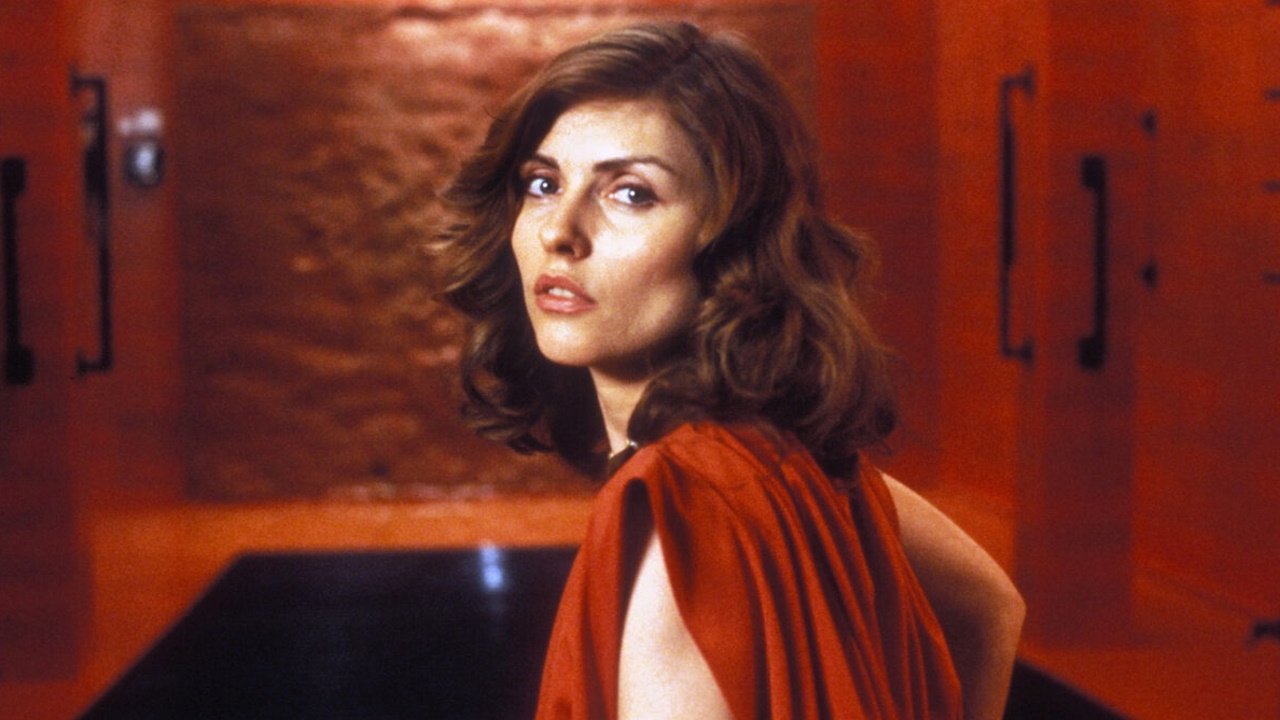
When Nicki casually asks Max if he's got any porno, it marks some brave new territory for depicting how people date in movies. Nicki's discovery of a videodrome cassette almost makes the scene darkly comic, but the scene is remarkably revealing about how a wider variety of sexual activities became available to people's vicarious viewing with the home video revolution of the early 1980s. This scene occupied most of two entire days on set, November 25th and 26th. Everyone knew it was a key scene. As Mark Irwin's camera glides in, we almost feel as if we have intruded upon this scene of lovemaking. The room changes from cool, telegenic blues to a red pool in the center of the floor. It's the red we associate with the pizza stain on the Samurai Dreams still, with Nicki's red dress, even with her name, which carries associations with nicks and brands, abuses of the flesh,
It's also the red of the Videodrome set on the television screen, so they are literally being bathed in the signal. Just before this film was cast in July 1981, Debbie Harry released her first solo album, Cuckoo, whose cover, designed by the Swiss artist H. R. Giger, showed her face being horizontally penetrated by four skewers. That cover may well have influenced Debbie's casting and the directions taken by Cronenberg's screenplay. from the ear piercing to the metallic tendrils we later see attaching Max's gun to his hand and wrist. Debbie herself told me that having Videodrome follow her collaboration with Giger felt to her like, quote, a very strong coincidence, unquote. Until I came into possession of Michael Lennick's call sheets for Videodrome, I assumed that the ear piercing we see on screen was real, but the call sheet for November 26th specifically calls for bleeding earlobe makeup.
This film dates from the earliest days of the AIDS epidemic, and it's unlikely that the shot of Max licking the blood from the needle would have been permitted by a major studio picture even one year later. Jimmy and Debbie are both outstanding in this scene, which is genuinely erotic, as so little in mainstream North American cinema is. In America, the MPAA objected to how long James Woods was shown with a leg physically between Deborah Harry's legs in terms of seconds. To abbreviate the shot to a length the MPAA considered acceptable, Cronenberg and editor Ron Sanders inserted a dissolve that allowed the shot to get to the point prematurely.
Notice that the interior corridors of the Civic TV offices are adorned with framed posters for movies like Up from the Depths, Screamers, The Evil, and Deathsport. All of these films were originally distributed by Roger Corman's New World Pictures, who had handled the North American release of Cronenberg's Rabid, starring the hardcore porn actress Marilyn Chambers. These same films were released in Canada by John Dunning's Cinepix Film Properties, who had distributed his first feature, Shivers, in 1975. so these films embody at least two different professional relationships for Cronenberg. When Bridey announces that Masha is waiting to see Max, she gives her the Polish surname Borowczyk, a name check of the Polish filmmaker Walerian Borowczyk, a former animator who made films of historical erotica like The Art of Love, a film that looks something like Apollo and Dionysus, the program that Masha is here pitching.
You may notice in this film a clash of sorts between the classical and the contemporary, the medieval and the modern, the Renaissance and the Renn. It's even present in the names of the characters. Names like Raphael and Moses clash with those of O'Blivion and Convex. Lynne Gorman, who plays Masha, was another player who finished her role before I arrived on the scene, so I can't offer any personal memories of her. She was primarily a stage and television actress. This is one of her relatively few roles in a feature. Her other important screen role was as the female lead's mother in Don Owen's 1964 film Nobody Waved Goodbye, a Canadian precursor of films of rebellion like Georgie Girl and Morgan, a suitable case for treatment. She was 60 or 61 when she made Videodrome, and she died in November 1989 at the age of 69.
Here, Masha is about to pose a series of questions to Max about the possibility of his becoming a producer. And they subtly turn the direction the film is taking momentarily away from Max's search for the source of the Videodrome signal to the inward, toward Max's more important search for himself, for his own individual code of morality, if he has one. If you're looking for a double-bill suggestion for Videodrome, try Marco Ferreri's Tales of Ordinary Madness, also released in 1981, making it ripe as a source of influence. Based on the book by Charles Bukowski, it shares some of this film's fascination with the protagonist as derelict, and Ornella Muti's character of the self-destructive hooker Cass has a lot in common with Nicki Brand. Also like this film, it ends by the seaside. On the set, Debbie Harry was considerably less accessible than James Woods. She didn't really pal around with the crew.
She would chit-chat a little, but this was her first big movie, and she was intent on doing her best, so she was very focused on memorizing her lines, which, when she was sitting down, she kept under her rump on index cards. Between scenes, I would see her off in a corner, trying out different line readings on herself. She was the only participant I didn't get to interview on set because, well, to be honest, she kept breaking appointments and putting me off. On the last day, I decided to just let it go and spend my last couple of hours on the set enjoying myself. And wouldn't you know it, that's when you-know-who sidled up to me and asked if I felt like doing our interview now. I begged off, telling her that I was out of work mode, and she turned on the charm full blast. I'll tell you, having that million-dollar face look at you with a smile turned up to ten, that's a memory you can take with you to your deathbed. But I stuck to my guns.
We ended up doing our interview by telephone, and she couldn't have been nicer. She kept me off balance on the set, but I ended up liking her a lot. I had already been a fan of hers for years. I had seen Blondie open for Iggy Pop on their first U. S. tour, and I found her to be funny, smart, and a serious professional. Unfortunately, her work fell victim to the film's being so extensively rewritten in the editing room. You know, every shot of Debbie that was included in Universal's official still set was from a scene that had been cut from the picture. It was not her fault. The real problem was that the film had to go before the camera before there was a finished script. And as David and Ron Sanders rewrote the picture in the editing room, Debbie's scenes tended to be those that pointed the way to narrative directions no longer taken. But she figures in a number of Videodrome's most memorable scenes.
People tend to see this Greek restaurant scene, which was shot at a place called Costa's on Halloween 1981, and think belly dancer. But this dancer, Franciszka Hedland, isn't showing her abdomen. What she is doing is closer to Armenian folk dancing. Though Max Renn isn't written or portrayed as a man with any sense of the past, of his own personal history or national identity, Masha clearly has a sense of all these things. and it's brought to the fore in her choice of this restaurant for a meeting place. It's very old world, and Masha seems to breathe it in like a rejuvenating aroma. Max breathes in the same world, and deduces that it's a shithole. Max doesn't have this sensibility. He is without, as Masha puts it, what the power behind Videodrome has, namely, a philosophy. Max has no moral imperative, and can't understand why any political system...
would televise torture when it's easier and cheaper to fake it. Masha's lighting of the cigarette brought Max back to his memory of Nicki's challenge, and it should be pointed out that Debbie Harry now disappears from the film for roughly ten minutes. There were reportedly preview screenings where she dropped out of the film for significantly longer. Now that I think of it, isn't it possible that the real Nicki never comes back? How can I say? 40 extras were hired for the filming of this scene. What are we talking about? Videodrome.
What you see on that show, it's for real. It's not acting. It's snuff TV. I don't believe it. So, don't believe. Why do it for real? It's easier and safer to fake it. Because it has something that you don't have, Max. It has a philosophy, and that is what makes it dangerous. Whose philosophy? There must be a name. Give me a name I can talk to. Masha, Masha, you know me. I stay away from the scary stuff.
You are going to have to be nice to me for this. We can take a shower together. Anytime you say. I'm sure you would be very beautiful. But you're a little older than I prefer. Thank you. So much.
Tell me a name and I'll make Apollo and Dionysus part of the package. That hurts me, Max. Hey, the world is a shit hole, ain't it? Yes, Max. It is. Brian O'Blivion. That is the only name I have to give. Professor Brian O'Blivion.
The building that we see here, identified as the Cathode Ray Mission, was the main sound stage used by the production. There were no red lights or soundproof doors and people had to be cautioned by bullhorn not to flush toilets during a take. It was a disused building, a former underwear factory, I was told, at the corner of Bathurst and Adelaide Street West in Toronto. 125 Bathurst was the official address. Today this door is the entrance of Toronto's Factory Theatre. What we see inside the Cathode Ray Mission is the true interior of the same building, the space which looked very much to me like an old elementary schoolhouse complete with a playground area outside. served not only as the interiors for the mission, but as the sound stages for a good deal of the remaining film. I assume this ground floor interior forms the auditorium of the factory theater today. For the first week I visited the set, this area was dressed exactly this way. Before I arrived, Max's apartment was erected here. For the second part of my visit in March of 1982, the spectacular optical stage from their trade show, which I'd first seen in December in a ballroom at the Constellation Hotel,
was rebuilt here. When Mark Irwin filmed the reverse angle of the shot of Jimmy walking around behind Jimmy's back, my wife Donna and I were watching the filming from the mezzanine up above. Knowing that the camera wouldn't pick it up, Jimmy looked up and winked at us, which is a very sweet memory. Now the film introduces Sonja Smits as Bianca O'Blivion. I didn't notice this while I was observing the filming, probably because Sonja was a very attractive lady, and I understood that she was playing a businesswoman. But Bianca's hair and manner of dress are decidedly masculine. Viewed from this distance, her hair looks much like David Cronenberg's at the time, in fact. And as I'll discuss shortly, Bianca is David Cronenberg to an extent, and not just to the extent that all of one's characters represent their author.
Bianca's office, which occupied the Mezzanine area I spoke of a moment before, was dressed by Carol Spier's team to suggest a similarly old-world sensibility to that of Masha. Bianca's manner toward Max is decidedly cold and harsh. Like that initial civic TV signal, she's a cool medium, to borrow a phrase from Cronenberg's fellow Torontonian Marshall McLuhan, and she speaks in McLuhanisms. when she says, for example, that hooking the city's vagrants into television programming will patch them back into
the world's mixing board.
But notice the warmth of this office, the warmth that emanates from its books, its objets d'art, its atmosphere of culture, whatever Bianca's ultimate means or methods. This is what she is fighting to defend, and Max, with his lack of tradition, his lack of couth, is very much an affront to it. I guess you encourage Father's derelicts to make home movies?
The world's mixing board? Professor O'Blivion sends video letters all over the world. Is the professor here? I am my father's screen. Once you've told me what this little visit is all about, he may choose to send you a cassette.
So many quotable lines in this sequence.
My father has not engaged in conversation for at least 20 years. The monologue is his preferred mode of discourse. Format. Videodrome. Is that a Japanese configuration? You've never heard of it? No. Then there have been serious gaps in your education. Videodrome. Mention it to your father. You may want to have a conversation. I love the view.
The Videodrome set itself was a very amazing construction to stand on. We had to walk on it in our stocking feet so as to not mark it up with our shoes. Carol Spier told me that it was painted a particular shade of red that was reputed to have driven prisoners of war deranged under steady exposure.
I'm going to audition. I was made for that show. It has something that you don't have, Max. It has a philosophy, and that is what makes it dangerous.
In the words of Humbert Humbert, Hey, a gun! It appears almost as a non-sequitur. There's no scene explaining how or why Max acquired this gun. It appears in his life as mysteriously and suddenly as a prize that players are given as they advance to the new level of a video game. It's a Walther PPK, James Bond's gun, which adds to its fantasy cachet. Perhaps it has appeared because Max's prolonged exposure to Videodrome is not only bringing his aggressions to the surface, but manifesting them as metal, while working its way up to manifesting them as flesh. Julie Khaner is excellent in this scene, making me wish that she had more to do in the picture. When she comes close to having physical contact with the Videodrome cassette, Max quickly intervenes and slaps her repeatedly. incarnating, if you will, a scene from Videodrome. But it's only an hallucination, which we understand before he does because Bridey briefly intercuts with Nicki, who is presumably now in the clutches of Videodrome and being beaten senseless, if not lifeless. You could say this moment momentarily changes the channel of reality that it foreshadows what we are later told of Nicki's actual fate.
At the end of the 1980s, Julie Khaner became a five-year regular on the Canadian series Street Legal, which starred Sonja Smits. Sonja joined the show when it started a couple of years earlier. Julie left a couple of years after Sonja, and they both did in excess of 80 episodes. She's still active in films and television, and on Twitter, where she likes to rant about different sports teams.
I was in a deep sleep when you knocked, and I guess I'm still not out of it. I'll remember to set the timer. Don't worry. You're sure? I'm sure. Are you sure? Yeah. Thanks, Bridey. Tomorrow. Max, that other cassette is from the office of Brian O'Blivion. I promised I'd hand deliver it directly to you. Will you call me if you need me?
The breathing, throbbing videocassettes seen in this film were the work of Bill Sturgeon, a member of Rick Baker's EFX Inc. company, whom I remember as very tall, very shy, and probably in his early 20s, if not younger. Yet he had already worked on The Howling, An American Werewolf in London, and John Carpenter's The Thing. The cassette was fashioned from a latex product called Hot Melt that was poured into a mold and hardened in layers over small bladders placed inside. The bladders were inflated by different EFX guys blowing into secret tubing. EFX was a remarkable phenomenon. Rick and Elaine Baker had become like adoptive parents to a group of super-talented young men who had followed Rick in his footsteps. Mind you, this was before his work began to win Oscars and attract international attention, when his name was found buried on screen in the credits of movies like Schlock, It's Alive, and Squirm.
and whose contributions the Dino De Laurentiis King Kong tried very hard not to acknowledge. Rick was giving back to these kids who looked up to him what he had received as a young man from industry mentors like the great Bob Burns and the legendary Dick Smith. The EFX guys were ridiculously young but intense and super talented. Whenever I paid a visit to their workshop, they always had reggae playing on a boombox. After Videodrome, EFX went on to work their magic on Michael Jackson's Thriller video. Though individual members have continued to work with Rick over the years, EFX seems to have discontinued as such after Rick and Elaine Baker divorced in 1984. Rick Baker designed the Teleranger television set and also the Flesh TV scene later, which bears the brand name of Videodrome. He assigned the actual job of manufacturing them to Bill Sturgeon and Kevin Brennan. The TVs were essentially more elaborate versions of the flesh cassette, a large, intricately bladdered foam latex casing with a central hollow to house an uncased television screen. Baker's team worked closely here with Michael Lennick's video crew, who controlled the monitors inside those latex casings.
O'Blivion tells Max that his reality is already half-video hallucination, which is also a cue to us about how much we should trust what we are being shown. He tells him this shortly before a hooded torturer walks up behind him and garrots him. The torturer then unmasks to reveal Nicki. This was Deborah Harry's first scene in the picture. We later learn that she has also died on Videodrome, which communicates the idea that Videodrome may not be snuff TV so much as what William Burroughs called death TV. These are ghosts, and Max can see and hear them because his own cancer has taken him at least halfway to where these dead souls reside. What we're seeing here, essentially, is an hallucinatory metaphor for a masturbatory experience, which the array of joysticks atop Max's teleranger seems to underline. We must remember that when this film was made, the home video experience was only beginning to make its way into most people's homes.
And with that private access to motion pictures and pause and rewind buttons came the therefore undreamed of ability to use films as masturbatory aids. If we're being honest with ourselves, this aspect of home entertainment probably had a great deal to do with why home video caught on in the first place. The bladders inside the TeleRanger were controlled by Frank Carere, a special effects technician who hooked up the tubing from the bladders to an ingenious keyboard device that functioned hydraulically. At this point in the effect, the actual TV monitor has been pulled out of the casing and replaced with an elastic dental dam screen, on which the image of Nicki's mouth was rear-projected from a 16mm projector positioned behind the set. So there's no video noise on the image, which is in keeping with the in-room immediacy established by Professor O'Blivion's voice earlier. Jimmy Woods told me in a post-mortem interview that he felt kind of stupid doing that scene, but he really sells it, and it's one of the scenes that makes this movie the important achievement that it is.
As the screen begins to billow out, which was achieved by means of a bellows also positioned behind the screen, the film takes a still bolder step toward the surreal, and Max pushes his face into the billowing mass of soft tissue. Cronenberg makes literal the glass teat that Harlan Ellison wrote about.
I got to observe Sonja Smits playing this role for several days before I got the chance to actually sit down and interview her, and she was quite a surprise. In character, she was so cool and officious that I remember having the impression that she was older than me. But she turned out to be a couple of years younger. Also, much warmer and funnier. She dressed in bright colors and had long, flowing hair, which was meant to be seen in later scenes where Max began to see through his hallucinations of Nicki to the core image of Bianca controlling them. so her casting was probably predicated to some extent on a plausible resemblance to both Debbie Harry and Julie Khaner, though they actually hardly blur at all in the final cut. Sonja was born in Ottawa Valley, Ontario in September 1958, and she has had her most lasting success in television, where she has worked steadily in such series as Falcon Crest, Airwolf, Odyssey 5, and Street Legal, for which she's won a Gemini Award.
and she currently stars in The Best Laid Plans, in which she plays the Prime Minister. She's married to Seton MacLean, the co-founder of Atlantis Films, with whom she owns a farm and a winery. Her performance as Bianca O'Blivion was nominated for a Genie Award in 1984.
But the videodrome signal, the one that does the damage, it can be delivered under a test pattern, anything.
The signal induces a brain tumor in the viewer. It's the tumor that creates the hallucinations. Do you let me watch it? I expect them to come to me eventually to hurt me. I thought it might be you. Now I realize you're just another victim. Just like father was. Where's your father? I think I'd better talk to him. He's in there.
I'm afraid he'll disappoint you.
As Max and Bianca enter this connecting room, Bianca says, this is him, as the camera pulls back to reveal something that few of us had seen in 1981, but which became all too familiar over time, a video library. In the course of covering Videodrome for Cinefantastique, I had the opportunity to visit David Cronenberg several times at his home. During the interview we had in his home office after I'd seen the film, it became very apparent to me that Brian O'Blivion was David's own father, Milton Cronenberg, a Depression-era bookseller who turned to writing for Canadian monthlies and pulp magazines since the 1940s, including Liberty, Famous Crime Cases, and Greatest Detective Tales. David wrote his screenplays literally surrounded by the personal library of his late father, who died of cancer in 1973. a grueling process that admittedly influenced his cinematic interest in the human body, disease, and aberrant biology. When I mentioned this to David, he initially thought I might be making unfair use of my personal knowledge of him in my criticism and analysis, but then he added that he forgave me because he thought what I'd said was absolutely true and not something that he had consciously considered.
Sonja Smits never actually works with Jack Creley in this film, but some years later, they got that chance in the very first episode of Street Legal, Birds of a Feather. Jack Creley died in Toronto on March 10, 2004, at the age of 78.
Have you been hallucinating lately? No. Should I be? Yes, you should be. of the growth in my head. This head. This one. Right here.
We see that Max has taken to wearing a shoulder holster for his Walther PPK, while receiving further instruction from Videodrome's first victim. In what seemed like another non-sequitur, Max mentioned earlier to Bridey that he thought he was developing a rash, and we now see him absentmindedly scratching a vertical rash on his stomach. Here we have a complementary masturbatory metaphor to the earlier one, which was penetrative. This one is receptive. When Max begins to scratch his itch with the nozzle of his gun, the rash suddenly ripens into a vagina of the viscera. This was a full-body foam latex appliance that covered the actor, who was ensconced within the sofa at a roughly 45-degree angle with only his head and arms exposed. The engorgement of the appliance was achieved by a couple of EFX guys blowing into tubes behind the sofa. This scene was originally written to take place in Max's bathroom, in his bathtub, but I was told that the actor had some serious qualms about sharing bathwater with a live television set, even though it had been thoroughly waterproofed.
Even so, Jimmy Woods reportedly hated this experience, and later said that regardless of the brilliance of Rick Baker's work, he would never work again with elaborate makeup effects prosthetics. And as far as I'm aware, I think he's kept his word. Some 30 years further on, this is still a very convincing effect. Max's legs were puppeteered by rods. Rick Baker felt that the illusion was destroyed somewhat when Max stands up. Jimmy Woods had to wear a false arm glued to his abdomen at the wrist, his real arm stuck behind his back. The false arm, which was the work of EFX member Shawn McEnroe, was convincing on its own, but in proportion to the actor, it looked a bit too thin. It's a startling thing when Max loses the gun inside his own body, but is it really more startling than the way the gun first appears? It's an hallucination provoked by the brain tumor instilled in him by Videodrome. But there is meaning to it, as has been known to happen to other people with brain tumors, from the Texas sniper Charles Whitman to the Dead Zone protagonist Johnny Smith. Max is being programmed by his cancer to become an assassin.
James Woods acted this scene believing that Nicki Brand was on the other end of the line. An alternative cut of Videodrome exists, shown on American television, that is appalling in nearly every way, but which contains a number of deleted scenes, including this scene, as it was going to unfold at one time. In this version, Nicki asks Max how he liked her video love letter and confides that she knows what is happening to him. She suddenly appears on his television screen using a red telephone that matches her red dress and tells him to come to her. Night flight to Pittsburgh, he deadpans. She tells him that she's waiting downstairs. Max is reluctant to
come to Nicki
again, so Brian O'Blivion appears on the set to say that Max came to him at the point when physics became philosophy, and now they've reached the point where philosophy becomes flesh. Feeling that things are about to get real, Max goes downstairs and finds Nicki awaiting him in a limo. She's now something of an ambassador or agent for Videodrome, telling Max that the people behind Videodrome were excited by his interest, that what he saw was a test signal meant to make its viewers trip out and hallucinate. She regrets that it doesn't work on everyone, and apparently doesn't work on her. When Max tells her she might not like it because he doesn't feel very stable any longer, she replies that she's never been the most stable person to begin with. Hasn't he noticed?
The limo then pulls up outside the storefront of Spectacular Optical, which was shot on location at 728 Queen Street East in Toronto. When Les Carlson made this film, he was a familiar, beloved character actor who had been active in Canadian features and television for some time. In fact, both he and Jack Creley had provided voices for the 1960s animated series Marvel Super Heroes. And while this film was still in production, he played the Christmas tree salesman in Bob Clark's perennial A Christmas Story. But there's something wonderfully oily about his presence as Barry Convex. And for a while, he became to David Cronenberg what Dick Miller has been to the films of Roger Corman and Joe Dante. He went on to play the newspaper editor in The Dead Zone, an obstetrician in The Fly, and he appeared in an episode of the series Scales of Justice that Cronenberg directed. In the year 2000, Cronenberg gave Les the lead role in an experimental short entitled Camera.
Les Carlson died in 2014 at the age of 81. The interior of Spectacular Optical was built on the basement floor of 125 Bathurst. I always get a strange feeling when I see this scene because I can remember vividly standing off to the side as it was being shot, and as we were all implored to do, avoiding eye contact with the actor. When Jimmy looks from side to side upon entering, I can still feel his eyes pass over me as if I wasn't there. My wife Donna reminded me that there was a payphone on this set, and that during the scene blocking, Jimmy asked David if he might go over to the payphone and fish around inside it for loose change. David vetoed this idea, but as I look back, I think Jimmy must have been inspired by Roger Corman's cameo in Joe Dante's The Howling, which was in theaters around this time. Roger is briefly seen in the film, waiting to make a call in a telephone booth, and when he gets inside, he fishes around in it for loose change.
It's a nod to his reputation as what Mark Thomas McGee called the best of the cheap acts. If we think back to the offices of Civic TV with all the Roger Corman posters on the wall, they combine well with Jimmy's proposed ad lib to suggest that Roger Corman and Not City TV's Moses Znaimer might be the real role model for Max Renn. When Barry Convex refers to the eyeglasses that Max is wearing as machinery, It's a great Cronenbergism that forces us to consider something we take for granted in a different light. It also prefigures this piece of machinery that Barry has in mind for Max to wear, which will definitely overwhelm him. When we cut to the Accumicon helmet being removed from the box, the film skips over another deleted scene that was included in the TV version. It had Barry explaining to Max that he started out as a lens grinder, but graduated to developing lenses for a special optical accumulator intended for military use. It created images where the physics books said no images could exist. In simulated combat conditions, soldiers began to hallucinate images that were not there, images of their own projection, as it were. He implies they were violent, but that's all he says. They're classified.
but he wants to record some images that Max might project, which is where this helmet comes in. It's a recording device. The reference to test subjects has no point of reference in the final cut. Barry also tells Max that he seems to be functioning reasonably well in hopes to find out why, which also doesn't quite make sense here, because if you're paying any kind of attention, Max has become something of a mess. Perhaps this scene was originally written to appear at an earlier point in the story, when Max first began to hallucinate in a milder key. One of the interesting side effects of this backstory is that it introduces the possibility that none of the tortures we've witnessed in these Videodrome broadcasts actually happened. They may have been recordings sampled from other people's hallucinations. Brian O'Blivion's, for example.
The video crew, Michael Lennick, Lee Wilson, and Rob Meckler, were responsible for these subjective shots, which are deliberately mosaical. They were shot on video, made to look deliberately harsh in color and texture on a high resolution Barco monitor, and filmed in 35 millimeter off of the monitor screen. Yeah, yeah, yeah, that's fine. Okay, we're rolling.
Taping mechanism is all self-contained. You don't have to do anything now but hallucinate. Yeah, yeah, okay. I'll come back for you later. You'll forgive me if I don't stay around to watch. I just can't cope with the freaky stuff. I just can't cope with the freaky stuff.
One of Les Carlson's most quotable lines in the picture. He was actually nominated for a Genie Award for Best Actor in a Supporting Role for Videodrome, as was his partner in crime, Peter Dvorsky, but they both lost out to Michael Zelnicker in that cult film to end all cult films, The Terry Fox Story. The Accumicon helmet was described in Cronenberg's script as being bizarrely beautiful, like a modern techno-interpretation of a medieval piece of armor. It was constructed by Tom Coulter, a Montreal-based artist who had provided the sculpture seen in Cronenberg's previous film Scanners. It was built in fiberglass studded with EPROMs, luminous micro-digits that were in fact being used in military research at the time. Jimmy Woods refused to wear it. I was told the reason at the time, but I can't remember now if it was claustrophobia or something about the weight of the prop putting too much pressure on an old neck injury, but he wanted no part of it, so David Cronenberg sat in for him in the shop with the camera pulling away for Max on the chair.
Rick Baker told me that he had originally designed the Flesh TV to have a paunch and love handles, but this aspect of his design was vetoed as looking too comic. This scene actually gives us the best look at the Videodrome set itself that we get in the picture. The clay wall that we see at the back of the set was going to play a prominent role in the final shot of the movie.
As Max whips Nicki, a shock cut reveals Masha on the screen. It's a foreshadowing of her fate. This scene... of Max finding Masha dead in his bed always struck me as something of a wrong turn, because it basically leads to four narratively empty minutes of film, and there is no inquiry into her death or disappearance because the narrative becomes so utterly absorbed in Max and his plight. But we must remember that this film was literally being written on the spot, at some point early in my first week on the set, in December 1981. My wife Donna and I were taking pictures of David in his Winnebago, and he suddenly turned to me and said, Tim,
I don't
have an ending for this movie. Why don't you write one? It would have been a great opportunity, but I'd been so busy with observing and interviewing, I hadn't yet had time to read the script from beginning to end. The production wouldn't send a copy to me in advance because everything was very hush-hush. If you've ever seen Mick Garris' interview special, Focus on Fear, you can see Cronenberg on a panel with John Carpenter and John Landis. and he gives them the most basic logline of the film and stops the show cold with the sheer brilliance of the idea. So it had that effect on people, and the idea had to be carefully protected. I was only permitted to be on set because Cinefantastique guaranteed the production that our coverage would not reveal anything sensitive until after the film had been released. The problem with Videodrome was that its Canadian producers Victor Solnicki and Pierre David evidently made their alliance with Universal with a release date attached,
So the film was greenlit before there was a script, and Cronenberg had to jump right into the saddle before he'd had a chance to fully unwind from Scanners and its promotional tour. Michael Lennick, who became one of my closest friends, once showed me a stack of multicolored script pages from this project, and it literally rose from the floor to just under my knee. Even the script in hand when I arrived on the set was substantially different to the one that got filmed. One of the things that the script proposed as Max began to lose his footing in reality prior to the heavy-duty hallucinations was that his environment would begin to, quote, twitch video, unquote, as the script said, and it would deposit traces of video dandruff on his clothing. This was a clear instance of something that wasn't quite within practical reach of special effects at that time on his budget.
If it had been done, the look of this effect at this point in time would probably have dated the film badly. But it was an adventurous idea, and the kind of thing that was soon easily within the reach of digital effects. This film, we must remember, dates back to analog time. There was to be an additional scene that would have confirmed Masha's status. It was set in Max's bathroom, where he was running a bath and staring at himself in his medicine chest mirror. The mirror was supposed to flicker suddenly with video-like noise, and suddenly the room reflected behind him was going to be the videodrome set with a couple of hooded torturers noticing him and walking menacingly in his direction. Would have been a great moment. Then the image was to flicker and disappear once again. Max then decided against his bath and reached into the bathwater to pull the plug and flinched as he felt something underneath, at which point the Flesh TV was to make its next appearance, arising Botticelli-like from the bathwater.
Masha was going to be on the screen, explaining to Max that she had been killed by Videodrome for leaking Brian O'Blivion's name. This was a rewrite of the scene I described earlier, which would have excused James Woods from the bathwater, and still allowed the video crew their moment of glory. Michael Lennick and Lee Wilson, with the help of David Stringer, had worked out a reliable means of waterproofing a working television set, but under pressure of a looming deadline, it was determined to be a false turning point in the story. and was eliminated on Friday, December 4th, just a few days before it was due to be shot on December 9th. Michael believed the effect would have been a career maker, one of the most impressive effect shots in the movie, and he looked back on the day it was cut as Black Friday. He estimated that the effect would have cost the production a whopping additional $3,000, but it wasn't just a factor of cost. We're now back at the 70 Crawford Street location. This was...
one of the key scenes in the film where Max discovers that Harlan was planted in his employ by spectacular optical to gain his trust and slowly introduce Videodrome into his awareness. Peter Dvorsky plays the scene so well that we easily accept this abrupt about-face in his character. But there's also something of caricature about the level at which this scene is pitched. It's unlikely and surreal and satirical all at the same time.
When Harlan calls in the reinforcements by introducing Barry Convex into the equation, the scene becomes even more surreal. Indeed, at one point, Max has to ask the two of them point-blank whether or not he's hallucinating now. On the basis of what is about to happen, which is the first domino in a whole sequence of events, there is really no doubt that he is hallucinating. The questions are, when did this storyline become hallucination? And for what events in reality do these hallucinations serve as metaphor? In a sense, what we have here is Max Renn, a man who embodies underground or countercultural interests, who has reached the point in his own success of attracting a hostile corporate takeover.
I don't
think it's entirely coincidental that these ideas came to the surface when Cronenberg was making his first film for a major Hollywood studio. We must remember that his earliest films were experimental, highly intellectual, and confrontational, meant to make viewers uncomfortable. In contrast to your average Hollywood director, he would have been seen as a radical. He called his first production company Emergent Films Limited, expressing a sense of emergency, and not just in the coming-out sense of that word. His first two features, Shivers and Rabid, depict a virulent source of infection. arising from one person to overtake a society and throw them into chaos, not just political or social chaos, but specifically venereal chaos. His films as a collective up to this point were very much about not just emerging, but merging. Indeed, the script I first read for this film followed Max's suicide with his rebirth on the Videodrome set, where he was to orgiastically meld with Nicki. basically finger-painting the room with secretions from each other's slits, with the camera slowly zooming past them to an agonized handprint on the clay wall at the back of the set.
I don't
think that ending was much welcomed by Universal, who insisted on an R rating, so Cronenberg's wild imagination was becoming increasingly curbed and redirected by the corporations that employed him, and which were essential to his continued forward movement. And indeed, the key to his continued forward movement was to begin internalizing his program, so to speak, to begin sublimating his messages, to package them in ever more commercially acceptable ways. Looking back, I find it truly amazing how calm David was able to remain on set, directing the film by day, and the days I was there in December were very long, somehow writing new scenes in his off hours, somehow almost always available to answer a question. At the same time, he had to be constantly aware that a major Hollywood studio was investing millions of dollars in his vision, a vision that he surely knew was unfinished and bound to be revealed as such at any moment. But he had a very devoted, admiring crew, and that counts for a lot. It was obvious that everyone there looked up to him as Canada's best shot at making international waves in the world of cinema, and he's more or less kept that promise.
Uh, we did record your hallucinations, Max. As I said, we would. And we did analyze them. You're ready for something new. That's terrific. What do you, uh... What do you want from me? I want you to open up.
The programming of Max by Barry Convex is depicted as a biomechanical rape. This effect was done in a variation on the earlier stomach slit scene with James Woods very uncomfortably positioned through a false door with a false body attached to him below his neck and shoulders for the length of time it took Les Carlson to shove the cassette inside. Oh my God!
Though the dialogue has Barry Convex telling Max that he wants to put Videodrome on Channel 83, as Max crawls out of the room, a voiceover recorded in post-production tweaks the meaning of the scene to say that Barry and the interests he represents want Channel 83 itself.
Give us Channel 83. Kill your partners. Kill them. Fill your partners and give us channel 83.
For these shots of Max reaching inside his abdomen to retrieve the cassette, effects inserts were filmed in the main area of the Cathode Ray Mission building, in a small mock-up of the corner we saw previously. The hand belongs to Jimmy's stand-in, Art Austin. Rick Baker's EFX company divided the script's special makeup effects demands among their top guys, and I remember this particular effect being conceived and engineered by a young fellow named Tom Hester. Tom had worked previously with Rick on An American Werewolf in London, and continues to work with him now and then, as well as independently, most recently as a character designer and sculptor on the Shrek films. Another member of the EFX team, Doug Beswick, machined the tendrils. which were forced through the hand mold with a system of push-pull cables. I remember that the effects guys weren't too pleased with the way the effect turned out. There was something about the fingernails and the way they caught the light in an unexpected way. It didn't look quite right, and the means by which the steel-like cables emerge and cut into the hand and wrist moved too erratically. Many takes were spent getting it to look acceptable, but they ended up going with the third take rather than spend more time on it.
This of course is a finished appliance.
Give us channel 83. Kill your partners. Kill them. Kill your partners and give us channel 83.
Here we see Max coming up the stairs at the Crawford location, the interior of Civic TV, newly programmed by Barry Convex to kill his partners. When I interviewed Rick Baker, he told me that the first draft of Cronenberg's script had Max shooting quite a lot of people with his flesh gun, including Masha and Shinji, one of the Hiroshima video guys. There is some subtle muttered comedy when he goes into his office and finds Rafe and Moses talking about a piece of foreign programming they are thinking of acquiring. Moses suggests that he might rewrite the shows and fix them in dubbing, which he feels qualified to do because he used to write in high school, before he, quote, lost it, end quote. As originally scripted, Max's handgun was supposed to fire an unexpected form of ammunition, gobbets of flesh that attached to the target's face and reduced it to a mass of cancerous tissues. This idea survived to the extent of having a head mold taken of actor Rainer Schwarz. Cronenberg then decided to film the scene as though it actually took place, though this decision prevented him from having the hallucination in reserve as a narrative option in the editing room. Max.
Cronenberg throws in a frisson when Bridey asks to see Max's supposed wound, which always reminds me of that moment late in Polanski's Repulsion when Ian Hendry sees the dead body, recoils, and then comes in closer for another look. This is the last time we see Bridey in the film.
As Max makes his getaway, he cuts across an alley where a couple of moving guys are transporting one of the film's many screen metaphors. James Woods's star was very much in the ascent when he made this picture. Born in Vernal, Utah in 1947, he had notable scenes in The Way We Were and Hickey and Boggs, but he didn't quite manifest the James Woods persona until the right role finally came along in Arthur Penn's Night Moves in 1975. Unfortunately, it was followed by additional years of TV movies. But his big chance finally arrived with Harold Becker's true crime classic, The Onion Field, in 1979, in which his performance as cold-blooded killer Gregory Euless Powell netted him a Golden Globe nomination for Best Actor. Then some terrific opportunities came his way, and he began to give bona fide star performances in movies like Eyewitness, Fast Walking, and Split Image.
He got Videodrome because he was in talks with the film's producers, Victor Solnicki and Pierre David, to star in a sexy mainstream picture they were planning called Models. But Videodrome was greenlit first, and Woods was curious to work with the director of The Brood. This is the door that most of us used to enter the Bathurst location. The area behind the camera was a fenced playground-like area. Jimmy Woods wasn't willing to play the scene of Max breaking through the glass window to gain entry, even though it was candy glass. He had survived a terrible childhood accident in which he'd fallen through a sheet of plate glass and nearly severed his hand at the wrist. So his stand-in, Art Austin, a great guy who also had a background in Toronto radio, elbowed the candy glass in his stead. Donna and I were absolutely charmed by Jimmy Woods, who respected Cinefantastique and went out of his way to be kind to us. He gave us a lift to our hotel one night, I remember.
What I remember most fondly about him was how he used his own energy and humor to keep the crew feeling up when things were going way into overtime. He suggested this bit where he approaches Bianca in the shadows and then steps into the light to say,
I don't kill people.
David and Mark Irwin loved the idea and were open to the suggestion.
So it was to be you after all. You've come to kill me. No. No, I'm Max Renn. I run Civic TV. I don't...
I don't kill people. Oh, but you do. You're an assassin now. A Videodrome. They can program you. They can play you like a videotape recorder. They can make you do what they want. And they want you to destroy whatever is left of Brian O'Blivion.
Now we see the full-blown flesh gun, as it was called. Although Jimmy had some other names for it, like the Pooperoo. He also said it looked like SpaghettiOs on a stick. They tested it so that it shot different kinds of ammunition, including something that approximated the aforementioned flesh gobbets, but what worked best on camera was a simple burst of Freon gas. Freon is very cold, and Jimmy, worrier that he was, fretted a bit about this frosty cold gas backing up onto his bare fingers. Naturally, Cronenberg had many things on his mind and tuned him out, so Jimmy decided to play a practical joke between these scenes. He asked one of the makeup people, it may have been Shonagh Jabour, a very quiet, shy, delicate little woman who drifted around in ballet slippers, to make up his fingers to look like they had severe frostbite and put the flesh gun back on. And then he complained to his director. Cronenberg looked at his discolored fingers with some genuine concern, but I imagine he asked if he felt up to finishing the shot. Anyway, Jimmy didn't let the joke detract unduly from the schedule, and the laugh re-energized everyone on set.
Here we have one of the most iconic scenes in the film, and it came together unbelievably fast. Cronenberg wanted a gun to emerge from the screen to shoot Max. The initial idea was to use another dental dam screen to help it press out through the elastic, but then the inspiration came to superimpose some video noise on the dental dam to enhance the illusion of it being glass. This was done by projecting 16mm footage of video noise directly onto the dental dam. The white screen was swapped out with a thin, skin-toned latex screen mapped with red and blue veins under the noise. Michael Lennick and Lee Wilson were able to fade the light down on the skin-toned screen so that when the two shots were cut together, it looks like the glass has turned into flesh. The three shots that hit Jimmy in the chest were the first bullet squibs that he ever used in his screen career, which we thought was surprising at the time. When I asked afterward how they felt when they went off, he told me they hurt.
Donna got some photo documentation of the red marks that they left on his chest as they went off, spanking his skin. She was standing so close to him that she got some flecks of the stage blood in her hair, which she was very proud of.
Long live the new flesh. Death to Videodrome. Long live the new flesh.
The spectacular optical logo was designed by Sherry Speer, the sister of production designer Carol Spier. This sidewalk derelict was played by Sam Malkin, who had a long and active career in Canadian features and television. His dialogue makes almost no sense, but the fact that he's using a battery-run television set to panhandle suggests that he's someone who's been to the Cathode Ray mission, and who has seen the light, and is taking the story of his salvation to the streets. On the night that previous scene in the Cathode Ray mission was being shot, I found myself standing beside David Cronenberg and I asked him what it was that made him write so often about derelicts. He shrugged his shoulders like he didn't really know and started to walk away. But then he doubled back and told me that a lot of artists end up as derelicts, like Herman Melville, for example. Then he added, maybe me too someday.
He may have said this because he was getting down to the wire and was worried about disappointing Universal and letting his crew down, but it was actually a revealing comment because quite a few of his films, Shivers, Dead Ringers, Cosmopolis, and Maps to the Stars, for example, not to mention his novel Consumed, all show a working-class kid's fascination with status and luxury. If you look at Cronenberg's films, you will find derelict characters like Cameron Vale at the beginning of Scanners. Nola Carveth in The Brood is a kind of derelict homeless until she's accepted under the wing of psychoplasmics. And here we get to the heart of the matter, because Cronenberg was inspired to write The Brood by the estrangement he and his first wife experienced when she became involved in some kind of religious cult. Cameron Vale, too, becomes the middle of a tug-of-war between ideologies. And Max Renn is another adept who finds himself alienated from his home, from himself, by two warring ideologies. So on one level, Cronenberg is still chewing here on something that had obsessed him since the brood. Very tricky grind.
Can't imagine you'd see things too clear without them, you know. But don't worry at all. I might get you fixed up in no time.
Where's Convex? Oh, setting up his trade show. Got to introduce the spring line. What's in the box? Your head. Got your head in this box.
You've been busy, Max. Been reading about you in the papers. Have you been to see Bianca O'Blivion? I saw her. And she give you any trouble?
Maybe you'd like to visit somebody else now. Is that why you're here?
Maybe. As I mentioned before, Bill Sturgeon created the various breathing and fleshy videocassettes seen in the film using a product called Hot Melt. The flesh cassette seen here was a more complex creation than the black one, because Bill had to layer veins and other biological textures into the mold. Hot Melt was too glossy in its substance to hold paint. Harlan's instruction to Max,
open up to me,
carries a far more sexual charge than Barry Convex saying I have something I want to play for you. Then Harlan repeats Barry's line like a second in command who has no real imagination of his own and can only imitate his higher up. What Harlan doesn't know is that Bianca has reprogrammed Max with the fleshed TV and can now use his abdominal muscles to grip Harlan's hand. and he can also spin them like a lathe, which chops his hand down not only to the likeness, but to the actual function of an old-fashioned potato masher hand grenade. The insert of the hand in the slit was filmed weeks after the main scene with Art Austin and set dresser Angelo Stea standing in for Harlan. Rick Baker told me that this scene was sort of left over from Cronenberg's first draft, in which he said it made more sense. In that draft, Max became so desperate to rid himself of the disfigured flesh-gun hand,
which in Cronenberg's imagination would have been more pointedly phallic with an actual foreskin nozzle, that he chopped it off, with the hand grenade then growing out of the stump of the handgun. The hand grenade appliance was designed by Baker and executed in foam latex by Kevin Brennan. Rick was very concerned that people wouldn't recognize the chewed-up result as a hand grenade, so a ticking sound effect was added in post. Frank Carere engineered the explosion. The scenes of the Spectacular Optical Trade Show were filmed at the Constellation Hotel in Toronto on December 16th, my first ever day on a movie set. It was an all-day shoot. 250 extras in this scene. You would not believe how much effort went into this choreography. The dance originally ended with two of the female dancers sliding down the arms of two of the male dancers. The finale had to be shot so many times for each camera setup.
that the spangled material of one dancer's garment had rubbed the skin on her partner's arm seriously raw, so they stopped doing it. Howard Shore's music throughout the film is extraordinary, but here he was basically writing a piece to mimic the music used as on-set accompaniment to the performance. And would Spectacular Optical have had good music at their trade show? The eye is the window of the soul is not a quote of Lorenzo de' Medici. It has no precise attribution, but it has been credited to Shakespeare, Cicero, Max Beerbohm, and others. Likewise,
Love Comes in at the Eye
is the second line of William Butler Yeats's poem A Drinking Song. Cronenberg told me that the quotes were deliberately false to suggest that Spectacular Optical was a very cynical, self-interested company that felt no guilt about bending facts to suit their corporate profile. which is one of those cases where yesterday's slight exaggeration becomes a bullseye prophecy of life as we know it today. When Les Carlson comes out, he originally had a line where he picked out an individual salesman in the crowd named Pete. Aye, Pete. Hence the later line, even Pete ought to be able to sell the hell out of a classy campaign like that, which has no setup in the final cut. ... Statesman and patron of the arts, Lorenzo de' Medici...
Love comes in at the eye, and the eye is the window of the soul.
I think that even... These shots of James Woods approaching the stage were shot in December. The reverse angle of Les Carlson recognizing and backing away and getting shot were filmed in March on the stage rebuilt inside the Bathurst location. Then, in an elaborate effect supervised by Steve Johnson, cables were run through the holes in the stage to a prop head articulated with push-pull cables... which split the head of Barry Convex open, allowing a number of puppetized foam latex cancers to burst through, with an appropriate volume of stage blood. Under the stage were ten people dressed in garbage bags to keep the overflow from staining their clothing, who operated the cables or the rods moving the dummies' arms and legs or pushed the cancers up. They were Steve Johnson, Elaine Baker, the foam runner at EFX. Costume designer Delphine White, who I remember removing her pullover sweater to reveal a t-shirt that said, Courage, my love. Video effects team Michael Lennick and Lee Wilson. Gaffer Jock Brandes, who held the coveted eye-popping syringe. Wardrobe master Arthur Rowsell. Set dresser Angelo Stea. Prop master Peter Lauterman. And me. I was the stiff's upper lip. Four Paniflex cameras were trained on the effect.
When Max grabs the microphone, Jimmy would set a lot of different things during rehearsal, like
death to videodrome,
SpaghettiOs on a stick. He was a riot. Cronenberg decided at one point, without telling the extras, to fire a real blank pistol toward the back of the stage to get their authentic reactions to gunfire on film. Some people weren't very pleased about that. I later found the blank casing lying on the stage, and I took it with me as a souvenir. I still have it. This exterior was shot at the Leslie Street Channel, and I believe this boat was called the Bayport.
Bugboat's interior was one of the most impressive sets that Carol Spier built for Videodrome. It's incredibly convincing. Everything that you see here was built inside a room on the basement floor of the building on Bathurst. I stepped in there and could not believe what Carol and her team had done with the place. When this footage was filmed, it wasn't known what message the Flesh TV was going to transmit to Max. At the time of filming, the idea was that Max would shoot himself with the flesh gun and arrive on the Videodrome set for an orgiastic finale with Nicki Brand, a scene that I suppose would have anticipated the shunting scenes in Brian Yuzna's Society. I believe at some point it was considered that Nicki would morph on the TV screen into Bianca, into Bridey, into Masha. They were all filmed dressed alike, their hair styled alike. But the idea was dropped. This meant that Nicki's original side of the conversation was no longer pertinent, and the footage you're seeing here became the last footage that Debbie Harry shot for the picture. It may well have been the last footage shot for the picture in its entirety sometime in the summer of 1982.
I was hoping you'd be back. I'm here to guide you, Max. I've learned a lot since I last saw you. I've learned that death is not the end. I can help you. I don't know where I am now. I'm having trouble finding my way around. I don't know where I am now. I'm having trouble finding my way around.
I imagine that David was just talking out loud trying to devise an ending for this picture.
haven't destroyed them. To do that, you have to go on to the next phase. What phase is that? Your body has already done a lot of changing, but that's only the beginning, the beginning of the new flesh. You have to go all the way now, a total transformation. Do you think you're ready? I guess I am.
To become the new flesh, you first have to kill the old flesh. But don't be afraid. Don't be afraid to let your body die. Just come to me, Max. Come to Nicki. Watch. I'll show you how.
Frank Carere was also in charge of the exploding TV effect, which shows a lot of fake guts being fired out of the flesh TV screen. The faux innards you see were made of sausage casings, granola, vermiculite, Cairo syrup, blood, and KY jelly. An earlier take was done using actual pig innards, but that didn't work out so well. We never do see Max light the fire in the makeshift brazier that we find in this tugboat, but it had an explanation in the proverbial earlier draft. Cronenberg would also end his next two pictures, The Dead Zone and The Fly, with his hero either committing suicide or proceeding into a suicidal situation in the presence of a loved one. This might also be arguably true of his fourth film in this sequence, Dead Ringers. It's important to remember that Cronenberg was the only English-speaking filmmaker of this period who was consistently successful, and those next three films of his were successful, at filming horror and fantasy stories as grand tragedy.
Videodrome was supposed to come out in January 1983, but got postponed when a Universal exec realized that they had penciled it into Super Bowl weekend. They wanted that football audience, so it was held back until February 4th. Alas, the postponement didn't help. On its opening weekend, Videodrome earned only slightly more than a million dollars, and box office returns plummeted yet another 52% in its second week, despite what Cronenberg called the best critical notices I've ever had on a film. The reviews weren't all good. Roger Ebert called it one of the least entertaining movies ever made. Can you believe that? But David Anson of Newsweek wisely wrote that even if the film couldn't be counted a complete success, it fails on a level that his, Cronenberg's colleagues would never attempt. David felt very complimented by that assessment. You don't always have to succeed. Sometimes the victory lies in making the attempt in raising the game, not just for yourself, but for everyone. If Videodrome doesn't ultimately tell a completely coherent story,
It does take us on a journey that evolves us as moviegoers. It makes us think in new directions, and it delivers more astonishing images than you'd be likely to find in any half-dozen other films of its kind, if it had a kind. Nevertheless, after two disappointing weeks in theaters, Videodrome was pulled from release and put into the fast lane toward that new graveyard of cinema, home video, where the film has prospered ever since. In 2010, Wired magazine included Videodrome on its unnumbered list of the 25 best horror films of all time. In closing, I'd like to thank the cast and crew of Videodrome for being so friendly and accommodating to me over those two weeks when I got to pretend I was one of their family. It's been more than 30 years, but so many of the names scrolling past in these end titles still conjure up faces for me, faces I can see, along with memories of the creativity and laughter on the set that I associate with them. I would like to specifically thank James Woods, Deborah Harry, the late Michael Lennick, Denise Cronenberg, Rick Baker, Mark Irwin,
and most of all David Cronenberg for all that they brought to this heady, educational, and transformative experience. When I was on the Videodrome set, Lou Reed's album The Blue Mask had just been released, so the memory of David Cronenberg is forever hardwired in my mind. To the lyric, he was the first great man that I had ever met. I'm Tim Lucas, and I'll see you in Pittsburgh.
Keep exploring
Other tracks with shared craft concerns
-
8 shared topics
The Lord of the Rings The Two Towers (2002)
Peter Jackson, Fran Walsh, Philippa Boyens
-
7 shared topics
Leprechaun (1993)
Mark Jones, Gabe Bartalos
-
8 shared topics
The Mummy Returns (2001)
Stephen Sommers, Bob Ducsay
-
8 shared topics
RoboCop 2 (1990)
Paul M. Sammon
-
8 shared topics
The Godfather (1972)
Francis Ford Coppola
-
6 shared topics
K-19 The Widowmaker (2002)
Kathryn Bigelow, Jeff Cronenweth