director
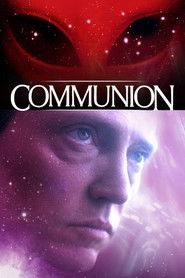
Communion (1989)
Release Communion Blu-ray (Scream Factory)
Mora and Birnes debate alien-abduction accounts, folklore, psychology, and the influence of Whitley Strieber's book. Mora discusses leaving open whether Walken's character faces an external event or an internal crisis. Production details include the decision not to show a spacecraft, the layered alien masks, and the five-million-dollar Los Angeles shoot. Mora identifies the marriage as the film's main concern.
- Duration
- 1h 46m
- Talk coverage
- 91%
- Words
- 15,341
- Speakers
- 2
Commentary density
Highlights
Topics
People mentioned
The film
- Director
- Philippe Mora
- Writer
- Whitley Strieber
- Runtime
- 103 min
- Also on
- OneSheet ↗
- External
- IMDb ↗ TMDB ↗ Find on Amazon ↗
Transcript
15,341 words · 25 flagged as film dialogue
My name is Philippe Mora. I produced and directed Communion. And I'm doing this commentary with a good friend of mine, William J. Birnes, who's the publisher of UFO Magazine and an expert on the subject of UFOs. And he's a distinguished writer in his own right. And rather than do the normal director commentary where I talk about myself all the time, and how I relate to the film, I thought it'd be interesting to discuss with Bill the whole subject of UFOs and alien abductions and how it relates to Communion. Communion was shot in 1988. That's 12 years ago. It's now February 2000. So a lot's happened since the book and the movie of Communion came out. And that's something that I think Bill can talk about. Hi, Philippe. I'm happy to be here. I am, as you said, the publisher of UFO Magazine, and I also wrote a book in 1997, which was published by Simon & Schuster and Pocket Books called The Day After Roswell with Lieutenant Colonel Phil Corso, who has since deceased. And it was one of these eye-opening experiences because the book and the process of writing the book, as I'm sure the process of making this movie
was an entree into a kind of community that was always there but was off your radar. And once a door opens and you see what's going on inside the community, you realize that there is a whole other world of experience that unless you're tuned into it, you don't know about. Bill, just broadly, what effect do you think the book and the movie specifically of Communion had in the broad culture generally on this whole subject? Well, what's so fascinating is how the movie, even more than the book, the book was a bestseller and basically aroused a whole level of near hysteria in some cases among readers who were Whitley Strieber fans from his previous fiction, but the book was fiction. But that... concern and focus and awareness and almost hysteria about UFO abductions was limited to a readership market. When the movie came out, for the first time a phenomenon which had been very widespread suddenly entered into our culture as a kind of a meme. And that's the funny, the interesting part about it. The movie created, inserted into our culture
an awareness of a process that, or an experience, that was as old as the ancient Greeks or even going back to the Bible. But now we've had a new terminology for it. What do you mean by a meme? A meme is almost a, it is a cultural thought. It is kind of a strand of DNA that gets into the mentalics of the culture and suddenly without any overt or explicit transmission, it becomes attached from person to person. And that's what alien abductions has become. And since this was the first movie, Communion was absolutely, I believe, the first mainstream popular movie, commercial movie, dealing with this phenomenon, it helped to create this awareness. Suddenly after Communion, alien abduction was something that people talked about as a fact. Before Communion, it wasn't. Well, let me tell you, you know, it's 12 years since I made the movie and I still objectively don't know whether UFOs exist or not or whether alien abductions take place or not. I'm perfectly prepared to accept that they can or have, but I certainly have no personal proof of it. But you're saying that this goes much deeper than specific incidents now. You're saying that this goes back
deep into other culture? Are you referring to things like Jung's archetypes where he referred to flying saucers and things as being these ancient symbols that are... Absolutely. Jung put this into a psychological perspective distinct from what... Freud would say about the abduction experience. You're dealing with sexual encounters. You're dealing with very deep-seated primordial fears. You're dealing with invasiveness, with vulnerability, with exposure. You're dealing with very deep-seated anxieties that arise at night. And if you look at this in terms of a Freudian archetype and a Jungian archetype, you see two distinct... archetypal approaches, but they both go to the sense of primordial experience. Well, it's very interesting you should say that, because Christopher Walken, I think, really took on the role, I should say, interpreted the role from the psychological point of view. And the bias of the film really was an ambiguous one. I really, as you can tell as the story progresses,
the Whitley in the movie has doubts about his own sanity. And they're not really resolved at the end of the movie. I mean, it's kind of a sophisticated form of writer's block. Am I being abducted by aliens, or do I just have writer's block? But Chris Walken's interpretation really was a psychological one. What really struck me about the movie, as distinct from the book, In the book, Whitley comes right out and says, it's a novel because this has to be a novel. Now, the motion picture, what you did in the motion picture was something very different. And not to try to be funny, but the way Christopher Walken played Whitley Strieber would have been almost like... Woody Allen's being abducted. He's a very introspective, angst-ridden New York writer who's suddenly confronted with an experience that not only is alien to his very existence, no pun intended, but his discovery of the nature of that experience in his life goes back so far, it fundamentally changes his attitudes. But he never stops being a culturally angst-ridden New York writer.
No, I think that's right. Christopher actually was very skeptical of the existence of the phenomenon in reality, and I think that helped his portrayal because Walken's character in the movie is actually much more skeptical than Whitley was at the time, as I recall it. But I think... It gave the film a lot of credibility because the more skeptical you are as you approach this, I think the more realistic it is. Well, in this shot right here, for example, one of the things that is so intriguing, and this becomes very important in the book, the lights that automatically go on, the sensor lights on Whitley Strieber's cultural property become precursors of a recurring event that becomes more and more horrific as as as the story progresses actually this cabin uh... is pretty close replica of uh... the cabin where these incidents took place and i slept in the actual cabin uh... i spent a uh... a night there when i was researching the film must've been nineteen eighty seven and of course i was thinking about the film so i was very primed and that night i had these nightmares uh... where i
Lights come on through the bedroom window and I saw alien faces. I saw a flying saucer over the swimming pool looking like it was sucking up energy from the water. I saw Whitley's wife running around the cabin saying, don't wake Andrew, their son. And I woke up in the morning, of course, and said to Whitley, oh, you know, I had this nightmare last night. And he said, I don't think that was a nightmare. But I think it was. But uh... one of the things in the dream was this light coming through the window which of course is these lights outside the cabin are triggered by deer rabbits that kind of thing so i think could easily be that but it shows you there's a fine line the way the momentum builds uh... the tension builds in the movie uh... just like the way the tension builds in the book it's interesting because you're seeing in the movie all the archetypal images of what will eventually become uh...
embodiments of horror, the circular shape, the oval shape suspended, the insect, because these creatures are, even though they're humanoid, they're nevertheless insect-like. But the funny thing about Whitley is how he translates those alien images into images deep inside him. So it's almost as though you get this customized alien. It's very interesting, too. Lindsey Krauss... at the time we made this film, was married to David Mamet. So she could relate to a writer having writer's block and strange problems, and I think it gave her performance a great credibility because Anne, as portrayed by Lindsay, doesn't really believe it could possibly be alien abductions. I mean, although at the end she has kind of an experience herself, but again, separating the... the film characters from the real characters, I think Lindsay's performance was very interesting because there was that dimension that she was married to a very famous writer. Exactly. And not only is he someone not really in the public eye, but his thoughts are in the public eye. So should those thoughts stray? Should there be, in Whitley's life, for example, where the line between fiction and nonfiction blurs?
Whitley's credibility as a fiction writer tends to suffer. Well, that was the reason for a lot of skepticism at the time the book came out, because a horror writer abducted by aliens has a certain ring to it. Right off the National Enquirer. In fact, when I tried to get the film set up at the studios, before it was a bestseller and after it was a bestseller, one of the comments... that kept coming back to me was, we don't want to do this because we don't believe it. Kind of a stupid remark because, you know, do you believe Raiders of the Lost Ark or any other Hollywood movie? But the fact that it was being pushed in the media as a true story actually inhibited people in committing to it. You're very right. Movies will... I mean, you will see studios throw $60 million at a Star Trek movie without batting an eye
because there is such a line a frame around the fiction but as soon as you suggest to somebody that this could actually be real now you're trying something you're actually yanking on a cord that you're not supposed to yank and that's what this movie does and does it quite successfully because here you go the lights are on it's night why are the lights being triggered exactly but you know um i think that um the fact and the fiction thing in film uh... as i experienced it with uh... communion became a really big issue i mean for me personally uh... when i read and i believe it's a book by uh... at doctor mac from how harvard jonathan mac jonathan mac on alien ductions and he had one case history in there i think the book was published i don't know ninety-five or something like that and but one of the case history one of the ladies in this said that she saw the movie communion and that that triggered in her
alien abduction memories. Well, I must say that really bothered me because it's a bit frightening when films start triggering psychological reactions. And we know film is very powerful. I mean, of course, that's a debate in the general culture right now in terms of violence. But this was certainly not a violent reaction. This was a deep psychological reaction, which she said was triggered by the movie. Communion was obviously part of this... culture of UFOs in film. And it does strike me since making the film that there really are, there's two strong threads in this. One is this folklore, this whole thing about UFOs and aliens being today's fairies and goblins and gremlins and the ghosts of hundreds of years ago. But then the other thing is More disturbing really is this whole thing that I guess started in 1947 with the Air Force announcing that they had captured a UFO in Roswell. I mean, they announced it. It was headlines worldwide. And the next day they denied it. And since then, there has been this whole controversy going to this day about what exactly happened there. That strikes me as not being folklore. That's based on real events.
and uh... obviously uh... there is the theory that the military uh... for various reasons wanted people to think that ufos existed assuming they don't they wanted people to think that ufos existed because they were testing their own weapons they didn't want to reveal that they had the stealth bomber they want to freak the russians out saying that they had superior technology was the cold war so how do we uh... get these two strands together When you go to Roswell and when you talk to Walter Hout, who still lives in Roswell, Walter Hout was the author of that famous press release, Army Captures Flying Saucer Outside of Roswell, which appeared in the Roswell Daily Record and all over the West Coast newspapers. So there really was no cover-up if what the Army captured was indeed a flying saucer. Or a spacecraft. We know now that it wasn't really saucer-shaped. Well, we know. How do you know in this, right? But didn't they retract it when you say there was no cover-up? They did retract it. What happened was the sequence of events were that if, in fact, there was a craft that was believed to be a flying saucer, that there was no cover-up because Blanchard, Colonel Blanchard, the head of the 509th,
um ordered walter how to write a press release and get the press release out to the media so on the west coast editions of all the newspapers the flying saucer story appeared without any qualification the next day this material was uh flown to um general ramey's headquarters back in texas eighth eighth air force eighth army air force headquarters because this was still an army air force unit the services hadn't split yet And the story goes, according to J. Bon Johnson, who took the famous photos, that, in fact, the actual debris from Roswell was laid out on the floor by Jesse Marcel. And Ramey was in his full... dress uniform not a formal dress but i mean his his his basic dress uniform in the middle of a texas july so i mean here it is it's mid-summer and there is ramey in this hot sticky humid climate walking out in a dress uniform what's that all about he this stuff which is basically junk debris it has sand on it some kind of gunk all over is laid out and suddenly ramey gets a phone call
goes in his office, takes the phone call, comes back out again, and he's no longer in his dress uniform. He's had his office, tie is open, and he says, get rid of this stuff, get rid of this stuff, quickly, quickly. And they get balloon material from inside a hanger, and they stick Marcel in the photo, and he has to pose with it. Now, that's the first story. And the next, and Ramey says, deny the whole thing, the thing is a weather balloon. Look, he's got a weather balloon. And hence, that was the cover-up. Let me ask you, you know, the communion figure, the almond-eyed alien, which is now pervasive everywhere in the culture from Bubblegum to South Park, were there any reports of what these things that were allegedly found at Roswell looked like? Absolutely. Contemporary reports? Absolutely. And are they similar to the communion? Yes, they are. We have... What purport to be eyewitness reports in our Children of Roswell issue in UFO Magazine, for example, we have three eyewitness accounts. One from an Army CIC sergeant who was there, he says, at the crash site, pulling bodies out of the wreckage. We have another woman who claims that her father was...
a contractor, a carpenter at the base, and he saw this creature being carried on a stretcher into the infirmary, or not the infirmary, the Hangar 84, the famous Hangar 84. He was being carried on a stretcher, and he saw it moving, and the creature looked up at him with these very sad, kind of hound doggy, basset eyes, and kind of transmitted to him telepathically, this is it, I'm wounded. Then you have a daughter, the daughter of a fireman who was The fire trucks rolled. There was a report of an aircraft crash, and these guys, they rolled out. They rolled out in the field trucks, as you know, out into the farmer's field, and this fireman took a piece of strange fabric, and he reported to his daughter that they were actually creatures that they pulled out, and they all seemed to have the same kind of poetic description. Whatever they were, they were not of this earth. Well...
You know, I always have this, I've got one nagging question in my mind. I mean, why would aliens look like human fetuses? I mean, and why do people continually see them looking like that? I mean, I kind of addressed that in the film with Whitley's support when we took away the mask of the almond-eyed alien towards the end of the film and revealed some other creature inside it. And then basically you go into... the Chris Walken, Whitley Streeper character's mind, and he's peeling away these layers. He doesn't really know what these things look like. God. He said,
now he looked at her, her eyes sad and scared. They looked so mysterious. Blah, blah, blah, blah.
Oof. God. This is going to
be so terrible. Another day down the toilet. What are you doing, Whitley? What are you doing, Whitley? Is your video on? Are you wasting time again, you devil? Hey, any of you warthogs seen my kid? Anybody seen Andy?
Does anyone
say something to you? No. Get into a fight? No. Is that Andy in there? Oh, yeah. Thought it was talking to a pirate. Everyone like your teeth? I don't like
this
spaceship anymore. It's ugly.
The little blue guys, too, strike me as kind of unreal. although a lot of people report seeing them. A lot of people report seeing that type of alien, as well as the Nordics and the reptiles, and there are something like hundreds and hundreds of different kinds of creatures that people who call themselves witnesses and abductees, experiencers is another word for it, report. I interviewed one woman who claimed encounters with a whole bunch of different species. um she loved the nordics there was a wolf man there are aliens that are purportedly kept at air force bases some fancy dress ball for aliens some schlep around wearing black berets i mean you really i mean you have enough aliens to fill anyone's um horror show of aliens and yet that concept of the alien as a fetus-like creature comes back to we have met the alien and it is us now when phil corso described the aliens via this Walter Reed army hospital pathology report on the dead aliens what he said was that these creatures were not life as we know it they were actually kind of electronic there were biological robots versions of androids that were capable of making long space voyages they didn't eat they didn't obviously eliminate they had and they simply were
They had a special kind of a brain to enable them to navigate the spacecraft by manipulating a magnetic wave or an anti-gravity wave. But they were not life. They were robots. You know, there's legal proof and then there's scientific proof. A legal proof... Well, an eyewitness is legal proof that people have been electrocuted... because of eyewitnesses in other words have been electrocuted with far less uh... it was far less evidence and is required to prove that ufos existed a lot of i would assume ufos of people still don't believe it where are we with the scientific evidence if at all if anywhere right now but there are two strands uh... first let's all let's jump over to legal evidence because uh... just the other day a very fascinating event took place, and I think it was in, I forget which district, federal district court it was, but in a federal district court in Phoenix, Peter Gersten, who is the head of an organization called CAUSE, Citizens Against UFO Secrecy, and he's a lawyer, and he is kind of a, he comes out of a whole New York prosecutorial background, successfully argued that the government, the Department of Defense,
was lying in a response to a Freedom of Information Act subpoena request because he, Whitley Strieber, could produce eyewitnesses and eyewitness testimony, sworn affidavits. And a judge heard this. Now, usually when a bunch of people trot in uh... wearing the various alien garb to court and say i was abducted by aliens most judges just throw it out they say this year you're crazy this is crazy i'm not going with this judge did was very different now maybe the judge is gonna throw it out later on ruling on a government motion for a summary motion for dismissal peter gersten uh... argued you know what your honor uh... we have all these eyewitness testimony how can they not have if we have the eyewitness testimony and the eyewitnesses are saying, we reported this to the Department of Defense, where did these reports go? And that logic struck the judge in a certain way and he reserved a decision. And he reserved a second decision. He didn't throw it out. He allowed it. Well, I think, you know, I mean, that probably goes to saying more about our legal system than whether aliens exist. But certainly by the requisite of eyewitnesses, there'd be no issue.
Exactly. However, in the scientific community, there's a big issue. Well, sure. I mean, in Peter Sturrock's book called The UFO Enigma, which was based on this report that Lawrence Rockefeller had funded up at Pantico Hills, his estate, Peter Sturrock, who is an astrophysicist, he's at Stanford, explained that his whole rationale for engaging in this, he's a pure scientist, and he really is fairly skeptical. He said one of the reasons for all this was that he would hear stories from astronomers. Now, this is what intrigued me most about his tale. He'd hear stories from astronomers about how these UFOs were getting in the way of their observations. And this really piqued his interest because the astronomers treated UFOs as gnats, not, oh, wow, it's a UFO, and I've seen a flying saucer, and this is incredible. They treated it as, I wish this thing would get away. as if it was a common occurrence. So he began polling. And this is in his book, by the way, The UFO Enigma, which was published by Warner last year. So he begins polling various astronomers. And he finds out that there are a lot of experiences having to do with sightings of UFOs. And then he hires Jacques Vallée as one of his assistants. And Jacques Vallée...
has written, as you know, books about UFO encounters. And what's so fascinating about it is Storack begins researching the very things that Vallée is talking about as a scientist. He's looking to dismiss the phenomenon and saying there were real, actual, earthly, non-UFO reasons for this. What he finds out is that nobody wants to publish what he's doing. Why is there this incredible veil of silence and paranoia and fear in the scientific community about UFO experiences. Then he discovers why. Who funds these people to do their work? It's the government. Somehow he suspects there's something nefarious going on and that was the basis for his panel discussions in which he actually showed there was a scientific basis for many of these phenomena which he says demand more research. Well many, I mean for the scientific community for You know, historically, especially when it's concerned with military projects like the creation of the atomic bomb, can be very secretive. And if you don't know why they're being secretive, it'll look like a conspiracy. We're alone. One of the things that's baffling to me is that, well, it's not really baffling. It's not really baffling. It's this question of if
UFOs don't exist, and if aliens don't exist, and we are it, if we are the only life form of this intelligence in the universe, that's a very scary thought. I mean, maybe that's such a scary thought that we are inventing. We don't want to be responsible to be the only intelligent people in the universe.
I used to be employed. I used to be able to write.
I used to be able to focus. I can't do anything. It's like I can't see anything but the inside of my own head. Do you want to go away or explain
it
to Andy? No, I'm scared. You're not going to do anything? No.
Welcome to the St. Mark's Church School second grade revel.
And yet we have, whether we invented it or whether it was there, have lived with an extraplanetary culture. in our midst, as part of our culture, from the very first moments we were crawling around the planet. Well, the Bible itself, of course, is full of things that you could interpret in that way. But wasn't existentialism, wasn't that based on the idea that this is it, we're nothing but pieces of meat, and there is nothing else? I mean, isn't that really a valid... and distinguished philosophy? Well, yes. I mean, and this is, again, is in the wake of the destruction of World War II, remember, and the Holocaust. So it's this completely nihilistic, I mean, how can human beings do this to one another? And what they were arguing was that there was no... essence there was no platonic form there was no shape there was existence came first everything else came second so on the one level yes it it is completely an experientially based philosophy and if existence comes first and there's no presupposition there are no laws of existence external to existence then obviously whatever you do you do which is the whole point of
of their souls final scene in in the stranger accepting the inevitability of his own execution as in a world of complete uncertainty at least there's one certainty he can rely on the I that his death will be imminent well that's what I think you know the the Chris Walken Whitley character in the film I think one other things that unconsciously is frightening to him and in fact to the audience is that either way he's in bad shape. If these aliens exist, he's in real bad shape. And if they don't exist, he's in real bad shape. He's facing a Hobson's choice because he really is either completely crazy or delusional. Let's call him totally delusional to the point of being non-functional. Or he's being abducted by creatures not of this Earth. And isn't that really the dilemma that all these alien abductees are facing? I mean, certainly the ones I've met are understandably disturbed. because of that reason. Either way, it's a dilemma. I don't know how modern psychiatry is dealing with it, but I do know there are thousands of people who think they're having these experiences. You know, I think I got a new dad I'm
the same old, you know, doodad. I mean like you were before you got sad. Pretty great Christmas, Santa. You did everything. You bought the bike. Yes, Santa. You bought the bike.
Is it growing because more people are coming out of the closet, so to speak, and talking about these experiences? Or is it growing because there is also a kind of delusion churning its way through the culture? Let's say that aliens exist, just for argument's sake. Are there real alien experiences, and are they kind of... alien-esque experiences in which people are copycatting, but they're not copycatting, well, I'm sure some are for notoriety, some are to write their books, but maybe others are copycatting because this really is a kind of delusional epidemic. You know, fear is such a deep-rooted thing. And we know in movies, of course, Hitchcock was an expert on fear. And I found his films very helpful, actually, for helping me model some of this fear. But relating to alien abductions, why are they generally fearsome and scary, do you think? I mean, for example, in Close Encounters, they weren't. They were kind of benign. But generally, we're thinking of them as malign.
What's so funny is that in Close Encounters, and obviously the ultimate encounter movie is E. T. , where... It's a happy alien. It's even worse. It goes beyond happiness. The alien in E. T. empowers the children in the movie E. T. He's a path to growth and empowerment. In fact, the alien in E. T. , it's very funny, this really... looks at the alien encounter movies in the 1950s, I'm thinking of Invaders from Mars and The Blob, where it's the younger generation. The story, the allegory in the 1950s is that you've got a younger generation struggling for its own identity, and the path to its own identity is this crucible of struggling with the aliens. But don't you think that if... aliens and ufos in fact uh... uh... irrational uh... or delusions then uh... perhaps uh... steven spielberg did us a favor by uh... exercising some kind of a ghost in showing us some uh... benign aliens maybe that was one of the reasons for their success i may be getting a bit to philosophical here but no i mean when you look at closing towns of the third kind the encounters with aliens
are passive encounters. The ship passes over Richard Dreyfuss' truck and his power goes out, and yet in seeing what he sees, he is, there's a message, go to this mountain. There's gonna be a landing at this mountain. It will not leave your mind. What Whitley did was Whitley, it's not that Whitley took the dark side. Whitley is talking about that the aliens manage to push every single button of our deepest fears when they abduct us. There is the complete, look at the complete vulnerability of Whitley Stryver in the book and in the movie. He is, he's obviously an intellectual guy. He is a successful writer. He is affluent to the point of being, not only living in New York, but having a summer house. His kids go to a special school. I mean, this is the perfect, as I said, this is a Woody Allen movie. It's the perfect New York movie nuclear family and yet into this family comes i mean he is powerless to protect his family he's powerless to protect his child his house the very inventions of defense the outside lights the burglar alarm they turn against him they're the signals of his own vulnerability of the aliens come in cloud passed over the moon
What cloud? It's not a cloud. It's a clear night. What are you talking about? Everybody gets scared when a cloud passes over the moon. What's the matter with you?
And he must rely on a woman, a psychologist, to reach into his worst failure as a man to protect himself and his family, to bring out these deep-seated fears. Well, these are... I mean, there's a... just could be described as classic symptoms of paranoia. And I think what Whitley did was, and I really do admire him as a writer, I think what he did was combining those classic archetypal fears and mixing it up with the subject of UFOs and aliens, certainly in terms of the book, was a masterstroke. Whether it's a true story or not, of course, we'll never know because we weren't there. But let me ask you back on the subject of Close Encounters and E. T. because they are great UFO alien movies in the tradition of 2001. Spielberg used a lot of, I think, religious... It was almost like... These aliens were religious figures, almost treated like Jesus Christ in the biblical epics. Well, when they're walking down the ramp in the final scene in Close Encounters with their arms extended, it's truly a religious vision. So can we say that ufology, or for want of a better word, ufology, could be a religion for atheists if there is...
no scientific evidence because when you get down to it you could argue that basically you have to have faith just like or just like in religions at some point you have to have faith yes i believe what does the science say in fox molders office i want to believe that's the poster there you go i mean i you know karl marx um we're throwing everything else in existentialism the second world war you may as well throw karl marx into this karl marx said that uh... religion is the opium of the masses. Do you think this is, you know, being skeptical for a moment, is this some kind of opium for the masses, this UFO? On one level, UFOs are kind of an opiate because if you can project the existence of alien creatures more powerful than you, alien creatures talking to you, I mean, some of the abduction scenarios get so elaborate that you literally have individuals who claim that they are prophets, that they are speakers, that they're channelers from the extraterrestrials. Why these people? Why are they given these messages from mankind? I mean, suddenly... There's a religious connection. There is a religious connection. I mean, suddenly you have a way to be an Isaiah or a Jeremiah talking to the uninitiated rabble
the people living in confusion about the real message that they're getting. And also this whole culture of UFOs has its own sacred artifacts. You know, the Shroud of Turin of the alien culture is... What, Roswell? Well, Roswell is the sacred ground. Alien implants. In 1997, when we took Phil Corso to Roswell, there was this eerie sense. I mean, here he was, this old man, in his 80s, in this brutal, brutal heat, walking in the desert, down this kind of jagged trail to the edge of the Arroyo, where ostensibly a spacecraft crashed in 1947. And nobody else was there. And there's the CNN crew, and they're filming away. And an NBC Dateline crew is filming in the distance. And there is Corso. And you almost want to say, it was here. This is the spot. This is the Arroyo. 50 years ago this month. You know, where are the marks? Where are the bits and pieces of the super tenacity fiber in the explosion? Where are the bits of the alien suits? I mean, there was almost a sense of awe. And what are you talking about?
You don't even know if that's the real site or not for the crash. And then there's some farmer at the end of the field collecting $5 a head from all the tourists and the buses coming out from Roswell to see the alien site. And you're seeing the same chaparral and scrub that you'd see if you go up the New Hall Pass and look at the high desert in California. You know, one of the reasons that you'll notice in Communion I never showed a spaceship was that I did feel that it was more of a psychological... So there was no there were no ufo artifacts in it Whitley did believe something happened behind his ear. Well. That's what makes this movie so fascinating Because on the one hand, this is, you're absolutely right, and what you did was correct. This is an artifact-less movie. It is all internal. You don't know if the visions of aliens you're seeing are optical illusions, they're visions inside Whitley's brain. Obviously, you've got people reacting to this. ...
me out in the middle of the night. Did they rob you? The other thing. The rectal thing, right. happens, you know, even to men. I've been going on the notion that it was some kind of hallucination, you know, nightmare. I speak of it, you know. I got to say, it feels real. I agree. Seems like something really happened to you. They had big eyes. Fish. Were they wearing dark glasses? No, eyes, big dark eyes, like a, no, more like an insect. Long face, thin, not human. I don't recall them being human. So what's it all about? Midlife crisis. No, I don't think it's a midlife crisis. Were these grown men, were they kids? Four or five feet, like big, thick kids. They took me out of my own house. Where did they take you? I was in this, you know, smelly, small, round room, and
they're looking at me. Look at how, in the Whitley story, and of course you translate this in the movie, how important is the landscape? of the story for the movie. You've got Whitley and the family, obviously, going back and forth from the urban setting where ostensibly they'd be protected. I mean, what alien in his right mind would walk along the Lower East Side in New York? I mean, I don't care what kind of alien you are, right? But here he is in New York in his New York apartment, ostensibly protected by the building, and there he is out in the country cabin. Now it's the rural landscape where there is no protection. So there are these two worlds that are contrasted, both of which are invaded by the alien presence. Well, one of the fascinating things, I think, that's occurred since we made the movie is this phenomenon of alien implants in as much as the doctor in Thousand Oaks, Dr. Roger Lear...
has actually performed surgery, or supervised surgery, on about nine people, I believe, and actually extracted... Well, he's done both, right? He's extracted implants, little metallic objects, they're not quite sure what they are, from people who believe they've been abducted by aliens. Now, of course, extracting something from a human doesn't mean it's an alien implant, but it certainly is a very interesting development. It's this craving... for evidence, the craving by the believers for a real artifact, which these may or may not be? Well, you know from what you've seen with your own eyes that something physically came out. It actually was extracted from a human being. Now, the question is, what is that? Is it a piece of debris? But here's what's funny about what was extracted in this latest surgery that he performed. The object looked like the other objects that had been extracted from other people. So if you look in the Roger Lear story in UFO magazine or read Roger's book, The Aliens and the Scalpel, and see the photos, Roger's own photos, and you compare them to the motion pictures that you took, you will see it looks the same. Now, he freely admits...
that he's extracted pieces of glass, pieces of plastic. I mean, people eat safety pins. He's extracted a whole range of things, but it's these devices. And again, you look at the photos, and you'll see the object really was encased in some sort of membrane. It wasn't just a nail coming out, dripping blood. It was encased in some sort of membrane. And whatever blood there was, as you yourself said, there's a remarkable absence of blood in the surgery. Now, here you've got a doctor looking at the strange mark behind Whitley's ear, coming back to Whitley's own story. What is this object? Is this object a sensor device? Is it a recording device? Is it a mind control device? Is it, Whitley himself has written in subsequent books that when he queried people, when he asked people about their alien implant procedures, The people who underwent the operation claimed that they had a fundamental sense of loss, as if a part of their personality had been removed. Is the implant a projection of the alien intelligence into our own intelligence? Well, it's baffling. I mean, you know, according to Occam's razor, it's probably a piece of metal or something from a previous accident. I mean, it's very unlikely that it's actually...
an implant, but of course there's always this question mark. Maybe it is.
You know what? You do this regularly to me. If it isn't the crystal in the sky, then you're flying around the room. But this is such bad material that little people with big eyes, some of them are blue.
It's
magazine writing. So who's been working on your stuff?
Taking drugs? So what is it? A girl?
Hm?
You've come to a certain age and blah, blah, blah? Because you know what I think? I think you're lying to
my face. Come on. I mean, if there's a million people who've made up stories about seeing UFOs and being abducted by aliens, if there's one person of the million that's telling the truth, then that's it. And that's kind of always fascinated me, that it doesn't matter how many people are making things up, it only takes one person to be telling the truth. Now, is it possible for the millions of people who've seen UFOs, literally millions of people over this last century, if you look at all the reports, I mean, just as recently as last week, thousands of people, if not hundreds of thousands of people, were citing things in China. Is... Are all of these people delusional? Well, you put your finger on something, on a real logical element, which it's the placebo principle, which says, I mean, Dr. Bernard Siegel wrote about this. He said the most astounding thing about medical marvels is that placebos work, right? You give people a placebo, and they get better. Well, if only one placebo works, if only one sugar tablet,
cures cancer, something's wrong here. It says something about the placebo, not about the disease. It says a lot about the disease being a mental thing. Well, this is the same argument you're making. If only one person has seen a UFO, it doesn't matter how many people are lying or delusional or looking at swamp gas or satellites. One UFO, that makes it. And that's what's so fascinating. I think it is because obviously it is the kind of subject matter that unfortunately will attract every kind of crazy that you can possibly imagine. In fact, I was at a UFO convention in Washington many years ago when I was preparing communion and I met a fellow who came up to me and he said, you know, you and Whitley are
absolute charlatans this is just you shouldn't be making this film it's ridiculous you you making this a lot and i said how could you possibly know that you've never met me before and he said the aliens told me well that's pretty funny i was in a room talking with these ufologists and um we were talking about a book they wanted to do when i was going to do the book and we were going to publish it and this was years and years ago and um They were involved in television and production as well as having had alien experiences. And so we were all very content. It was one of those Hollywood meetings that were all very self-satisfied and were throwing the compliments around. Well, I think you're the greatest. No, no, really, you're the greatest. And please, please, please. And finally, one of them says, you know, Bill, this is going to be a success. The aliens agree.
that you're going to be the subject of disclosure. You're going to be the vehicle for disclosure. Really, ah, Bill, I know this. Disclosure will come via you. And this other person next to him says, yeah, they're saying that right now. Well, listen, I wish the aliens had helped a bit more with the box office theatrically on Communion, although they apparently helped with the video, which was very, very successful when it came out. And, of course, it's gone on being successful. Looking at the film again, one of the things I'm reminded of is... I was aware of the history of all of this, you know, going back to those Nuremberg engravings of the UFOs fighting it out in the skies over Munich, I think. No, Nuremberg, I'm sorry. And Australian Aboriginal artworks and New Guinea artworks. There's the famous Wongina figures in Northern Australia, which I'd been interested in since the early 70s.
and so i did put in the background of the film you referred to this earlier on but i did put in a lot of imagery of archetypes in the background the new guinea sculptures and in fact my mother one of my mother's tapestries in the psychiatrist's office is there she's very involved in union archetypes and things but i thought it was i mean it's not exactly a new trick but i but i thought it reinforced the concept that these could be ancient psychological issues re-emerging in modern times or to give the ufo believers their due ufos could have been here since the very very beginning as one of the theories is and one of arthur c clark's theories is that we are they that what did they do they fertilized earth they created out of a life form that had been here our life form And we are on an evolutionary track towards some sort of reconciliation or union with our alien parents. I mean, how would we seed another planet? How would we seed another planet inadvertently? Well, guess what? We've already done that. When the folks at JPL described this incredible story of scientists going, astronauts going to the moon
and discovering a virus on the moon. And what the virus was, somebody at the JPL lab sneezed on the telescope lens and it lived on the lunar surface. We were the aliens. We were the aliens. We colonized the moon. I'm sitting, so you know, lighten up. Crazy women. So how does that fit into religion? In other words, can you be religious in one of the conventional religions judaism christianity catholicism islam and also believe in aliens i don't know i mean it it really is um the fascinating aspect about this is that sometimes the two possibilities can coexist i mean when you realize that the vatican has uh... an observatory that runs in arizona people observatory and the vatican of course is active in the search for extraterrestrial life that's right then they have uh... that very interesting uh... for one of the better description that vatican swat team that checks out miracles and louisville you've got a vatican hit squad that of your quick response squad that arm if somebody sees mother teresa in a donut in the millburn new jersey
You know, these people are there. They pack their bags, whatever they pack. They get on planes, and that's the end of it. And there's, I guess, kind of a similarity with their rigorous examination of miracles. Actually, a bit more rigorous than some ufologists. That's right, exactly. They test those miracles. They try to find... Because they don't want anybody... I mean, the church dogma, they don't want somebody walking down the street seeing Mother Teresa in a knot hole in a tree. Well, one of the arguments, and I think it is a bit far-fetched, but one of the arguments that the conspiracy theorists have is that the establishment has evidence of UFOs. They've got flying, they've got everything. It's all true. And they're hiding all this because they don't want to disrupt... society and disrupt religion and cause chaos by changing all the paradigms. I mean, that's something that continually comes up. Is it possible that the government, the U. S. government, could keep something this momentous secret? Sure it is. Of course it is. One of the fascinating stories is a story told about the Bush campaign.
when um i forget who it was i want to say it's someone from mufon was talking to george bush about all these alien encounters george bush's response was and you don't know the half of it there's the story of the moroc conference where was it eisenhower um was taken to some base in the california desert and the alien said to eisenhower here we are What we want is we want to be able to give you our technology and be able to work with you and relate to you. And Eisenhower says, no way. Very gradually, we will allow the concept to seep into the human consciousness. He didn't use those words, but very gradually. And maybe at some point there will be a revelation, but really not during my presidency, not on my watch. I reject what you're offering us. Well, these are, you know, folklore or UFO lore, maybe true events. But I can't help thinking, for example, if there's a, you know, terrorist alert on the Canadian-U. S. border and some guy's coming across with a car full of explosives, there is a national alert for, national security alert, you know, of the highest degree across the country.
Don't you think that if there was some danger of abduction... I'm being devil's advocate here. Of course. If there was a danger of alien abductions, don't you think there would be a similar alert? Not unless the government was complicit with it. I mean, sure, there'd be a similar alert. But on the other hand, what if the government could do anything about it? We're completely vulnerable.
I mean, what if the whole reason that, to use another story, the whole Flight 800 business about this is really a cover-up, is not so much that they're talking about a Navy missile, but what they're talking about is a terrorist missile. And do you think the government would want... the American people to know that in flights going over water, any fishing boat or any small craft could house aliens with Stinger 3 missiles that could bring down a plane, and then that craft simply putts itself back to shore, and the aliens disappear into the communities in Brooklyn and Queens and Los Angeles. Sounds like a good sci-fi novel scenario to me. Well, you're dealing with terrorists, and so of course the government is not going to say that. We can't protect you anymore. Why is now you see Bill Clinton saying, I'm going to raise the level of awareness about biological terrorism. I'm going to raise the level of awareness about electronic terrorism, about our computer hackers. But not aliens? But not aliens. But supposedly, what did he say to Webster Hubble? I wanted you to find out two things for me. Who shot JFK...
and what's this flying saucer business all about now that's bill clinton to webster hubbell well that's very interesting you should mention that cuz i've been fascinated by the number of presidents who have who are on record as being very interested or who have witnessed u f as reagan saw a u f uh... uh... when he was a passenger on a plane when he was governor of california and carter when he was governor of georgia exactly uh... so u s o and made a report and said to people, I'm going to really get the truth out about UFOs, and then went radio silent on UFOs. It's a very interesting little bit of history, and Reagan mentioned UFOs after he met with Gorbachev in a crucial meeting, I think. Right, in Scandinavia. In Scandinavia, he came out and said that one of the reasons that there should be peace on Earth is... the possibility of an alien threat. There's interesting historical characters who've said this. MacArthur. In 1955 said the next war will be fought in outer space. Not just, and of course it will be, even if it's not with aliens, it's a satellite war, but he said with creatures from outer space. He did refer to another tank from another planet.
In the mountains there were many mines. Strange men were seen, little and tough. They were called kobolds,
the
people of the lower depths. Kobolds? You talking about munchkins? You talking about trolls? You talking about leprechauns? What are you talking about?
Whitley,
the little men are real. They have haunted the world forever. You're talking about folk stuff. I don't know. Trolls or something. I'm talking about something else.
MacArthur was in the loop with General Arthur Trudeau, who worked for him in Korea. He was on his staff. And Trudeau, you should explain who he was. And General Trudeau was the head of Army R&D. who in 1961, who in 1957 came into Army R&D and basically retrieved the Roswell file that had sat there for 10 years, got Colonel Corso posted to Army R&D and gave to him the job of filtering this Roswell technology into mainstream defense contractors to get American patents to become products in the defense industry. Well, I guess the theory there is that these aliens, which I guess is reasonable, these aliens that landed in Roswell in 1947 or their surrogates, if that's what the people and the beings in these craft were, were not that far advanced technologically. I mean, they're advanced, but by, what, 100 years or something? Is that the theory? Because if they were...
that far advance why would they be you know concerned about earth having atomic weapons well as well what the theory was to remember that we shot the thing down that that that our now that our pencil beam radars that we were developing in 1947 are targeting radars disrupted whatever anti-gravitational or electromagnetic wave that was the envelope the slipstream envelope for this craft and disrupted it and shot it down. There were all sorts of fascinating real parallels, real kind of concurrent technologies. This was not a flying saucer. It was something, it was a flying crescent or a flying wing, a flying delta, a flying triangle, a lifting body. We're flying these things now, okay? What's so astounding is that when you apply various differentials in current along the wing shape, it enhances its stealth, it enhances its lift capabilities. Are we at the very primitive stages of being able to develop an anti-gravitational magnetic craft? Well, it's kind of amazing that we landed on the moon in 1969 and then basically stopped. Well, that's a whole other story. What drove us off the moon? Did, in fact, what some of the astronauts said about strange spaceships floating around, alien cultures having been to the moon first, was that true? I mean, NASA did a study.
I think, I forget what year it was, but they did a study. It was called 500 Years of Lunar Anomalies. And they recorded all the lunar anomalies since the 1500s. And some of these are phenomenal stories. Well, you know, speaking as a filmmaker, again, being devil's advocate here, I have to say that all the photographic evidence and film evidence is... not that convincing to my eye. You know, the flights, it just never quite seems real. I'm much more convinced by some of this historical evidence that you refer to, you know, even the references to the astronauts and certainly the presidents, that something, some kind's going on. But I find, I don't think I've ever seen a film that actually felt right, if that's the right word, And the photos in particular. Well, that's what's so intriguing. I was at one of Richard Greer, Dr. Richard Greer's kind of experiences, talking about remote viewing yourself to a UFO. And in the process, he was saying, you know, look at some of the lights in the sky, and you'll see a light move in a strange pattern, and that's probably UFO. They're all around. And I was looking, and, of course, there's the whole retina movement.
reflex reaction, which is where you think you see something moving and it's not because your retina is taking a picture and it snaps it and moves forwards. And I was experiencing that, of course, a very natural thing. And yet there were people in this group saying, oh, look, I see a UFO. And it was like the emperor's new UFO. It was simply a star or something. But according to them, it was moving in a zigzag pattern. Then a few people would nod off and then they'd say, oh, I was at the UFO and I was there and I spoke with him. And it was almost like a support group. Well, it's something that really, it's such a big phenomenon now. So many people believe in this or believe they've had these experiences. It is amazing that there isn't more research done on what this whole phenomenon is. If it's a psychological, some kind of mass delusion, I mean, that really should be studied as quickly and as efficiently as if it's really...
uh... aliens visiting us one of the uh... aspects of there's a book coming out in in a few months by harold burke who's a ufo magazine writer called flying saucers one oh one and what uh... are the premise of the book is that so many people in the ufo experience community fight amongst themselves as to what's true what's false what's a hoax what a delusion you're crazy no you're crazy If there's a real story somewhere where there's common ground, it's lost in the fighting. So what Harold Burke did was say, look at all the commonalities of the UFO experience. And in looking at all the commonalities of the UFO experience, what he was able to find was that there are a whole range of agreed upon events that run standard right across the entire community and he said that's where the ufo experience is so he said far from being something hidden and far from being something that nobody knows about hundreds of thousands of people have had ufo experiences around the world now because we dismiss the reality that's just like when the first um white men came to north america and the indians looked at them rowing ashore
They saw the small boats rolling ashore because their language could incorporate that. But what they couldn't see were the large ships with the three masts and sails out in the harbor because they had no language for that. So it's not that they couldn't see it. They overlooked it deliberately because they couldn't describe it. Well, that is how many people treat the UFO phenomenon. It is beyond their experience, even though many, many people have seen UFOs. then report them, then we know about. Well, you know, I think there's something to it. I just don't know what the hell it is. And really, after having been interested in this for many, many years, I remember reading the Flying Saucer Review in London in the 60s, one of the early publications, and following it. And, you know, it is an enigma wrapped in a mystery, wrapped in a riddle. It really is. But you've had a lot of experience with this now, and you're an open-minded person and very literate, intellectual person. What's your feeling about it? I mean, is this just an intellectual riddle? Is this mixed up with real military conspiracies? What's your feeling?
Well, I think when you look at some aspects of the UFO phenomenon, you read some of these reports where, for example, the 1956 occurrence at the Lake and Heath Air Force Base in the UK. where jets of Venom fighters are scrambled to intercept a UFO. And it's seen from a whole bunch of perspectives at the same time. 1957, 58, at the Tehran airport, where a number of U. S. jets are scrambled to intercept a UFO, and the UFO actually tracks one of the jets and fires a kind of a, I'm calling it a microwave beam, it could have been anything, and illuminates the cockpit, and the pilot loses control. um on and on and on through um there was this um ufo occurrence across the south eastern states the southern states from texas louisiana arkansas through oklahoma um in which flight control after flight control reports a strange object a jet tracks it a bomber tracks it it goes around and and gets on the bomber's six and now is able to
Again, fire a beam into the bomber. I mean, this is tracked all over the place. These are the kinds of UFO sightings. And then you have the debunkers coming up, oh, no, it's a radar anomaly. It's this. Well, they're the ones that are spewing fiction. Those are the kinds of experiences and phenomena that I think speak to the truth behind this and not just a mass delusion. Those are the more convincing ones, I agree, where there are military observers, military pilots... uh... they're much more convincing than for example the hypnosis that is featured in uh... communion because i don't think hypnosis is a terribly scientific process uh... although it could be therapeutic but i can't it doesn't really but especially if the frances sternhagen character the analyst already believes in ufo's and she's suggesting that whitley she's suggesting that that Whitley joins some kind of a support group, what's essentially happening is her belief in UFOs is really suggesting to him that they're real. Well, the description that Whitley gave me of some of these creatures, the little blue guys and the funny little puppet guy, they frankly did sound like dreams because...
I know from my own experience that you do sometimes dream of ill-formed figures, faces that are not... You dream of puppets. I felt they were dreams. But the intensity of Whitley's experience is what impressed me. I don't have any doubt that something happened to him. I don't know what it is. Neither do I. And when you talk to Whitley and when he describes these kinds of experiences... you feel as though he had to have had them in order to have been that detailed and that precise. I mean, here he's talking about the actual abduction process, and he's being taken by strange creatures, and Whitley describes it in the book Communion and in his subsequent books in this kind of excruciating detail. I mean, whether it happened in his mind or whether it happened in fact, Whitley believes he was there. You feel the needle going into the side of his head. You feel his absolute terror at being taken by these creatures because he's welcoming these creatures as a facet of his life, and suddenly they turn on him and abduct him. So even here in this particular scene where you've got these two different types of creatures, the shrouded blue creatures and these kind of embryonic flesh color, the grays, the big-eyed grays,
Whitley is, in the book, he describes his trying to navigate through this world. Now, if that's a delusion, he's completely caught by his delusion. He's totally divorced from reality. If that is reality, again, this is the Hobson's choice, he's physically been abducted. He's in an entirely different realm with creatures that don't come from planet Earth. Well, Whitley, I think, is lucky in many respects, but certainly in as much as he's a writer, he can write this stuff, he can get rid of these demons, if that's what they are. But then, of course, there are a whole lot of other people who can't and who are living with these psychological issues. And I just have to wonder where all that's going to go if... if it's not treated seriously? Well, that's, I mean, on the one level, are there really creatures from outer space? On the other level, how much of this is the government doing? Now, you'd say, why would the government create this elaborate illusion? Not a delusion, but an illusion. Why would they do this? Well, look at this from the government's point of view. We realized the power
of psychological programming all the way back in the Korean War when some of the best-trained American pilots broke under Chinese and Korean and Russian brainwashing, reconditioning. Our top pilots were F-86 Sabrejet pilots, and the Russians wanted to figure out What's the deal on this radar-controlled gun? I mean, whenever the MiGs chose to fight, the F-86s were shooting them out of the sky. We created, with those planes, sudden air superiority. Now, that frightened the Russians far more than the Chinese and the Koreans. But it frightened the Russians, because if we could do this in Korea against MiGs, what could we do over Germany? with these planes. What they wanted to know was how did the radar directed gun work. So they created an elaborate set of conditioning, a whole world in which American... F-86 pilots were taken to Russia, and it's the James Garner movie 36 Hours, where they would awaken ostensibly years later. The Americans had won the war, and now they're being debriefed by American doctors to try and recover their lost memories. And one of the memories was, how did the F-86 radar-controlled gun work? And these pilots gave it up.
The Russians got the secrets. It was so successful that in the Vietnam War, they were able to say, could you please shoot me down a so-and-so and so-and-so Phantom G, and they would shoot it down, and they really didn't care about the Phantom. They wanted the pilot. So you're saying that there could be many, many reasons why there would be military programs that could be working with psychologically disturbing people deliberately disturbing people or studying the mind in that respect, like the Manchurian candidate stories. Exactly. I mean, what if we do have Manchurian candidates? I mean, I hate to suggest this, but one of the very early questions, and I don't believe this is true, about John McCain is, is John McCain the Manchurian candidate? Was he programmed in Hanoi? Now, I don't believe it for a minute, but the fact is... there is that disturbing element of what if they get one of us and that person gets to be the president? Okay, what then happens? Why would the government choose to create this illusion? Is it because the government knows there are UFOs?
and the government is out there creating the illusion of UFOs to prepare us for UFOs. Well, we know that people were citing the stealth bomber before it was announced all over the United States. It was flying everywhere. People actually saw the stealth bomber, thought it was a UFO. And the CIA said in its own history report on UFOs, we encourage people to believe it was a UFO because that aided us in keeping the stealth bomber stealthy. So, exactly. So they were basically encouraging people to go nuts because... People definitely, they knew they'd seen something. Hey, it's your CIA. This is see my A. I mean, the whole thing is that that's exactly what they're doing. Are they doing the same thing with flying triangles? The head of the Lockheed skunk works announced that Lockheed has a super lifter, a triangular-shaped super lifter, hovering plane, a neutral buoyancy aircraft that's huge, football field size wide.
And they're flying it back and forth over the Mojave Desert. Maybe they're flying it out of Luke Air Force Base. And then you deny, deny, deny. And it's nighttime camouflaged. And you only fly this thing at night. Or you float it down the Hudson Valley so people could see it. What if it has a dual purpose? You're testing a weapon. But what if you can incite such fear on the part of a population that they become demoralized? Remember the great 1950s science fiction trilogy, Foundation and Empire. by Isaac Asimov. One of the creatures was able to obtain, achieve victory after victory because he was able to instill a sense of pathological fear and depression, the mule, on the part of these populations on these planets they were after. Well, what if our program And we know this from General Trudeau, Philip Corso's boss's own notes, where he says, we were engaging in psychological warfare to demoralize the enemy military and demoralize the population to make them more compliant and worthy of any enemy. Where did they test this stuff? They tested here. I do recall that Stalin, at one point, believed after Roswell that...
the United States had captured an alien technology and was very concerned about it and sent a lot of KGB agents into Roswell. That's exactly correct. And what if we wanted this? We want Stalin to believe we've been infused with alien technology. That'll scare the hell out of him. Well, it's a pretty convincing argument, too. It probably was a very good idea. But what if... But here's another aspect. The Soviets were using radio tube, vacuum tube technology into the 70s, into the late 60s and early 70s. We're using transistors in 1950. They're using radio tubes in 1970. Well, where do transistors come from? Well, according to what Phil Corso said, transistors came because President Truman asked the Army to take bits and pieces of the Roswell lander to the one telecommunications company that was experimenting in these new types of circuitry, Bell Labs, Western Electric, in 1947 in New Jersey. And Truman asked Bell Labs to come up with the lowest common denominator of technology you can devise. Now Shockley and Britten were working for years to try and come up with a directed particle gate, a directed electron gate, and they couldn't do it.
failure after failure after failure. And yet, in 1947, they were able to come up with just the right amount of arsenic doping silicon in just the right proportion, in just the right way, not so that electrons spewed all over the place, but that it went in the direction you wanted it to go. And by 1948, Bell had the patent. By 1949, this was on the market. And by the middle 50s, we were all holding radios up to our ears, while the Soviets were still building spacecraft with vacuum tubes in the late 1960s. Now, was Stalin so obsessed with UFOs and American involvement with UFOs because he knew we had this piece of technology? but very possibly i mean you know what when i read communion uh... i thought it was the most convincing psychological study of this phenomenon and when i read your book the day after roswell that's the most convincing book on ufo artifacts i mean that's very very uh... fascinating i'm curious was there any uh... government uh... repudiation of any of the uh... facts written in the day after roswell about the
that reverse engineering and what you're talking about? Well, what's so fascinating is not only was there no government repudiation, not only did a person not come up and say this isn't true, but the Pentagon ordered the book in large volumes for its bookstore and for all the Air Force bases. And the Pentagon said all of Corso's friends want a copy of his book. Corso was at Air Force bases and Army bases signing books. And people were walking up to him saying, Colonel, I was in the same program you were in years later. It never stopped when you left. And when you read the notes of Corso's boss, when you read General Trudeau's own notes, when you hear his frustration, obviously Trudeau writing in 1980 is not going to say to the Army War College, oh yes, this is all reverse engineered, this technology came from Roswell, this is true. He has a code word. He says he was trying to get advanced technology funded by the United States Congress.
That's what he was trying to do. And Congress wouldn't fund it. Why wouldn't Congress fund it? He explains, Congress is not going to fund anything that's not invented here. And he said, so we had to take all these NIHs and engineer them through American industry so they'd become products invented here to get Army funding for things that were our own creation. So he gives this bureaucratic general staff rationale what Corso did to take this technology out and get it funded that's why we gave away the patent weren't giving away the patent the army couldn't get money for something invented somewhere else whether it's invented in Russia invented in Italy invented in Poland or invented in outer space we still couldn't get the funding so get it invented here give it to IBM to Bell Labs Monsanto so stories like communion of alien abduction really just could be the tip of the iceberg of all of this. Well, the fascinating thing about what we have found out from other people who were involved in programs similar to Colonel Corso's program is that the real secret that the aliens brought to us was not...
craft that were magnetically levitated and anti-gravity, and it wasn't the fact that human beings were being abducted by aliens. It was this whole issue of being to project oneself, telekinesis and astral projection. Imagine that we are confined by our bodies because we believe the dream state to be true sleep when the dream state might be a third state, a state which allows us to experience various, or to manipulate various psychological events in such a way that is so powerful that we can be, we can move forward and backward in time and interact with the past and fly and hover. A couple weeks ago, after we came back from meeting the widow of a person who was the Navy version of Corso, we were talking about And this was really a very casual conversation, but where it went was so fascinating. We talked about how do you fly in your dreams? Now, just take a beat on that concept. I usually run and take off. You run and take off.
I use my eyebrows to control hover flight. Somebody else flaps his arms. The fact is, everybody at that table to the last person, man and woman and child, could describe flying in a dream. Now, if you can describe flying in a dream as if you're doing it, not, oh, wow, I'm flying, but when you run and jump, and sometimes I will do these long jumps and try and keep myself up, when you're doing that, it's a natural phenomenon. In other words, in a dream state, human beings fly. What if the dream state is a real state? Well, what Corso said, what this Navy person said, what Stephen Greer has said, what other abductees have said is that that dream state is a real state of consciousness. And that's the secret of the alien presence on this planet, that we as human beings have this extraordinary power. Of course the government wants to cover it up.
Do you really want a bunch of people with telekinetic powers floating around? It would be like Scanners 8. Well, Uri Geller, I met him a couple of times. According to Uri, the government did a lot of experiments on him, and they certainly didn't want him doing the things he was capable of doing. A lot of people think he was bogus, but I witnessed some things he did which were, well, I saw them. Right. Saw the... key bending and spoon bending and all that kind of stuff, which sounds pretty, you know, like a magic show. But it was pretty amazing when I saw it. I asked him, you know, how did you get these powers? He says he has no idea, but he did believe that he was abducted by aliens when he was a kid. He had a classic abduction experience. which he apparently hadn't talked about too much because people were laughing at him anyway. Right, I mean, you can bend a spoon, you have telekinetic powers, the last thing you want to do is say you were abducted by aliens. This is classic. As...
Whitley Strieber's character goes deeper and deeper into the aliens in his own consciousness. He looks more and more alien as a human being. He looks like the greys that are invading his dreams. He's pale. His eyes are very dark. They look overly large. Chris's face did look like the aliens. That really was a bit of a coincidence. And he worked on it too with makeup towards the end. But it worked. of the paler and paler he became and the darker and darker he's dressing and the more his eyes are dark, he's looking more and more like an alien. So it's a very effective, I mean, he actually transforms, which is of course the title of a subsequent book, Transformation, but he actually transforms over the course of the story both in the book Communion as well as in the movie. He is transformed into someone who accepts the alien presence, who's gonna live the alien presence, It's almost like he's accepting the alien presence in him. So it's like finding your inner child, he's finding his inner alien. Well, Whitley's book actually was wonderful material for a film because it raised so many questions, which we couldn't... They're still not answered, the questions still aren't answered, but...
It raised a lot of questions as to what was going on with this phenomenon. And I come back to that thought we discussed before, that we could be the aliens. We are the aliens. We are the aliens, exactly. And it's one of the things that Chris Walken, I think, felt in the climactic scene of the film. I think he says something like, you are the dream, I am the dreamer, where he meets himself. The aliens turned into himself, which is something we created for the film. Right, but it's also what the astronaut encounters at the end of 2001 in Space Odyssey. It's literally, it is Telemachus uniting with his father, Odysseus coming home. And in the scene, even in the movie, it's pure mimesis. where what you actually see is this joining, this union between what was at the dawn of time and what's now at the end of time. And in fact, that's exactly what Whitley is describing as part of the abduction experience. It is a kind of inner odyssey, not because the aliens are abducting you, but because there is something alien in you that the aliens are touching.
fascinating aspects of the lore about the movie Communion which has become a cult phenomenon and the book Communion is that you were friends with Whitley Strieber. This was not simply a book that came to you in a traditional Hollywood deal. You were friends and basically helped encouraged him to bring the story out and that's part of the film that most people don't know. I met Whitley... in London in the late 60s and we lost contact and I we met up with each other again around the mid 80s I think 1985 I met Whitley in New York and he started telling me that he was very disturbed is my recollection and then he told me about what he thought was happening to him that he was being abducted by something beings of some kind
And he said to me that he didn't know whether he could, he didn't know whether he should get a psychiatrist or a publisher. And I encouraged him to get both. And then he wrote the book. And early on, I told him I thought it would make a great film. And we early on planned to make it into a film as it evolved prior to it being published. When I got the galleys in LA, I sent the galleys around to various movie companies, all of whom passed on it. And then the book came out and became the number one New York Times bestseller. And even then, there was quite a bit of resistance to it because people felt it wasn't true. Hollywood, of course, is known for only making movies that are true. And because the film was such a big success, I'm sorry, because the book was such a big success, uh... i was able to raise the money independently and uh... there were a couple of companies who wanted to make the film uh... however they were disturbed by the ambiguity of the approach that i wanted to insist on uh... in being faithful to uh... whitley's book which is that we don't know the answer to this uh... the
studio mentality at the time wanted a definite answer they said either make them real and ugly and murderous and scare the shit out of everybody or say they don't exist but we'd rather you do the the the horror version but I really didn't want to do it I really felt there was the possibility here to make a so-called serious science fiction movie or science faction as I called it at the time and And so that's how we proceeded. The film cost approximately five million dollars and we shot it in Los Angeles in 1988, I believe. It was an eight-week shoot and it was all shot in LA except for a small second unit where we did some exteriors in New York. What's so fascinating is that You have the studios after the success of Star Trek and the success of Close Encounters and the success of Star Wars. So you have all these successes throughout the 1970s and 80s. And they're pure science fiction. And yet, when a story comes along, and it's a New York Times number one bestseller, so you already have your market. I mean, the market for Star Trek was a market really from 10 and 15 years earlier.
I mean, it was dedicated and conventions, but here's a market of people who actually claim to share the experience that the writer was writing about. So it's a community that's been created around a book, and yet the very fact that you were ostensibly telling the truth in a phantasmagorical story would make the studios very nervous. Well, that's what baffled them, really, because... you know they do think in cliches of genres and this did not fit into any genre it wasn't science fiction because we were saying it was a true story that's right but it had a lot of elements that historically have been in movies so they just didn't know what to make of it but um... well what's so funny is that the movie created a whole genre of television movies based on the abduction scenario it's the classic pattern person man or woman has unexplainable experiences
forcing the person to look inward. There's missing time. There are illogical time sequences. And a person goes in for therapy, discovers the horrifying truth that he, she is being abducted, and the even more horrifying truth that he and she has had an ongoing relationship with the aliens from before the time that person was being abducted and what to do about it. And you're left with the mystery of what does all this mean. It did spawn a lot of, or inspired, if that's the word, inspired a lot of television and even a lot of funny stuff. I think in South Park, for example, one of the characters got abducted and got an anal probe. X-Files, I think, was influenced by it. In the early X-Files, there were some sequences that were very similar to Communion. Yeah, very similar, exactly.
But it's interesting how, you know, over the last 12 years, as you say, now it's just an accepted part of, it's a new genre, really. Well, if you look back over the history of UFO magazine since the middle 80s, you can also see how the watershed of abduction appears in the pages of the magazine, because after abduction, it became the abduction phenomena. And after the movie, it was the abduction movie phenomena. And that so inspired, again, it encouraged people they would say to come out of the closet about their own abduction experiences but on the other hand how much of an experience did uh did it create what i found most likable about the film the most realistic for me was how the whole abduction experience, how Whitley's abduction experience is a story about a marriage and a family. I mean, it's not science fiction-y in the way that
these aliens are coming down in the wrecking this person's life it is how this person who's obviously intelligent affluent professional is able to sustain a marriage in the face of something that is so reality defying as an alien abduction well that's a you know not all the way of looking at the movie is that it's a it's a movie about a marriage that's falling apart and then comes together again that so happens the causes uh... not an affair neither of the partners having an affair or anything like that, but it just so happens he thinks he's being abducted by aliens. But really, it's a character-driven piece about a husband and wife. It's one of the reasons I had Chris Walken stand in front of a Jackson Pollock painting and Lindsey Krauss stand in front of a Lee Krasner painting. It was a husband and wife story, as well, obviously, as that strong theme.
Beautiful bottle of Bordeaux. I'm going to drop that book, you know, that I'm writing. Oh, yeah? What are you going to do, drive a cab? I'm going to write about this. Us. I'm going to write about what I know. I like that look in your eye. I'm going to do it right now. Wait. Watch this.
Watch out! Whitley is back! Woo! Woo! You sleeping? Look at this. I got it all. Well, you know, every now and then a director has to get artsy-fartsy, Bill, otherwise you can't sleep at night. That's true. That's true. And what would film critics have to talk about if you didn't do that? But, um... Well, it's interesting you mentioned film critics because although it got some very good reviews, it also got some reviews that just focused again on this issue of was Whitley telling the truth or not. Of course, now, 12 years later, no one really cares whether he's telling the truth or not. It's just looked on as a movie, as a piece. But at the time, it was such a phenomenon that it kind of got in the way, really, in marketing the film.
And I don't know of any other movie where the issue of whether it was true or not was such a big deal. And I think it was a media issue. It was a journalistic issue. Well, it was. And it was a false issue. Because the issue was that Whitley Strieber had written a novel. He was not writing a nonfiction book. There on the cover of Communion, it says, Communion, a novel. Well, I think there was a little confusion there because he did... believe begin saying it was a true story because the publisher asked him to take a lie detector test about the experience which he passed right so a lie detector test of course doesn't mean that events actually occurred it just means that he believes it that's right so yes there was a novel element to it but I think the fact that he had to take a that he took a lie detector test and passed I
started this whole issue of is it true or not and you know can a horror writer be abducted by aliens um the mystique of the truth or fiction aspect of the book so much was an envelope around the book when it first came out um on the one level people were saying don't be afraid it's only a novel it's a stephen king novel On another level, people are saying, no, no, no, he's writing the novel because he can't say it's true, and this is really true, and so it's very horrifying. And I remember living at the very edge of Long Island, actually on Shelter Island at the time, way off the coast, and our house was on the water line, on the beach, and it was a house that really had two sections to it. And you had to walk across this kind of glass-enclosed section to get from where my office was to the bedroom was. And late at night, I'd be reading Communion. And I remember walking across, and there through the glass wall was Gardner's Bay, looking out to Long Island Sound. It was Gardner's Bay. And it was this expanse of water.
And what was out there? And you had the thought that rising up out of the water, landing on the water would be the ship. And it was a very, very frightening experience the book was talking about. You know, the book is really in that if you take away the alien aspect of it, the book really is in the tradition of the great spooky books. It is. You know, you don't want to be home at night with the lights off. You don't want to look in the cupboard, there might be something, and it's the boogeyman under the bed. It really does reflect that whole culture of horror books. And of course Whitley had that ability long before he wrote Communion, but I think what made this take off as a book, and then later was reflected in the success of the movie, is that he combined this alien factoid, if that's what it is, or alien fact, and
just plain spooky stuff. At the end of the film, the resolution is a little happier than at the end of the book. In the end of the film, he overcomes his writer's block and decides to write the book, Communion. Right. So we kind of resolved it happily. Well, here it is. The book is about the writing of the... The movie is about the writing of the novel. So in addition to being a book about a marriage in trouble, it's also a book about an artist... overcoming his inability to create art the film is yeah the film is by looking deep inside himself and again it's an odyssey to the alien within that enables him to write about the alien without well you know what does inspire any artist um it's a combination of real events and imagination sometimes it's just real events sometimes it's imagine imagination but i think um in this film it was both I think we've covered the waterfront now, Bill. We've gone from Roswell to existentialism to Karl Marx to Trudeau. To Ingmar Bergman. Ingmar Bergman, Jackson Pollock. To whom I compare you favorably. Thank you very much. Jack the Dripper. Jack the Dripper, right. Well, thank you very much, Bill, for doing this with me. Thank you so much.
Keep exploring
Other commentaries on related filmmaking topics
-
8 shared topics
The Lord of the Rings The Return of the King (2003)
Peter Jackson, Fran Walsh, Philippa Boyens
-
8 shared topics
The Lord of the Rings The Fellowship of the Ring (2001)
Peter Jackson, Fran Walsh, Philippa Boyens
-
6 shared topics
The Taking of Pelham One Two Three (1974)
Nathaniel Thompson, Steve Mitchell
-
7 shared topics
The Lord of the Rings The Two Towers (2002)
Peter Jackson, Fran Walsh, Philippa Boyens
-
7 shared topics
Congo (1995)
Kelly Goodner, Jim Hemphill
-
8 shared topics
The Silence of the Lambs (1991)
Elizabeth Purchell, Caden Mark Gardner